
Learning Can’t Wait · Season 12, Episode 7
Rose Else-Mitchell: Science of Reading, Implementation Science & Literacy Instruction
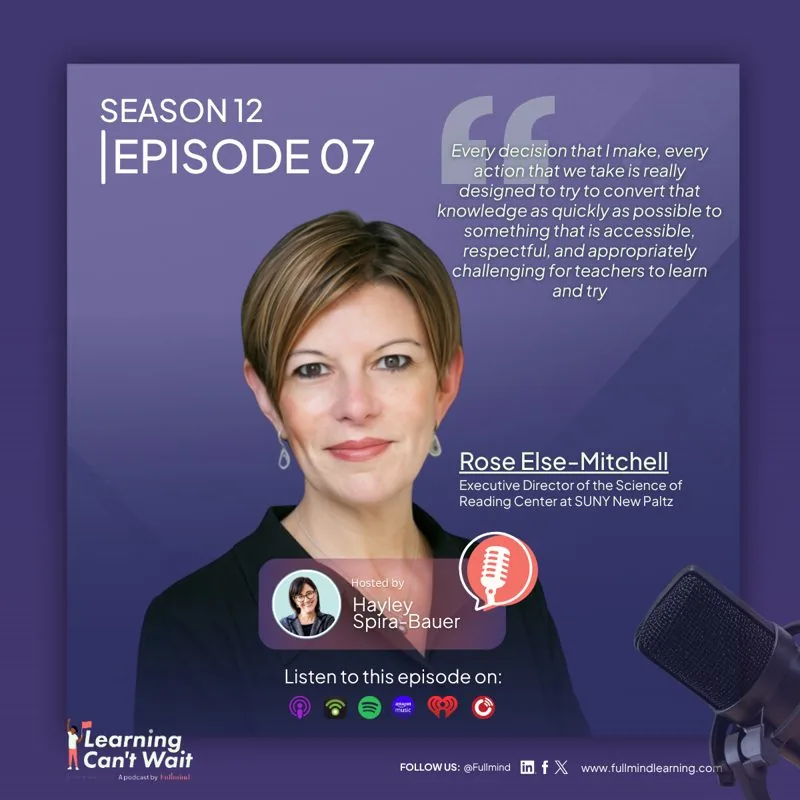
- Rose Else-Mitchell, Executive Director of the Science of Reading Center at SUNY
 Hosted by Hayley Spira-Bauer, Chief Academic Officer at Fullmind
Listen now
Rose Else-Mitchell: Science of Reading, Implementation Science & Literacy Instruction
Episode summary
Rose Else-Mitchell, executive director of the Science of Reading Center at SUNY, explains the difference between efficacy and effectiveness and why curriculum adoption is only the start; implementation and measurement are the real work. Drawing on Joyce and Showers, she argues professional learning sticks through shared language, ongoing coaching, and peer feedback. She focuses on older students who cannot read, the challenge of MTSS in secondary schools, and a new micro-credential for teachers beyond grade 3, and introduces the center's teacher-voice podcast, Reading Realities.
Key takeaways
- Efficacy is a research base; effectiveness is results in real classrooms, so plan implementation and measurement
- There is no perfect program; teachers liking it is not proof it works
- PD sticks with shared language plus ongoing coaching and peer feedback, not one-off training
- Many struggling adolescents have ABT, Ain't Being Taught, not a disability; secondary MTSS is rare
- Not all screen time is equal; policy should distinguish intelligent tutoring from passive consumption
About this episode
In this episode of Learning Can't Wait, Hayley Spira-Bauer sits down with Rose Else-Mitchell, Executive Director of the Science of Reading Center at SUNY, to discuss the evolving Science of Reading movement, the importance of bridging the gap between research and classroom practice, and how educators can evaluate the effectiveness of instructional materials and professional learning. Rose shares insights from her journey as an educator, highlights the critical role of implementation and coaching in driving student outcomes, and emphasizes that every student, regardless of age, can learn to read when educators combine evidence-based practices with a belief in student potential.
Full transcript
Transcript generated from the recording; minor errors may remain.
Hayley Spira-Bauer: Welcome back, everybody, to the Learning Can't Wait podcast. This episode is years in the making, and Boy, am I grateful that today is the day we're recording it. I'd love to welcome Rose Else-Mitchell. Actually, I'm gonna say that one more time. I'd love to welcome Rose Else-Mitchell, the Executive Director of the Science of Reading Center at SUNY, to join us here today on the Learning Can't Wait podcast. Welcome, Rose!
Rose Else-Mitchell: Hi, Hayley. I know you as the Energizer Bunny, and that was an Energizer Bunny introduction, so thank you. I'm so glad we're able to do this finally.
Hayley Spira-Bauer: I know, so am I, and, you know, this is an important topic we're gonna start on today. Who knows where it will take us, but… You know, the media and schools and all of the education ecosystem has been buzzing around the topic of science of reading for approximately the last 5 to 7 years, maybe you can correct me on that. So, no better time to coalesce and really codify the dialogue than here with you, and I'll have you start us off by telling everybody how you came to be the personal and professional version of yourself.
Rose Else-Mitchell: I love this question. It's, like, self-conscious and, you know, embarrassing and, you know, a little bit of a moment to brag all at the same time, so I'm not really good at either of those things, so I'm shy about it, but… You know, I'll share just a couple of… a couple of highlights, and I think… the big answer to that question, the macro answer to that question is, you know, I came to be the person I am today thanks to teachers and mentors, and it's a journey that's taken me from Australia, where I was born, to the UK, and for the last 25 years, here in the US. I arrived in the U.S. Right as, Bush II, was… going through hanging chads in Florida, and, and soon, on starting my, journey at Scholastic, building professional learning, I was, you know, greeted by No Child Left Behind. So, my whole history, in some sense, in the US has been driven by, you know, what was… used to be known as SBRR, scientifically based reading instruction, scientifically… based… reading research, SBRR. And, it's… it's really been a motivator to me around, what a privilege, and what a challenge it is for everyone to learn to read. I was a former middle and high school teacher in Australia that's a secondary teacher, and so I was very into my content, I was into my Jane Austen, and my Shakespeare, and all those classic things that you're into as a ELA teacher. And, I didn't… I didn't understand reading. And I didn't even really know it was a thing, because I could do it, although there are people in my life I now know who couldn't do it. I now understand what dyslexia is, I now understand… so much more, and think about kids that I taught who I didn't understand. So, I would say, you know, the mentors have been teachers, heads of department, colleagues, and reading researchers, but also kids that I feel like I didn't know how to reach. And I think that's not uncommon for people working in the field. So, yeah, lots of, lots of different ways to, to, to who I am today. I think, probably personally, the thing that animates me, is, is a curiosity. Both about what motivates others, as you have, and also a desire to take anything that is… conceptual and abstract, and to see it out in the world. And so, that really gets to the work that we're doing at the center, which is about how we continually, quickly, and respectfully close the gap between reading research and classroom practice. Lots of people say that they do that. Every decision that I make, every action that we take is really designed to try to convert that knowledge as quickly as possible to something that is accessible. Respectful, and, you know, appropriately challenging for teachers to learn and try, as soon as they can. Because if we don't… if we don't do, we don't learn.
Hayley Spira-Bauer: Rose, you have so beautifully illustrated, or kind of set me up to ask. A series of questions about your own experience being a teacher, but how that translates to evaluating the efficacy of the content, curricula, and tools that we implement in classrooms. Based on your background and what you know now, what would you say are the best ways for educators, and I mean everybody in the school and district system, to evaluate whether or not the content curricula and tools that they're choosing to implement are actually effective?
[05:00] **Rose Else-Mitchell:** Mmm, that's a great… that's a great question. Well, first of all, I'd say, you know, two… two different terms to bear in mind. There's efficacy, which is, you know, is this tool, is this content curricula, based on principles of research and… ideas that have been replicated, and a research base that is sound, and updated. And then there's effectiveness, which is really about the work, you know, outside of highly constrained, you know, efficacy conditions, which is, you know, it's… easy in some sense. No researcher would agree it's easy, but it's easier in some sense to get something to work in a kind of perfect lab setting or a highly structured context. It's harder to get effectiveness, which is something working at the same rate and scale. In real classrooms with real kids, and a variety of educators, and all of the challenges that those provide. So I think making sure that we understand where something is. I think it's very easy with a lot of content and program marketing to see, you know, graphs and charts and effectiveness and efficacy and all of these words thrown around. It's effective, is it effective? Is it on EdReports? You know, there are more and more kinds of tools. I just got an email this morning about different ways to measure and evaluate edtech and a new framework, all of that. But there's actually sort of fairly basic understandings around what is efficacy and what is effectiveness, and, you know, all hail to, the late Bob Slavin, who I think we're all indebted to, for helping us, understand and translate that, somewhat to To the world of the classroom. So, I think many states, many districts have tools. The EdReports model is a good one. I think Louisiana and Mississippi have great guidelines around what this looks like, but I think… I used to give this example to, to, states where they were doing, extensive curriculum adoptions, and I would sort of say it's a little bit like… the way that, your first child has become, and this only works, obviously, if you've had a child, so I don't mean to exclude those who haven't. But you spend a lot of time planning and thinking about what you're gonna do, and what the birth plan's gonna look like, which is really, like, not up to you. You know, all plans are good, but, you know, the baby will decide. And you put all of these things in place, and then suddenly, you know, you have a baby, and you're leaving the hospital, and you're like, whoa, what now? And that's a little bit what's going on with curriculum adoptions, is there's all of this planning and adoption and committees and what have you, and the real work starts with implementation. So…Rather than getting the perfect program, because there isn't one.I think it's really, really good to get a very active implementation plan, that is about getting the stakeholders involved, and then a very active measurement and evaluation plan, which is working out how effective is it in your context, and how do you know? How do you know this is working? What are you doing around dosage and amount of reading instruction based on what your goals are? And is the quality of that reading instruction, appropriate for, you know, the students that are using it? And that's really what it boils down to. So I think… planning is all very well and good, but it's really about getting the implementation right. And that can be making sure you've got a pilot first, making sure you've got teachers, you know, helping to decide, butjust because teachers like it doesn't mean it's effective.It can go some distance. But ultimately, it's really about what teachers will do with it that matters.
Hayley Spira-Bauer: Oh, that really speaks to me. First of all, your metaphor is fantastic. I… there could be nothing more true than that metaphor in my own personal life. Don't let me…
Rose Else-Mitchell: Don't leave the hospital, don't let me leave, go home, I don't.
Hayley Spira-Bauer: Oh, yeah. You're like, nobody told me how to do what's next! I read all the books, but it was only about, like, giving birth itself. Yes, yes. And the other part that really speaks to me about what you shared here is about the research-to-practice gap. I talk about her often. We had a researcher on our team, her name is Dr. Kelsey Young, and she taught me about implementation science. This was, like, her dissertation when she was in school or getting her degree, and I became obsessed, as I often do. And, you know, one critical component, not the only component. Of… Proper implementation is ensuring that professional learning design is really thoughtful, and it is long-term. In ensuring there's a concrete level of understanding and reforming of the implementation practice when a new content curriculum or tool is introduced. Can you talk about what makes Teacher PD stick? I know this is something that in your previous life, you spent a lot of time in, and maybe perhaps sometime now, too, as we really try to get full-scale adoption across the U.S. Of the science of reading, in your case, maybe New York State. What does it look like when PD is done well, and when it sticks?
[10:00] **Rose Else-Mitchell:** Yeah, that's a really good question. I've been asking this question on and off in different ways for a long time, and you know, a lot of PD folks do… do think about this, because it's the PDs that you're measuring, right? There isn't a straight line between professional development and student outcomes. People want there to be, but it's a… it's a set of, a process chain, really, that will make that change. So, I think, as we think about with students, you know, the goal of good professional learning design is what are teachers… what can teachers… what do teachers know, and what can they do? Having experienced professional learning. And there is a certain amount of knowledge that we need around, reading. One of the challenges, I think, that we have in science reading is that a lot of terms have been used, over and over again. I mean, just take comprehension or comprehension strategies. And so, any teacher hears those and thinks, oh, I know what that is, but what I might say, what it… what I might call a comprehension strategy, and what you might call it, might be two very, very different things, and not just based on state standards. So, shared language around, around professional learning, which means that not everyone's going off to read their own book, and go to their own practice, I think is… is… is an important idea, right? Which is, what… what can you holistically, do, and what can you share, more broadly across a… across a teacher population. Some of the most important research around professional learning goes right back to the 80s, from Joyce and Showers, and lots of old people on the… on the… listening to the podcast will be nodding. And, the highest impact and effect size, they showed in terms of the different kinds of models, as you said is that it's ongoing, but very specifically, that it's ongoing coaching and feedback. So once you have this knowledge base, you know, what can teachers know and are able to do, that are able to do part, really needs to be something that is ongoingly supported, and possibly measured, but not in a teacher evaluation kind of mode. But, you know, what do you need more help trying? What do you need to see modeled before you then try it? So I think, coaching and feedback is really important, and one of the hardest things, based on, the availability of coaches, the kinds of ratios we often have, where, like, a coach in a school district might have, you know, 200 teachers that they're supposed to support. So I think there's some breakdowns there in terms of professional learning design to make sure that the knowledge part of good science of reading PD is connected to the coaching feedback practice and application, and that that's a continual process. The other thing I think we know a lot about is that teachers learn very well when they support each other. And Joyce and Showers didn't get into this so much, but there is fairly good work around peer coaching, but that does have to be, you know. Ongoing as well, and there has to be time for it, and that's one of the hardest things, is when… when do teachers get the opportunity to step into each other's classrooms to observe and to provide critical feedback to one another? And, you know, they're just less practiced at doing that. Leaders are less practiced at giving them feedback, and teachers themselves, you know, they don't get to do that that much. In some places, the only feedback they might get is, you know. During an annual evaluation, which is less about feedback and more about, you know, am I keeping my job? So, the stakes of that are really different.
Hayley Spira-Bauer: Absolutely. And, you know, one really critical component to this entire conversation is that the science of reading and implementing it effectively, as we transition to talk a little bit about your work today, is not just for little kids. It is really important that, you know, we are talking about middle schoolers and high schoolers who still struggle to read. What does research say districts should be doing for our older students to support their Skillet and their acquisition of the skill of reading that maybe we're not paying enough attention to.
[15:00] **Rose Else-Mitchell:** Yeah, thanks for bringing this up, Hayley. This is a really, really important thing, so dear to my heart. You know, having worked on Read 180 for over 20 years of its, of its, its… You know, design and publication and… research life, you know, I've seen so many older students who can't read, and who have never read a book, who have never been engaged in school, who have found so many different kinds of avoidance techniques, and it is the most heartbreaking thing to see. And at the same time, doing this work. When you see a student who hasn't ever read a book, who suddenly is able to have self-efficacy. And… and success in reading something, even if it's a decodable text for an older student. It's just… it's… it is really emotional. And the kind of… the kind of work that needs to be done with those students is this combination of… Of, of empathy, wisdom, and, and, and practicality. So, I think, you know, the simple view of reading, Scarborough's Rope, all those things still stand. It's just there are so many different kinds of aspects, to the science, and to the relationships that matter when students are older. I think you had Dr. Paige Pullen on recently. I thought she spoke pretty wisely around, the three, sort of. The three circles of research that she thinks about in terms of implementation. I think there's more and more that we start to know and understand about adolescents more generally, whether it's about sleep, emotional regulation, mental health. The role of, of, of digital devices, personal lives, poverty. And of course, you know, more and more learning disabilities, or, you know, the learning disability of ABT that we used to call it, which is Ain't Being Taught, which is often mistaken for a disability and may have become one, but it may just be that a student has not had explicit, systematic instruction. In any aspect, of learning to read. So, I think, you know, we used to say with Read 180,the most important thing is not that you're a reading teacher, the most important thing is that you believe that all students can learn to read, and that is something we know from the research. It is much harder work if you're… if you're 14 or 15, to do all of that unlearning, to be vulnerable, to be in a classroom of other students who are struggling to learn, and to make progress and trust an adult, when many adults may have left you behind, or may not have understood what you needed. So, that, I think, is the most important thing that has to happen, is you believe, as an educator, that all students can learn to read. And, you know, except for a couple of… You know, particular kinds of conditions and cases, that is… the situation. So, it requires just so much will, and it requires some systems to, as you asked, to make changes to, and that includes putting in place multi-tiered systems of support. But I can tell you, I was training a group of educators recently, and I thought they were going to be elementary educators, but they were secondary, and, you know, they were asking about the students that couldn't read in their content area classrooms, and I said, well, is there, you know, does your district have a multi-tiered… and I didn't even get the question out before they all started laughing. You know, we know that MTSS is challenging to implement effectively and with fidelity in elementary schools. It is even more challenging in middle and secondary schools. So, it's… and there isn't such a thing as a Tier 2 curriculum for biology, or, you know, Tier 3 work for, you know, CTE programs. But those kiddos who need some of that intensive reading instruction are sitting in classes all the time with teachers who also don't necessarily understand, just as I didn't, you know, what is in the reading brain, what makes it challenging for a student who hasn't been taught to read to read. And what you can do as a content area teacher, or as any teacher of students with with text to make that more accessible. And that's, you know, it's hard. It's hard for teachers, and it's incredibly hard for kids. So, so much good work going on in several states around this area. At the center, we're currently working on a micro-credential specifically, for teachers of students beyond Grade 3, and going right up to high school, to provide access to them around ways to introduce morphology, what it really means to identify a student, maybe even just through their writing and spelling, very quick spelling inventories, you know, as to whether a student really should be identified to be screened, to get more intensive support, and what you can be doing in your biology class, in your history class, you know, in your English 10. To, support those kids when they're in front of you.
[20:00] **Hayley Spira-Bauer:** Yeah, I love to know what's going on at the Center, because you are really working with tomorrow's teachers. So, what… in addition to this micro-credential, what sort of cutting-edge, exciting, learnings and teachings and happenings are going on, and what can we be hopeful about as it relates to our next generation of teachers?
Rose Else-Mitchell: That's… that's a great question. You know, I was in Alabama last week for a training with the State Department there. One of their Fantastic educational specialists is working with, teachers, you know, grade… grade 3 and up around this topic as well, and… There were several teachers there who were, second career teachers, young, but second career teachers. There were teachers there who are today's teachers, and who've been doing it for 17, 20 years. And I think… to draw a through-line around all of those educators, it was that they were open to learning and open to changing, what they… what they do and how they do it. We just started a podcast at the center called Reading Realities this year, and, you know, most of the Science of Reading podcasts out there are, you know, bringing the research and the science to educators, which is great, and, you know, there are many organizations that do a great job of that. But back to the idea that teachers teach teachers, and they have, you know, a lot of respect for one another, and their openness to learning from one another might be different from learning from a principal or from even a coach in their district. So, we interview teachers and ask them, you know, what… what they've changed about their reading instruction, what they've learned, whether their career's 5 years or 20 years, over the years to, to, get better at teaching reading. Because it is the kind of thing, because we learn so much more in science regularly, and we learn so much more about every single child. That you can get better at, like many aspects of teaching. And I think the through line, again, through… the through line through the conversations that I have with educators is. How willing they are to acknowledge that they've done something that they don't think is, you know, the greatest, and to either reach out to colleagues. To seek information online, to go to a conference, to ask for more support from a principal, and to… to get better at their craft. And, I love hearing their vulnerabilities and how they've learned from one another. So, if you've got eager podcast listeners and who are reading teachers, or who are supporting, teachers. Of reading, I commend it, because it… not because I'm doing the podcast, but because these teachers are very revealing about, about their experiences. And, you know, it's really moving, because, like a lot of us, they have a student, or a class, or a parent, or a moment where It sort of changed how they thought about what it means. To read. For themselves and, and for their teaching.
Hayley Spira-Bauer: Vulnerability plus teachers plus podcast is my happy place. Love that. I remember this is how we started our conversation, was talking about podcasts, but this is your newest iteration, and I think it's really meaningful work. As you said earlier in the conversation, teachers do well learning from other teachers. I know the best improvements I made in my career were not from being told how to do something, but from watching a peer do it, or from them watching me do it, and immediately giving me feedback, so that I could do it again, and try it again, and iterate on my practice to be better on behalf of the kids I was serving. So, I love that your focus is with guests from the classroom. And I'm really, really glad. Can you repeat the title of it, please, so our audience can make sure they write that down?
[25:00] **Rose Else-Mitchell:** Yes, it's called Reading Realities, and the whole idea was that you know, it's messy, and you know what? Teachers sort of… they're a little bit… some of them are a little bit OCD, and they like their instruction, their classroom, all the things to be kind of organized and tidy, and unfortunately, learning is a bit messy. So, permission to be messy, and that is the reality of reading reality. So, yeah, and it's available on all the podcast platforms as well as YouTube, so… Short, just like yours, about 20 to 25 minutes, and a real range of teachers from all over the country, not just New York. We work in multiple states. And, have partnerships, broadly. So, we're very grateful for all the teachers that we've spoken to, and, and we'll be starting a new, season two will, will drop in, in… At the end of this month.
Hayley Spira-Bauer: Amazing. So, what else is on the horizon? What else are… what else should we be excited about, in your future?
Rose Else-Mitchell: Oh, you're so nice. Well, I did tell you that I was doing some new things. So, I, in two weeks, I start my own, learning, which is that I'm, I'm starting a PhD in educational psychology, so some of that will be, refre… refreshing, some of that will be refreshing. All of the things that I've been able to learn from wonderful mentors like Dr. Anne Cunningham, and… Ted Hasselbring, and Maryanne Wolf, and all of these fantastic people I've learned, about reading and about technology from over the years. But some of this work I hope to go deeper. So, I'm going to be looking at, the role of reading and, technology, specifically the differences at different developmental stages. In reading on a screen and reading in print. Obviously, this is, you know, a topic very, very much at the forefront of school districts who are putting, kind of, time limits on the use of devices. And you can understand why that might be, that there are just devices everywhere, and, you know, those attention challenges, etc. But we also know that, you know, for many students, including students with certain disabilities, that some of the kinds of reading supports that are available online are essential. So, just saying, no reading online, versus, you know, reading online at this point for this purpose. And really, it's something we just accept. Has to happen. I taught a class at the Harvard Grad School with Dr. Phil Capin, and Dr. Alyssa O'Rourke this past spring, and… You know, it was interesting, some of the students asked whether they could have, they could have the, materials printed out. And, that's not something that the grad school provides anymore. I don't know when you went to college, but when I did my master's, we got a big, fat packet of readings. And I still think, even though I probably wasn't the greatest, highlighter, highlighting annotations is actually a bit more of a science than we understand. You know, I know that it was great being able to read like that, and I know that I do prefer reading research in print myself. But I'm an N of 1, and I think there's real, learnings we can get around when and for whom And, under what conditions and with what tasks, online reading versus print reading can be most valuable. So, that's, that's my next, next area, because I think, you know, the research to date basically says. That, both for university students and for, adults, that, we do read less effectively. Online. So, you know, in terms of whether it's taking notes against that reading, or general comprehension outcomes. So, we seem to have sort of forgotten that that is what the research says, but I think it's probably more complicated than that.
Hayley Spira-Bauer: Rose, how exciting! Congratulations! I love this update! I also really love your area of focus for a number of reasons. One, I am in the camp. That the current backlash against technology, my job, irrespective of my job, is like a little throwing out the baby with the bathwater moment, and is really long-term more damaging for the natural innovation that is happening in education Today. So, we need data to prove that to be true, right? Like you said, we already know that there are some scaffolding tools and accommodations that occur Online, through virtual resources, or, you know, technologically enhanced resources that we can't necessarily get in a book. So, I appreciate that the data will hopefully illuminate for us a clear path forward that can help inform our practice, because otherwise, we're just going with our guts. And guts can be great, but it's much better when you can verify and validate our gut opinions and our feelings on a topic.
[30:00] **Rose Else-Mitchell:** Yeah, yeah, for sure. And I think, you know, I think not all screen time is created equal, I think we all agree with that. And there are probably more harmful effects in certain kinds of applications, and certain amounts of durations. You know, I do think there's a distinction between a student using, like, a very well-designed, intelligent tutoring system. Say, for space retrieval practice. Versus sort of more gamified consumption-based, you know. Technology, video, etc. But I think we're losing that, and, you know, obviously you do lose some of those distinctions when you create policy. It's hard to have the nuance when you're creating a state or a district policy for a large, large district. You know, I think we won't be able to prove anything, but we'll be able to at least, you know, it's science, we'll be able to ideally, you know, reduce some of the, Some of the, the noise around. What particular kinds of, reading, can benefit, and what kind… what particular kinds of students can benefit from. You know, particular kinds of screen enhancements.
Hayley Spira-Bauer: Yeah, absolutely agree, and I'm really excited to follow this journey with you, and… see the impact that you continue to make. I cannot believe we're at our final question, but here we are. As the final question, I will ask you, what advice would you give a teacher who's starting their career today?
Rose Else-Mitchell: Well, the first thing I'd say to them is thank you. I have a hashtag that I use on social, which is hashtag the most important job in the world. And, that… that really, is something I truly believe. When I first started teaching. I was sort of astonished at how little thought people gave to teaching. And… as they got older, they started to think about, you know, a teacher that was significant to them, etc, and maybe that's, you know, that's the benefit of age. But I think anyone who has taught and know that They've been able to do something important, connect with a student, teach a student, support a student in their journey and their pathway to to learning, to opportunity, to the next stage of their education, just knows how extraordinary, that experience can be. So, I think I will… teachers are given a lot of directives, and a lot of advice, so I think I would just say. Thank you, and wish them all good things, because I'm not sure when this is going to air, but it's the summer right now, and we're coming into August, which means in the next week or so, at least, in the South. And out in California, teachers will be going back to school. So, thank you, keep sane, and and, as a society, I just want to say, we respect and love what you do. For kids.
Hayley Spira-Bauer: Amazing. Rose, it's been amazing listening to you share, and I feel very, very inspired by the conversation, as well as by what you have coming next. Thank you so much for joining us on the Learning Can't Wait podcast today.
Rose Else-Mitchell: Thank you for having me. It is so fun talking to you. You have such a wide range of skills and understanding and experiences and connections and I just love how knowledgeable, and how personal you are to talk with. So thanks, Hayley. I look forward to us chatting again IRL.
Hayley Spira-Bauer: Yeah, same here! And thank you to everybody for tuning in today.