
Learning Can’t Wait · Episode 195
Paige Pullen: Science of reading, Three Sciences Framework & Explicit, systematic instruction
- Paige Pullen
 Hosted by Hayley Spira-Bauer, Chief Academic Officer at Fullmind
Listen now
Paige Pullen: Science of reading, Three Sciences Framework & Explicit, systematic instruction
Episode summary
Paige Pullen, founder of Pullen Education Strategies, recalls realizing after 12 years in elementary classrooms that children were learning to read in spite of her, which sent her into doctoral study and a career in reading research at the University of Virginia and the University of Florida. She explains what three-cueing got wrong, why dropping running records without a replacement leaves teachers stranded, and her Three Sciences Framework of learning, instructional, and literacy science. She argues reading instruction cannot stop at third grade, models how to teach multisyllabic words to older students, and calls for cohesive, ecosystem-wide support.
Key takeaways
- Science of reading legislation has narrowed to phonics and K-3; literacy science is broader and continues past third grade
- Replace running records with error analysis that tells you exactly what to reteach
- Learning science, instructional science, and literacy science together should guide classroom practice
- Older students still need explicit foundational instruction plus content vocabulary and word-attack strategies
- Pull-out instruction is less stigmatizing than sitting in class unable to read what peers are reading
About this episode
This episode centers on how the “science of reading” must expand beyond phonics to a broader “literacy science” that spans birth through adolescence, and how systems can better prepare and support teachers so no child learns to read “in spite of” their teacher. Dr. Paige Pullen shares her journey from feeling unprepared as an elementary teacher to leading large-scale professional learning and now launching a startup focused on bridging research to practice across entire district ecosystems. She and host Hayley Spira-Bauer unpack common instructional missteps (like over-relying on 3-cueing and running records), the need for explicit, systematic foundational skills for older struggling readers, and the importance of learning science, instructional science, and literacy science working together. They also examine legislation, district decision-making, and family engagement, emphasizing that reducing stigma for adolescent readers and rejecting teacher shame are essential to ensuring all students gain true literacy, not just early decoding.
Full transcript
Transcript generated from the recording; minor errors may remain.
Hayley Spira-Bauer: Welcome back, everybody, to the Learning Can't Wait podcast. I have a very timely guest here joining me today, talking about a topic that is near and dear to my heart, and in fact, really spiked my interest this morning, of all days! We have Dr. Paige Pullen, the founder of Pullen Education Strategies, joining us here today. Paige, thank you so much for coming on the podcast!
Paige Pullen: Thank you, Hayley, for inviting me. I'm really excited to talk today.
Hayley Spira-Bauer: Yeah, you know, you are a well-known literacy expert, and I'm excited, especially given some new findings about what's happening in our country. Not… actually, let me back that up. Not particularly new findings, but exacerbated findings about what's happening with our youth in America today, with their ability to read, their comprehension, their decoding skills, all of the good things. And so you are the perfect guest to talk about this topic, so thank you again, and let's jump in with the first question. How does that sound?
Paige Pullen: That sounds great! And I just got a, I'm trying to close these things, so if you want to start that again… I just am quitting messaging, but did you hear the ding?
Hayley Spira-Bauer: Nope, not at all.
Paige Pullen: Okay, so I will ignore it from now on, but… okay, so do you want to ask that last question again?
Hayley Spira-Bauer: Sure! So, Paige. I'm super thrilled to have you here to talk about these big topics, but I'm going to start us off by asking you, how did you come to be the personal and professional version of yourself?
Paige Pullen: That's a really good question, and it's most… It's absolutely pertinent to our conversation today, because for the first 12 years of my career, I realized at some point in that journey thatchildren were learning to read in spite of me, not because of me, and that was because I was woefully unprepared to teach reading.
Hayley Spira-Bauer: Hmm…
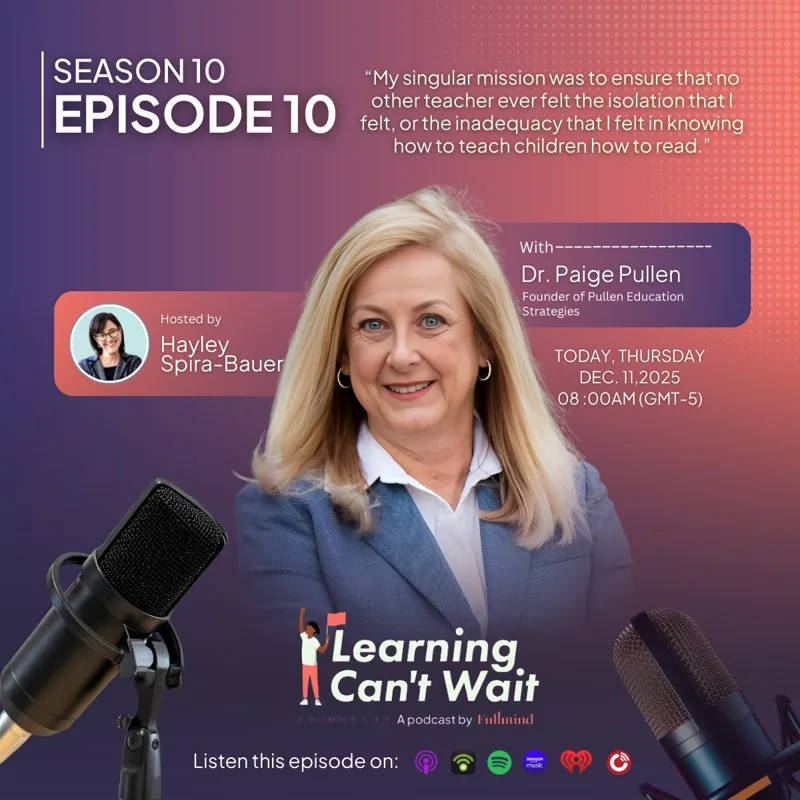
Paige Pullen: Unfortunately, I'm not sure that has changed a whole lot today. It has in some ways, and we'll talk about that as we go on. I'll continue to talk a little bit about my journey. But I taught for 12 years in elementary school in both general education classroom, and also with students who were struggling to learn to read. And when I… when I… it occurred to me that I really didn't have the knowledge and skills to do that well, and that my children were suffering, I went back and studied, reading in a doctoral program. Focused on special education. And then I followed up with that with 16 years in research and higher education at the University of Virginia. And then I moved to the University of Florida, my alma mater, where I worked on developing a series of products that would help teachers across the state. So, one was an online professional development system to lead to the reading endorsement in the state of Florida, a series of micro-credentials, and a literacy coach endorsement. That led to over 40,000 teachers receiving competency-based learning around the science of reading and evidence-based practices. And so, that experience that I faced in those early years of my career actually set the stage, and I left that The classroom with a singular mission, and that was to ensure that no other teacher ever felt the isolation that I felt, or the inadequacy that I felt in knowing how to teach children how to read.
Hayley Spira-Bauer: That really hits. That really hits. I, too, am, Elementary educator who felt really ill-prepared, ill-equipped. Trained on now-outdated instructional practices to teach my kids how to read. So, can you set the stage for us? Give us, like, the 30,000 foot. What were we doing wrong then that we know better about now?
Paige Pullen: We were doing a lot of things wrong then, and we are doing better now, but we're not finished, and I think that's probably a big part of our conversation today. We have, over the last You know, decade, really been pushing the science of reading, and that's been a really important conversation, and we have moved in the direction of evidence-based practices. Some of the things we were doing In our reading instruction was because we weren't really addressing the learning science, how individuals learn. One of the principles that I talk about now when I do professional learning with teachers is learning science, and that we don't treat novices as little experts, which comes from Paul Kirschner's work. If you haven't read the book, How Teaching Happens, I highly recommend it around learning science. But some of the mistakes we were making is because we were assuming that children read like a skilled adult, and that's not what happens. Children first have to grasp and understand the orthographic. And phonological aspects of language, and be able to break words into parts, and put them back together so that they can use context and meaning. We were skipping that really important part and going right to context and meaning, which was that three-cueing that we know is not effective now. And so… The science of reading movement really propelled us to… go back to thinking about phonics. And that's a really critical aspect of literacy instruction, but it's not… it's not the whole story.
[05:00] **Hayley Spira-Bauer:** Yeah, oh, I'm thinking about that MSV three-cueing system, and how I learned to do a reading record. Can I tell you the worst part, Paige? My kid's school was still pulling out running records for me as of last year. I believe they fully sunsetted it this year, but as they pulled it out to me, my husband would just, like, pinch my leg under the table, like, it's okay, just don't say anything in it. But I have to say something! Right?
Paige Pullen: But you can. You know, I'm with you. So this is… this brings up another really important point, though. We've passed this legislation, and we say teachers can't do running records, teachers can't do the three-cueing, which is right, they should be saying those things, we shouldn't be doing those things. But, sometimes we end up throwing the baby out with the bathwater. And we end up not listening to children read and analyzing their errors at all, for example. We do need to listen to children read, that is true, but we don't use MSV. And so part of this is really thinking about how we're supporting our teachers in providing them with the skills and abilities One of the other things with the science of reading Movement is we've focused a whole lot on knowledge building. But not a lot of them practice. So we say, oh, three-cueing and running records, we can't do those anymore, but we don't give them something to do instead. And so really helping teachers understand Going beyond the what? In the theory, to the how, and bridging research to practice. And that is really my goal, is how do we help teachers take what they're learning and the knowledge that they've learned. And how do we apply that? So let's take running records, for example. I'll give you a quick example. I've created something called the Observation and Reading Behaviors Diagnostic Inventory. To replace not… it's not a running record with a different name. It is actually, when you listen to children read, listening to their errors and identifying, is that a grapheme phoneme error? Is it an error in the vowel sound? Is it a morphological error? So, really analyzing what… how is the child processing The words on the page, And how does that… impact my instruction. So if I listen to a child, and they're missing the vowel sound multiple times, and then I look and I dig deeper, and oh my goodness, it's vowel teams every time, then I know that's what I need to teach.
Hayley Spira-Bauer: I need to explicitly instruct.
Paige Pullen: I need to apply explicit instruction, and I need to look at my scope and sequence, and I need to say, oh my goodness, I've taught that. But my students didn't get it because they're not applying it in real reading, I need to go back and reteach. And we know from learning science and instructional science that we are… that we… that we need to have Spaced, interleaved practice. And explicit and systematic instruction. So we should listen to children read. And we should listen to children read connected text, and it shouldn't be… Only when they're doing an oral reading fluency probe, we need to listen to them reading real text, and we need to be… detectives ourselves, in terms of really looking at what children have learned, and then Have the knowledge, skills, and ability to then Teach what the children need. In the moment, and provide corrective feedback. You and I are both on the same page with this, in terms of Explicit systematic instruction with corrective feedback, but teachers don't always know how to provide that corrective feedback. We need to teach them.
Hayley Spira-Bauer: Well, and you've touched on another good point, which I know is something you're passionate about, which is that this term, science of reading, gets really distilled down to only phonics so often. Where do you think the national conversation on this topic is falling short, and what are we missing in that focus?
Paige Pullen: We… it was really an unintended consequence of this term, so when we think of the science of reading, to me, that sounds like it's science that's complete. We already know everything.
Hayley Spira-Bauer: Mmm.
Paige Pullen: A lot, it's not finished, and we're still continuing to learn. So that's one of the… one of the challenges, I think, with the term. The other piece is that it has been distilled down into really thinking about phonics. That was never intended. It was supposed to be much broader than that, and if you Listen to experts in the field talk about it, they'll talk about a broader concept. But we end up talking mostly about decoding. We need to expand it to really more of literacy science, and I talk about it in a construct called the Three Sciences Framework. The Three Sciences Framework hits a variety of bodies of work. Learning science, how humans learn. So, what do we know about cognition and development and how individuals learn. That led to research from Barak Rosenshine, for example, and Siegfried Engelmann and Doug Carnine, about what are the instructional practices that lead to Increased student learning and retention. So, we have learning science that informs instructional science. Those two sciences should then move towards literacy science. What do we know about the evidence-based practices in literacy? And… If you think about that as a circle with an arrow going around with each of those sciences, effective literacy instruction happens at the center. So we have instructional… learning science, instructional science, and literacy science. Those three should guide what we do in the classroom with kids. And so, we have really been limiting what we've done in our professional learning, and I am moving towards really thinking about what are the instructional practices that every teacher needs to know and be able to do, and that be able to do is a critical piece to that, that's going to help children learn and retain the information that they've learned. The other piece, in terms of the science of reading legislation, that is often misunderstood. We have 40… States now that have science reading legislation. Almost all of those states are… The legislation covers kindergarten through third grade. Some of them include pre-K, But most of the legislation is kindergarten through third. There is a critical need for understanding what happens from birth to 5 to prepare children for kindergarten. And learning to read doesn't stop at 3rd grade. There's this… if you're not reading by… on grade level by third grade, you're not likely to be able… you're not likely to learn to read. Part of that is because we stopped teaching reading, and… There's a lot more to learn about teaching reading and writing, again, literacy more broadly than just the science of reading, and we need to think about the continuum from birth through adulthood, and We are seeing adolescent scores, even as we've seen some increases and decreases in scores at 4th grade reading, consistently, we drop at 8th grade, and so we can't stop.We can't stop at 3rd grade.
[13:00] **Hayley Spira-Bauer:** So this was the topic that I got fired up about this morning. I was reading The 74's, set of reports and writings about what's happening with middle schoolers and high schoolers who don't learn… don't know how to read, and what… Why I was fired up is because, obviously, this is super interesting. We often… this is not where people think about explicit… instruction being necessary. But then secondarily, I had a friend of mine call me the other day, her son's in 4th grade. And she's like, I don't even know what to do. I was like, well, you need to ask the school what direct instructional practices they're using that are age-appropriate, but still very explicit. To ensure that your child masters every single concept that early readers also need to master. So let's talk about that for a second. You're obviously fired up like I am. Where do you… if it's being done right in middle school, high school, what does it look like? Does it look like a kindergarten classroom?
Paige Pullen: Oh, absolutely not. We… it does look like direct and systematic instruction, but it's not going to look like a kindergarten classroom. You're right that it doesn't matter whether you're 6 or 16, if you don't have the skills, those foundational reading skills, you need to learn those foundational reading skills, and there are effective programs available that have an evidence base to teach adolescent readers how to read. We also need to Think about how we support older readers in the content areas. For example. If you are learning about… I just was reading… I was just working in a district this week, and one of the passages, this was a 5th grade, so, you know, beyond 3rd, but not high school, but still related, 5th grade students reading passages about the Pony Express. They didn't have the background knowledge. They couldn't read many of the words, they didn't understand the vocabulary. Now, they're expected to read that grade-level passage, and then go and talk about it in their general education classroom. And so, how can we support that? One, we need to provide the foundational skills in an explicit, systematic program. And then we need to use… Programs that provide us ways to support the content that students are going to see in the general education classroom. So, for example, I modeled a lesson for teachers, and we took that passage, and We broke it down, and we pre-taught some of the vocabulary. We looked at some of the multisyllabic words. Now, you think about a multisyllabic word, think about the word frustration.
[15:00] **Hayley Spira-Bauer:** Hmm.
Paige Pullen: If you don't know consonant, vowel, consonant. Words, which teachers say, our kids can't read this, they don't even know consonant, vowel, consonant. Well, let's take a big word like frustration. If we teach them how to break it into parts, you can blend F-R-U-S For us… Now we break T-R-A. Oh, that's an open syllable. And then T-I-O-N says Sean. And then we blend it together frustration, we give them, you know, if you're frustrated, it means that.
Hayley Spira-Bauer: You're unhappy because things didn't go the way you expected.
Paige Pullen: And so you're feeling frustrated, or you have frustration. So that's a… you know, that's a way that now, when those students go back. On Monday, and they're reading about the Pony Express with their peers, they're going to have the background knowledge and be able to tackle some of those really difficult words. So it's really twofold. We have to support in a couple of different ways. We have to provide the explicit systematic instruction in those foundational reading skills, and we need to support the development of vocabulary and comprehension. And strategies to attack words that are Big words that they may not have those skills to do, so that they can participate with their peers in the general education classroom.
Hayley Spira-Bauer: You know, I… Appreciate how you laid that out, gave ex… you gave explicit examples here so people can understand it. How do we reduce the stigma for these later developing learners who are in classrooms where they are learning the basics?
Paige Pullen: This is a really good question, and it comes up a lot, and so… We have to think about… Inclusive practices, and where inclusion has gone, and… as a special educator, I… What's most important to me is a continuum of alternative placements. That children need to be… students need to be taught in their least restrictive environment, which may not always be the general education classroom. If you are providing this direct, systematic instruction and foundational skills, In the general education classroom. That's going to be more stigmatizing than pulling you out and providing it in a space that's not necessarily in front of your peers. And so… You know, it's a… it's a tough topic. But we have… we… if children are coming and going from classrooms all the time for a lot of different reasons, it doesn't have to be stigmatizing to be pulled out, but we have to make sure that students get this instruction, and… By having it in the general education classroom may not always be the best answer.
Hayley Spira-Bauer: And I know the other answer is not… you know what's more stigmatizing? Not knowing how to read when you graduate high school, because kids can't think that far ahead, but my brain definitely says that to me. Like, my brain says, you know what's worse than having to get explicit instruction of this nature when you're 16? Graduating high school and not being able to get a job because you can't actually read a manual for onboarding, or going to college and failing all of your courses and having to drop out. Like, that is way worse. It is way worse, and so… so yes, I, you know, it may not be a popular thing for me to be sitting here saying.
Paige Pullen: Pull students out of the classroom and give them the instruction they need, but that is absolutely going to be less stigmatizing than them sitting in the classroom not being able to read what other… what their other peers are reading.
Hayley Spira-Bauer: You know, Paige, part of this is the decision-making that's happening in a district, in a school, but also, it's part of the decision-making that happens from guidance that's coming from state level and federal level. Where do you think we're getting this right, and where is there opportunity for us to improve around the national guidance we're receiving to support literacy acquisition for kiddos?
[20:00] **Paige Pullen:** In terms of national guidance or, you know, advocacy and support and legislation. I think it's critical that we continue to fund programs and fund teachers and provide support. Where I have seen success is when you address the whole ecosystem. And by addressing the whole ecosystem, I think I may have mentioned this earlier, it is… About helping everyone in that ecosystem. N-no. How and what they need to do to help the students in that district be successful. That means we need to provide support, from… Top to bottom, left to right, Starting with superintendents, building-level administrators. Coaches, teachers, paraprofessionals, special education teachers, general education teachers. We need to all be, not to be cliche, but rowing the boat in the same direction.
Hayley Spira-Bauer: Yeah.
Paige Pullen: And we need to have cohesiveness across those areas. At the district level, the… Folks who are making really important decisions, like what curriculum are we going to use? What is the high-quality instructional material? That's being decided sometimes at the state level, sometimes at the district level, and sometimes both. We need to make sure that the people who are making those decisions no one understand… the Three Science Framework. That three science framework being learning science, instructional science, literacy science. A curriculum needs to meet certain criteria. If districts don't have… if it's the state and district making those decisions, they need to have the knowledge and skills to be able to make those. A building-level administrator to support The literacy in the school. Needs to really have a literacy mindset. How can we create a culture of literacy in the school? And that we are using data to make decisions, and the data doesn't live just with the interventionist, it doesn't live just with the general education teacher. That data the data are shared across that ecosystem. And that's one of the missing pieces that I see, is I see a lot of… everybody's wanting what's best for their students. There's no question about that. This is not a matter of, we don't want our children to succeed. It's a matter of, we all want our children to succeed, but we're not necessarily doing it in a cohesive way. So… Making sure that in policy, the people who are making policy have support from people who know this, you know, know the science, know the research, and make sure that those legislative asks and requests or mandates are aligned to the science. I mean, so that's… that's a critical piece, and then providing support across the board. Which is… which is why I have moved from higher education to going out on my own, I'm actually just starting a startup now, and really thinking about how we bridge that research to practice, and not just for teachers, but across the ecosystem. How do we support districts at the system level? For making this change happen.
Hayley Spira-Bauer: You know, Paige, there's another stakeholder we haven't yet talked about, which I think is critically important here, and that's families. So, how do you think about a family's role in supporting the work that's happening if it's done right at a school? What does it look like? What does it feel like? What does it sound like?
Paige Pullen: One of the things we want to make sure that we do is that we honor families and bring them in to the fold in terms of their their child's literacy. They want their child to be successful and develop literacy skills as well. They may not themselves have had the best experiences in literacy, so we need to make it really easy for them. And we need to reach out and provide opportunities and resources for them, and help them understand things that they can do to be a part of their child's literacy development, even if they aren't the best readers themselves. And so I think that's really a critical piece. I mean, we could do things like family literacy nights, and many different strategies and activities and projects that we can do, but I think the key is really providing resources, support, and helping them understand that they are a part of their child's literacy journey, and they don't need to be the reading experts. But we can give them support of things that… where they can support literacy at home.
[25:00] **Hayley Spira-Bauer:** I love that, I love that. It is a critical component, and The pressure is a lot for a lot of families for a host of different reasons. And so you've given really practical support here. I… unbelievably, to your point, we had so much we could talk about. Unbelievably, I'm ready to ask you my last question. And that is now back still on the micro level. What advice would you give a teacher who's starting their career today in elementary school?
Paige Pullen: If they are starting elementary school, they're going to enter that elementary school, and they've just finished a program in a college of education, or perhaps an alternative route to certification, and likely. They are going to not be fully prepared, and that may not even be the fault of the Institute of Higher Education, because when we go through elementary education programs, we have to learn how to teach science, how to teach social studies, how to teach math, how to teach reading, how to teach writing. And it's hard to become an expert in everything. So my first piece of advice isreject the shame. There is no shame in feeling unprepared, and there is no shame in reaching out and asking for support.This is not a personal failure. If you've been teaching for 12 years, and you're still feeling that way, it's a systemic failure, and we need to do a better job. You want to look for that veteran teacher who's doing a really good job, and connect with that veteran teacher. You want to stay involved in the research. You need to listen to podcasts, like Learning Can't Wait, and find out what's happening in the field. But essentially, you need to have a mindset of being a lifelong learner. It… this is something that takes practice. Just like children need to practice learning how to read, you have to have the mindset that I can be successful in this, and I need to continue to learn and get better every day, and there are resources out there. For, for help.
Hayley Spira-Bauer: Page. I'm really excited to see… what comes next for you? I know we're a little bit stealth about it right now, but it's super, super thrilling to know that you're bringing this knowledge to the K-12 space. It's a space I'm personally passionate about, and so are my listeners. Thank you so much for coming on the podcast and sharing your wisdom with everyone.
Paige Pullen: Thank you, Hayley, and maybe in a couple of months, I'll be able to come on again and come out of stealth.
Hayley Spira-Bauer: I love that, I love that. And thank you to everybody who's tuning in today.