
Learning Can’t Wait · Episode 136
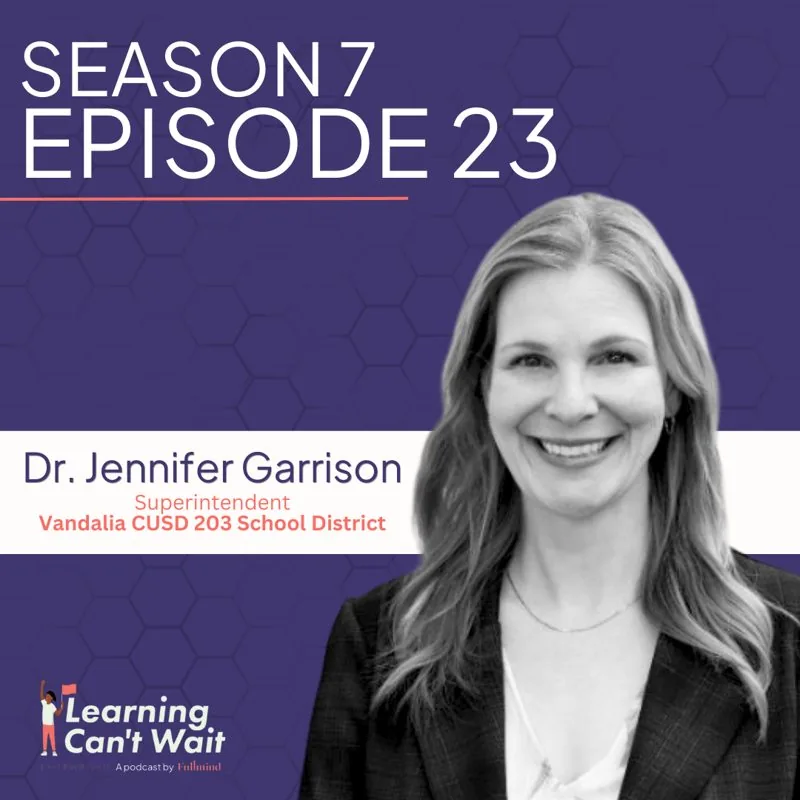
Dr. Jennifer Garrison: Career-connected Learning, Trade School, Work-life Balance
- Dr. Jennifer Garrison
 Hosted by Hayley Spira-Bauer, Chief Academic Officer at Fullmind
Listen now
Dr. Jennifer Garrison: Career-connected Learning, Trade School, Work-life Balance
Episode summary
Dr. Jennifer Garrison, superintendent of Vandalia CUSD 203 in rural Illinois, credits an Army National Guard sergeant for teaching her that leadership is team building, which carried her through Covid with civility and hard conversations. She became a superintendent at 31, navigated a difficult pregnancy with board support, and finds balance through obstacle course racing. Her district's priorities are career and technical education with dual credit and employer career ladders, education through athletics built on resilience, and academic fidelity. She hires for coachability and tells teachers to own their mistakes.
Key takeaways
- Military leadership taught her that rigid-looking systems run on team building and inspiring others to follow
- Civility and hard conversations around the board table brought the district back stronger after Covid
- Working moms need honest conversations with their boards and a community that fills their own cup
- CTE with dual credit, welding, auto body, and teacher prep gives rural students viable, upskillable careers
- Hire for coachability and diversity of thought; model the Own It culture when you mess up
About this episode
Superintendent Dr. Jennifer Garrison joins host Hayley Spira-Bauer to share how her rural Illinois district is transforming education through career-connected learning and athletics. From skilled trade pathways to building resilience through sports, Dr. Garrison highlights the power of community partnerships, student-centered opportunities, and modeling civility in schools. A must-listen for educators and leaders working to reimagine student success.
Full transcript
Transcript generated from the recording; minor errors may remain.
Hayley Spira-Bauer: Welcome back, everybody to the Learning Can't Wait podcast. I am so excited to introduce you to Dr. Jennifer Garrison, the superintendent of a, there we go, of me making the mistake already. The superintendent of Vandalia Community Unit School District 203 in Illinois. Welcome, Jen. I'm so happy you're here.
Dr. Jennifer Garrison: Thank you for having me.
Hayley Spira-Bauer: I think you and I bonded recently about all the things related to leadership and balance and parenthood, and we're going to dive into that today. But I want to just start off by you telling our audience, how did you come to be the personal and professional version of yourself?
Dr. Jennifer Garrison: A quick overview. So I actually graduated from Vandalia schools right after high school. I joined the Illinois Army National Guard, and that is where I got my inspiration for leadership, probably about the age of 20, 21. So I pursued leadership in the military, but my original passion was always education. So I took my inspiration from military leadership and went back and got my principal endorsement. I was teaching at the time and serving part-time the National Guard. So I got my principal endorsement. I quickly elevated to the position of principal and then some other principals in the region were getting their superintendent. I thought, no, I never want to be a superintendent, but I'm going to go ahead and jump in the coursework. Well, then quickly it led me to be a superintendent at the age of 31 and 16 years later I had an opportunity to come home, and now I've been the superintendent of my home district for seven years and my own son goes here too. So that was really the blessing of coming home. He was starting kindergarten at the same time I was coming home to lead our school district.
Hayley Spira-Bauer: That is an awesome coincidence or maybe happenstance. That sounds amazing. So, okay, that is really interesting to me because you are not the first guest that has shared with me. They brought a lot of their learning from the military into their leadership of schools. And I would love for you to just illuminate for the guests that maybe aren't as familiar with what you took from being in the service to being a leader in a school. Are there particular lessons for you that stand out that seems so relevant to school leadership today?
Dr. Jennifer Garrison: Yeah, I think the primary lesson that I learned as I was going up the ranks in the military is oftentimes we might think of the military as very rigid and very formal, but really that sergeant taught me that it was about team building and community and inspiring others to follow you. So his focus was really on building the team to work cohesively no matter what the situation. And that was really the light bulb for me. That definitely is how I want to be viewed in the educational space as a leader. So that's really, again, I'm just repeating myself. That collaborative team building is integral, whether it's in the military or in the school system.
Hayley Spira-Bauer: I be that particular skill part of team building, no matter the situation was extremely valuable when you transitioned during crisis times of Covid.
Dr. Jennifer Garrison: It was, I mean, yes, we also had to be willing to have the hard conversations in that space, but really, I used the word civility a lot during Covid. Yes, we might not agree, but for our students we have to come together to do what's best. And we had those hard conversations around the board table, around our teacher administrative teams, and I, although that time nobody wants to relive it, I think we came back stronger because of that.
Hayley Spira-Bauer: That makes a lot of sense. I'm wondering if you could talk a little bit about how starting your superintendency at age 31, how you were viewed by others. I would say there are two big things that are coming to mind for me as I hear that one, you mentioned the age it's very young to be a superintendent, and two, just the perception of others and how that impacted you.
Dr. Jennifer Garrison: And I'm going to connect it back to the military because I believe I was around the age of 23 that I became a sergeant. So I was leading others much older than me. While I knew others were going to view me that way, I just had to lead with confidence and earn their trust to then become a team. I'm sure others probably just like I might be the only female in the room sometimes that I don't realize it until somebody else points it out. So while it was in the back of my mind, I don't think I led with, oh my gosh, I'm only 31. How are they going to view me? I think it was probably even more relevant when I was a principal because I mean I was in my twenties and I probably looked like a baby at that time.
[05:00] **Hayley Spira-Bauer:** Yeah, no, I hear that. And thanks for calling out that second part of it, the gender aspect of being a woman in a role that's typically held by men, which most superintendents are. I love too, that you keep going back to what matters most. It's all about inspiring confidence in building trust amongst the people in order to be a great leader. Jen, one of the things we bonded over when we met was about all the different responsibilities a superintendent has, and when you layer on with that being a working mom, it makes the issue even doubly more complex. Can you talk about how you find balance in your work so as to be the best version of yourself at home and at school?
Dr. Jennifer Garrison: So I was a superintendent before I was a mom. So I don't know if it was about six years into my superintendency. I only have one boy. He's a blessing. But I just had open conversations with my board of education and I will say that's where I'm blessed and I'm lucky that they were very open and willing, and I know this is personal maybe more than someone know, but I had a difficult pregnancy and my board supported me along the way. I had to do remote work on bedrest before we even really embraced the remote work. And I found one other superintendent in the state of Illinois that had experienced something similar. So I just used my network and reached out to her and asked for tips and tricks. And I guess what I will say, was it easy? No. But having the support to move forward with that next step in motherhood. ([06:47](https://www.google.com/url?sa=E&q=https%3A%2F%2Fwww.rev.com%2Ftranscript-editor%2Fshared%2FyPpAutJc5ZwZymKOZcd_p6fVfw0W3oQdTGkTtDJgiSPRBRrc1OnoGg4ldnVDye9iujvSHdiPSyFc7hGGMORFWj000nY%3FloadFrom%3DDocumentDeeplink%26ts%3D407)): I was scared at the time like, oh my gosh, how am I going to balance this? And then we just make it work and it's those conversations, Hey, I just had a baby. I'm going to be bringing him to games. He's going to be part of my school family, and he doesn't know any different now. I mean, he's 11 and that's just part of the norm and the culture. When I interviewed for this job, it was the same thing. I led with that in the interview. Yes, my primary job and responsibility to as a school district is to leave the district, but hey, also know as he gets older and I'm attending his games, I still view that as me being visible, even though if I'm at a junior high basketball game, I'm there as mom, but I'm also present. But I will balance going to some high school events too.
Hayley Spira-Bauer: I don't believe in oversharing because I overshare always. And I also think by you having the vulnerability to share your story of having a difficult pregnancy, there are other people that feel comfortable sharing their own stories of difficult pregnancies, including me, which I don't ever think I've publicly talked about. So thank you for doing that and making me feel comfortable. That is wonderful to hear that you had the support of your board during that time and that you've really woven your family and your home together in a way that feels comfortable for you and makes it possible to be your best and authentic self. On the side of all this, Jen, you're also a rabid athlete. Where do you fit this in? Are you sleeping
Dr. Jennifer Garrison: Again, sharing a story? So it was probably, I always was into running, so I was doing half marathons, then we had [student], I got back into running half marathons, and I guess it wasn't keeping my mind busy enough because I,I would label myself as a perfectionist or a recovering perfectionist because I'm always working on that aspect of my personality.And my husband just looked at me and said, Jen, you need to get a hobby. This isn't doing it for you. So I found obstacle course racing, which has a hint of military in it and a lot of veterans in it, and it became a sense of community. So it's more than a hobby. It's a community related to my hobby, if that makes sense. And exercise is my outlet for my brain to stop thinking about work or to stop thinking about the laundry or where I have to run my child here, there everywhere. ([09:20](https://www.google.com/url?sa=E&q=https%3A%2F%2Fwww.rev.com%2Ftranscript-editor%2Fshared%2FCOjwYNTfqsH1SoilFjz2pDDIVYTggvzzFK21-lUU86RIXAeOQuU-AhthJz_6lXRCxVSf1C4J6QOx6-IoeMt3KZP7tdI%3FloadFrom%3DDocumentDeeplink%26ts%3D560.85)): And I mean to really visualize it to other working moms, I had to bring the equipment into my house, but it's not a lot of equipment. It's not like I've spent thousands upon thousands of dollars, but just found a space and created that home environment like, Hey, mom's going to be working out for 30 minutes in this space or that space. And it just became part of the household that that's what mom does. And six to 10 times a year, depending on what my goals are, then I go do my obstacle course racing. And like I said, it's a community and the best thing for me trying to put in words is I interact with other like-minded people who care about one another.
[10:00] **Hayley Spira-Bauer:** That sounds really special and it feels like a cup filler. It's so often operate on autopilot. Are you hearing sound feedback or just, am I hearing it?
Dr. Jennifer Garrison: I am not.
Hayley Spira-Bauer: Okay. That's really strange. Let me just make sure I'm using the right microphone. So often, so often we focus on filling the cups of our community, the cups of our family. As working moms, we also need to find space to fill our own cups. I actually follow this small business owner on social media, and she was saying how after her kids get dropped at school, she works from home and she's like, this is my commute. While she was doing her hair and her makeup, she's like, I have no separation between when I'm switching from mom mode to business owner mode. And I identify that with that. There's so often when my workday ends while my kids are already home and then I transition over to being mom and I have no separation for me. And that can be so challenging mentally. So carving out time to make sure that you fill your cup, as my mom always said, allows you to put your oxygen mask on first so you can meet of everyone around you. My mom was a flight attendant, by the way. So a really relevant metaphor,
Dr. Jennifer Garrison: And I will say that it doesn't come without mom guilt. When I'm driving to the airport and I'm getting ready to go, I do still have that feeling and I just have to work through it that he's going to be okay. He is with people that love him, and it's giving him more exposure and more opportunities. So if I'm being honest, yes, that's still there, but I don't let it keep me from finding that balance of going to join the other community that supports me. And I always find that that time helps me come back to be a better mom, to be a better superintendent when I do take care of myself. And I'll say my current board president really has even pushed me to make sure that I'm taking that time. So he's been amazing for me because I would work and not take any vacations, but he reminds me to do that and go out and to explore.
Hayley Spira-Bauer: That's really awesome. So let's talk a little bit about the community that you serve as in your leadership as superintendent of Vandalia. What are some of your goals looking forward? It's 2025. We have a lot of changes happening at the federal level. Where is your focus and attention for your district?
Dr. Jennifer Garrison: So if we are naming our priorities for the district, the first one, the board and I would say is career and technical education. So for a while there's been a push in the nation and even in the state that all students should go to college. And we're not saying that's not the case, but some students need the opportunity. So current technical education, even education fits under that umbrella now. So we have a teacher prep program that students can enter as juniors or seniors and get dual credit, which means those courses count in high school and in college, or it could be welding, it could be auto body. So we're trying to take the stigma away from those that want to go directly into the workforce because the reality is somebody going into the workforce at 18 as a welder is going to make enough money to be successful as an independent adult, and then he or she can upskill once they get in their profession. ([13:50](https://www.google.com/url?sa=E&q=https%3A%2F%2Fwww.rev.com%2Ftranscript-editor%2Fshared%2FW0d-ziE5C_j0vgjQQILlO3dXt35E6Ph9IQ6HWIGgPzR1wvUVntpDOu6khh_Hk5vEtkafk-8wh_9pFJFtBcMd772alSk%3FloadFrom%3DDocumentDeeplink%26ts%3D830.59)): And oftentimes, at least in 2025, it might change five years from now, as we're finding those employers are helping our students go back and get their continuing education. So once they prove that they can show up on time, pass a drug test, I mean, it's some of the basics and that they have the work ethic and the competencies on their skilled trade. It's really a viable career. And then we're encouraging our industries to look at career ladders. So explain to our 16 to 18 year olds, yes, they might start at the entry level, but I think of one of our local facilities, they have positions for engineers. You could work on the line or you can be an engineer. So we're in a rural area, and I think the industrial factory model still might be in some of our mines, but when you step inside these facilities, they're very automated and enhanced. So it's a different type of skilled trade that we're needing in 2025. And I could talk forever about that. I mean, I tease another example that,
Hayley Spira-Bauer: Oh, I love it. Don't stop. No, this is fascinating because you are boots on the ground. I talk so often to people that are click removed and you are boots on the ground doing this work, so don't stop.
[15:00] **Dr. Jennifer Garrison:** It is another profession that we're helping our students get credentialed, and then there's a lot of remote work in it, so they could possibly be working for a major corporation in a urban area and still living and working remote from here with a salary. That's just so much more than what I started off as an elementary education teacher. And it's just like, wow, let's build these career ladders for our students to excel where they want to go to the University of Illinois to be an engineer if they want to, yes, be an engineer, but go straight into the trade and then work their way up once they have some money or the employer helps them to, like I said, continue with their education. And then our second one, if again you were talking to me or my school board, we would say education through athletics. ([15:49](https://www.google.com/url?sa=E&q=https%3A%2F%2Fwww.rev.com%2Ftranscript-editor%2Fshared%2FssGMeggYLXpAkPcx_3tp9ybMroRwtNma_Z02Ln80SH5gcUm4gay2JR4etnFSGn7bGAz8x6sBRvoN8ZkKbOxDVxvl1PY%3FloadFrom%3DDocumentDeeplink%26ts%3D949.34)): So we are known for our wrestling program in the state, and it's been looking at how we can take values of respect, responsibility, work ethic, and really make sure that we're looking at our athletes as a whole and developing a mindset and a culture focused on resilience. If I had to use one word, it would be resilience. So we've created more opportunities for our females to align with what some of our males had. We weren't doing anything illegal just to say that, but for example, strength and conditioning that we're really taking it to the next level, focusing on our female athletes from that ninth grade through 12th grade, we have plans to then dip down into our middle school junior high levels, but we had to start somewhere. And we are focused on academics. That's where we started seven years ago. We have a lot of great things going on with our English language arts curriculum. We're enhancing our writing, so I don't want the listeners to think, oh, they're just focusing on vocational or CTE and athletics. We started with the academics and now we're not forgetting about that, but we're looking at fidelity of implementation and our local assessment data and figuring out what else we can do to move our students forward.
Hayley Spira-Bauer: Okay, so let me pause for a second on your first point about career connected learning, right? I think there's a lot of terms for it depending on what state you're in, ([17:16](https://www.google.com/url?sa=E&q=https%3A%2F%2Fwww.rev.com%2Ftranscript-editor%2Fshared%2F_NOkOV9EbnpFPw_XS0BYN_CbF3I1CATHDs24dEOwxZZaKMGKcSmDtICWMhcfvrznpgDxFniqtCYzfKfWsX88jSoGyfs%3FloadFrom%3DDocumentDeeplink%26ts%3D1036.7)): And there's a big push, right? I think for a long time we assumed that every kid was going to go to college, and that was the only path towards success. And I love what you said here about learning can continue beyond just what happens in post-secondary, right? Learning can continue when you have a career. You can go back to school, you can further your degree or your certifications within a program that you've accepted. Does the local community support work that you're doing, I know a lot of, for all schools I've spoken to, I hear really wonderful stories of how the community supports their career and connected learning pathways. How does it look for you?
Dr. Jennifer Garrison: It's amazing. All I can describe it as amazing. So I could be at a football game and we can talk about it in people light up. So it is actually something bringing us together and making us stronger when we talk about the different pathways and the different opportunities. So I wish I could frame it in a better way, but so Covid was so polarizing and the states and in the nation, this is an opportunity that I don't see is it's totally opposite of that. It's bringing people together to have the conversations. And quite honestly,I think industry is not going to wait for us, so we need to hold hands and figure it out together.When the community is supporting it, it makes it that much more exciting to work in this space.
Hayley Spira-Bauer: And then secondarily, you spoke a little bit about your sports program. You said academics through sports? Is that how you said it?
Dr. Jennifer Garrison: Education through athletics.
Hayley Spira-Bauer: Oh, okay. I just botched that completely. That's okay. Education through athletics. I'm curious, you said you were or were not a high school athlete?
Dr. Jennifer Garrison: Well, I started, but then I transitioned to join the military. So I can't say I was not an all-star athlete.
Hayley Spira-Bauer: Well, you know what? I think that there are, as you say, there are many qualities of the military that are in the athletics as well, right? You talk about teamwork that is central. I was just having a conversation with my 8-year-old last night where he was telling me how good he was at soccer practice, and I was like, well, how good were you to your peers? Tell me about how you supported them. And he's like, I cheered them on. And when they missed a goal, I said, it's okay. You'll get the next one. And for my family, that's more important. I'd rather have a good sport than a good athlete. I want someone who's those skills transition to many other phases in life. That's really cool to hear about your wrestling program. It's so fun to watch you light up because you really, my listeners can't see your face, but your face is definitely shining as you talk about the different aspects of what you're building in your community. How big is your school district? My research online says about 1200. Is that accurate?
[20:00] **Dr. Jennifer Garrison:** That includes our pre-K. If we're just talking K through 12, we're smaller. So 1500 is probably a better number for us.
Hayley Spira-Bauer: Okay. Yeah. That is for folks that are joining after listening to a couple other episodes are out Rural America. This is often true in small rural communities. You have small districts that have three schools if that, and the community's exceedingly close. I really appreciate what you've highlighted here about how the community comes to together and collaborates to make your school systems so much stronger. Jen, I'm curious about if you had a magic wand to fix one thing in education, what would you fix?
Dr. Jennifer Garrison: One thing in education. I mean, this sounds, that's where my mind is at. More civility.
Hayley Spira-Bauer: Yeah, more civility. Do you think that's something you can teach?
Dr. Jennifer Garrison: I think we can model and lead by example. And yes, I think it's something we can teach within our walls and hopefully what we teach within our walls helps spread outside of our walls, if that makes sense.
Hayley Spira-Bauer: Sure does. It sure does. Jen, I'm wondering when you interview candidates, what, for positions within your district, obviously some of the things you've named here are really valuable. Are there any other attributes that you are particularly concerned with finding when you bring people into your community as teachers or leaders or community, different types of staff within your buildings?
Dr. Jennifer Garrison: I think the key characteristic we would be looking for is a person coachable. So I've been in education a long time, but I know I still have room to grow. I don't know everything. I might have blind spots. And whether you're 22 years old or 50 years old, where there's always room to grow, and that is now, finding that in an interview is probably quite difficult. But the questions that we ask when we check references and do our research, I mean, looking at social media as part of an interview, even if people don't realize it, but just looking for those coachability characteristics. Being a team player, we do look for diversity in our team. We don't want all like-minded people, as in I want everybody to think like me. I prefer people to think different than me. So we can challenge our thinking, but again, starting off, we have to, that's what we're looking for is if a person can work and thrive in that environment and have those conversations to push on each other because in the end, we grow together.
Hayley Spira-Bauer: Diversity of thought I think is so important. It'd be boring. It'd be so boring if we all had the same ideas. That's
Dr. Jennifer Garrison: What I said. If everybody was like me, this place would not be fun.
Hayley Spira-Bauer: And I always say, if everybody was like me, everything would be way too loud. So we need a little bit of each other. Figure it out. Jennifer, I cannot believe I'm getting ready to ask you the last question. This time together has gone so quickly. I'm wondering what advice you would give a teacher who's starting their career today, given all that you've learned.
Dr. Jennifer Garrison: I would, again, it's been a long time since I was in student teaching, but the advice I would give is yes, you've had the textbook experience, you've been in school, you have the degree, now you're stepping into a classroom, and each year your classroom is going to be different. So build a network within your school community, even outside your school community. And that's, I'm going back to be willing to learn and grow. And we have this saying called Own It in Vandalia.If you mess up, own it, it's going to be okay.That's the culture that in the climate we're trying to build is we're not all perfect, and it's okay to say, I don't know how to do this. I need support doing this. So just encourage that teacher to be open-minded, to continue to learn and build a network. Building a network is so important.
Hayley Spira-Bauer: Own it. I love that. Jennifer, I'm so glad we had time to talk today. Thank you for sharing so much wisdom about leading and balancing and how you make it work and how you lead your community. It has been such an honor to interview you.
Dr. Jennifer Garrison: I appreciate the opportunity. Thank you.
Hayley Spira-Bauer: And thank you to everybody who tuned in today. I.