
Learning Can’t Wait · Episode 90
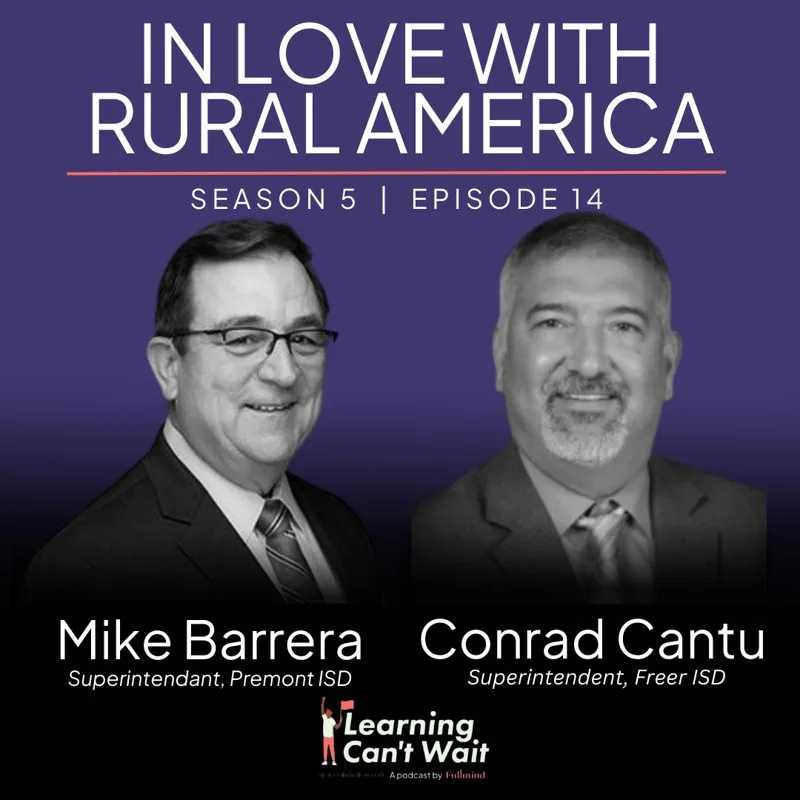
Mike Barrera & Conrad Cantu: Rural Education, Career and Technical Education, Rural School Innovation Zone
- Mike Barrera
- Conrad Cantu
 Hosted by Hayley Spira-Bauer, Chief Academic Officer at Fullmind
Listen now
Mike Barrera & Conrad Cantu: Rural Education, Career and Technical Education, Rural School Innovation Zone
Episode summary
In the rural education miniseries, South Texas superintendents Conrad Cantu of Freer ISD and Mike Barrera of Premont ISD describe how the Rural Schools Innovation Zone lets small districts share specialized programs: Freer's Medical Academy, Premont's cybersecurity and drones, welding, and a Grow Your Own teacher pathway. Conrad recounts buying a bigger bus when participation jumped from 8 to 30, and Texas's incentive allotment pushing some salaries past $90,000. Both stress a culture of support, hiring local people who stay, work-based learning after graduation, and attracting industry to the region.
Key takeaways
- The Zone pools districts so each hosts a specialty, from a medical academy to cybersecurity and drones
- Texas's teacher incentive allotment in tier-5 rural districts can add over $20,000 to a teacher's pay
- Only one valedictorian in 20 graduations said they would teach; salaries and Grow Your Own programs aim to change that
- Hire from the local community and build capacity; outsiders train up and leave
- Next steps: work-based learning so graduates use their certifications, and recruiting industry to relocate
About this episode
In this episode of the Learning Can't Wait podcast, host Hayley Spira-Bauer returns to the Rural Education mini-series with guests Mike Barrera, Superintendent of Premont ISD, and Conrad Cantu, Superintendent of Freer ISD. Both guests bring valuable perspectives from their roles in the Rural School Innovation Zone (RSIZ), sharing their expertise on the unique challenges faced by rural schools.
The episode delves into Mike and Conrad’s backgrounds in education, highlighting their districts' contributions to RSIZ. Conrad discusses the inception of the medical academy, while Mike elaborates on offering cybersecurity and drone certification courses, among other initiatives. They also discuss future challenges, emphasizing the importance of integrating industry into their communities and expanding their programs beyond graduation.
A major hurdle for rural schools, as agreed by both superintendents, is the attraction and retention of quality educators. They suggest that fostering a strong community and providing compensation incentives at both local and state levels are critical solutions. Emphasizing the significant impact educators have on students, Mike and Conrad encourage new rural teachers to embrace the serene rural lifestyle and build a meaningful community around them.
Produced by Fullmind
Episode notes
In a continuation of our rural education miniseries, our host Hayley Spira-Bauer sits down with Conrad Cantu, Superintendent of Freer ISD and Mike Barrera, Superintendent of Premont ISD. With deep roots in their southern Texas communities, Cantu and Barrera both appreciate the richness and potential of rural areas and have high hopes for overcoming the challenges these districts face. Listen to it on the Learning Can’t Wait Podcast!
Ready to explore how innovative career pathways and community partnerships can transform your rural school district? Schedule your free consultation today and learn how Fullmind can help your students gain essential skills, certifications, and the confidence they need to succeed beyond graduation.
Key Takeaways
- Innovative Educational Programs: Both Mike Barrera and Conrad Cantu have significantly contributed to the Rural School Innovation Zone (RSIZ) by introducing diverse programs like medical academies, cybersecurity, and drone certification courses, ensuring students gain valuable skills and certifications for higher education and future careers.
- Challenges in Attracting and Retaining Educators: To address the challenge of attracting and retaining quality educators, superintendents Mike Barrera and Conrad Cantu emphasize the need for strong community support and competitive compensation packages, fostering a supportive culture that makes rural teaching positions more appealing.
- Community and Industry Integration: Mike and Conrad stress the importance of integrating industry into their educational programs and creating opportunities that extend beyond graduation. By incorporating local industries into the educational framework, the RSIZ is not only enhancing students' learning experiences but also contributing to the sustainability and growth of the local economies, creating a symbiotic relationship between education and industry in rural communities.
In the evolving landscape of rural education, there are new standards emerging as a result of administrator’s dedication to their students. Bridging the gap between traditional teaching and modern career readiness, an innovative group of Superintendents have joined together in partnership with the Rural School Innovation Zone (RSIZ) to bring opportunities into their rural communities. This thoughtful approach, combined with strong community support, is transforming rural schools into vibrant hubs of opportunity and growth.
Leading in Education Through Full-Circle Careers
Conrad Cantu’s Journey:
Cantu’s career, which includes over 20 years in education, began as a teacher and coach. Cantu had a brief tenure in administration before leaving the field to help manage an oil company during a boom. This experience outside education clarified his passion for teaching, leading him back despite the lucrative oil industry. Now, as a superintendent, Cantu's journey is a testament to the profound impact that self-discovery and diverse experiences can have on one’s dedication to education.
“That's probably the most important years of my career; when I left education… because it really gave me an idea of what I really wanted to do, and that was being in education,” shares Cantu.
Mike Barrera’s Deep Roots:
Barrera’s roots in education run deep, starting his career as an agricultural teacher in his hometown of Premont, Texas. After advancing his education and gaining extensive experience in career and technical education, Barrera returned to Premont as a superintendent. Barrera’s return symbolizes a full-circle moment, bringing national insights back to benefit his local community.
“It's been so enlightening to be here to be back after so many years, and then to be able to to bring what I've seen and been a part of… you know, that I saw all over the country are are now right here, and to be a part of that is is really big,” Barerra explains.
Education Innovation as a Way Forward
Through the partnership with the RSIZ, Barerra and Cantu have implemented groundbreaking programs in their districts that are transforming the educational landscape for rural students. Opportunities to obtain certifications in cybersecurity, drones, and medical specialties not only enhance student engagement but also prepare them for high-demand careers, bridging the gap between education and industry.
“We’re preparing them for the future with skills that are relevant and exciting.” — Mike Barrera, Superintendent, Premont ISD
The proactive approach has led to a significant increase in student engagement with these career-oriented programs, underscoring the positive impact of dedicated leadership in rural education. “Now we have a big bus going to the Zone,” jokes Cantu as he tells about his district’s rize in involvement.
Challenges in Attracting and Retaining Educators
One of the most significant challenges rural schools face is attracting and retaining quality educators. Both Barrera and Cantu acknowledge that competitive salaries are crucial but not always sufficient. Cantu candidly shares, “Our teachers come into the field, and they could easily go make more money doing something else.” In response, Texas’ teacher incentive allotment program has been a game-changer, allowing exceptional teachers to earn substantial bonuses.
Beyond financial incentives, building a supportive and engaging community is essential. Mike emphasizes the importance of creating a “culture of support” where teachers feel valued and part of the organization. By fostering a sense of belonging and offering continuous professional development, rural schools can create an environment where educators are motivated to stay and grow.
“It's a culture of support... they have to feel like they own a part of the organization. When they start to see the successes of the kids, it just adds to it all,” explains Barerra.
The Next Hurdle for Education
Despite the vast successes both Barrera and Cantu have witnessed in their districts, they understand there is still work to be done. “We have to kind of change our mindset into what we can do to give them opportunities while they're here and support them when they leave our building,” shares Cantu. He explains he sees students excel within the Zone courses and come graduation, some students don’t use their new skills to their full potential.
“The next work here is creating partnerships with industry and corporations. Once they recognize that we have a viable pipeline for training and certifications for our young workforce, they might relocate here, bringing jobs to the region,” agrees Barrera.
Advice for New Rural Educators: Three Things To Keep In Mind
The top three tips for new rural educators at all levels are:
1. Connect with the community around you
One of the greatest traits of a rural community is the human connection it brings. Creating a supportive and motivating community will translate into a better learning environment for the students and a more fulfilling life for the educator. Attending local events, engaging with families, and showing genuine interest in the community allows educators to understand their students at a higher level, as well.
2. Find enjoyment in your surroundings
Barrera and Cantu echo each other as they explain their love for rural communities. The close-knit community, support from their peers, and the beauty of southern Texas has kept them in the area for decades. They both encourage new rural educators to find peace in their slower-pace rural lives.
3. Remember your passion
Cantu encourages new educators to stay focused on the student’s best interests. He emphasizes the rewarding nature of education and continuing to search for the best opportunities for students. Barrera reminds educators how incredibly impactful teachers are on students, perhaps more so than the actual subject matter.
“When you have that passion to be an educator that shines through and it becomes very, very fulfilling,” Cantu shares. Barrera echos, “Always remember that the kids will remember you for what you do for them. If your heart's in it, you'll be fine.”
Conclusion
The experiences of Conrad Cantu and Mike Barrera illustrate the dynamic and evolving nature of rural education. Despite financial challenges and logistical hurdles, their dedication to creating a supportive and opportunity-rich environment for both teachers and students shines through. Their stories remind us that with passion, innovation, and a strong sense of community, rural education can thrive and provide students with the tools they need to succeed in an ever-changing world.
Full transcript
Transcript generated from the recording; minor errors may remain.
Hayley Spira-Bauer: Welcome back everybody. We are continuing our rural education. Mini series of the Learning Can't Wait podcast here in season 5 and i'm, so fortunate to be able to steal some time from 2 incredible superintendents. We have Conrad Cantu from the superintendent of Freer ISD. Welcome, Conrad.
Conrad Cantu: Thank you for having me.
Hayley Spira-Bauer: It's a pleasure to have you, and we have Mike Barrera, the superintendent of Premont Independent School District. Welcome, Mike.
Mike Barrera: Hey? It's good to be here. Thank you.
Hayley Spira-Bauer: I'm so glad to have you both, and I thank Michael Gonzalez from the Zone for introducing me to you, too. I know we're gonna spend a lot of time talking about the Zone today. But before we do that I'd love to know how each of you came to be the personal and professional version of yourself. Conrad. I'll start with you a a little brief bio on how you got into the seat you're in today and doing the work you're doing.
Conrad Cantu: Okay, so I've been education a little over 20 years. Started off as a teacher coach actually, in Freer ISD. After that I moved on to move to Laredo and still teaching and coaching, and then I started administrative work there. For a couple of years. Then I left education. I thought I told people. That's my probably the most important years of my careers when I left education, and because it really gave me an idea of who I really what I really wanted to do, and that wasn't being the education. So I came back, moved back to Freer to be the High school principal for 3 and a half years, and then our superintendent left, and I kind of was named the interim for a couple of months, and then they name me the loan Finalist, and then I've been superintendent for the last 6 and a half years here at Freer.
Hayley Spira-Bauer: Wait. Can we hear a little bit about what you did in your time out of education? Did you go into finance? Were you working on on a farm like what were you? What's what took up your time that helped you get back to education.
Conrad Cantu: So there was a oil fill boom. You know. They had the Eagle Ford Shale down here in South Texas, and my brother-in-law started up a company. And he was needing help W. With that. So I helped them manage the company, and proud to say, the company still going strong today, you know. So started that for about a year. But it was really really good and exciting. It was nice to be in that that industry I had to take a pay cut to come back in the education field, and that's kind of where I wanted to be. Also pays really, really well.
Hayley Spira-Bauer: Wow! I I feel like we could spend considerable time talking about that pay cut not to make you feel badly about the decision you made. It sounds like you're happy with it, but it speaks volumes to the profession at large. So I'm gonna I'm gonna PIN that for a second. I'm going to sharing a little bit of your background. And also how fortunate the students of your district are that you made that pivot back into education excited to learn more. Mike, how about you? How did you come to be the professional and personal version of yourself?
Mike Barrera: It all started for me right here in Premont. I I I born here, and I grew up here, and I taught school here I. I was the Ag teacher here at Premont 30 years ago, and went off to to work on my master's, and then my doctorate in Oklahoma and came back and spent 20 years, 27 years, account and account, I see, as director for career and technical education. So my roots run really deep in current technical education, the concepts and the theories and stuff techniques and all. And always in the back of my mind. My wife and I wanted to return to to Premont. And it wasn't until she she retired, and then I was towards the Into my my career, and I took a job as a superintendent over Ben Bolt, which is right up the road. And and then this job came open, and so I ha! I I jumped on it, I mean. So it's been so so enlightening to be here to be back after so many years, and then to be able to to bring what I've seen and been a part of. And and here it is, you know, here we are with, you know, career technical programs, innovative programs. You know that that I saw all over the country are are now right here, and to be a part of that is is really big, and that's the big part of it all.
Hayley Spira-Bauer: Mike, for you to have such a storied career, and all centered really around one district. I imagine you've seen a lot of change. I'll start with you now like, tell me, what change have you seen? And it's been 30 years you said, since you were an ag teacher in female.
Mike Barrera: Yeah, I taught school right across the street from this, the superintendent's office, so they always had an eye on seats. But you know, back in the day it was. It was pretty pretty straightforward we we had 3 levels of ag, and we taught at mechanics a little shop welding and that kind of stuff. And in in all science classes, plant science and salsa. But you know it was a start. It was kind of an introductory thing, saying you got really good at it. And and there were no certifications that the school could offer back in the day. So you fast forward today, and there's some really good licenses that we have through the Zone they've been able to coordinate with. With postsecondary education institutions like Del Mar College and and Coastal Bend College, and even with Texas A&M University-Kingsville here. Been able to add those dual enrollment classes, dual credit classes to get them to get them their certification and their licenses while they're while they're still in and see all that all that funnels into preparing them for the future, and and and not only with the, with the skill. But with a I guess the motivation to to to work, you know, and then, and that's what a lot of folks talk about these days that the the younger generation just doesn't have that motivation or not that motivation. But at drive that work in me. And these classes out here, kids have to travel to to go to these classes. And they so they there's a certain degree of dedication that comes with that when they when they're dedicated like that. That that's that's building the the work ethic. And so when you, when you pair the work ethic up with the opportunity for a license or a even an associates degree. They're they're good, they're they're prepared. They're they're ready to go. They're confident they're motivated. And and we we put we put a really proud of the product that we're able to put out in the workforce. You know.
Hayley Spira-Bauer: It sounds like if I could, just to still what you've shared here to one word which is not to undermine how important what you shared was. But it sounds like there's just a lot more opportunity today for students than there was 30 years ago.
Mike Barrera: Oh, yeah, tremendous amount of opportunity. And and you know that. And they. I don't know the kids, the kids around us in our in our zone. I mean they you know that you can see it. I mean, they're they're they're they're proud of it.I maybe it's because we're proud of it. I don't know but.
Hayley Spira-Bauer: I bet. I bet that's part of it. Right. When you see your school leader dedicated to ensuring, you can do as many as many rich learning experiences as possible. And from what I heard from some of your colleagues in the Zone. Traveling to games on the weekend, getting on that bus and visiting the HVAC training pro program, or the medical facility and being a part of it with you. That's really inspiring. Conrad, can you talk a little bit about how your students have risen to the challenges and opportunities that Mike named the the Zone has afforded your region.
Conrad Cantu: We were a little unique in the fact that we had a lot of students going to our medical Academy for the past 4 years. This is like your 5 of the Zone, but we never had that many students traveling out to the Zone. And that was something that really was was something I wanted to work on and working with our executive director, Mike Gonzalez. I just told I want our kids to be more involved.There's too many good opportunities out there in our zone that our kids are not taking advantage of.So this year we have 30 kids going out to Falfurrias, you know. That's a pretty significant number where you only have 200 students, 189 students in your high school. And so I was really excited about that, because now our kids participate in the welding program, our kids are going to grow your own. Our kids are going to electrical the electrical program. So that a has been for me a big win because in in the creation of a zone. We've created all these great opportunities, but on the other 2 school districts they were taking advantage of it. But we weren't, and it would upset me every time, and they went on a tour to. You know we have all these groups coming in to visit the Zone, and then we go on these tours to to Premont and furious. And I tell Mike like this, it's upsets me every time because our kids aren't in these classrooms right? And so that's something we just made a conscious effort of promoting and and and letting them, you know, expose them to those situations. And I'm happy to say that over the summer I bought a 14 pass. Fif. Oh, yeah, 15 passenger bus to guard the Zone, because we only had about 8 kids. And they called and told me and said, Michigan, through the bus is not big enough. We got. We got 30 kids. And I said, Well, that's a from in my mind a great problem to have. So now we have a big bus going to the Zone. So I'm really excited about that.
Hayley Spira-Bauer: Wow! Sounds like you're jealousy. Really served your kids welfare. Mike Conrad.
Conrad Cantu: Yeah, we have some great programs in the Zone and and and and you know. We, we just need to take advantage of those. –
Hayley Spira-Bauer: So let's let's come back here for a second, Conrad. At the top of the call. You told us you took a break from education, but you found your way back. However, in doing so there was a salary pay cut that you had to take. Talk to me about some of the challenges and or ways what you know to be rural. America handles teacher, salary and leader salary. How are you thinking about that? And Freer.
Conrad Cantu: Yeah, that that's a huge problem for us. You know, our our teachers come into the field and they could easily go make more money doing something else. We're fortunate in the State of Texas that we have what we call Teacher Incentive Allotment. And teachers are doing exception well, and and they get their kids to grow. And then they do. They do well on their you know, evaluation. They get a lot enough to potentially over $20,000. So we now have some teachers that are making. You know well, over $90,000, which I think is pretty very great for a teacher. They deserve every every bit of that and more. And so that's been that's been good for for our, I guess, rural education. And the way that works is, you have these tiers of of allotments, and you know, the higher the the rule, the higher the school is in the rural setting and economically disadvantage the more your allotment goes up right. And so we're in tier 5. I believe so is Premont. So we're in the top tier. And so when our teachers get designated, you know. They they receive a pretty substantial paycheck, and and for us is in July. And so that's been good. I feel like as a state we have to continue to strive to to improve our our salaries for our teachers. You know we want teachers and our best and brightest going into the education field. We need to compensate that like we do right. And and I, I tell, I tell this story all the time I've been high school pre been high school principal, but a high school teacher. I've attended 20 plus graduations. As being, you know, a high school educator. Out of those 20 plus graduations. I've had one person, one valedictorian and valedictory in their speech say that they're going to be an educator. We gotta change that right? And I think that the reason for that is there's there's really not economically is just it's tough, right. And so that particular validator and his, both parents were actually worked in my department were teachers and teachers in their own right right? And so he knew what he was getting into, but but I I think we we have to continue to try to move the needle there and improve salaries for our educators.
Hayley Spira-Bauer: You know, you bring up a really fantastic point here, both about general sentiment to become an educator, and I want to get to that in just a second. But I want to hear from you, Mike. Also the financial incentives provided by the State sound like they're a huge addition. What else do you find to be successful in retaining talent in your district? Let's say they are not overwhelmed by the salary. But they are staying anywhere. What other things do you think encourages teachers to stay in your district?
Mike Barrera: Oh,it's a culture of support, I I mean, you know, they sense of belonging, and they they have to feel like they are part of the organization, or in a sense that they own that part of their that they own a part of the organization. And you do that with the provide, you know the culture, but the support to keep them. To keep them jazzed up to, to to keep going. And you do that with all the teachers, and you want to keep them, we we when you hire them, you're investing in them. And and you're investing in them so that that you want that consistency, or you want that longevity in their in their career. You want them to stay with us. And it's we struggle with that because we're we're rural, and they can, you know they they have most of them will drive in. No, they're not living here, and and not, I don't say most of them, I say about half of. And so you know, that's that's that to keep them here, you gotta work at it. And so you do. You do what you you do things to. To keep them to have that kind of holds that culture in, and that positive culture. And and and you work with them, and it's a pretty neat place. And so when they start, and I I really I really think so when when they start to see the successes of the kids. And you know that's what from within a teacher, that that they they want to see your your students be successful. And then, when you have options like we have in the Zone that help them be successful. It just. It just adds to it all, you know. And and so that kind of loops it all together, and and and you know our our idea is that they'll stay. They'll stay with us. So I mean, see, I came back here, so it's a little bit different for me. I I always wanted to return here. It's different when you come here, and you you know you. You've got a career ahead of you, and you've got some options. And so. You know, you go make a lifetime career out of it. You gotta you gotta make it enticing enough for them to want to stay around. So it's a it's a game we all play, and Conrad's got the same same thing. I mean Conrad's further out in the country than we are, if you really look at it. And so it's it's a place where you know you gotta it. It's the environment culture of support and really good environment.
Conrad Cantu: Yeah, I I I kind of piggyback on that. We have a you know. You have to want to live in in a rural setting right? I I I love the rural setting and but you have to want to live there. We're at Freer. We we're having the most success with getting students or former students, maybe living in town or come back, and they don't necessarily have a teaching degree and kind of hiring them, building their capacity, getting them to help help them get certified. And then they're hopefully gonna stay in the community for long for 20 plus years. Because what we were seeing for a while now we were hiring people from out of town. They come in, they get experience, and then they go on and they leave, and they they leave with all that training and and that capacity that we built, you know, in them. They they left here we are, start all over again. So getting people from from the area has been a really good recipe for for fill in our our needs in the classroom.
Hayley Spira-Bauer: It's such a good point. And you know I had a conversation just earlier this week with Someone who worked at Teach For America, and founded the first rural region for Teach For America in the Mississippi Delta. And they said that nobody knew what to do at first like it was kind of like a lot of eyes open at the organization as they were figuring out the unique challenges of bringing teachers to that district.But how many of them stayed, and it fell in love with working in a rural community. You know, I I mentioned before that we started recording that there are challenges to working in rural communities.and there's beauty to it. One particular thing that I'm fascinated by is the collegiality which is no better demonstrated by any organization other than the Zone, and it is really cool to hear about how Mike shared. Teachers are motivated by their students engagement in the different programs that you offer, and that's teacher. Excuse me, students can attend. – Let's talk a little bit more about those programs. I think. As a former educator, myself, or forever. Educator. I should say I'm fascinated by the hands-on learning experiences your schools are offering. So, Conrad, I'll start with you. Tell us a little bit about what Freer got jealous, and now offers in district that really keeps kids engaged and teachers.
Conrad Cantu: So every buddy in the Zone has. Their own specialization. And ours is is a medical academy. And and yeah, kids that come to our medical Academy. They're kind of on a pathway to go into LVN. They're they don't get into the program just yet, but they we start with a prerex on their path. We have. They? They graduate or they have the potential graduating with 4 certifications, phlebotomy, patient care, tech certified medical assistant and EKG. And so kids go on. They leave our less with with 4 certifications. Kind of proud of that, because I wanna kind of rewind. Back. About 7 years ago, when I was a high school principal. We started off and we're we were tinkering with, you know, we had an early college program, and we wanted to do something in the careers and so we started this, sir, this CNA program and we couldn't get the kids certified. We couldn't even get them to test. So you know, we we didn't give up. We kept kind of trying to build and learn and and and learn from our mistakes. And and here we are, fast forward. When we got into the Academy we started the Medical Academy, and we started putting more resources in, coupled with the help of the Zone and and some of the resources that were brought to us through them. We now have a very bright, vibrant medical Academy. And I say it's kind of like the the the one that is kind of the the most diverse. So we have about a third of the kids that are that are. Or now we have other schools. But we have a third that are Premont kids, third, that are file, and third, that are that are free kids. Now we have Benavides, and 2 other schools been abused, and I will do so, joining us as well. I think they each got like Benavides has 9, and and then I would do say has 7 or 8. So it. It really has been something exciting, and we have some great people that are running that program. We had somebody who started. She left us to go on to be the director of nursing for a Coastal Bend College, and then somebody that was working under here, not in the Medical Academy. They're all they're both from Freer, and we're working in the in the medical field, and they move back to town. And so we kind of took advantage of their skills. So the the person that left us is now serves on our on our zone board. You know she's still very committed to the Medical Academy, but she just does it in a different capacity.
Hayley Spira-Bauer: You decide on the Medical Academy? Was it because of the fact that those folks lived back in Freer and they had the skills? Was it an interest survey that you did for your students like? Where? How did you land on that.
Conrad Cantu: 2 things, obviously. It's a occupation and high demand. Right? And and there's job, there's tons of jobs available for students who gain these skills and then the other. The other thing is you you build on on the the capacity or the the skills that you have in within your your faculty, and we had an RN. That was phenomenal. She was on school nurse, and we wanted to tap into her skill set. And so she kind of started off the Medical Academy with it. We had a what we call Next Generation grant, and that was one year that $400,000. And it was kind of start this program and you and we that's how we moved her over to be just totally in as an instructor. Year 2 we start. That's how kind of the handshake agreement have you talked to Michael Gonzalez, for it was like we started partnering and it was like the beginnings of the Zone year 2 we had to share like, how am I gonna share the cost? Those FTE so Premont and Freer got together, shared that cost of that particular, you know position.And then the year after that we kind of formalized it, and and with the with the creation of the Zone. Right? So it it was high, you know. High job, high job demand. And then the talent of of our our existing staff. You know.
Hayley Spira-Bauer: That makes a lot of sense that makes a lot of sense thinking about the careers and the pathways our students will pursue is very logical and and probably very resourceful. Mike. You have a cybersecurity offering over at Premont, which.
Mike Barrera: Yeah.
Hayley Spira-Bauer: I also think has an important pathway. Tell us a little bit about your offering over every month.
Mike Barrera: How it got started is that and it? It's it's based on the premise of you know you. You look at the you look at the job demands in the in the region, and you study those to see where the high wage high demand you're preparing them for the future. And you're you're, you know, cyber security. Something woof this way out there used to be, and it's it's it's it's like it's here. Now and then the other ones did with drones was drone certification with. And and we're seeing so much you're seeing that whole area explode with with the use and how they're they're the application of the drones in the world today. And so those were those were targeted areas we needed to to to and and plus it's kinda it's flashy, you know. It's something that that would attract the kids attention. You know that that, hey? That's kind of that's kind of cool. And they they they've got robotic. We have robotics where they've made the actual robots that kind of move around and stuff. And that's that's that's always an exciting deal I have to. I have to also mention we we have a group. It's called the Grow Your Own and teacher certification. And I I didn't mention that earlier. But the the Grow Your Own program is also a way for us to build capacity in our local populations, for in a field that that that is is is in demand. And that's that's our teachers, that teacher education. And it's pretty. It's it's it's good to see like this morning I saw the Grow Your Own kids coming to the elementary to to for a day of. I guess job chat or or instruction for them. And to see them in in dispersed in the classes, and see that class is open for kids at Freer and for kids in South Maris, and they can come over. And and so they're all part of this this as well. And so we're we're actually, we're growing teachers. We're we're growing future teachers for for our area, for our region, and see they're they're more likely to stay here, I mean, when you're young and and and you. You grow up in this, and you have an opportunity to stay with a good job. You know, our ideas are that they will stay. And so that's that's, you know. Research tells us that. And so the you know that in in that that they would eventually want to come come back here and now we're providing a job for them, or employment, or opportunity or career even. You know, that's where we want to be.
Hayley Spira-Bauer: I'll never forget that my parents knew I would be a teacher before I knew I'd be a teacher, because in fifth grade they had a tutoring program for fifth graders to read to kindergartners.And not only did I do the tutoring program, but I befriended a family, one of the students, and I just used to go over their house with my mom and read to the kindergartener for fun. And I just found such a passion that I never knew I had previously, because I had been given the opportunity to work with a little child who. You know, couldn't read and was disengaged, and the Kid and I bonded, and we became so close that he came to my fifth grade. Graduation like it, created a spark in me. And I. So I love the idea of grow your own for your students. It that spark. You're right. Research tells us it's true and anecdotally. That was true for me. Who knows where I'd be today.
Mike Barrera: Paid off.
Hayley Spira-Bauer: Paid off – when you think about there. You've highlighted so many incredible things about your your districts and the benefit of the Zone, and how it's brought resources to your community you've shared. There's collegiality amongst your districts. What are some things on the horizon that are pain points for you that you look at and know you have to tackle so challenges ahead of you that you're thinking about right now. Mike, we'll start with you on this one.
Mike Barrera: We'll see the concept of career. Technical education is we're we're creating a pipeline of a trained workforce to fulfill jobs. High wage, high demand jobs. And so when you think about the what's on the horizon the next, the next work here is is creating partnerships with with industry and corporations that will. Once they recognize that we have a viable, a very good pipeline for training and and and certifications for for our young workforce, that they might con that they would that they will relocate here, and when they do that, then they're then they're bringing jobs to the region. And and you know. That's jobs for our people here, in our communities, in our, in, in, in the counties that surround us, and that that's the next work here is we've got to sell this concept on a bigger scale, to the, to the, to the business Co, the companies around here to to look at us, to say we can provide. We can provide a workforce. We can provide a training system to train up your. You know, your new employees or employees and relocate here. And you know, it's we're. There's lots of space space we have, you know.
Hayley Spira-Bauer: That's not. That's not a shortage.
Mike Barrera: So, you know. Come, come out here and we've got we've got the system for training. And and so you know, that's that's what I saw a lot of in. I was in in in the graduate school in Oklahoma, Oklahoma State and the vocational technical education programs where I've spent most of my my studies. And that that was the linkage that they had that was very strong with them. They created the programs, but their their right hand partners were were industry, and and you know they they they in by entice those companies to come out to rural America, and they they set up shop there, and they they there was a place for that that created a lot of jobs for a lot of the in the areas that were traditionally, economically depressed. And it it's it's a win. It's a win for everyone. So we're we're we're sitting at the gate right now. We we've got a very good system that's going here. We have great collaboration with our with our partners and our in the surrounding district counties and districts as well.and you know you that that takes that in itself takes a lot. Because.you know, growing up here, Freer was our big Bible. False is our big rival. And and you know, when you first mentioned about taking kids from Premont and putting them into classified, you know, the parents are saying, well, we don't want. Send our kids so we don't, we don't, you know. But those barriers are gone, you know, the the kids go there, and they're in class with with the other kids from all over the district, and you know that's on a that's on a Tuesday, Wednesday, and maybe a Thursday, and then Friday night. It's football and the rivals on, you know. So but you know that. But it's created a lot of collaboration in the in the region. And I think collaboration is what it takes to to entice big companies to wanna to want to come here. So that's the work that needs to be done.
Hayley Spira-Bauer: I I see that I see it sounds like you have a plan, though. Sounds like you have a plan inklings of it. Conrad. Same question for you.
Conrad Cantu: For us, our, our, our pain points are seen kids once they leave our our building seen them through. I I feel like that is something that that we don't do a good enough job of. We have. We do an amazing job building our skills mentioned the 4 certifications and all that great stuff. But I'm still seeing those kids leaving our buildings with decertification. And this kind of we. We got them started on on this system.and they're not taking advantage of the skills that they have. And so they may be still working that as a waitress or a waiter at the local cafe, or whatever it may be. And so that is something that that we have to kind of change our our mindset into. What can we do to give them opportunities while they're here and support them when they leave our building where we're in the process of of creating the P-TECH, or, you know, with our our current eighth graders and support them through the first 2 years after high school. But the biggest thing that that I that we are working on. And we're we're gonna implement, be implemented this summer and already started with our our former students is work based learning opportunities. And I felt like we can get our kids who I feel are, you know, I'm I'm kind of biased, have very good skills, and they're very well prepared and we get them in front of the employers, and they can show off their their skills. That's gonna lead to a job. I was at sitting at the cafe the other day, and young lady walks up, and we had made this connection with a with a education to employment an organization that that said, we have this grant, and we're gonna put you in like a shadow job shadowing. And this was specifically for kids, or you're one and 2 out of high school. We gathered up a few kids, and you know we had a meeting, and that was a couple of months ago put them together, and you know it made the connections, and then and and I was real excited about it. But I didn't hear anything after that, and the young lady comes. I'm just trying to start my second day an internship today at the hospital and for vacations. But she was working at the diner. And I said, Man, you know that's great. And is that something that you'd like to do? She's like Yes, or I really I liked it. I drew blood. All day long I ran an EKG, I didn't just Job Shadow. They they were having me work, and so I said, You know you keep doing a good job and impress them, and it's gonna turn into some appointment. But I'd like to recreate that both while they're at school, and then continue on the high school cause I think that's the connection that we gotta be for those kids because kids still have barriers. They're still. We got a a 80% of our kids are economic disadvantage. They still have the barriers of transportation. They still have the barriers of just leaving for in general or or having to commute, for that matter. And so we're gonna have to do our best to try to eliminate those barriers to. So I can take advantage of those skills.
Hayley Spira-Bauer: I think you're both thinking about the long term and the long game, and I think it sounds like a lot of your short game is working really well. So it makes a lot of sense to me that you're turning toward the future and your long game.
Conrad Cantu: Absolutely. Yeah.
Mike Barrera: Yeah. –
Hayley Spira-Bauer: Alright. I have one final question for you both. What advice would you give a rural teacher who is starting their career today. Conrad? I'll start with you.
Conrad Cantu: I would give advice. My advice to any educators starting their career, especially in a rural setting, is Don't forget why you ended up a profession. You're you know. We have to keep the the main. I guess, focus in the forefront, and that is that that of the student. Right? We have to do what's best for student as an educator, you know, you have 20 plus, you know, 20 kids, 15 kids whatever. However, many kids you have in your classroom, you need to do what's right for them and do your best for them. Education is a very rewarding career. You know I obviously. When in a different direction. But this is where I wanted to be. And you know, when you have that passion to be an educator that shines through and and and it it becomes very, very fulfilling we will do our best, and I'll continue to advocate for for salaries. But when you're an educator in a rural setting. You, you make a pretty good living. I feel like our teachers in the community are are there, you know, we would classify them as middle to upper middle class, you know, because of salaries and and what it, you know the cost of living it for Texas is not as much as the cost of living in San Antonio. So you'd come into to to a rural setting and make a pretty good living. Rural America is something that I'm very I mean I'm in love with. I I wouldn't rather be any any other place in the rural setting. I when I move back to Freer, you know, and I'm I'm an outdoor guy, and and I was sitting there I went to the fee store. And the owner asked me, hey, Conrad, how do you like being back in Freer? Said, well. This morning I got it was it was Christmas vacation morning. I got up. I hunted.got home, and me and my daughter, my daughter Rodeo, so me and my daughter practice, you know. You know she she had to practice. So we we practice on the rodeo for rodeo events. And now I'm getting out. Come back from lunch. I kind of like living in Freer, you know. A. And you know the the people in a rural town. There's a lot of benefits to that. We are like a one big family and I think you know rural America is the place to be. That's just my opinion. Right.
Mike Barrera: You were.
Hayley Spira-Bauer: Well, that just sounds like a great day, and it you've made a real case here for being a teacher in rural America, Mike, same question for you. What advice would you give a teacher starting their career in a rural school today?
Mike Barrera: Well, when we hire new teachers or new to the profession.you know we have. We have somewhat of a onboarding conversation, and you know this is, and I always try to tell them about you know. What do you? What do you remember about your school education, experience. And 9 times out of 10. Let's say they remember Mrs. Robinson in first grade. She taught me, you know, and then they you know you don't. They don't get really get into the subject matter as much as they get into the teacher, you know, and their favorite teacher, or they say, Oh, Mrs. Storm was my biology. Teacher, boy, she, I remember how she would bring those those frogs out. We would dissect them. But there! And so I I jump off of that, and I tell them now remember when you're in a classroom. What they're gonna remember most is what what you they're gonna remember more about is is you and and the subject matter and all that. They're they're gonna load into their into their their education box. And they're gonna move on and everything.But they're gonna remember what you did as a teacher.So always keep that in mind. Always keep that that they're they're they're sponges, and they're gonna then they're gonna remember, and and I and I'll tell them about the teachers that I that I you know that that I mentor our mentor with me. And and so that's that's really the important part of that. And then off of that comes: you. You know you. You have to like living in the country and and off of what Conrad said. You know he gets to hunt in the morning. I said. I live out in the country, too, I said. I can sit on the back porch, and I can watch the cows come in for water before I go, and I you kind of check on them, and in the afternoons and the weekends we, you know we've got our our cows to to to look at, take care of it, stuff our cats and dogs along with all that, and it comes with it's a it's a way of life, you know, and and so that's got a lot, you know. You mix all that together. And then, you know, you're of course you're not, gonna I said. You're not gonna make a lot of money, I said. But if you, if you plan it right, you you'll retire, and you'll you'll be fine, I said, and always give them that financial advice about. Start to put some money away now. And so into. You'll but you teach for 30 years, and then you you'll have a retirement pension, and but it's not. It's not going to be the full. So you wanna think about how you would fill that with with, you know, some investments and that kind of stuff I said, start now what what you can, and you know it'll pay off, you know. So when you, when you've been at it for 30 years, like I had you finally see that. And so I said, It'll happen. And so. You know, get your game plan together. Oh, don't always remember that the kids, you know the kids will remember you for what you do for them, and you know, if your heart's in it, you'll you'll be fine, and you'll be able to enjoy the countryside as well. And so you know, sign here so we can get.
Hayley Spira-Bauer: Keep going.Oh, well, Mike and Conrad, you have painted such an awesome picture of what it's like to be a teacher and a student and a leader in rural America. Thank you both so much for joining the podcast today.
Conrad Cantu: Thank you for having us. I appreciate the opportunity.
Mike Barrera: Yeah, thank you. Appreciate you. And you have a great day. Come, see us sometime.
Hayley Spira-Bauer: You know, I said, that I said, now I have to come visit all these amazing schools that I'm learning about.
Mike Barrera: He sure did.
Hayley Spira-Bauer: Alright. Stay tuned for that. Thank you. Everybody for tuning in today.
Conrad Cantu: You know.