
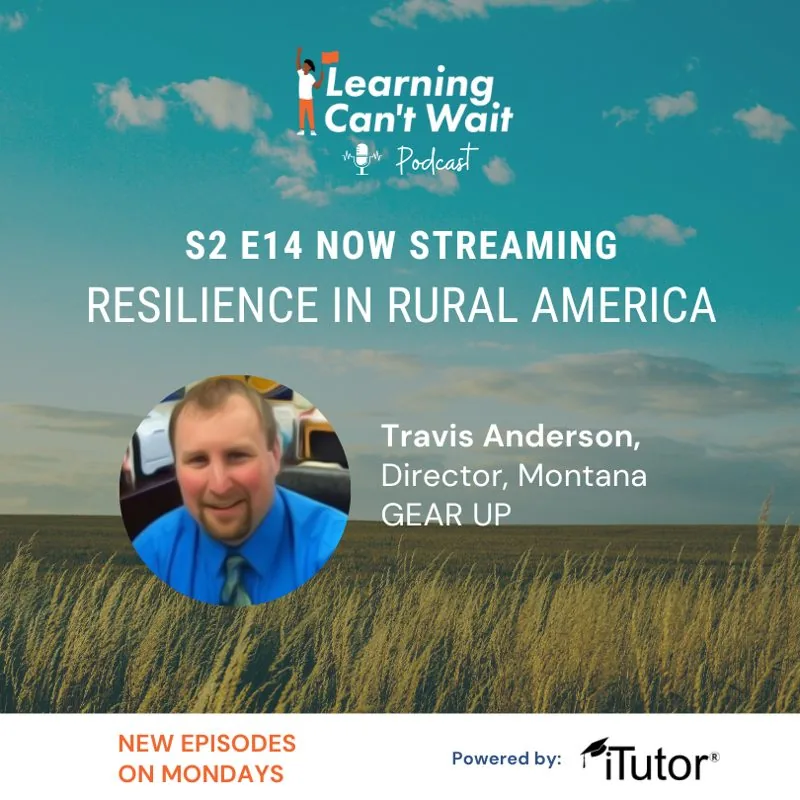
Learning Can’t Wait · Season 2, Episode 14
Resilience in Rural America
 Hosted by Hayley Spira-Bauer, Chief Academic Officer at Fullmind
Listen now
Resilience in Rural America
Episode summary
Dr. Travis Anderson, director of Montana GEAR UP, explains how the federal $24.5 million grant brings campus visits, tutoring, dual enrollment, connectivity, and first-year college supports to remote Montana schools, where communities of under 1,000 people sit 100 miles apart with no cell coverage. A former rural principal and superintendent, he describes math openings with one or two applicants, shortages that extend to bus drivers and cooks, and housing costs near Bozeman that price out teachers. He credits the pandemic with freeing educators to innovate and advises new rural teachers to embrace learning new roles.
Key takeaways
- Montana GEAR UP funds campus visits, tutoring, dual enrollment, hotspots, and first-year college supports across remote districts
- Rural staffing shortages reach bus drivers, kitchen staff, and custodians; two applicants counts as a pool
- Housing costs near Bozeman, where homes average $850,000, keep recruited teachers from staying
- Funding is often available; the missing piece is human capital, which virtual providers can supply
- Best teachers never forget what it was like to be a student; best principals never forget teaching
About this episode
In this episode, we discuss how the pandemic has accelerated the need for quality tutoring in rural areas. Travis Anderson, Director of Montana GEAR UP, guides us through the unique needs and barriers that have arisen.
Learning Can't Wait is brought to you by iTutor.com.
Full transcript
Transcript generated from the recording; minor errors may remain.
Welcome to the Learning Can't Wait podcast, an iTutor production at iTutor. Our vision is to ensure every child has access to education regardless of circumstance. Each episode, we will be joined by Pathfinders within and around the education space who are bringing about transformational change on behalf of.
Students, I am your host, Hayley Spira-Bauer. Hello. Hello, podcast listeners. I am so glad you're back here today joining me, the Learning Can't Wait. Podcast host Hayley Spira-Bauer, and our special guest, Dr. Travis Anderson, the director of Montana GEAR UP. Welcome, Travis. How are you? Good morning. I'm great.
How about. I am doing well. I, you know, Travis, director of Montana GEAR UP. You mentioned to me at the top of the call that today, this is a big week for Montana. Why is it such a big week in Montana? Yeah, this is a big week in Montana cuz this is our, this is, this is kind of the week that the, the calendar in the whole state of Montana revolves around this week.
This is Cat-Griz week. So those of us that are in Montana, we're either a Montana State Bobcat fan, or you're a University of Montana Griz fan. And, the game's actually in Bozeman this year. And, it's even a little bit bigger this year because ESPN's College game day is actually broadcasting from Bozeman and is covering the game.
So it's, it's a pretty big weekend. Sorry about that. So, you know, I lied. I said I didn't know anything about this, but I do know something about this. I founded a school in Harlem, New York with a woman named Jessica Sims, who became a very, Peloton instructor and is actually now the college game day one of the hosts, and she's in Bozeman and got in yesterday.
I've been actually following her account on social media. She's there right now getting hyped for the game. So I did know there was a game in Montana. I gave Oh no credit. Just didn't get two and two together. Did you? I didn't, but, but you know, I know it's cold there right now. It's crazy cold. It's crazy cold.
And you know, related to the game. Before we hop into the podcast, I have to ask if you're willing to admit live on air, who will you support? Which team do you cheer for? Well, it's, it's a, you know, I'm an alum of Montana State University. I've got this Montana sweats, state sweatshirt on, and my wife and I are both Montana State alum.
Unfortunately, though, our daughter is at the University of Montana as a freshman at University of Montana. So we have a little bit of a house divided, but, my allegiance, certainly is with Montana State. Bobcats this weekend. All right. A house divided indeed. I'm excited to see how this weekend plays out.
I will definitely be tuning in. And given that we're talking specifically about rural schools in rural America, I thought no one better to talk about this topic than you. Someone that I've known for a while. We've worked professionally together via iTutor and the work you do with GEAR UP. But today we're here really to talk about.
For folks that are unfamiliar with what schooling, education, rural, what, what it looks like in a rural environment. We're here to give them your insights, your experiences. So why don't we dive right in? Let's do it. Yeah. Yeah. Let's do it. So Travis, let's start with you. How did you come to be the professional and personal version of yourself?
Dr. Travis Anderson, director of GEAR UP, Montana. Yeah. I guess the, the, the short story is I am a, a teacher. I started my education career as a junior high and. High school science teacher went, got my administrative credentials, received my master's degree in ed leadership, and became a principal, and spent about 15 years working, in mostly rural settings at the elementary, middle school and high school level as a principal curriculum director.
And then finally as a superintendent. Then, then also finished my doctorate in educational leadership again, and now I'm working in the, the university system running the, the Montana GEAR UP. So that's kind of the real, real, real short story. But I, I've, I've kind of had, some opportunities to, really work throughout that.
You know, we talk about that P-20 spectrum a lot in education where you're talking preschool through post-secondary education, and I've, I've had quite a bit of experience kinda working it throughout that whole spectrum. So it's, it's been a rewarding career for. There are a lot of people who are listening who know a lot about K-12 and maybe less about GEAR UP.
So why don't you share just some context for folks that are tuning in who are not as familiar with GEAR UP. What is GEAR UP? How does it help schools and communities? And why did you leave a really, it sounds like, very successful career in school-based education to continue your. Through GEAR UP, there's obviously a reason it con it, attracted you and why you stayed there for so long and I'd love to hear it.
Yeah, great question Hayley. So, I, I'm former, I'm former Army too, so there's only one group that has more acronyms in the military. And that's education , right? , that's for sure. So, so GEAR UP actually stands for gaining early Awareness and Readiness for undergraduate programs. And it is a grant distributed by the US Department of Education and in our case it's administered.
And, given to. Montana border regions. Now our grant in Montana is a seven year, 24 and a half million dollar grant, three and a half million annually. And our goal is the, the name would say to, you know, gain early awareness and readiness for undergraduate programs. We do a lot of work in our partner schools in a multitude of things.
One, we help work with, college awareness. Again, because of the remote nature of many of our schools in Montana, you could go a hundred miles and not. To anywhere re, you know, resembling a, a community bigger than a thousand people. Right. We're, we're actually very remote in many of our areas in Montana.
So we, we work with schools to. Facilitate campus visits for students. We also work to facilitate programming on college campuses during summertime to get students access and, and, awareness of campuses. We also work with, our partner schools to provide tutoring academic supports for students. A again, to keep students on track for graduation.
What good is being. Post-secondary education if you can't graduate. Right. So we help 'em with that. We also do a lot of work with providing and delivering, dual enrollment opportunities, for students. And then I know I'm kind of glossing over some things, but, those are some of our big pieces. And then we also provide considerable support to have some access to technology.
You know, we found that out during the pandemic. Not only are we very remote, but if you look at, and I always kind of like to use that one, the, the. The, the Verizon map when they showed on commercials of, of like Verizon. There it is. Right there. Yeah. I'm all those that are listening. I'm pulling up a map from a previous conversation that Travis sent to me.
it's a, it's a Verizon map that shows LTE coverage. So why don't you explain to folks who cannot see this image, what is you and I are looking. Yeah, so I, I use this a a lot when we refer to challenges that we face in rural Montana, and I, I know that this is experienced in many rural communities across the country is, you know, there's so much that's.
Put into connectivity and, and wireless connectivity and internet connectivity. But many of our communities there, that doesn't exist. And so when you look at the map here, the, the Verizon LTE coverage that's on the, the left side, you see some very, very big. Gray areas that have, that don't have coverage, and many of those actually exist in our Montana GEAR UP communities.
In fact, so much so that once you get about, when you're in the community, you can get cell coverage after you get about two, three, maybe four miles out of town. There's absolutely no coverage for 50 miles and you may not have cell service for, like I said, 40, 50 miles as you're driving down the road. So that's definitely become a challenge, and it got that challenge was exasperated during the pandemic.
So we did work with our partner schools again. As so many schools went to delivering instruction remotely, if there's no connectivity and students weren't able to connect, what was, it became a huge disadvantage for those students. So we worked with them to provide everything from mobile hotspots to increased, connectivity and hotspots and maybe school parking lots where students could pull up in their car, work on homework from their car.
We even worked with schools to provide. Things, even just like headsets like this were, you know, students in a, in a packed house trying to do remote learning so they could just have a mic and a headset. So when we look at that, that coverage and that, that remote piece of Montana, that's definitely something that is a challenge that we work with.
And, so those are all things that we do through Montana GEAR UP again to keep kids on track for high school graduation. Prep for college ready to be successful once they step on campus and become successful once they get there. And then I guess the last thing that we do that I kind of wanna share with our listeners is we've launched a series of, we call 'em first year service partnerships with five campuses in Montana.
And those campuses are Montana State University, Montana State University, billings, university of Montana. Flathead Valley Community College and Stcu College. And Salish College is a, is a wonderful tribal college that we have on campus, and we work to provide students supports in their first year on campus, everything from orientation to help with scheduling classes, to help with understanding financial aid packets, to support and completing FAFSA, but also understanding supports that are available on campus.
The other map that you see here is the Frontier Counties, and you talk about population density. And when you look at, you know, with our Montana population density of like 7.3 people per square mile, we have a, we're the fourth largest state geographically. We only have a million people in the entire state of Montana.
So when you look at some of our larger metro areas, you know, there are counties on the east and west coast that have. You know, several times the population of the entire state of Montana. So many of our communities are less than a thousand people that we work with. And then when they get onto these larger campuses, and even though Montana State University, per se is, it's a big campus for us.
It's about 15,000 people. There's about 15,000 students on Montana State University campus that's larger than the size of the counties in which most of our students came from. So to provide 'em with access to supports, understanding of what's available to them and how to ask and how to get those supports is, is a huge advantage.
And it's a service that we've been partnering with to, to provide. Been pretty proud. So in addition to some of the tutoring work that we're providing in academic supports, that's also one of those other supports that we've been really working hard on these last couple of years. Ooh. I think for folks that have never heard of GEAR UP before, they're probably starting to Google it right now because.
A lot of the things that you're naming are services and supports that many schools take for granted, right. Embedded into super, well-funded, well-resourced communities and, you know, are, are some of the, like the concerns in rural America are, as you mentioned, exacerbated and have been even more exacerbated by the pandemic.
So having a support like GEAR UP at the school level can be a phenomenal improvement and, and provide more equity. For the deserving students of the community, which I love and was one of the reasons why seeing the work that Montana GEAR UP has done and some of the other GEAR UPs that I know about has really changed my perception of how grants can be applied.
so thank you for sharing that with our listeners here today. Yes, yes, absolutely. I hope I didn't get too granular on that one, but I very excited about the work that we're doing. You can tell you come alive when you talk about it. And I think you didn't really ex explicitly answer earlier, why did you move to GEAR UP?
But I think this is why, I think it's because all of the amazing things you're doing to support kids K-20, to ensure that they're successful getting through college, or excuse me, through high school to college and in college, right? So it's a, not just a two model, but it's a two and through model, which is important.
Yeah, absolutely. It's, you know, it's just one of those things where, I, I think some of our best educators are those lifelong learners, and we hear that term all the time as a lifelong learner. And this was a, a learning opportunity for me to, to learn a new aspect of education. That's why I jumped at it, and that's why I'm so very excited about the work that we're doing because I continue to learn and grow myself as an educator.
I love that. If you're not learning, you shouldn't be in this profession. So I'm glad you're naming that for all our listeners because our kids deserve people who are curious and who are embedding curiosity in kids. So very cool to hear how you transition to this particular role and what your, what your hopes were for your getting into it, which was to learn more about how education can be better for kids.
So I wanna dive back a little bit to talk a little bit about rural, rural America, Montana. Frontier County. You mentioned there's, there's a map that you and I are, there's two maps we're looking at. One is about Frontier Counties, which is basically about population density. And I would've guessed to be honest with you that Alaska was the least dense state in the country, but it turns out it's not.
The order from this map is it's states that it's Wyoming, then Montana, then Alaska, and for folks that come from places like where I come from, you know, 45 minutes outside New York City. That is. Really hard to imagine. So you, you named that there were in some places 100 miles between schools or settings, communities.
How does that impact placing teachers in schools? Yeah, and that's a great question. And as a former school principal, I, I can tell you that, and we, we experienced it, and I'm sure Montana's not unique in this. And in fact, talking to many of my colleagues around the country, it's, it's becoming more and more pronounced, but just the staffing shortages, you know, that there are staffing requirements to operate a school and to provide quality educational, offerings for students.
And just something as, as simple as, having a math teacher opening in some of these rural communities. You may have one or two or maybe no applicants for this position. So how do you, how do you make that work? And that's definitely a challenge that our, our rural communities face. And I know as a principal, a lot of times,I was always excited when I had two applicants, cuz that meant.
I had a pool. You had a, I could do interviews, right? You had a choice. Yeah. Yeah. So when I, when I do site visits with our partner schools, and, and again, we have very remote schools. One of the first questions when I go and, sit down and visit with the superintendent and principal is, you know, how many FTE are you light right now?
And this FTE. But I talked about FTE and operating schools in rural communities. Teaching shortages are definitely a challenge, but that also compounds into bus driver shortages and kitchen staff shortages and custodial services shortages. So it's, it's, it's, it's all around. It's so much so that My previous job is superintendent.
I was actually working on the side to get my boiler operator's license, cuz we couldn't actually hire someone that had a boiler operator's license to operate the heating. Part of the school. So here I am. And it was a, that was always the big joke, was that, you know, Dr. Anderson's working on his boiler operator's license so that we can keep the school heated, keep the heat turned out.
So that was, you know, those are definitely challenges that many of our schools face. And, yeah, it was, it was, it was definitely an interesting dynamic. I just wanna make space for that for a second. Right. Like you're, you're saying it with like a jovial smile, like, oh, I was getting my license, and they would make a joke about it.
Rural Montana on November, late November, 2022. I know is, is the real feel is negative 15 degrees Fahrenheit right now in some places, right? Mm-hmm. , I, I told you I was following that yesterday, but having a school without heat is, One, the schools are staying open without heat, I'm assuming. Yep. Yeah, they're all And the heat's running.
Okay. No, but I'm saying like without the type of support that you're naming because of the challenges you face in a rural community, it would be very, very difficult to learn in an environment like that. And there aren't many options before you, whether it be a teacher or a bus driver. So rural schools face challenges that other schools face just probably.
At a higher degree and the shortages that you're naming or even having only two applicants for a role really limits ensuring that you have every resource available to support the kids that you, you have. So it's even more important for spotlights to be paid on rural America so that. The problems they're facing can get highlighted and multiple folks can be aware of, of what the challenges are and how you're solving them.
Absolutely. That's why I say that, Montana has some of the best, most dedicated educators, in the country and, and. I, I can safely say I've worked with educators from across the country and they're all amazing. They're all magical in their own way, but I will say that our Montana educators are, are just amazing in a way of their own because, and one of the things with the, the rural nature, you rarely get to just be.
A singular role and, and that, I mean, you rarely just get to be the superintendent or you rarely just get to be the teacher. You're probably also doing things like, you know, getting your boiler operator license or maybe you're doing coaching duties or you're run PTA meetings or you're, you know, you're, you're handling all these things.
If the, the kitchen staff, one of the members of the kitchen staff call in sick. You know, in my former school we, we had a very short staff and if a kitchen, one of our kitchen staff called in sick teachers would. During their prep to go down and help prepare lunch and then help serve lunch for the kids because, you know, they were, I, they were just amazing.
And to have people that were willing to do all of those different tasks and work together really truly for the benefit students is, is really magical to be part of. So we have our challenges, but I think that that's one of the things that I'm very blessed and very special to. Been able to be a part of some of those things.
I love hearing that the, the challenges you face have, have really led to folks' hearts expanding and their ethic, their ethic and their work commitment. It, it's incredible and. Having met a few teachers and a few folks from the Montana community, I can double down on that statement that they are special and they are committed and they want to change lives for children.
And I love the way that you're, you're sharing these stories from your own communities and your own experiences of how. Committed and invested. Everyone is in making everything work for kids because that's, that, that is important. As much as naming the challenges, it's in as important naming how you step up and who steps up and how they do it.
Yeah, absolutely. Like I said, we, we have, just amazing educators across the state and I'm just so proud. Call so many of them, my colleague and friend. I love that . So you know Travis, you obviously have been in Montana for a long time. You've been in as part of a community of rural kind of leaders and gear folks do the problems and challenges and.
The way that folks rise to the occasion in your community mirror what you hear from other rural school leaders and school adjacent leaders. You, you know, that's a really good question and I. I think some of those challenges have, have shifted or, or, or changed, really over the last 10 years, but specifically over the last five years or even three since the onset of the pandemic.
And one of the things that we noticed, and I'll say, you know, 10 years earlier, some of our areas in Montana started kind of becoming pretty, pretty popular areas to live. . So we had a lot of folks moving in from out state, which drove up to housing prices, which then created areas in, in which teachers couldn't, afford to buy a house or things like that.
My, my previous district where I was a superintendent was right outside Bozeman, Montana. Recently there was an article in the Bozeman Daily Chronicle that, that said the average house price in Bozeman was $850,000, someone on a teacher's salary that, that kind of takes them out of that market. Right, right.
So, so we had. Challenges because we had a lot of teachers that wanted to come and work in our school, but then once they would take the job, they, they couldn't find housing or they were driving 20, 30 miles. To get to work, you know, because they were living in, out outline, you know, out out, outline communities or, or things like that.
And the, the community where I was in was really close to a ski resort and, you know, had some really high, high home values and things like that. Million dollar properties, multimillion dollar properties. So it, it ended up being, that was our, one of our challenges, right? Because teachers couldn't afford to live in those communities.
Since the onset of the pandemic, Montana has seen a, a big influx of, of folks moving in because things, you know, remote work possibilities and, and pieces like that. It's beautiful. Right. You wouldn't wanna live here. I love it here. Yes, and I love all coming in. I love it that, I love it that I live in a place where people wanna go, you know, and, and live and raise their families.
I love that about it. But it's, it's created some of those challenges where we're finding teachers and, and being able to, To get them, recruit them, and then have them be in your community. And, and, but being also being able to have them come and. You know, live, you know, buy a house, raise a family. Those types of things are getting to be a unique challenge that we're hearing a lot from our rural schools, that they're just having a hard time recruiting and retaining folks because it's just the cost of living in many of our communities, or even things like rental availability.
Housing availability is just not what it was. And so that's, that's becoming a compounding challenge for many of our communities. Not only finding great staff, but then once you get 'em, where do you have 'em live? Wow. Yeah. The, a pandemic has changed so much about education. This is a, a clear byproduct of folks moving out of cities during the pandemic and moving to places that had maybe less population density because, Something they desired all along, but never had the ability to do until they had remote work options.
yeah. No, thank you for naming. Yeah, becausewe were naturally, socially distanced from the beginning. So when they said socially distanced, we were like, okay, fine. Whatever. You know, like we're on call from the next town . That's just, that's just how we operated, right? Sure. Population density. When there's only seven people per square mile in some of these counties, that's, you know, that's pretty well socially distanced, right?
Right. So we were already there. And so yeah, that kind of was a, a new dynamic. And that was, I think, part of the reason why so many people found it desirable to come to Montana. That and Yellowstone, whatever, for whatever reasons since they started filming that show people just, that's right. Come to Montana.
Mm-hmm. That, that happens sometimes. I've heard about that effect before from a television show that goes vi, that goes viral and folks wanna move near where that is cuz they. . There's such natural beauty right here in our own country, and Montana happens to be that destination from Yellowstone that they saw.
Yeah. So I mean, those are all kind of things that have created challenges that our schools are facing. And I, I think the, the good thing about it too is that we've got a really good. Cadre of, of school administrators in Montana, of educators in Montana. That, and, and we really have very good support from our elected officials, from our communities.
And, I think these challenges will be addressed. And I think schools and communities are finding, unique and, you know, ways to, to address it. I mean, for example, in my first principal job, the district actually. Housing, which was provided to staff members at relatively low rental. So I was able to live in one and share a, an apartment with one of the teachers, and it was one of the funnest years I've ever had, you know, that year that we lived together in that teacher.
So it was, there's. For every challenger, there's a solution. I have every confidence that, my colleagues will address those challenges with quality solutions. Having that sort of confidence probably makes it all easier every day when you get, when you get to work. So I love hearing that. I'm curious, Travis, you know, you mentioned a lot of the services that GEAR UP provides and one of them is tutoring.
How, what is the impact of, let's talk about the social, emotional, and academic impact of the pandemic on the students you serve via Montana. GEAR UP. I'm going to say that there has been a nationwide decline, right? Our NAEP data has told us there's a nationwide decline in student performance. We know, you know, the American Psychological Association, CDC have also put out a ton of statistics about students' mental health at this state in, I won't say post pandemic, but in, in this state of, or excuse me, this stage of the pandemic.
How, what are you seeing in Montana and how are your schools and your community addressing. Increasing needs of the students. That's a great question and, and you know, when we talk about providing tutoring, mental health supports, socio-emotional learning, I'm very happy that it's, I guess I'll address the socio-emotional aspect first, that it's becoming something.
We're aware of and we're getting to, to a better handle of, right? We're getting, we're getting better at how do we identify and support students that have socio-emotional needs. We're doing a great job. Our counselors are doing a great job of working with students as a, as a parent in public schools. I can also speak from a parent perspective, and I've, I've been, you know, so, so happy with the, the work that has been done at my children's schools addressing social-emotional learning.
I think that it's, it's, it's come leaps and bounds. Even from when I first became a teacher 20 some years ago on social-emotional internet. It was just something that was never really discussed. It was something that wasn't even on the radar. Most schools it was, everything was about content and delivering, you know, and, and, That was kind of the early days of No Child Left Behind and, and some of those things when I first started teaching.
And so everything was about, you know, addressing content and standardized test scores and all that, which was good. And that pendulum just kind of shifted back to looking at that whole child and looking at social-emotional learning and looking at some of those pieces and really digging down. Because the other part of it too is if we're all learning through all this, is that's as critical as the student's overall success as.
Some of the academic skills, right? And so I think that that's being, that's great. Now, I, I, I think with, the nature of rural is now, now that we're identifying it, now that we're understanding best practices and now that we're really digging into, now we have to get to people that can drive those best practices and deliver those services.
And that's where I think, one, we're doing a good job of addressing that, but also I think that's where. Having opportunities to, to leverage resources like iTutor to, to work with and, and deliver some of those pieces and, and maybe even just start, some of those conversations can be such a valuable resource, especially here in rural communities.
Now, when I talk about the tutoring piece, I, I, I think one of the challenges again comes to how do we, how do we address that? You know, it's not, I don't think it's a matter of resources. Right, because the resources are there. We've had that with GEAR UP, where we have the grant, we have the funding available, we have the resources, the, the financial resources to address these things.
A lot of our issue especially is the human capital. Do we have, do we have the drivers that can make it happen? Do we have, I always like to use math cuz I'm a math and science guy, so I'm really good at using my scenarios on that. And we had a situation where we were working with a school to provide math tutoring after school.
And in that community they had a great, great, great math tutor and they were, this math tutor was fantastic. But that math tutor didn't feel comfortable tutoring students with geometry. Well, that's a pretty critical class, right? You know? Sure. Right. I mean, algebra, algebra two great. I mean, trigono, she, those are fantastic, but this, this particular teacher really didn't, or you know, this particular tutor, I should say, didn't feel comfortable.
Tutoring students in geometry. So how do we find, you know, that's a, that's a la that's, that's a human capital that's we're missing. So how do we leverage those resources that are becoming available to address that need? And that's where I think, some of those providers, again, like iTutor, have been so valuable in addressing and, and kind of bridging some of those gaps, you know, where we're having some of those pieces where maybe the human capital isn't quite there.
We have that resource that maybe wasn't there a generation ago that we can, we can make that work. You know, I didn't disclose at the start of the call I said we knew each other professionally, iTutor and Montana GEAR UP have, iTutor has been a supporter of the Montana GEAR UP work in some of the schools we've met through Montana GEAR UP for a really long time.
And, and I said to said to Travis before this meeting today, I said, you don't have to talk all about iTutor. I really wanna hear about rural America, but. What I will say is that I know to be true is whether it be iTutor or other providers of virtual instruction, the pandemic and laying the ground roads for the infrastructure with one-to-one devices, internet connections, which not every home has, but most schools have at this point, has allowed for more unique interventions and supports and human capital being brought in, than previously, per previously possible.
You name. Yeah. You know, it, it doesn't always, it's always possible to just bring someone in from the next town in Montana or in rural America. And so having an online version of coming in from the next town expands c c capacity. Absolutely. And I think one of the things that, that the pandemic allowed us to do, it gave us freedom to, to be innovative and creative.
As much as I love educators, there's a lot of times that sometimes we. In that, well, it's never been done that way before or this isn't how we've always done it. The, the pandemic and the the new nature of, of education allowed us that ability to be innovative and creative on how we find and deliver academic services or social-emotional services to students.
And so it, it allow. Educators across the country to explore and utilize and leverage these, these, these litany of resources that are out there and available in new and innovative ways to, to meet those student outcomes. I think that's the part that in many ways has been the blessing and disguise that the pandemic has presented, is that it's allowed people the opportunity to be innovative and creative and to not have to say, well, We never did that way before, so let's not, that might not be something we wanna look at now.
It's, well, yeah, but we've never had to deliver education the way we have right now, so let's, let's be innovative and creative and it's given educators across the country that free reign to be innovative and creative. And that's, that's something that, like I said, I think it's been a blessing in disguise.
And I hope, I hope, hope, hope that those are things that continue beyond the pandemic, is that we continue to be innovative and creative and look to leverage resources in new ways to deliver to students that would drive positive student outcomes. Travis, I could not agree more, and what I see happening right now are people either quickly chasing.
The innovations and implementing them really confidently and curiously or sort of watching from the sidelines wondering if it's going to work. And I think it, for me, it's a both ands. This is something I talk about a lot on the podcast and other places and spaces. Absolutely try new things and measure their.
Measure the efficacy for children, for communities, for schools, the benefit for teachers and administrators, and adjust accordingly if we all just, you know, carte blanche, kind of implement new ideas and never check if it's working. . Well then shame on us. So we have to do the try the new thing, be innovative, and monitor how effective those implementations are along the way.
If it's not working well, you tried, and then you can adjust and you could at attempt something new, but you're not gonna get to greater results and better outcomes unless you're continually pushing the envelope for kids. I couldn't agree more. I could not agree more. I think that that's very profound.
And yeah, I mean, even my grandmother always used say, if you fall on your face, you're still moving forward, so just kid up and keep going. Right? Right. So if you try something, and the funniest part is, so I actually, I've done a lot of research on change theory and organizational change and some of those things, and.
In a lot of ways, and, and I'm kind of seeing this now too, practitioners within those systems that are changing in, in, in some ways to kind of use the macabre examples. They, they go through almost stages of grief. Parallels two stages of grief. And you will see bartering and you will see, you will see, you know, denial.
You will see acceptance. You will see all of those things. And some people, They, they transition along that spectrum at their own rate, right? People go through those processes very differently. Sometimes you have those, those early adopters when you go back 15 years ago, they were the people that were Google certified as Google educators, right?
And they were doing all those, those crazy cool, innovative things and Google, and then you had some folks that were kind of moving a little bit slower. Along that line, and now you're kind of seeing more people that are kind of coming to that implementation, that adoption, that adaptation piece much quicker because it's necessitated it.
And so I think that that's been really exciting to see, from an educator standpoint on on much more widespread adoption of some of those practices. I agree, and, and it, and it certainly benefits rural America, I think, as much as anywhere else in the country, in, in this, the country or the world, because we're able to access some of those things now that we never did.
I love to hear that, Travis. I feel. I normally ask this question as I wrap up the podcast one, I don't wanna wrap up the podcast. I'm just gonna name that and I also have to be respectful of yours and our listeners' times today. So what I'm gonna do is I'm gonna tweak the last question I typically ask. I normally ask folks, if you could give any advice to a teacher starting their career today, what advice would you give?
But I wanna tweak it to add, if you could give advice to any teacher beginning their career in rural America, what advice would you give? That is a great question and. If I could give any advice to, a teacher beginning their career in rural America, and I'll even kind of answer that. If I could go back 25 years to young Trav and say, Hey, you know, give him, give him some wisdom.
And, and what I would, I would say to, to my younger self or any teacher, is embrace the opportunity to learn something new because. Like I, I talked about in, in many of our rural schools, very rarely do people get to be a singleton, so to speak. As a practitioner, you, you very rarely get to just do one thing, and so I, I say be ready to embrace the opportunity to learn something new.
And whether that's. Working as, you know, teaching multiple classes a day of, you know, college, you know, algebra one, algebra two, geometry Tri. If you're talking a math piece or science, you're, you know, teaching biology, chem physics, which is what I taught. Be ready to learn those things, but also be willing to take on new challenges, you know, during that time, I've, I.
Taught multiple class. I've taught earth science, biology, physics, human anatomy. I've taught ca algebra, algebra two, but I've also coached football, basketball, girls, basketball track. I've coached baseball. I've coached golf. I've worked on boilers. I've, you know, I, I've done, I've done that whole gamut and I think that it's, It's made me so much more excited about education because I've been able to learn all of those new things.
And so that's what I would say to somebody, that's just starting their career, whether it's in an urban setting or, or a rural setting, is embrace those opportunities to learn, expand those on those new things. And, and, you know, here I am. I'm, I'm. 20 years plus in education, I'm still looking to learn new things.
And so I think that's the best way to, that's, that would be the best advice I would give. And there's one last one that I would impart your listeners with and I, I think it's been something that's gone well for me for many years. I. . When I first started teaching, I had a, a, I taught actually under a principal in a school where I was a student.
And Ron Steiner, you know, God bless his soul, he was amazing Principal. I was actually a student in this school and then he hired me for my first teaching job. And, and Ron told me early on, he said,the best teachers are the ones who never forgot what it was like to be a student.So you're gonna have kids that struggle, you're gonna have kids that you know, and learning isn't the easiest for everybody.
So the best teachers are the ones that never forgot what it was like to be a student. And he said, and conversely, the best principals. Are the ones that never forgot what it was like to be a teacher. So be willing to be understanding and empathetic toward those challenges and struggles that come with that profession as well.
And so that's what I would, that's the advice I would give to someone looking to starting in teaching is, you know, the best teachers are the ones that never forgot what it was like to be a student. Oh man. That is the best way to end this podcast episode today. I love those two pieces of advice you gave.
I haven't heard them before, and, and I really, I, I really appreciate the sentiment behind them. And Travis talking to you is always a joy. And I just wanna thank you so much for joining the podcast today. I, I thank you. I just appreciate your time and I appreciate the opportunity to, uh, visit with your listeners.
It's, it's been an absolute pleasure and I hope you all have a, have a wonderful day.
Thanks for listening to the Learning Can't Wait podcast. If you liked what you heard. Please rate, review and share this episode. Be the first to know when we have a new episode by subscribing wherever you listen to podcasts. If you'd like to be a guest on the show or have a suggestion for an episode, email us at podcast@itutor.com.
Your campus needs teachers now and we've got you covered with over 1500 state. Educators from across the US ready to serve both your part-time and full-time requirements. ITutor is perfectly poised to virtually meet all your academic needs with live educators in and around school hours. Learn how today at itutor.com.