
Learning Can’t Wait · Episode 102
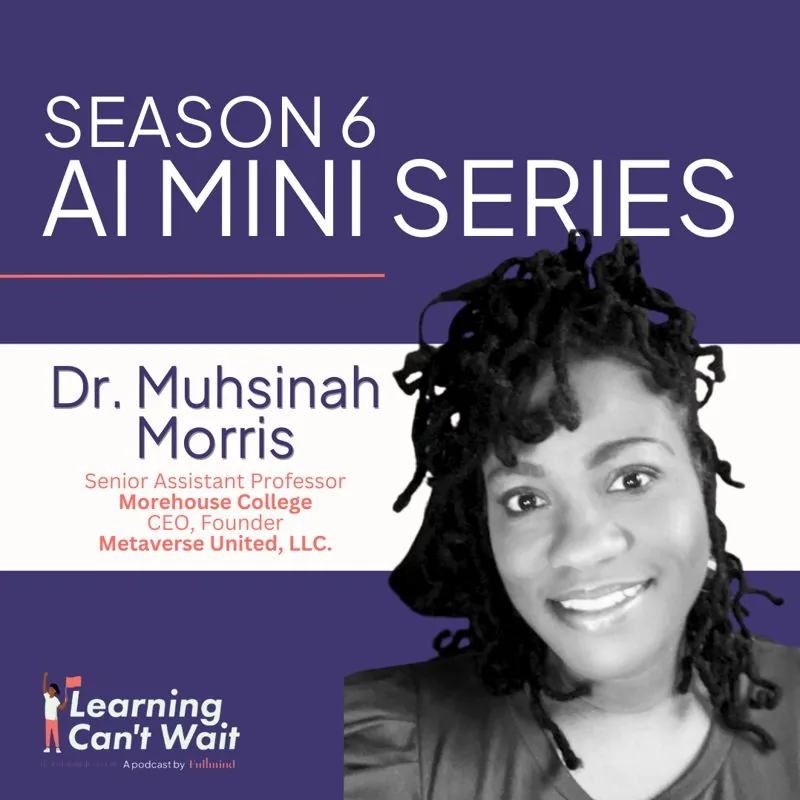
Dr. Muhsinah Morris: Metaversity, AI-Powered Teaching Assistants, Virtual Reality in Education
- Dr. Muhsinah Morris
 Hosted by Hayley Spira-Bauer, Chief Academic Officer at Fullmind
Listen now
Dr. Muhsinah Morris: Metaversity, AI-Powered Teaching Assistants, Virtual Reality in Education
Episode summary
Dr. Muhsinah Morris returns to describe how Morehouse College's metaversity, a digital twin campus built with VictoryXR where students attend immersive VR classes, has inspired about 120 others. She explains how spatial computing lets medical and science students practice with unlimited repetition, how she trains pre-service and in-service teachers in metaversive teaching, and the rollout of AI-powered teaching assistants loaded with instructors' own lessons to give students 24/7 support. Inspired by her neurodivergent sons, she defines access as usability for all abilities and urges discernment, research, and play.
Key takeaways
- Morehouse coined metaversity; 120 campuses now use its blueprint with VictoryXR digital twins
- VR gives learners kinesthetic, visual, and auditory input at once and unlimited practice repetitions
- AI teaching assistants answer from the instructor's own scripts and resources before reaching the broader model
- Access means not just having a tool but being able to use it effectively regardless of ability
- Discerning real from fake is the biggest AI risk; do short-form research, avoid gossip, and be informed, not afraid
About this episode
Continuing our AI Mini Series, host Hayley Spira-Bauer sits down with Dr. Muhsinah Morris, the visionary behind Morehouse College’s Metaversity program, to discuss the transformative role of technology in creating equitable, accessible learning environments for all students. Dr. Morris shares her unique perspective on access, going beyond socioeconomic divides to include accessibility for neurodivergent and disabled learners.
The conversation touches on Dr. Morris' personal experiences with invisible disabilities, the challenges of discerning AI’s ethical boundaries, and the immense potential of AI-powered teaching assistants to support students beyond the traditional classroom setting. Whether it's overcoming the stigma of AI use or learning how educators can get hands-on with cutting-edge virtual tools, Dr. Morris advocates for the power of technology to close learning gaps and enhance student achievement.
Tune in to hear more about how AI, accessibility, and innovation are shaping the future of education, and gain insight from Dr. Morris on how educators can embrace these tools to create lasting impact.
Produced by Fullmind
Episode notes
The future of education is taking shape at Morehouse College, where Dr. Muhsinah Morris is leading innovative initiatives that combine virtual reality, artificial intelligence, and immersive learning. Through Morehouse’s "metaversity," a term coined by Dr. Morris and her colleagues, the college is reshaping how students engage with educational content and experience the classroom.
Want to explore how immersive technology and AI-powered tools can transform your classroom? Schedule your free consultation today to learn how Fullmind helps educators create inclusive, future-ready learning environments that blend innovation with human connection.
In the latest episode of the Learning Can’t Wait podcast, host Hayley Spria-Bauer delves into the metaverse and its uses in postsecondary education with Dr. Muhsinah Morris, Founder and CEO of Metaverse United, LLC and the Metaversity Director and Senior Assistant Professor at Morehouse College.
What a Metaversity Is
Morehouse College holds a unique place in higher education as a pioneer of the "metaversity" concept. As Dr. Morris explains, the college not only introduced the term but also laid the foundation for over 120 other institutions to create their own digital twins—virtual representations of their campuses.
Powered by the platform Victory XR, these digital campuses allow students to attend full-fledged college courses using virtual reality (VR) technology. Students can engage in immersive experiences that go beyond traditional education, fostering collaboration and belonging in virtual spaces that feel as real as their physical counterparts.
Students at Morehouse are able to bring more than just their physical presence to class—they bring their avatars too. As Dr. Morris describes it, students aren’t fully present until both their physical selves and their avatars are in the metaverse, creating an immersive, interactive environment that enhances learning. This method allows students to experience lessons in entirely new ways, whether that’s journeying through historical events or exploring future possibilities.
Learning in the Metaverse
The metaversity at Morehouse is more than just a digital playground; it’s a tool for deeper, more effective learning. Students engage multiple senses—visual, auditory, and kinesthetic—simultaneously, making abstract concepts more concrete. According to Dr. Morris, this kind of immersive learning allows students to experience lessons in real-time 3D environments, fostering a sense of presence and engagement that is difficult to replicate in traditional settings. The technology blurs the line between the physical and virtual worlds, and for students, these experiences register as real-life memories.
More importantly, the metaversity provides students with access to tools that will prepare them for the future of work. Fields like architecture, engineering, and even medicine are integrating VR and augmented reality (AR) into their practices, and Morehouse students have the opportunity to gain early exposure to these technologies. This positions them at the forefront of their fields, equipped with the skills to thrive in technology-driven industries.
AI-Powered Teaching Assistants
Building on the success of the Metaversity, Morehouse is now rolling out AI-powered teaching assistants as part of its program. These AI tools offer students personalized, 24/7 learning support, providing guidance and feedback beyond the classroom. By integrating AI into the metaverse, students can review lessons, receive formative assessments, and ask queries that are answered using resources provided by their instructors. This system, which taps into the capabilities of large language models like OpenAI’s, ensures that students stay on track with their learning goals and receive targeted assistance when needed.
Dr. Morris highlights the potential of AI-powered teaching assistants for all learners, especially those with unique needs. Inspired by her own experience as a mother of five, including two sons with autism, she envisions a future where AI can support neurodivergent students in their educational journeys. Her goal is to create a forever school for the neurodivergent, where inclusivity and technological solutions work hand-in-hand. This vision aligns with the broader mission of making education more accessible to everyone, regardless of ability.
Equity and Access in the Digital Age
For Dr. Morris, access is about more than just bridging the digital divide; it’s about ensuring that everyone can use the tools at their disposal effectively. This means making education accessible to all people, including those with disabilities and neurodivergent learners. Dr. Morris opened up about her own personal struggles with fibromyalgia, an invisible disability she’s had since 2002. As she shared during her conversation with Hayley, she navigated the creation of the metaverse while facing physical challenges. Despite her condition, she was able to make monumental strides in educational technology, an achievement she attributes to her perseverance and technological support.
“I traversed the entire world creating this metaverse with one arm,” Dr. Morris recounted, referencing the time when she underwent shoulder reconstruction surgery. Her experiences underscore the need for inclusive tools that cater to students with diverse needs, as she recognizes firsthand how technology can serve as an equalizer for individuals facing physical or cognitive challenges.
Challenges in AI Integration in Education
Despite the promise of AI and immersive learning environments, Dr. Morris acknowledges the challenges posed by these technologies. In her discussion with Hayley, she pointed out concerns about distinguishing between what is real and what is AI-generated. With the rise of deepfakes, voice cloning, and other deceptive uses of AI, ensuring discernment and maintaining ethical standards is crucial.
“For me, it's discernment from what is real and what is fake,” Dr. Morris emphasized. “How can we discern when AI technology has been used, and when it hasn’t, without it being a scarlet letter?”
Her advice? Be informed. Instead of falling prey to fear, she encourages educators, students, and the public to conduct thorough research, starting with accessible short-form content and gradually moving to more in-depth materials. She points out that human intelligence, after all, created artificial intelligence, and we must trust in humanity to harness this technology for good.
The Future of AI and Student Engagement
As Dr. Morris eloquently put it, AI offers unparalleled opportunities for student engagement, particularly for those who may be hesitant to ask questions in traditional classroom settings. Through AI-powered teaching assistants, students now have 24/7 access to resources and support, allowing them to ask questions and seek clarification whenever they need it—even in the middle of the night. This accessibility helps bridge the gaps in learning and fosters a culture of inquiry, where students become more confident in seeking answers and expanding their knowledge base.
“We used to have something called the homework helpline, but now we have an opportunity for AI-powered teaching assistants that have the entire script of everything the teacher talked about,” Dr. Morris explained. This availability allows for continuous learning and helps students develop the art of asking questions, a critical skill in gaining deeper insights and understanding.
Next Steps for Educators
Dr. Morris's final piece of advice for educators entering the post-secondary space this school year is to embrace technology and "create your own AI teaching assistant." By experimenting with platforms like Victory XR, educators can take their lessons to the next level, making learning more efficient and engaging for students.
Ultimately, she reminds educators of the importance of joy and human connection in the learning process. “All our students want to know is that we enjoy being with them and that they are being seen,” she said, highlighting the human aspect that AI and immersive learning can enhance rather than replace.
Full transcript
Transcript generated from the recording; minor errors may remain.
Hayley Spira-Bauer: Folks. You know how. Sometimes someone comes into your life, and you know they're going to be there forever. This next guest is a repeat. Learning Can't Wait podcast guest, but also one of those people. For me. We have Dr. Muhsinah Morris, the director of Morehouse's Metaversity program back with us on the Learning Can't Wait. Podcast welcome back, Muhsinah.
Dr. Muhsinah Morris: Hey, Hayley! So happy to be here again.
Hayley Spira-Bauer: Yeah, I'm so happy you're here. And for those that didn't listen to the 1st episode, you're more than welcome to go back. I think it's from season 2 or season 3. But, Muhsinah, my story is so fun. We were at ASU+GSV. We were sitting outside on a patio. Muhsinah wanted to sit down, I said, Come, join me, and we realized we were meant to know each other.
Dr. Muhsinah Morris: They're meant to know each other. We are sisters from another Mister.
Hayley Spira-Bauer: That's so true. But more than that. I feel very blessed that at that moment happened, because Muhsinah.as I'm sure a lot of the listeners know, is doing things and doing incredible things in the education space, and I really feel honored to be able to follow your journey. Muhsinah.
Dr. Muhsinah Morris: Oh, thank you so much. It has been an amazing journey. It's a journey that I can't even believe that I'm on.
Hayley Spira-Bauer: Well, tell. Tell everybody, what have you been up to since the last time we spoke.
Dr. Muhsinah Morris: Absolutely so. The metaversity at Morehouse College is still going strong. So I have transitioned several times from chemistry department chair to education, Professor to training pre service and in service instructors on metaverse of teaching and learning. And then now, the metaversity program is its own program, and I am the director of that program. So I am going to be keeping it going. And now we're rolling out our AI powered teaching assistants as part of our metaversity program, which is all the conversation right now.
Hayley Spira-Bauer: So before we hop into that, because that is absolutely the topic. I'm excited to talk with you about a little bit here. More, a little bit more here today. I want to talk about Morehouse and college and metaversity. Is Morehouse unique in owning or having a metaversity? Or is this something we see across many other schools right now.
Dr. Muhsinah Morris: Morehouse is unique in the fact that they have me because we were metaversity. Literally, we coined the term metaversity at Morehouse College, and so Morehouse in the metaverse is my brain child, myself and 3 other colleagues of mine decided, hey, we're gonna go on this crazy journey, and they let me just go crazy in my creative space, and it became our metaversity. And so now there are a hundred 20 metaversities that follow Morehouse's blueprint that work with our edtech partners, VictoryXR. They have digital twins or digital representations of their campuses where they teach their courses full college courses in the metaverse. Using all of the tools that we have that are available in virtual reality. So immersive virtual reality is where our platform is on the XR Labs. And so the digital twin of Morehouse College also resides on the XR Labs platform as well.
Hayley Spira-Bauer: You know I am so honest about my lack of depth of understanding of the post secondary space that for me is outside my wheelhouse. It's why I love having you and other guests on here to talk about it, because I love to learn. I love to grow.
Dr. Muhsinah Morris: Absolutely.
Hayley Spira-Bauer: Talk to me about like how the what the sentiment is for students that are enrolled in the metaversity. How do they feel about what type of education they're receiving, the experience they're having and what that might mean for them. Post college in the career land. Having this experience as an undergrad.
Dr. Muhsinah Morris: Absolutely so for our courses there. Morehouse College is an in person residential college. So we do have a Morehouse Online program. But that is separate is for working professionals to matriculate through college and finish up their degree. However, our in person residential course is literally bring yourself to class. Bring your headset to class. But bring your avatar to class, too, so you don't show up and are present until that avatar is also present in that particular space. But what our students, what what this has allowed us to do is to make sure that our students are being met where they are. They're able to go on experiences, whether past, present, or future, or things that haven't yet been defined, and take what is concrete in the real world, or what is I abstract and make it more concrete in this this world where they're getting kinesthetic. They're getting visual. They're getting auditory input all at the same time. And that's what I call that metaverse of teaching and learning where they're learning in real time. 3D. In a persistent shared space. So they are just like we are, except they're not in little boxes. They're actually their avatar presence is around one another, and it fosters this feeling of belonging and collaboration that you just can't get in other spaces, because honestly, they're experiencing the exact same thing. The memory bank is registering this experience that they're having in this simulated environment as a real experience that is happening in the trajectory of their lives. And so it's enhancing their learning experience. And then it's putting them miles ahead of other students who don't have access to the technology just because training and development in the future of work is happening in these type of environments with augmented reality with virtual reality, with mixed reality devices. And so you'll see a lot of contractors or people who are doing any type of work. Architects even, that have these goggles or glasses on where they're getting input in real time to help them do their jobs more effectively. And so it's helping our students be at the forefront of the future of work.
Hayley Spira-Bauer: My best friend is a trauma doctor like not sorry she studies trauma and its impact on longitudinal mental health. And she told me that you know students in Med school now, which was not the case. Then they get to yes, yes, N.In the VR. World.
Dr. Muhsinah Morris: There!
Hayley Spira-Bauer: Not like just on patients. They get to practice and have experiences hands on virtually, that she didn't get to have when she went to school, and I can't even imagine how much better trained doctors are. Spay.
Dr. Muhsinah Morris: Spatial computing at its finest. Let me tell you, as a chemist who trains doctors because I'm the gatekeeper. You have to get through chemistry, no matter what it takes to get to that. MD, so students need dogged repetition, they need experiential experience. They need experience, and no matter how good or bad the experience is. You don't get the same repetitions unless you got the same repetition, so there's nothing that can be getting in there and having practice. And so we have skill labs usually, but skill labs are in that one setting in the hospital or in the in the medical college, and you go to that skill lab, and you basically spend the night if you want to get better. Well, now, you don't have to do that. You can be in the comfort of your own home, and just suturing, suturing, suturing, practicing, how to cut through fascia. Through all these things, practicing in the cadaver labs. We have a cadaver lab. So instead of all these different cadavers that you have to cut up, cadavers are very expensive. People are not donating their bodies to science like they used to, so also very expensive. And the disposal and all of those things are very expensive. And so imagine trying to learn how to take a heart out over and over again. Well, once you do that one cut. You've already either done it right or wrong. But imagine in the virtual world. If I'm cutting to do any type of open heart surgery I can practice. Oh, I didn't get it right that time. No harm, no foul start over no harm, no foul start over till I do get it right, and then I'll have something that is instructing me. So here come the AI powered tools, and that the augmented reality that is also now putting up captions and saying, No, cut here, no slice here, no slice deeper, no, with extra force, or, you know, giving them that intuitive 24, 7 real time feedback that they need to know. Am I doing well, or am I not doing well instead of guessing, and then getting there and working on a patient. And you know we don't get life back so.
Hayley Spira-Bauer: I'm realizing that after this interview I need to connect you with someone who's looking to do this for teacher programs.
Dr. Muhsinah Morris: Oh!
Hayley Spira-Bauer: And this is real time. We're recording right now. But this is the. This is the realization I'm having on this call, because they are looking to expand the model that's used for medical professionals to do their training to teaching and learning, so that our teachers can be more equipped with more practice reps with students.
Dr. Muhsinah Morris: So that's what I do. So what we so basically, when I moved over to the Education Department training Pre service and in service instructors training them on how to do metaverse of teaching and learning. So that is my pedagogical approach to how do we use spatial computing and extended reality technologies in this web based environment in order to reach students. And how do we use active learning practices that we already know problem based learning. And in investigative case based learning and things like that to provide our students with a rich learning environment that will get them to the student learning outcomes faster. So that's what metaverse of teaching and learning is. And that's what my company, Metaverse United, does, helping people find where they belong in the embodiment of the Internet at unitethemetaverse.com. So that's what we do is train teachers and educators, and I'm training a thousand educators now on how to create their AI powered teaching assistants according to learning standards. And you know, whatever your standards are for your State, whatever your standards are for your actual county, because people don't understand. The educators do it all differently. We teach everybody everything, but every state and every county kind of does it differently. But we're going to take just a standard 3 part lesson and break it down so that people could understand what, how to really create a metaversive teaching and learning type of lesson that will reach students.
Hayley Spira-Bauer: I love this. I love this. I'm learning.
Dr. Muhsinah Morris: So definitely connect us, definitely connect us.
Hayley Spira-Bauer: Percent. So let's go back now and talk a little bit about what's happening in Morehouse. You posted something on LinkedIn. Always LinkedIn, providing the good information about AI teaching assistants. So let's talk about how AI is coming to play in your world right now.
Dr. Muhsinah Morris: Oh, my gosh! It is just like a dream come true. I've always really wanted AI buddies is what I call them, because, you know. I, okay, so mom of 5 kids, everyone in the audience, I have 5 boys and 2 of my boys have autism. One has moderate support needs one is a twice exceptional child is a gifted child. So my 4th and 5th son, so 4th son, [student]. He and I have a book. [student] can do all things. But [student] can do all things, and he was my muse for wanting AI powered buddies in the metaverse. Okay? And so when I talked to Steve Grubbs. Who's the CEO of VictoryXR. He said, what do you want when you think about the metaverse? When you think about education in the metaverse. What is it that you're looking for? And what is it that you're looking to do? And I was like a forever school for the neurodivergent, where there's inclusiveness, where there's technological solutions that are going to be existing. I need all of the things right. So be from that conversation. Organically, these AI teaching assistants have come to fruition. So it was really generally like. The next step from our metaversity is to be able to have the aptitude for students to have 24, 7 personalized learning support. That means that after the lesson is over, then they can be retaught. The lesson they could have formative assessments throughout. They can go back and look at a transcript of what they asked the AI. But before the AI goes to OpenAI, which is our source our learning, large language model before it goes there. It goes through all of the lessons and the resources that us, as the instructor, have plugged in. So we plug in our own scripts and our own resources and things that we've compiled over years of being subject matter experts in our field, and then that is able to be answered and asked queries of, and so it will go through that, and then go to OpenAI to ask other questions. But it also redirects students and gets them back onto the path of where the lesson is taking them. So it it's it's just an a magical, amazing experience for students to be able to have their teachers information at their hand because they're going to use AI, they're gonna use tools to help them get better, smarter, faster, like they're going to use it, just like how we use the web. And they don't know the evolution of technology, the way that we do. And they don't know how to facilitate it, and to be, you know, to do it well, and we have to be facilitators of this information and conduits of integrity for the way that they use it. And so building with VictoryXR. This, these AI power teaching assistance is so important. We're also doing AI tutors with our HBCU STEM Success Center. That serves HBCU students. And so we're going to have. We're going to be training our tutors to create their own AITAs for different subjects. So physics, foreign languages like Spanish and French, college algebra calculus, all these pro these courses that students usually typically have trouble with, or have these Aha moments at 3 AM. And they need answers. They'll be able to contact their AI tutors AITAs within their court classroom, so very excited on a chrome browser, and in the headset so cool.
Hayley Spira-Bauer: What I love about what you just shared here is W. What I think is very true and core to your belief system and my belief system which helps to align so much of this in is rooted in equity and access, and the ability to provide new and important learning opportunities for many, many types of people in all different walks of life and experiences.
Dr. Muhsinah Morris: Exactly.
Hayley Spira-Bauer: But I know you have a very specific opinion about what access means, and I would love for you to share when we say access. What are we talking about here.
Dr. Muhsinah Morris: When I say access. I'm not just talking about socioeconomic digital divide type of access. That is very important. But when I'm talking about access. I'm talking about accessibility for the neurodivergent accessibility for those people with disabilities. Accessibility for all people, all humanity. And so that means not just making sure that you have the tool, but that you could use the tool and use the tool effectively so that it creates more quality. Engagement in your own lives. So that is the whole point is, I want to make sure that there is equity across humanity, regardless to what your ability is. So not just do I have it. But not only do I have it, but am I going to be able to use it effectively according to my ability?
Hayley Spira-Bauer: It's just such a different world than we grew up in.
Dr. Muhsinah Morris: It is.
Hayley Spira-Bauer: Think about how technology has advanced so far. You know, I talk openly. I have Lupus. I have. It's really hard for me to carry heavy things my joints are hurting. When I was younger this was also true, and the accommodation that I received, which was great and better than any other alternative was that I had 2 sets of textbooks. So when I walked around high school I could keep my backpack empty, and then when I got home. I could have a textbook at home today. Yeah, go go go.
Dr. Muhsinah Morris: That is so funny that you said that because literally, my 1st invention was a double sided book bag because I was a child, that my mom was so concerned because I carried all my books home every single day. I know Nerd Central. But my mom said, carry your books home every single day, and the way my mama used to go and get the old textbooks and keep them at home, so that I wouldn't have to carry so many, but one of my inventions for Invent America competition was the double sided book bag, so that I could carry have a balance weight of book bag like, so that I could carry the book bag. So it's interesting, because now that I think about it, my double sided book bag would have just helped you a little bit be able to balance it, even though because.
Hayley Spira-Bauer: Kind of.
Dr. Muhsinah Morris: It would have just been been just easier. So I mean it has merit that that just made my heart happy. I mean.
Hayley Spira-Bauer: I'm such a nerd with you. You know what my 1st invention was. It was also self serving before BMW. Mercedes and all these car companies came out with heated steering wheels. I invented a heating steering wheel, and I called it a heating, steering wheel for driving arthritics because my hands always hurt.
Dr. Muhsinah Morris: Yes.
Hayley Spira-Bauer: I would be very well.
Dr. Muhsinah Morris: Do you know that I cut the drive so people don't know that I have invisible disabilities? I suffer very much from fibromyalgia and have since 2,002, and probably before that, and just didn't know that that it was but But I use the heated still. Listen.
Hayley Spira-Bauer: It.
Dr. Muhsinah Morris: Needed farewell even in the summer. Because because arthritis has no chill. So anyway.
Hayley Spira-Bauer: No, it doesn't. It sure doesn't.
Dr. Muhsinah Morris: Yeah, I tell people all the time I traversed the entire world creating this metaverse with one arm. People don't even know that. Remember, did did you meet me when I had one arm? No. Was that was that the one Arm bandit? Then.
Hayley Spira-Bauer: No, you weren't. You weren't.
Dr. Muhsinah Morris: Yeah. I had my shoulder reconstructed.
Hayley Spira-Bauer: Pain. I do remember that. Actually, I do remember that. Listen, it's it's this, though it's this conversation, because. You know, disability means so many different things. And and for it's different for every child. And so the way that technology really brings learning opportunities to all children wherever they are, with whatever needs they have is profound. Yeah. What, Muhsinah? I, what what concerns do you have like? There's there's a very balanced conversation that occurs when you talk about AI, that that's real. What what challenges do you see? And how can we, as a society, overcome them?
Dr. Muhsinah Morris: For me. It's discernment from what is real and what is fake. I think that that is the biggest concern and risk factor that I find, even when I think about vulnerable populations and and communities where people may just not be aware of that, there's they're deepfakes, and that there are, you know, people that can call and clone your voice. Or just all of these other types of ways that technology are using that are not humane. Right? And so I'm really concerned about, how can we discern what is AI technology? And when AI technology has been used from when it has not been used. And what is a way that we can do that without it being that? It's like a scarlet letter, because you used AI, because it shouldn't be that. And then in terms of artificial general intelligence, and what people are really afraid of in terms of their terminator, thinking is is.don't be afraid. Be informed.My biggest thing is do the research. And and for people research is social media. So I'm have to give you the workflow. Yes, do your research workflow, the way that you're gonna do it, because I'm gonna tell you the way that students are gonna do it now is gonna start with TikTok, or with a real. And so it starts from shortest form all the way to long form. And so you have to be informed that people are going to go to the shortest snippets of content. And so, if you're not a subject matter expert, putting out short snippets of content, nobody has dug through your journals to find your information. So anyway. So that's another whole conversation. But anyway, do your research start with short form? Just find out small information. What is artificial intelligence. It's a discipline. It is a discipline, it is a a subject matter. And so then what are these other things like algorithms and machine learning and data, science. And what do they really mean? And what do they mean by data and privacy and security? Just do small snippets of research and stay away from the gossip. Blogs. Stay away from the gossip, blogs and just people's opinion, and look for the subject matter. Information about how this works? What does artificial intelligence mean? Because it's not something that's new we've been doing. I mean, we've been in this time warp of technological tools that are being used to help better humanity for a very long time. And 19 fifties was when the 1st algorithm basically was was created, that that. You know, pushed us into what we now call artificial intelligence. And so I I caution people about being so afraid of something that human beings created because human intelligence created artificial intelligence. And so I'm going to lean towards the fact that human beings do some really crazy things. But human beings also do some really wonderful things. And.
Hayley Spira-Bauer: You've got to trust in humanity that.
Dr. Muhsinah Morris: We're gonna trust humanity.
Hayley Spira-Bauer: But you know I want to go back to something you said a moment ago about subject matter experts. You are a subject matter expert. And so where can people, if they want to learn more about what you're doing? Where can they go? You you quickly named a website before. But what? Where else can they learn about your research, or work your line of your just everything you're touching right now.
Dr. Muhsinah Morris: So if you go to unitethemetaverse.com. That is my website and where it says about me. And it tells you all these gnarly things, and it has all these links I really post on social media a lot primarily, LinkedIn. So if you catch me on LinkedIn, you'll be up to date with all of the things that I do cause. I am a social media blogger. LinkedIn and Instagram are my biggest ones, but I have all of the things. And then I have my YouTube channel and the Beyond Reality podcast and I post things that just happen, conversations that need to be had, quick things that have come up. That people need to know that are beyond reality, whether it's about artificial intelligence or just about my life as a mom balancing it. All right? But it's all beyond reality. Right now. So that's the podcast, but that is how you can keep up with me and all the fabulous things that I'm doing and I always talk about some of the good work that I'm doing. I always repost people's work that that's happening in the space that are doing some really amazing things that you should watch out for and keep your ears and eyes open for so yeah, definitely, follow me.
Hayley Spira-Bauer: It's a good thing you do post all that, because that gave me an excuse to reach out and be like. Tell me all about the AI teaching.
Dr. Muhsinah Morris: Yeah.
Hayley Spira-Bauer: I need to know. The audience needs to know.
Dr. Muhsinah Morris: They do need to know. What I want them to know is thatthere is no greater time than this to have 24 7 personalized support.There's a child that will never ask a question a day of their life in school. They'll sit in that chair and they'll have thousands of questions inside, and they'll never ask it.And the teacher, having 40 students in there may never see that that student has that a question that is on the precipice of their tone. But pop! The bell rang, but another student or Oh, I had another distraction, or something just happened, and it took their thought away, but they're in their bed, and it's the middle of the night, and that question comes up. And they have no one to ask it to. They can write it down in office hours. They can't get to school early. What if they can't stay after school? They can't get to the teacher. What do I do?
Hayley Spira-Bauer: Hmm.
Dr. Muhsinah Morris: We used to have something called homework help line, but that was only like where you could call in, and it would be some random person, and they may or may not really know what you're trying to get help on. But now we have an opportunity for AI powered teaching assistants that have the entire script of everything that the teacher talked about in the class and all of the resources and everything. And when you have that question in the middle of the night you get up on your chrome browser, and you type in your question, and it's going to give you something, and it might close some of the learning gaps that you've had, because you'll continue to ask questions. And what people don't understand is, there's an art to asking questions. And once students start asking more questions, they learn how to get more information, and they gain more information quickly. And so once they can do that, then you're really, really making major impact in ways that you don't even know how to quantify yet. And that's what I'm proving. I'm gonna prove the model that more access to information is important for student achievement.
Hayley Spira-Bauer: Yes, you will, and we'll all follow you doing it, Muhsinah. What? As my final question, what advice would you give? An educator, maybe in the post-secondary space, who's starting their career? Who really wants to del dive in deep with their students this this school year.
Dr. Muhsinah Morris: Create your own AITA, and you can do that by creating your account with VictoryXR. Who are edtech partners, you can create a nexus account and just start playing with the tool. The creator tool is there. We have a lot of great examples. I'm gonna be doing some training to help you understand how to create your lessons more efficiently, more effectively and quicker. And I just need for you to play. Don't be serious about it. Get in there, get in the game, and you know, I the the most amazing thing that I learned as an educator is when my students saw that I was in the game, and that I was playing the game that they loved to play, and it made me laugh. It was a giggle that restored my joy in education. A giggle from my lips to my students, ears that made them just totally enamored with the fact that she's a person that has real feelings and real joy, and is enjoying being with us. Because really all our students want to know is that we enjoy being with them, and that they are being seen. That's what helps you grow and learn and and expand is that you're seen and you're heard. And so humanity can't wait for us to figure out all of the nuances of what is going to make this right from wrong, and we can't spend a lot of time going back and forth about too many things when literally children need this tool to be able to get to the next level of their lives and to lead quality lives when they're in the workplace like it's, it's a necessity. And so there's no way that you're going to overcome any of your circumstances that you were born into unless you innovate, unless you're entrepreneurial, unless you're going to have access to these wonderful tools that can help increase your your technological footprint and your understanding. It's the only way. So.
Hayley Spira-Bauer: Muhsinah, you are such a light, and your wisdom and expertise are so valued. Thank you so much for coming back to share about what you've been cooking up, and I can't wait to have you back again soon.
Dr. Muhsinah Morris: And I can't wait to be back. Love, you love you guys, y'all.
Hayley Spira-Bauer: Thank you.
Dr. Muhsinah Morris: And again, educators make everybody everything. Listen.Educators make everybody everything.100%. Yeah.
Hayley Spira-Bauer: 100%. Thank you. Everybody for tuning in today.