
Learning Can’t Wait · Episode 198
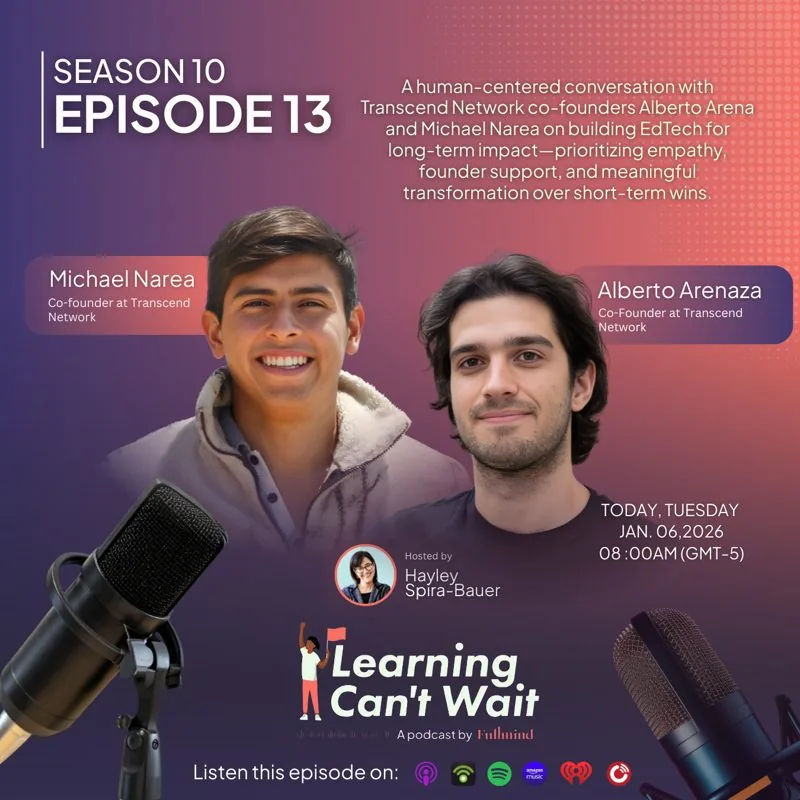
Alberto Arena and Michael Narea: Founder empathy, Global EdTech & Long-term vision
- Alberto Arena, Transcend Network co-founders
- Michael Narea, Transcend Network co-founders
 Hosted by Hayley Spira-Bauer, Chief Academic Officer at Fullmind
Listen now
Alberto Arena and Michael Narea: Founder empathy, Global EdTech & Long-term vision
Episode summary
Michael Narea and Alberto Arena, co-founders of Transcend Network, describe building a global community and fund for early-stage education founders. Michael explains wanting founders' souls nourished for multi-decade journeys, and Alberto credits his Minerva University experience with showing that people can simply build new institutions. They recount meeting at a Redwood City incubation lab, explain how their intentional onboarding, six-week fellowship, revenue cohort, and first-check fund work together, and share what founders need as the cost of building falls toward zero: belief, partners who can be trusted, and deep empathy for the users they serve.
Key takeaways
- Founders need partners who nourish their vision for 20-plus years, not just capital or consultants
- Global diversity brings data points: India's lightweight community-first building, decades of U.S. choice debates
- As building costs fall toward zero, belief and support matter more than money or skills
- Failure to find product-market fit is often a failure to empathize with the user's daily reality
- Before writing code, deliver the transformation by hand and check if this is a decades-long commitment
About this episode
This episode of Learning Can't Wait features Transcend Network co-founders Alberto Arena and Michael Narea in a deep, human-centered conversation about what it really means to build in EdTech for the long term. They describe their own journeys—Michael seeking a true “co-pilot” for multi-decade visions, and Alberto being shaped by transformative opportunities like his experience at Minerva—and how these led them to create a founder network that prioritizes soul-nourishing support over short-term wins. They explain how Transcend’s highly personalized onboarding, six-week fellowship, revenue-focused cohort programs, and early-stage fund are all designed to help founders clarify the transformation they want for their users before obsessing over features, capital, or growth hacks. Throughout, they emphasize empathy, global diversity, and the rise of end users (like teachers and school leaders) as founders, arguing that the future of learning will be shaped by humble, collaborative builders committed to decades-long impact rather than quick exits or yet another tool in an already overcrowded tech stack.
Full transcript
Transcript generated from the recording; minor errors may remain.
Hayley Spira-Bauer: Welcome back, everybody, to the Learning Can't Wait podcast. I am thrilled to introduce two guests who are well-known in this space for their impact on early-stage organizations. I'm excited to welcome with you all Alberto Arenaza. Oh, see, now I'm gonna need you to say it again, Alberto. Can you say your last name one more time? Alberto: Alberto Arenaza is fine. You can… however you say it, is gonna say that. It's okay, I… It's okay. I'm excited to welcome Alberto Arenaza and Michael Narea, the co-founders of Transcend Network. Welcome to both of you.
Michael Narea: Nice. Happy to be here, Hayley. Thank you. Alberto: Thank you for having us.
Hayley Spira-Bauer: You know, the two of you have a really good bird's-eye view of a lot of what's happening in EdTech and the future of learning and work. I'm thrilled to be able to ask you a lot of questions, both for my personal interest, but also for the interests of our listeners who I know are watching this space evolve. And really adapt to emerging technologies, changing funding sources, and a whole bunch of other factors. So, I'm gonna jump right in by starting with you, Michael. I want you to tell me, for you personally, how did you come to be the personal and professional version of yourself?
Michael Narea: Yeah, I, I think… I'm 34 now. In earlier years, I was always trying to be innovative, a lot in the learning world, starting different companies, and… I don't think I really ever found A group of people. Who were really nourishing the visions that I wanted to bring into life, or that my co-founders wanted to bring into life. And… there were a lot of investors, there were a lot of supporters, a lot of consultants. But who is really that co-pilot that was gonna go on the journey with us for 5, 10, 15 years? So I experienced this as a founder, I experienced this as a co-founder, even as a program director of an incubate… incubation lab. And I think that's what kind of inspired me to join Alberto in starting Transcend Network, was, like.Founders deserve better, and they deserve for their souls to be nourished and supportedas they go on probably what's becoming a multi-decade journey going forward in this space. I think we're gonna have a lot less Short wins, and people committed to 20, 30, 40-year visions coming to life. So yeah, that's kind of how I… I think I've always been thinking longer term in this way, and I feel like the market's finally ready for me to fully step into that. That mode.
Hayley Spira-Bauer: I have to say that's really a beautiful way to frame a conversation about building things. It's not often what you hear, and I think that's… if I may be so bold as to say, I think it's one of the reasons why people respect and admire, and really, like, look out for what's coming from Transcend Network. That is such a, like. We talk in education very often about the whole child approach, and you're applying that same idea to founders, which is really, really unique. Thank you for sharing your framing of it. Alberto, same question for you. How did you come to be the personal and professional version of yourself? Alberto: Yeah. I think for, for me, sort of… alberto: I mean, different stories, but, alberto: Maybe lending on some similar values in how we approached alberto: Relationships with folks, particularly founders, right? Alberto: I felt like I went through… alberto: Personal experiences that were really powerful for… for me and my… in my journey, and… alberto: The people that supported me, the opportunities that alberto: that allowed me to become who I am today are things that I think about alberto: very often, right? And I… I want to make sure that through our work, we're supporting founders who are creating those types of opportunities for others, right? We see a lot of founders that are… alberto: Have very clear visions for the work they want to do, and alberto: What we found to be the strongest alberto: indicator of that sort of impact they want to have is when they have a clear vision for where they want to take their customer. Let's say they might be designing for a teacher, for a parent, for a specific learner, and they know where they want them to be, and what they want to experience. Alberto: And when we see founders like that, you want to see them succeed, and you want, alberto: we want to, sort be that role that Michael was describing, supporting them alberto: to really bring their vision to life. A lot of the other things around what type of capital they raise, what type of technology they build, it's more of a… alberto: question you can figure out later, right? But I think starting with that vision, that's something that's very important for both of us, and I think alberto: I may have shared this with you in our previous conversations, but I was a student at a university called Minerva that was started about 10 years ago or so, and that personal experience for me was very, very impactful, and alberto: there's this sense coming out of it that you can just build things, you know? You can just go and start a new university, and what would the world look like if we allowed thousands of people to build those types of experiences? And so, that's a big part of what we're trying to do at Transcend, is, like, open up the vision alberto: Have a greater ambition around how many founders can alberto: build their own visions, and it doesn't have to be one over the other, right? It doesn't have to be, like, only one vision will really come to life. So, that's. Alberto: I think a big part of… alberto: How we ended up doing this work. Yeah, I did some research on your university that you're referring to, and I think it's really cool in that when I ask folks on this podcast how they came to be, sometimes they say, I had a terrible experience in school, and I knew it could be better. And other times they say, I saw what was possible, either that I experienced or someone else did. And both framings can allow you to come to the point of ingenuity and innovation. But it's really amazing that you had that picture for yourself. Now, I'm curious, Michael, can you talk us through how the two of you met? Like, where's the beginning origin story for your relationship working together?
[05:00] **Michael Narea:** Yeah, 2015, I took a director role at an incubation lab in Redwood City. We had 60 education technology companies going through that lab. And Alberto was at Minerva at the time, And we hosted… the whole class, for a day at, in Redwood City. To… it was a design day where we actually looked at, can we build a better innovation lab from first principles? So we had, like, 30 Minerva students there, coming up with ideas. Co-building together. And… yeah, I think that's where Alberto, we met for the first time. And you just had a lot of really good questions coming from a very sincere place, pretty… pretty open into how you were wanting to build relationships in your time at Minerva. And then, we kind of kept in touch. I flew… I saw Alberto in Seoul, in London. In different cities that Minerva was traveling to, I would always find a place to visit, and Honestly, was very curious how the mines were evolving as they went through that pretty global experience as a community.
Hayley Spira-Bauer: You're all… oh, Alberto, do you want to jump in there and add some color to that? Alberto: No, that's it. That was the story. We stayed in touch over the years, and alberto: I think it was in 2018, that Michael was in London, we… alberto: got breakfast, I think, and we started thinking about this stuff that we were… alberto: Thinking about, and we're excited about. Alberto: And we… alberto: sort of identified there was a… an area of overlap that hadn't necessarily been as clear before, and that was that there were a lot of startup founders that Michael was working with more on an operational perspective, that in my mind, I was trying to, like, make sense of more alberto: At a high level, in terms of the trends, and mapping out what was happening in the space, and that we both saw alberto: different ways of supporting them that was more ambitious than what was out there, and didn't… alberto: really understood what it was going to look like until, I think, over the next year and a half or so, started, kind of slowly shaping it, talking to different people. Alberto: And, yeah, and then around late 2019, early 2020, that's when we started Transcend more, more formally. So, it's been almost a decade now. You both have touched on a little bit about how you two were very global, meeting each other all over the world, but what is really interesting as well is that you're largely considered, like, the most global founder network, and that has been a really core principle of yours since day one. How has global diversity shaped your approach differently from other Silicon Valley-centric accelerators? Either one of you can jump in here. Alberto: I mean, I'll just share one quick thought there, and it's that, alberto: a lot of the conversations and trends that might be present in the US K-12 system, there are countries that have been thinking about a lot of those questions for decades, right? And the other way around as well. We found in the early days of Transcend that alberto: India was a country that had a lot of stuff figured out on the technology side, and that we actually learned a lot from Indian edTech founders who were starting alberto: with very light approaches to entrepreneurship, we're basically setting up a Discord, building a community of users, and basically building a product around it. Alberto: And then other trends, like maybe homeschooling or, school choice that are maybe emerging now in other parts of the world, those have been, alberto: in the conversations in the US for decades, right? So, I think it actually opens you up to alberto: a lot of… New data points that might inform alberto: yeah, kind of our thinking by basically taking interesting data from different places. So I think that's… to me, that's one of the wonderful… alberto: Things about being able to see so many different visions from different parts of the world. Alberto: How about you, Michael? What do you see, like, on the global side?
[10:00] **Michael Narea:** Yeah, I mean, I think if you go to… let's say. My family's from Ecuador, so I just… I'm spending a lot of time there now, and… you talk to my cousins or their friends, and it's like, everybody's very entrepreneurial. Like… They're just doing it in the means that they have access to, or that they, like, know that they can make work in their local city. And with the advancements of technology, internet, AI, etc, global connectivity.That entrepreneurial energy can come from any zip code at this point, and we're gonna probably live through the next 10 years of millions of founders probably coming online with their work they already have. And it's gonna be very interesting to see what that global marketplace looks like. As that happens. So that's what… that at least was my motivation for the globalness of, like, this is not just gonna be a big city, transformation, this is gonna be… Every single place on the planet, every single human will either by economic force need to be a founder, or they will choose to be out of privilege to be…
Hayley Spira-Bauer: You're painting a really exciting picture for the future, Michael, of what the next 10 years could potentially hold in terms of innovation and acceleration of, you know, product creation. I'm curious if you could walk us through right now, let's say you all are going to be very busy in 10 years. And I know you're… I know Transcend Network will have evolved then, but in current form, what does a EdTech founder experience when they're part of the network?
Michael Narea: Yeah, currently today, or… or… yeah, you're talking about currently today, I believe. That was the question, Hayley.
Hayley Spira-Bauer: Yeah, let's, let's do today, right? Like… Yeah. Yeah, of course, of course it will evolve in 10 years.
Michael Narea: Perfect. So I think someone kind of discovers Transcend Network through one of our partners, through maybe someone like you, Hayley, be like, yeah, if you're thinking about starting something, you should talk to Michael or Alberto. Like, definitely, just have a call with them, see what happens. That's usually what… what happens. So, me and Alberto probably speak to 8 to 10 new founders every single day. And… then they meet… if they meet Alberto, they'll meet me, then they'll meet our operations officer, Penny, they'll meet our partner, Tom, they'll meet all these different people. To see… What is the right next step for you, your soul, your vision, and your business? I don't think any of us make decisions on how to support a founder in a silo. We're texting each other every single day about what we believe this founder needs. And then as we speak to the founder and deliver to them what our beliefs are, they co-build with us their path at Transcend Network together. So, I emphasize the intake and how they joined Transcend Network, because I think without that intentional onboarding that is slow and really listening to each other and not rushed. I don't think you have a thriving experience in Transcend Network for themselves, but also the community. So, very intentional onboarding, and then you join our fellowship, which is 6 weeks, going over the fundamentals of how do you run one customer experiment a day to find product-market fit. And then, now we take people into… Actually, let's get to six figures of revenue together over the next four to five months, and that's a cohort program that we rolled out this quarter, and we're doubling down on next year. And then Alberto, you want to speak on the fun dynamics in our work? Alberto: So, we also manage a fund, the Transcend Fund, which alberto: Allows us to write the first check into companies that are, alberto: those early stages of, finding attraction, developing their vision for their customers. And so, our view is that by working with the founders more closely through our founder programs and within our community, we can get to back them really early, and it's a bit of a… alberto: Flipped model, in that it's unlike we're, kind of. Alberto: running an accelerator program or a fund where we're, like, waiting for people to reach out to us. We're actually working with them, trying to get them to kind of get closer on their… closer to their vision, to their problem market fit. Alberto: And when they're making progress, and there's a… there's sort of a conversation around what is the right alberto: funding for you as a founder, and when there's a fit, we can basically explore if there's an investment opportunity there. So, it's one of the ways in which we can partner with the founders.
[15:00] **Hayley Spira-Bauer:** Again, there's an emphasis that goes back to the personalization. It doesn't sound like there's, like, a one-size-fits-all approach. Can you tell me a little bit about… how you two have evolved your specific roles. I know you just touched on it briefly here, but in the beginning, I think you both were doing everything. But that is also not a scalable or sustainable model, so if you could talk about your learnings and how that's changed your current operations, that'd be really helpful.
Michael Narea: No, that's a great question. I think right now, we're at a time where I, am… Managing and developing a lot of the founder support and development that happens with the founders in our community. And to do that, we can't do it alone. We're working with A few different partners that are really helping us develop the founder's vision, market positioning, transformation, and then how do we get to six figures of revenue together? And then Alberto's been really taking lead on the fun side of our work. Alberto, if you want to add more color there? Alberto: Yeah, I think the… that's completely right. The one thing I would say we keep in mind as we build out the network is that, alberto: We try to make sure that it's all connected, and it doesn't feel like there's a disconnect between the fund and the programs and other partnerships that we're developing. Alberto: Because I think at the core of it, there's certain values around how we want to support founders that, yeah, like, need to be at the center of everything that we do. And so, it's not, like, on the fun side, Michael's not, sort of working with the founders, or, like, making investment decisions, or that, alberto: I'm not involved in the founder programs, but it's more like, we're now focusing a little bit more so that we can invite the other one in as well, and we can… alberto: Take more of a clear direction with the roles and the vision for each.
Hayley Spira-Bauer: So what are founders saying, right? We're in a really unique time, in that, as you mentioned, rapid proliferation of technologies, we see the actual tools that are coming to market very differently than we did 5 years ago, and the funding source for these edtech companies has really evolved, to put it as neutrally as they possibly can. What do you hear from the founders right now? We're closing out 2025 when we're recording this, it's being released right at the top of 2026. Would love to hear your perspectives.
Michael Narea: I think they really… Are looking for people that actually believe in them, and want to nourish their souls. Want to see their vision come alive. They won't tell you that.
Hayley Spira-Bauer: They're not as evolved in being articulated, or they're not willing… they, like, don't identify it in themselves yet.
Michael Narea: I think you go to a conference, and it's all about pitching ideas, it's about impressing. But when you get into minute 15 of a one-on-one about a vision that they've held dear to their hearts for many years and have not taken the step to birth, and they're about to. It's very sacred. Very sacred time. And… I think Alberto and I and the team get to live in that space with them 8 hours a day. And the things they say, and what they actually need. Are oftentimes very disconnected from what the market is offering to founders in support. And I think in a time where the cost to build something is going to zero. It's going to be very interesting who is actually there to support founders in the next few years. It might not be the capital that's needed. It might not even be some of the skills that are needed. It's like, maybe they just need to be believed in. And… supported so that they don't sell out too early when they get pressured to… is what I would say. Alberto: I think one way in which that, dynamic plays out is… alberto: If you ask any person who's in… alberto: a user of technology, they will say that the volume of alberto: Inbound emails they're getting, the volume of tools that they're using on a given day, Has exploded, and… alberto: I think there's a sense of, like. Alberto: why? Like, I don't… I don't know that there has been a sense of, like, yeah, my role has really been transformed because of these tools, or, my… alberto: my day looks very different than it looked, I don't know, a decade ago. And I think it's a question that's worth thinking a lot about as we think about alberto: basically, as Michael was saying, like, the barriers of entrepreneurship basically being lowered, does that mean we're gonna have 10 times more inbound in the next decade, and we're going to have the same realities on the ground? That sounds like a horrible scenario.
[20:00] **Hayley Spira-Bauer:** Squeak, squeak. Alberto: And I think there's something we have to think about in terms of, you know, what is the process that a founder goes through to define what the product does and what they stand for, so that they're building something that is actually connected to alberto: the daily challenges, and the daily experience, and the daily language of their customers. So that those products actually alberto: do more, right? And, I think a part of what we've been seeing over the last few years is that more of the end users are becoming founders, as opposed to just technologists, right? And I think that's a very democratizing, alberto: motion, right? So if, as a teacher, you can go and build whatever product you're struggling with day-to-day, alberto: I think that is going to be a much better world, because it's very likely that other teachers are experiencing it as well. Alberto: and I think what we want to make sure is that those… alberto: Next generations of builders are building things that are relevant to their alberto: Customers, and something that is actually alberto: Sort of transforming them in a meaningful way, as opposed to being another add-on to their long list of alberto: products they're using. I get excited by that, because very often in education, you can think you're solving some of the most important problems, but reality, those aren't the problems that leaders, teachers, students are actually facing. They're perceived problems. And so it really gives me a lot of enthusiasm for the future of the space to think. About end users being the ones creating… having access to create tools. Just using your premise of supporting and nurturing the founder, I'm actually curious what qualities of a founder from each of your perspectives really help folks to succeed. Like, what are some attributes, or some personality traits, or, you know, soft skills, so to speak, which I think is, like, an infantilizing term, but I'm gonna say it anyway, that you see in successful leaders?
Michael Narea: Yeah, I think the number one we've been seeing this year has been this… well, from my standpoint, no, we're all curious what you're seeing, this openness to… Partnership and co-creating the future together with others. I think… In a lot of startup cultures, there's this, like, dominate, winner takes our mentality. And I think the founders we've been most successful with partnering with have been… very humble, like. I'm just trying to bring this vision to life. And I don't want it to be crushed. So… They're oftentimes very protective of what they're trying to birth into the world. Rightfully so. But I think if they know how to qualify, who is a really good partner to them and their soul, and isn't. They will be really successful. I don't think there's a school in the world that teaches people how to qualify that, like, who should I be surrounding myself with and not? It's oftentimes we're all on that lonely journey doing it, and I think we're kind of… I want to see that culture shift into, like, can that just be the open conversation in… around the founder of, like. Are these the right partners for you, and what have you done to qualify that they are the right partners for you?
Hayley Spira-Bauer: Alberto, I see you ready to jump in and share. Are you in agreement with Michael here? Are you seeing something similar, or do you diverge a bit? Alberto: Hmm. Alberto: I think I'll highlight what feels, alberto: kind of an important trait or skill. I guess it's connected in that, when you think about alberto: Product-market fit, or finding… basically building something that is relevant to a founder… sorry, to a user. Alberto: I think there's… there's a question of, alberto: empathy, almost, like, kind of the failure to find proper market fit can sometimes be essentially, like, a failure to empathize with what exact problem, alberto: The user is experiencing. Alberto: And… I think it's a… It's an understudied, alberto: theme or skill. In other… like, in social sciences, for example, like, if you look into, like, at… alberto: Anthropology, for example, like, there are very clear playbooks on how to actually listen and interpret the signals that someone is telling you how to actually embed yourself in a certain, community or in a system. Alberto: To really be able to alberto: understand, from your limited exposure of the… of their world. And for some reason in… alberto: entrepreneurship, it almost feels like it all needs to be, kind of reduced to a… alberto: Quick survey, an MVP, and a… alberto: I don't know, a pitch deck, right, that you sort of slap on the… on your website, and I feel like there's a deeper work of empathizing with the user that alberto: almost always leads to more human products and more human approaches. Just to give, like, a very specific example, we see a lot of founders that are not clear on what their product should be. They have a little bit of traction, but it's not quite alberto: enough, for them to feel comfortable that this is the… the way. There's a tendency to say. Alberto: Go build that feature, like, try different growth hacks, different, things that will… make you find… alberto: One, sort of, nugget of growth. Alberto: One of the things we encourage founders to do is, like, to really listen to the community that they're building for, and actually not focus on the product at all, but really alberto: think about what challenges they face, what transformation they want to go through, what is the change that they want to go through as an individual, right? So we were talking to a founder last week who has been really studying and, like, embedding herself in a lot of school alberto: leaders' worlds. And, alberto: She realized that a lot of the school leaders she was speaking with are stuck in a cycle of compliance, and they're just checking boxes, and… alberto: that they actually want to be seen more as coaches and as leaders, right? And that type of transformation, is a very, very insightful alberto: early nugget of empathy, because it helps you understand where your product can take the customer, and I think, I would say that would be the skill that I… alberto: I think really matters for early-stage founders. It's to understand who they're designing for, understand what alberto: Transformation they want to go through themselves, and try to build for that, as opposed to finding the one specific feature they should build, or this specific growth channel, you know. You two bring such a human element. To this work in a way that feels so authentic, and, like, really makes my, like, makes my heart so happy. Education is such a delicate part of our societies, it's like a… necessary component of how kids grow, but can also be something that really allows children to thrive. And EdTech is just one component of that, and so it gives me a lot of hope hearing how you're supporting all these founders and the future of what's being built for schools today. My final question is always an iteration of the same question, and my… and you've answered it in different ways and shapes, but I'll let you sum it up in one sentence. Michael, how would you… what would you advise an EdTech founder who's just starting out right now?
[29:00] **Michael Narea:** Yeah, I would say… the… Before you talk to one customer, really check in with yourself. What do you want to build for the next 30 to 80 years? Is this… is this it? Is this that decision? Because if you're gonna build in the learning space, and that's not your perspective. I think you run the risk of creating a lot more noise than value. And when you start to do business and get traction and customers. You really need that grounded connection to a long-term impact you want to really have. To make the right decisions for yourself and the people you're serving, so… I would say check-in. Like, is this really… Something you want to spend decade-plus, two decades working on, because that's what the journey is going to ask of you. Alberto: I can share… I can share my… my one piece of advice for a founder, and I think he'll be connected to that, which is that alberto:Before you build a product, try to think of a transformation that you canSort of. Alberto: Support for the persona you really want to Design for and empower. Alberto: without writing a line of code, right? So, if you're serving students, and you want them to feel interested in alberto: STEM through project-based learning, right? Before you build a product that does that? Alberto: try to find, I don't know if, like, other kids in your local school, or in your, like, among your friends who… alberto: you can… I was like, have them go through that experience without any technology, because there's something that alberto: It's very powerful about that human moment. Alberto: That will probably motivate you as a founder to keep going when they go and get stuff. It will also give you a sense of whether this is alberto: What you want to be doing, and it'll also give you a clear direction for what should your product alberto: make them feel, right? Perhaps you're going directly into alberto: project, when in reality, what they need is to actually feel confident that they're able to even start a project, instead of finding them a project that is ready to be started today, right? And oftentimes, that alberto: Those insights come from actually doing that alberto: as a… as a person. So, that would be my… my one piece of advice.
[32:00] **Hayley Spira-Bauer:** You both are such heartening folks. Like, listening to you share and knowing that so many founders are getting the same messaging and much more, is really, really, really inspiring. Thank you so much for coming on the Learning Can't Wait podcast.
Michael Narea: Thanks, Hayley. Appreciate it, and excited to see where this podcast and your expression goes in the coming… in the coming year. Alberto: Hayley.
Hayley Spira-Bauer: And thank you to everybody who tuned in today.
Michael Narea: Bye-bye.