
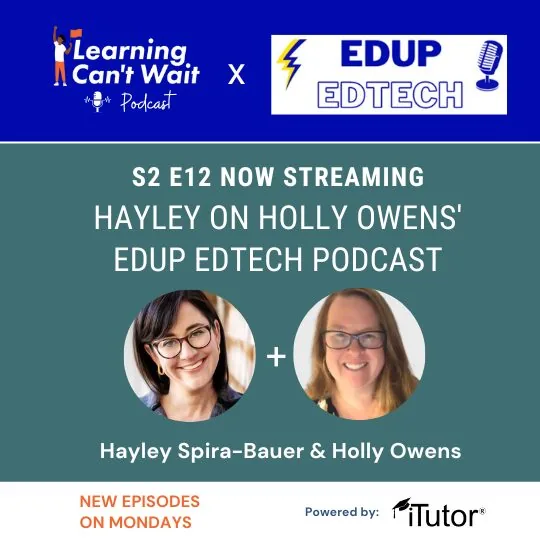
Learning Can’t Wait · Season 2, Episode 12
Hayley on Holly Owens’ EdUp EdTech Podcast
 Hosted by Hayley Spira-Bauer, Chief Academic Officer at Fullmind
Listen now
Hayley on Holly Owens’ EdUp EdTech Podcast
Episode summary
A crossover episode: Holly Owens of the EdUp EdTech podcast interviews host Hayley Spira-Bauer, chief academic officer at iTutor. Hayley traces her edtech awakening to a BrainPOP focus group at a Harlem middle school, credits co-teacher Lynn with teaching her to let a student solve a problem alone, and defines edtech as tool enablement that supports instruction. She describes iTutor's services, from virtual certified teachers and high-dosage tutoring to homebound instruction and special education staffing, argues that under-resourced communities have always faced shortages, and insists the future of edtech must put equity first.
Key takeaways
- Edtech is tool enablement to support and supplement instruction in and around the school building
- Trusting a student to free their own stuck hand changed how Hayley teaches and parents
- Historically marginalized communities have always had a teacher shortage; the pandemic exacerbated it in pockets
- Virtual certified teachers let rural schools offer courses like Mandarin and ELL support they cannot staff locally
- Equity must sit at the front of every edtech conversation, not as an afterthought
About this episode
In this episode, the Learning Can't Wait Podcast features a special guest host Holly Owens', host of the EdUp EdTech Podcast. Holly chats with Hayley Spira-Bauer about how iTutor’s team of educators, administrators, operators, and international professionals unite around supporting all learners. iTutor provides the educator support institutions need as this sector continues to mitigate teacher shortages.
Time to tune in!
Learning Can't Wait is brought to you by iTutor.com.
Full transcript
Transcript generated from the recording; minor errors may remain.
This week on the Learning Can't Wait podcast, we'll be listening to an episode of the Ed Up edtech podcast hosted by Holly Owens, which aired on November 2nd, 2022. In this episode, Hayley will be interviewed regarding innovative approaches to education and solutions for dealing with teacher shortages, and now the Learning Can't Wait.
Podcast.
Welcome to the Learning Can't Wait podcast, an IDER production at iTutor. Our vision is to ensure every child has access to education regardless of stance. Each episode, we will be joined by Pathfinders within and around the education space who are bringing about transformational change on behalf of.
Students. Hello everyone and welcome to another fantastic episode of Ed Up edtech. My name is Holly Owens and I'm your host. And today we have one of my very best buddies, colleagues, we're all the things we have. Hayley Spra Barra, who is the CAO, the Chief academic officer of iTutor in the Room. Hi.
Holly, thank you so much for having me on today. I'm excited and you can tell me if I burchard your last name cuz I get so excited and I I have it in my head and then I say it wrong. Well, given I host a podcast, I can empathize with this deeply. . Yes. Yeah. It's Spira-Bauer. Okay. We got that. Not nearly as easy as Holly Owens.
And even sometimes people pronou wrong, which is fine. And actually had somebody ask me if I spell my name H O L l E y yesterday, which is the first time I've ever heard that. Weird. Oh yeah, that's different. Yeah. Yeah. So finally, you're on my show and I'm excited to have you here. So I want you to tell us about your journey into the edtech space.
Give us all the de. It's funny, as I was thinking about this question, Holly, because when does the journey really start? It's not when you start your journey into the career or the job that is defined as edtech For me, I can tell you the moment when edtech blew my mind. I was at a charter school, middle school in Harlem New.
And this little company that you may have heard called BrainPOP, which was, you know, just a absolutely no brain . This little company called BrainPOP was doing focus groups in schools all over New York City, and my school was chosen to do one of the focus groups, and I recall sitting in the focus group and thinking to.
Holy bananas. This is an incredible game changer for how my classroom will look and sound. And it was so as a teacher, I was teaching fifth grade reading at the time. I was able to integrate different points of view, different presentation of content, do more interactive quizzing and assessment, which we now.
Often call formative assessment in the classroom on content that I was teaching in a way that was not possible previously, or that I wasn't aware was possible previously. This was like your first foray. You said edtech focus groups and ed techs reaching out to you. I remember the BrainPOP, the flipper, the cards, yes.
That you had. Yes. Which now it's really common to see that integration of flip cards and studying tools, but at the time that I was doing it however, many years ago, it wasn't, and my classroom was enabled by tech, but not edtech rich. So I think that was my journey into edtech and that's like my very first memory of edtech being a part of my path.
And ever since then I have had my eye on what was going on, what was available, what was something that either I or the teachers I supported as an administrator could integrate until I finally decided to make the leap from school-based learning to virtual learning myself when I. ITutor five and a half years ago.
So my journey was much like many teachers who transition. I used a tool, I got fascinated by it. Either I went to work for that tool directly or something adjacent in a manner that I thought could make teaching easier. And ultimately, I mean, we'll probably talk more about why I do what I do at some point in our chat.
But yes, I, I do it because I think. Where I work today has the capacity to expand school's capacity and make teachers' lives. This is why we're friends and buddies and colleagues is because of the way you talk about edtech is the same way I feel about it. And making a life easier for those educators in the classroom and finding innovative ways to engage the learner is so important.
And having that open mind. And we both have definitely drank the edtech Kool-Aid for sure. Yeah. And I think like I will be candid, I have a critical, critical opinion of everything I do in education. Yes. And we started our conversation by talking about someone else that has a critical view and that we respect that critical view.
Mike Yates, and just gonna name drop that conversation. Yeah, we're gonna shout him out. We love Mike. Okay. Both of us think that he has a really critical view of what's happening in education and personally I think that even. Edtech as it explodes in 2022. We have to be tempered about how we let it explode and how we as the kind of purveyors of what's good in the space, keep a critical eye.
Because if you're not questioning it, then you probably are just following too much along on the path. So I am a huge proponent and I have a really critical eye on how the space is changing. Right. Absolutely, and I 100% am on that same path with you. Like the shiny new tool isn't always the best thing to implement if you don't know how it impacts your students or how it's going to impact the curriculum.
So you definitely have to have that critical eye as. Well, so you've shared a lot already about your journey and I even learned a few new things about you sharing that. But I wanna know from you, do you have a favorite education quote or, and or you can say anybody shot them out, who has inspired you along the way?
Yeah, absolutely. I have a lot of people who have inspired me along the way to be a better educator. I have one story that like really struck me, and it has changed my perspective as an educator, but also as a parent. So I had a co-teacher when I was teaching first grade at in elementary school. Her name is Alexandria Lynch.
She went by Lynn and we had a phenomenal year together. We learned a whole lot from one another, watched our students grow. And really transformed what we thought was possible for ourselves and for our students in the span of 10 months, which was incredible. Wow. That's a very short amount of time. I know.
Education world. Well, her and I had a shared vision about what community should look like in a classroom, and that I think was the core of it. And I have this one story, Holly, that I have to share. Will you share? Yes. I don't know if this is gonna, I hope this translates Paul. Our student was playing and got their hands stuck in the back of a chair, and it was free playtime.
They were doing centers and they got to choose their centers and do their activities. And Lynn and I were debriefing, one of our lessons for the day during this time as we were about to circulate through the centers. And we both saw the student get their hands stuck in the chair and I leapt up to help.
Get their hand out of the chair and Lynn put her hand on my shoulder and said, let's pause a beat and see what happens. I don't know that we ever debriefed that moment, but that changed fundamentally, how I was as a teacher and how I now am as a parent in just the level of trust she displayed for that student to solve a problem independently.
And they did. They got their hand out, and let me tell you, they never did it again. But that person, Lynn, has really inspired me and changed a lot of how I view education and parenthood. Oh wow. Watching them try to figure things out for themselves and get themselves obviously outta sticky situations. Is something that's so difficult for an educator to let go of cuz you feel like you have to be there to support them.
You're showing them how to be a good human and help others and, you know, difference between right and wrong, all those things. I would've, I don't know what I would've done in that situation. I would've been so scared about the student breaking something Right. And, and getting. It's hard not to like let your heart bleed it.
It did bleed. But what that moment showed me was if they learn how to get out of that situation themselves, one again, they won't do it again. But two, they've developed some new problem solving technique and ultimately that's what we want. We want critical thinkers in this world who are able to navigate challenging situations and ultimately ask for help when they.
The kid hadn't asked me for help, Holly. I just, I know. That's crazy to me. Cuz I would've been like, I'm, I myself, I know as a younger child, I would've been like freaking out. Like, please help me get this out of wherever it's stuck in. Goodness me. . Right. Well, I'm glad to hear that you did have that wonderful experience and you had Linda help you along the way and she continues to inspire you.
That's wonderful. It's always great to have good mentors or good partners in what we do in education. So as an EdTech guru, as I consider you, cuz you have a podcast too, and you talk about a whole lot of different things, so don't forget to mention that. How would you personally define educational technology?
Yeah. You know, I do have a podcast and Holly has been on it. It's called the Learning Can't Wait podcast. You're prompting me there, so I'll definitely name it. Yes. You can listen wherever podcasts are distributed. , how do I define edtech? So,I define ed tech as tool enablement to support and supplement instruction.
In and around school building, which is broad, I think. Yeah, definitely broad. You know, every time I ask this question, I get a different answer from every guest. I think that's part of the problem. Yeah. , right? Yeah. It's, it's everybody has, like, you know, some people have skewed your way and been more broad.
Other people have skewed very specifically in giving, you know, concrete examples or situations in which edtech has been used as inside, outside the classroom. It's really different every time. It's interesting. I feel like I, I need to do a. Paper on this . There are some people trying to wrangle the definition and dialogue around edtech.
They haven't landed yet, like they haven't arrived in that. So a paper by Holly Owens is probably pretty warranted. Yeah, let's add about 12 more hours in the day. Yeah. In your sleep time. . Exactly. And I would say the same thing about you. Let's add about 12 more hours in our day and then maybe, or if I just happen to become a vampire overnight and don't need sleep, then we'll be good
Yeah. That's not, that's not me. I definitely need my sleep. Yes. Love the sleep. So let's get in the eye. Let's tell us about it. I know about it cuz we've conversed many times, but tell the audience, what's iTutor? What services, products, what do you offer? How do you help institutions and organizations and education?
Sure. ITutor has been around for nearly a decade. We partner with schools districts to solve pain points with state certified teachers and subject matter experts. So what does that actually mean? I mentioned earlier. The goal of the work that I do is to expand the capacity of teachers in schools. In reality, what iTutor does is it helps to solve the teacher shortage for school districts by supporting them with state certified teachers to teach core subjects virtually when they cannot source a candidate.
Closely. It helps schools to provide high dosage tutoring with fidelity as defined by Annenberg Institute at Brown, after school, three days a week, 45 minutes minimum, a repetitive tutoring with the same instructor live using content aligned to the school day. You'll notice I'm starting to make a list here.
ITutor does quite a bit, yes. Supporting schools around the us but iTutor helps with credit recovery, not throwing kids into an an asynchronous course, but rather using the course material provided by the school or created by the state certified teacher to ensure the student masters the instruction either during the school day, after school, on the weekends.
Home bound instruction student is medically fragile, behaviorally challenged, ensuring they have a teacher for the mandated minimum requirement, hours for their time out of school. Virtual suspension, ensuring there's no lapse in time. When a student does have to miss school for suspension, they can have immediate solutions for schools that are prepared with a virtual suspension room, extra help servicing students with disabilities.
This is one that comes up a lot right now. I. Posted an article from Disability Scoop that the Department of Education has stated. Schools cannot relax licensure requirements and must provide students with disability certified educators even when there's a teacher shortage. ITutor does that for schools all over the us, ensuring that they meet the requirements, provide resource room.
The list goes on and on and on and on. Yes. I don't wanna bore, I don't wanna bore your listeners, but there's a lot of things we do with both state certified teachers and subject matter experts. Solving these pain points give your teachers a support they deserve. With iTutor, iTutor, educator community consists of state licensed teachers across every state who can partner with your staff to provide instruction when they can't After school, late nights, weekends, and summers, our educators got you covered.
Head to itutor.com. Teachers. Well, thank you. Yes, and I think that's so essential right now with what's happening in the education system with teachers. There may be, you know, I've seen articles out there that say there's not really a teacher shortage. There's not really this happening, and then there's the other side.
It's like this huge thing is happening, but we do know something is happening. Teachers are leaving. The the classroom, they wanna get into other positions. We need certified teachers, we need grade teachers to help our students continue to grow and learn. And iTutor there for that. Yeah. And what I can say is thathistorically marginalized communities have always had a teacher shortage.
That is not the first place. Every teacher looks for a job in a community that is under-resourced and socioeconomically challenged. It is exacerbated. Now in this post pandemic society, as we have teachers retiring, we have the pipelines lessening. We have less teachers going into the field than previously.
And what we know to be true is that this shortage as defined by the researchers that have dug in deep over the past few months, the shortage is not prevalent every. It is prevalent in pockets throughout the United States, and there are solutions for that. So what we need to do is lean on innovative approaches to education so that our most vulnerable populations are receiving the same high quality as instruction as less vulnerable populations and schools that are highly resourced.
I'm so glad you mentioned that. If you just think about people that are listening and thinking about your own educational journey, what type of school did you go to? Was it one that was affluent and had access to many resources, or is it one in a rural area you didn't have access to? Many resources I grew up about.
About an hour or so south of DC the, the area that I grew up in, , I mean, it was very rural and we just didn't have access to a lot of resources. There wasn't a lot of money to put back into the school systems. You know, these are like blue collar workers, that sort of situation. So just kind of reflecting on that and thinking about your experiences and then how products like it can come in and help you fill some of those gaps and mitigate those issues so you can focus on what's important.
And that's the. Yeah. And at the end of the day, what I love most about what iTutor does is it makes people's jobs easier, right? We know principals have a very challenging job. We know classroom teachers have more on their to-do list than ever before, so whether it's. Having somebody to share the differentiation load with or it's, you know, I spoke to someone the other day, Dr.
Dennisha Murff from Wayne Township in the Midwest, and what she was telling me is that some of the schools where there are shortages, there's one teacher on smart board teaching two different classes. The teacher's standing in one physical location and then they're not in the other. So that teacher then has a roster of students upward of 60 kids at one concurrent time.
That is a goodness challenge. Very difficult. Even the strongest, most seasons of teachers with the most capable skills are going to be challenged by that experience, and even Abbott Elementary kind of had a joke about that two episodes ago. I love that show, but it's not a joke. There's a real crisis in many parts of America.
That means that academic implementations for students are diminished. Thus outcomes and impact will be diminished as well. And students deserve better than. Yeah, and it really impacts everything. I, when we talk to different people, and I'm, I'm sure you get this too, especially from different edtech companies and different walks of life, like education's, like a universal language for how you're gonna be doing everything within your culture, society, how things are gonna be set up.
If education is failing, what does that look like in society? How does that impact things? What's that look like for our culture? It's just, it's so multifaceted and I think about this all the time, , it's like, it's a constant thought in my head, but I digress because I know that you and I could probably, I was just gonna say, honestly Holly, that's why I think we get along so well.
Cause we know that there is opportunity for improvement and I could talk about that all day. . Yes, I know we definitely need to do another episode about that. But I wanna know also too, in terms of the roadmap for iTutor what's coming up. Approaching 2023, you know, what are some of the goals? What are some things you can share with the audience and talk about without violating any NDA agreements?
So iTutor is in a really exciting phase where we are ramping up our technology and iterating and improving at a really rapid clip, some very, very, very exciting integrations in the coming months that again, just expand our capacity to support schools. I won't name all them yet cuz you know that NDA thing you named a minute ago.
Yes. Folks can follow along on our social platforms on LinkedIn or visit us at itutor.com to find out more about those releases or even subscribe to our newsletters for that information. But really the focus has been and will always be reaching more schools and bringing more teachers into the fold. So there's this ancillary but not secondary.
Function of iTutor, which is that we have a large repository of state certified teachers. We are growing our repository of subject matter experts right now. There's over 1500 state certified teachers on our roster. That number is ever fluctuating and growing with time. And so what we are doing is we want to continually grow that.
We want to continually bring teachers into the fold and subject matter experts, give them other income earning opportunities, allow them to have choice and flexibility in how they spend their time and how they exercise their skills and expertise. And again, having those teachers at the hands and at the doorstep of me schools around the country without geographic constraint, allow schools like yours, Holly, that are super rural.
To offer more courses to their students. Right? You may not have. A Mandarin teacher available in a role? Definitely not down there. Definitely not well. And so schools have that ability. So offering more of those expertise, those certification, those skill sets for students who want to expand their course list or allowing for.
More English language learner certified educators to help accelerate learning before, after, during the school day for students that really are in need of additional support for a short period of time so they can accelerate their language skills and access content. I mean, there's so many opportunities and so in.
Year. It's continuing to expand our technology to allow for more schools to enter our ecosystem and more teachers to be in our repository and help students. Sounds like it's going to be a lot of fun, but also a lot of work to get there. Yeah, the team that I, I get to work with every day makes it both a joy and inspires me every single moment.
I feel. Over the past five and a half years, I have gotten to meet some of the most brilliant people I've ever met, and learned all sorts of things that I never thought I would learn, and really expanded the ability to impact the field of educat. I love it. I absolutely love it. So we're coming up on the end of the episode here.
We've said a lot . Yeah, . We could say a whole lot more. I'm pretty sure you and I could do like a, a part one and a part two and possibly a part three . For sure. So I wanna know from you and wrapping up the episode, is there anything that we missed you, anything else you'd like to share about iTutor yourself, edtech, and then also.
I wanna know from you, based on your wealth of experience, what do you envision for the future of a tech? What does that look like? Yeah, sure. So I would say that in terms of what we missed, I wanna make sure I'm talking about that podcast that I host called The Learning Can't Wait podcast. It could be found at podcast.learningcantwait.com or itutor.com.
If you scroll to the bottom, you can click on the Icon podcast and listen to any of our episodes. We just had Tafshier Cosby on. And next week we're going to have, actually an episode from when I was on edtech Week, followed by an attendance episode with Hedy Chang, Dr. Danielle Dooley. And Oh my goodness,
Yeah, a lot. The name drops a lot. Namedropping. . I know we're definitely gonna put this in the, we're definitely gonna put all your links and everything in the show notes, so it's easily So they could listen to this one and then hop right over to yours. Yeah. Perfect. But in terms of the future of EdTech, I think what it has to be.
I won't make a forecast here, but what it has to be is equitable. And equitable means a whole lot of things. It means access, it means diversity of learners. It means just a whole bunch of things that we could probably spend 17 episodes talking about. But I, I just kind of wanna name thatanybody in this space or anybody considering coming to this space should be thinking about equity at the forefront of the conversation rather than as an afterthoughtor, an expansion or an iteration.
Wow. I'm just gonna end it there. That was so good. . I mean, I absolutely love chatting with you and I can't tell you how grateful I am for having a connection like you and also you being able to come on the show and just talk about your experiences as well. It's really, really fun and I just love that we have this relationship and I'm sure there's gonna be a follow up.
I'm certain too, not to mention, I'll have you back on online. We'll just Yes, we'll have all the places and spaces we can . People are gonna get sick of us, but that's okay. Thank you so much for your time, Holly. Thank you so much for having me. I feel absolutely honored to be one of your guests. Yay.
Thanks for listening to the Learning Can't Wait podcast. If you liked what you heard, please rate, review, and share this episode. Be the first to know when we have a new episode by subscribing wherever you listen to podcasts. If you'd like to be a guest on the show or have a suggestion for an episode, email us at podcast@itutor.com.
Your campus needs teachers now and we've got you covered With over 1500 state certified educators from across the us Ready to serve both your part-time and full-time requirements. ITutor is perfectly poised to virtually meet all your academic needs with live educators in and around school hours.
Learn how today at itutor.com.