
Learning Can’t Wait · Episode 69
Adrian Mim: Math Education, Teaching Styles, Diversity in STEM, Calculus Project
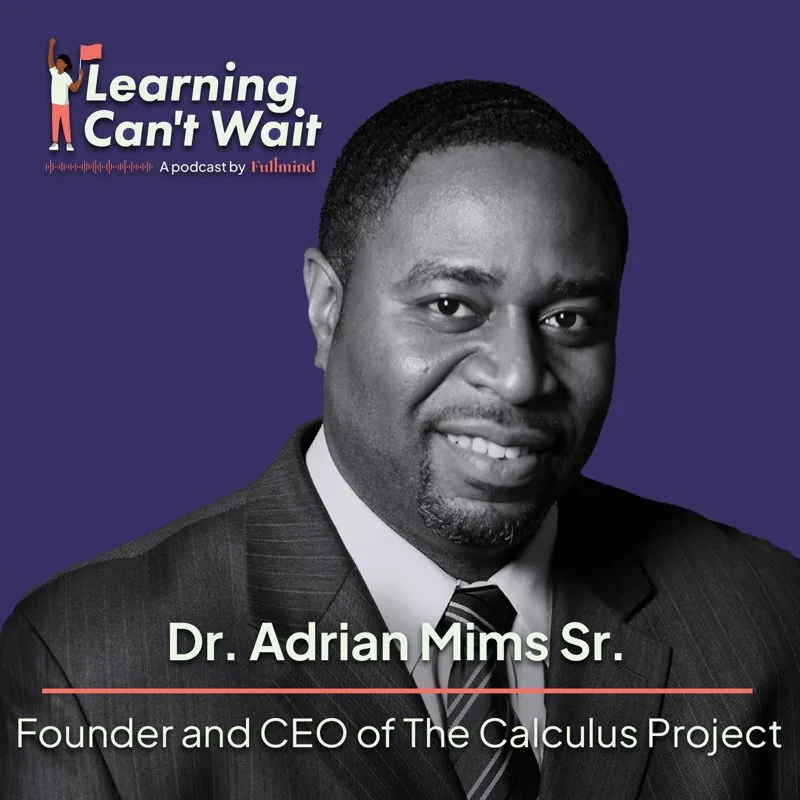
- Adrian Mim, Founder and CEO of The Calculus Project
 Hosted by Hayley Spira-Bauer, Chief Academic Officer at Fullmind
Listen now
Adrian Mim: Math Education, Teaching Styles, Diversity in STEM, Calculus Project
Episode summary
Adrian Mim, founder and CEO of The Calculus Project, explains how his Boston College dissertation on Black students dropping out of geometry honors became a program that pre-teaches content in summer and builds student cohorts for belonging, cutting attrition from 60 to 70 percent to zero in one year. He argues that inconsistent teacher preparation and pay drive shortages, and that schools sort students before they teach them. Calculus matters because admissions use it to sort, half of high schools don't offer it, and remedial courses cost families money.
Key takeaways
- Students dropped from geometry honors for lack of preparation and to stay with peers; summer pre-teaching and cohorts fixed both
- The Pride curriculum teaches contributions of STEM professionals of color so students build math identities
- Teacher preparation varies wildly by pathway, unlike pilots or doctors, and lowered standards worsen the gap
- Calculus on a transcript signals college readiness, yet only about half of US high schools offer it
- Parents can help without knowing the math by having students write questions for problems they can't solve
About this episode
Welcome back to the Learning Can’t Wait podcast! Today, host Hayley Spira-Bauer speaks with Dr. Adrian Mim, Founder and CEO of The Calculus Project. Listen as Adrian explains how curricula is built around white middle class, and how we can work to close math achievement gaps by promoting and practicing inclusivity. Dr. Mim describes why it is important for students to learn about the mathematical contributions of people of color, and shares some of the philosophy behind The Calculus Project.
Finally, Adrian answers the age-old question of what parents can do when they don’t understand their kids’ math homework.
Join us every Tuesday at fullmindlearning.com/podcast. Next week, we talk to Natalie Arias and Kevin Malonson about how opportunity begets opportunity.
Full transcript
Transcript generated from the recording; minor errors may remain.
Hayley Spira-Bauer: Welcome back everybody. I am so excited to learn during today's episode, and I hope you will be, too, from the founder and CEO of The Calculus Project, Dr. Adrian Mims. Adrian. Welcome to the Podcast
Dr. Adrian Mims: Thanks for having me. I'm really excited to speak with you.
Hayley Spira-Bauer: I'm super eager to talk to you. Because I get to talk to brilliant people on this podcast every episode and every time. I learn a lot. But this topic feels particularly right for learning, and so not too much pressure on you. But let's let's dive in starting us off with how did you come to be the personal and professional version of yourself.
Dr. Adrian Mims: You know it's interesting because I'm an educator. I'm a mathematician, but I always tell people I feel as though education chose me because I wasn't planning on doing the work that I'm doing now. I initially aspired to become an electrical engineer. I grew up in South Carolina, attended James F. Byrnes High School, left there. Went to the University of South Carolina with the goal of becoming an electrical engineer changed from a major junior year to mathematics, and then graduated with my degree in mathematics, and didn't really quite know what to do with it. Moved to Boston, and became a math tutor through a program called METCO, which is one of the oldest voluntary bussing programs in the country, might be the oldest that started back in the late 19 sixties. And so I provided math support for students in the program at Brookline High School and also help them out with physics. And in addition to that, I did other jobs. You know, I worked in banking, and I worked in marketing, and I was just really trying to figure things out, and after a few years of doing that I just decided to dive in, you know, both feet first into math education and held various positions at Brookline High School.
Hayley Spira-Bauer: I love the same teaching found me. It sounds like especially given the subject matter that you focused on. Everything was a through line to your deep, profound understanding of mathematics. Would you say, that's true?
Dr. Adrian Mims: Yeah, I mean, I always say that. I've I've always loved math, even though math was hard for me at times, you know. I struggled. My sixth grade math teacher was Mr. Dugan. I still remember all the the names of these people. He noticed that I was really good at math, but I think what really made me focus on being a good student as well was the fact that II grew up with severe asthma, and I was hospitalized a lot. I couldn't play any sports, so I wanted to be good at something grew up in a very competitive environment. So in my math class, Mr. Dugan was a very traditional teacher in the sense that he just gave us a bunch of worksheets. And so I'm looking at everybody's worksheets, and I'm trying to finish them my worksheets before they finished, and as soon as I finish one set of work sheets he's giving me another, and II would walk around the classroom to see how far ahead I was. And so that was my form of competition. And again I had some ups and downs. My, my seventh grade math teacher, you know I struggled a lot learning from her. She was a wonderful person, but it was hard for me to adapt to her teaching style, and then had a great eighth grade teacher, while her style suited the way that I learned. And then ninth grade I had algebra. I struggled there so it was just up and down, but I never really lost the passion and love of math.
Hayley Spira-Bauer: So what you're speaking about here, the delivery method, the teaching style, is often what stymies folks and makes them believe they're not a math person. I know the CEO of Zearn, Shalinee Sharma always talks about how there's no such thing as not being a math person. Do you like talk to me about that notion, and how that really plays into what you've built with The Calculus Project?
Dr. Adrian Mims: You know it's funny you you say that. If you look up the definition of mathematician, it doesn't say someone with a math degree. And so what we tell students is that you are a mathematician. You use numbers all the time. And it doesn't necessarily mean that you have to have a degree. But you know, if you are, you know, for example. Well, I'm trying to think of one that people usually don't think think about a professional athlete professed by athletes. They can be mathematicians. They're constantly looking at their stats, and then when it comes time to negotiate their contracts, they're basing their stats on how to leverage and get more money because of how their stats compared to other players who've signed previous contracts. So that's math. And I think so. Unfortunately, one of the things that has happened is that, because, you know. Curricula in general is really built around white middle class, that too many students in particular, students of color. Don't necessarily see opportunities or see people who look like them in various fields. And as scholars. And I'll give you an example, because one of the things we do in The Calculus Project. We have what we call the Pride curriculum. Where students learn about the contributions of STEM professionals of color so that students can develop a stronger math and science identity. So I always ask these questions when I visit schools, why is it that you're not talking about HeLa cells. And Henrietta Lacks in your biology classes. And if anyone doesn't know who Henrietta Lacks is or HeLa cells, Google it look it up, but also you have. You have Katherine G. Johnson. How is it that you don't talk about Katherine G. Johnson in the physics classes, or talk about Dr. Kizzmekia Corbett and relate the work that she did to address the spread of Covid. And when you look at the spread of Covid it was exponential growth. So there are various ways that we can implement and be very inclusive in math curriculum and just in curricula in general. And so I believe that that's very important to help students, you know, envision themselves as not only learners, but also as mathematicians or STEM professionals.
Hayley Spira-Bauer: It's such an important call out because it's a it's a theme, right? So, as you mentioned, the curriculums that are primarily implemented were created for one subsection of the population, white middle class individuals and also the curriculum and the programs that were built to train our teachers. And so there's this up leveling of professionals that's required to ensure cultural responsive practices both in teaching content and in supporting learners. Social, emotional needs in a, in a curricular environment. You know, before this call you you named that math instruction is really focused on improving math. Instruction is really focused on curriculum right now. But you have feelings about that. What are your feelings about the movement to lift math instruction via curriculum. And if you're not feeling super positive, spoiler, alert, what is the route that you think we should, as a United States be focused on for our students.
[07:00] **Dr. Adrian Mims:** Yeah, I mean, when I think about math curriculum. If it was as easy as just saying, Hey, we really need to try this new math curriculum, I mean, think about it, you know. Here we are, 2023 we're still trying to figure out ways to improve learning outcomes, and if it was as easy as developing robust curriculum, I mean, given the genius that we have in this country, we would have solved this problem a long time ago. We the the problem in terms of how to improve education. It is extremely complicated and and multifaceted. And so I can probably talk about just this issue, the rest of the. Podcast so I try to be as succinct as possible. Give you one example. Teacher, preparation. There are multiple pathways to becoming a teacher. And so when you think about it, if you get on an airline, whether it's Delta, United, JetBlue, whatever. You know the person flying that plane had to go through the same number of flying hours and meet all of the standards and the criteria to become a pilot, no matter where you you work, whatever airline if you're a doctor, all doctors have to go through the same pathway same number of hours. Same level of training teachers is very different. There are various pathways of becoming a teacher, and all graduate schools of education are very different, and don't always focus on the same things. And just to give you an example, you can go to a graduate school of education, and they will break it down. And they'll say, Okay, well, this is urban education, and then his regular education. Okay, well. Regular education can't benefit from what they're learning in urban education and vice versa. So why is it so distinct? And so what happens with the teacher who goes and takes all of the regular education courses goes into a school district that eventually becomes extremely diverse. Representing the demographics that one would find in an urban school. So will this teacher be prepared to deal with some of the the cultural changes of the school, and how to meet students where they are, you know, with regards to their cultural backgrounds. So II think we need to make a concerted effort to make sure that teachers have all of the tools, and they're properly trained, but more importantly, that they're paid. Well, they're they're paid as professionals. And what's happening around the country, depending on where you are. They are actually lowering the teaching standards, to attract teachers, to be able to bring teachers into various classrooms. And that's not the way to go is is is a huge problem. But the other problem is is that you have a lot of teachers leaving the profession. And when you look at some of the high needs areas like math and and science. One of the reasons they're leaving. They can make 2 to 3 times as much money in the private sector than they can make teaching. And so what happens is when you go into some of these schools, whether it's in a a rural district that might be poor or certain urban districts. You find a lot of permanent subs in the classroom. Well, these subs don't have the same level of training. However, the students who are in the classrooms are required to perform just as well as their counterparts throughout the State, even though they don't have the same level of resources. So
Hayley Spira-Bauer: This is one thing I don't want to take up the the rest of the time, but it's there is a fundamental issue with. In my opinion, the regionalization, the localization of how teachers learn, and then how teachers teach. I find it so wild that you can have such variance from state to state. From county to county, and even within a district about the way that we teach children. So let's zoom out a little bit then and talk about The Calculus Project. Obviously you've built it for a reason. Why don't you tell folks why you found it? The Calculus Project and calculus? I know that's not your only focus. But why calculus? What was the importance of calculus?
Dr. Adrian Mims: So the The Calculus Project was born out of my dissertation. When I decided to go back to graduate school for a third time at Boston College, and my my dissertation topic was improving African American achievement in geometry honors, and and the reason why I wanted to focus on closing the Achievement gap. And first. You know, II talked to my dissertation chair. I said, I want to write my dissertation on closing Achievement gap in mathematics. And he told me Dr. Jerry Starratt. Who passed away a few years ago. He told me, he said, look, that's too broad. You gotta narrow it. And so I narrowed it down to geometry honors. And the reason why I did that is because when I was a math teacher and also dean of students at Brookline High School. I noticed that we would have on average 20 to 25 students who identified as black or African American, coming in taking geometry honors their freshman year. That was the first course in a sequence of 4 courses that led to high school calculus or AP Calculus. However, by the time that graduating class matriculated over the 4 years. None of those students existed in calculus or AP Calculus, so I thought that was fascinating, like that rate of attrition is pretty scary, like what is going on. And so that was really the the the core of my dissertation, looking specifically at geometry honors, because by the second quarter we would lose 60 to 70%. Of students who identified as black or African American. They would literally drop down to geometry standard, and some of it because they lack preparation, because it was a different way of thinking mathematically. They had never written two-column proofs before, and they didn't know the importance of learning theorems in the postulates. So I learned that from working individually with them, the other reason was that some students could actually excel and do well in geometry honors. However, they would deliberately drop down to a lower level course to satisfy that need to be with their peers. So it was more important for them to have that sense of belonging than to learn how to write two-column proofs. And actually there was a research and name, Dr. Signithia Fordham, who coined the phrase racelessness to describe this phenomenon where you know, students of color would deliberately under achieve to drop down to a lower level course to satisfy that sense of belonging. So for me, it was okay. We're gonna Pre. Teach the students the math during the summer. Help them learn that there's in the postulates that they need to get through the first quarter, because we know if they get through the first quarter. Chances are they'll successfully complete the course. And 2, we're gonna teach students how to work in teams. And we're gonna create student cohorts and populate these honor level courses and specific specifically, geometry honors with calculus project students to satisfy that sense of belonging. And so literally,we went from 60 to 70% to 0% in one year. Not one student withdrew.So that's when we knew we were on to something. And so from freshman year. We built the program down to include rising eighth graders, and we continued to build it up all the way to twelfth grade. And the second part of your question about why calculus regardless of what a lot of people say or information they put out there college admissions folks. They are looking at transcripts heavily, and there's a lot of research around the benefits of taking calculus. But there's also the reality that college admissions when they see AP Calculus on a student's transcript to them that translates into the student can handle rigorous coursework, and that they can graduate within 4 to 6 years and admissions people. They want everyone that they admit to graduate within 4 to 6 years. And so they've collected data over the years to show that a student's math attainment in high school clearly provides important information as to whether they'll graduate within 4 to 6 years. So, of course, admissions folk are looking at other criteria for accepting students. But that is one major criterion that, unfortunately, is lacking in a lot of low income students with their transcript and students of color.
Hayley Spira-Bauer: You know. It's funny. That's not the answer and expected you to give. But I it was. It's powerful, and it tells an important story about how you focus for work and your time, and for whom? You've done that. The answer I expected you to give was about how calculus matters in real life. You know, there's so many people that graduate high school and say, I calculus, why take that but there is. There is application. I did some. The reason why I was excited to talk to you. One of the reasons I was excited to talk to you is I did some research prior to this call and calculus is really implicated in so many aspects of our world that I don't think folks realize it's the underpinning to so much of how the world works, and how even thinking about the world like it underlies the way we think about the world. And we study information, and we make predictions and change habits, so
Dr. Adrian Mims: That for me felt like a real stick it to them, you know. Well, you know what the the reason why I mean, calculus is is is beautiful, and it does have a lot of applications.But you know, the reality of it all is is that I look at access more than anything. And I look at the fact thatwe have an educational system that puts learning second, but puts sorting first.and students are put into this grinder where they're sorted and they're tracked. And when you think about the achievement gap in mathematics. You think about the students who are above the gap, who are thriving and doing well, and the students who are below the gap. And so I look at our work as looking at what the students above the grap the gap are getting and making sure the students below the gap get the same thing. And so, unfortunately, your Zip code does determine the access that you have to quality teaching and and and resources that are vital to your learning. And you know, approximately 50% of the high schools in the country even offer calculus. So now you're talking about having access which we have a lot of students who are in communities where they don't even have these on an advanced level courses, but they can do the work if they were given the same resources.So we're leaving a lot of talent on the sidelines.So I tell you one quick story about my niece my niece attended Northeastern. She graduated this several years ago. I think she graduated, maybe about almost 10 years ago from the Bouvé College of Health Sciences. She's a speech and language pathologist. So I was surprised when she reached out to me, and she said, I'm struggling in calculus, and I said, Wait a minute. You're not a like engineer or whatever said, no, I'm taking a calculus course. So I found that interesting. Why is a speech and language pathologist taking calculus. And so, you know, II know a few people. I reached out to some people at a Northeastern, and I had a conversation with this one individual. And you know we just broke it down, he said. Look, you know, the Bouvé College of Health Sciences is very popular. We have a lot of applicants. So really, calculus was used to sort: the the students to get the cream of the crop and narrow down. Because and these aren't actual numbers. But just to give you an idea how this works. Let's just say, if they only have a hundred seats where they can accept students, they might have a thousand applicants. So how are they going to sort through all of these applicants, because the demand is higher than the supply. Well, you raise the criteria, and when you raise the criteria that helps you to sort. And so when you end up sorting students. Given all of the information I told you about access to calculus, or whatever you tend to end up with not a whole lot of diversity in terms of students being accepted. So, anyway, to her advantage, she took calculus in high school, so it wasn't as difficult for her to get through it. But when she graduated with her masters in speech and language pathology.she never used calculus again. I mean, she didn't help anyone to stop stuttering by calculating the area under the curve. So those those are some of the things that bother me about education that we're still using an old plan of sorting students. And we have students who can particularly do these jobs that are very important. But we we are. We're sorting them out, based off of one or 2 courses that perhaps they probably didn't even have access to.
Hayley Spira-Bauer: Yeah, that's pretty alarming. And and I'm sure it's not an isolated incident, you know, even, I think, a lot about the entrance exams that are used for community colleges and how what it basically does the math. They're math heavy intended to. You know, either sort kids into remedial coursework for call in colleges and community colleges, which then ensures that the students have to pay more money to take their remedial courses because they didn't pass them like it. It reminds me of that mindset which specifically disadvantages, you know individuals who have come from zip codes where their school may not have been as well resourced to ensure the instruction. Like it. All the things you're talking about here reminds me of that that the big question around community colleges, remedial courses, and the assessments that they used to have students take it built on, built on systemic oppression like that is the definition of it.
Dr. Adrian Mims: Well, you know what? Here, here's the thing to your point.Students. When we, when we run our orientation sessions to recruit students, we invite students and their parents to come, and one of the things that parents listen to very carefully is, we tell them. Look, The Calculus Project is a lot more is more than just helping your child, you know, succeed in honors in advanced level math. Putting this investment in now can actually save you money. And so that's one of the things that we speak to when a student goes to a college and they test into a remedial course one. Those credits don't count towards a graduation. A lot of parents don't know that until they have to pay for it. So you know, money saved is money earned. And so with The Calculus Project, this isn't something that I'm just putting out there, just to, you know. Do something to keep myself busy, or whatever both of my children participate it. Well, my son, he just graduated from Bridgewater State, and my daughter. She's a senior at Brookline High School, taking AP Calculus. But my son hated math, and I forced him to do The Calculus Project from eighth grade, and we butted heads a lot, but his story is that he went to Bridgewater State. He got accepted. The first thing they did. They did. They gave him a test called the Accuplacer. If he fail that test he would have had to have enrolled into a remedial math course, but he passed it now. The content that's on the Accuplacer is really college algebra. So that's why I was pushing my son to take AP Calculus. He took high school calculus because, taking high school calculus made sure he was over prepared for their the Accuplacer. So sharing that information with families so that they can make the right decisions is is very important.
Hayley Spira-Bauer: Can I remember the name the Accuplacer? Or so? Thank you. That was exactly the exam I was trying to trying to think of. You know you mentioned families and I. We have a little bit of time still left together. So I want to just pick up this one thread that you and I had previously discussed, which is. You know, lots of parents, myself included, will tell you which. By the way, I find it hysterical that I'm included here because I taught kindergarten, first grade, second grade, fifth grade, eighth grade. I worked in elementary schools and middle schools, and my second grader comes home with math sometimes.: and I just don't understand. Want him to answer a question. So, Adrian, what do you say to that? How help families who are supporting their learners at home when they themselves don't understand the map.
Dr. Adrian Mims: Yeah, I mean, it's it's kind of a two-way street, one of the I do a couple of things. One thing I do is when I work with schools. I encourage schoolsto be more inclusive and enlist parents as allies, and one way to do that is to have parents come in for back to school night, but also just have parents do a drop in and have coffee donuts in the morning and and talk about what's going on in class. Now I know that might be pie in the sky. There might be issues with the collective bargaining agreement and contracts with teachers or whatever. But I think it's important to really find time to carve in those relationships. Because when you have those lines of communication open what it does. It allows parents to reach out to teachers and say, Hey, I see that you're covering long division, and I didn't learn it this way. Can you give me or share some resources, or give me some tips as to how I can support my child? Well. Teachers reaching out and empowering and helping parents to do some work on therein in the home actually pays huge dividends for the teacher when the students come back into the classroom because they're getting that additional support, those that that additional help for older students. One of the things that I tell parents is that and I'll give you an example. Let's just say Johnny comes home. He has 10 homework problems. He does 5 of the homework problems and the other 5 are blank. Well, the parent might not be able to help with the problems Johnny left blank. However, the parent can say, you know what, Johnny, you can't turn in a homework with only 50% of the problems done. Here's what I want you to do. I want you to write down at least one or 2 questions for each problem that you left blank. So that when you turn it into the teacher the teacher will know that you've tried, and that they'll be able to figure out the best way to help you. And so I think we have to change our mindsets as educators and understand this, too, that. Yes, we can know a lot by what students know by the way they answer a question, but we can learn just as much about what they know what the questions they ask. And so enlisting parents and helping them with developing these strategies is, is is definitely on the back end, very helpful and beneficial to teachers.
[29:00] **Hayley Spira-Bauer:** I love that. I love that asking the question. What you don't know is almost more important than what you do know, because it tells you all about your line of thinking, and where your confusion is. So I guess that's a perfect segue to my final question, which is, what advice would you give a teacher who's starting their career teaching math
Dr. Adrian Mims: Today? Yep. Well, I got a lot of tips for that. I'll I'll share with what I did that I found very helpful. I made a opportunity. I created opportunities for myself to observe. Other teachers teach who are veteran math teachers. And I took notes. I learned a lot. I learned about what I should definitely do in the classroom, like establishing really great relationships with students, simple things such as trying to learn everyone's name the first day. That's big with kids when they see you in the hall, and they just started attending your class. And you say hello. They are so surprised that out of all the students you remember them: so always try to get to know your students names the first day. But when you're observing, these teachers write down what they do well, and the things that they don't do well, and being a good teacher is all about being authentic, and take the things that they do well and build it around who you are as a person. There were some things that teachers did that I definitely didn't like that. I made sure I didn't incorporate in my classroom, such as locking the door in case a student comes late or writing a student's name on the board kind of shaming a student into doing the right thing, you know. So so that there was some teachers doing that. So I think, looking at veteran teachers, that's very important. Also, if there's a teacher in the math department, seek that teacher out to see if they'd be willing to be a mentor for you. That's always good. And the last thing I would say is is that, you know teaching is hard. So whenever you get a letter from a student or a parent saying.My child loved your class, or a student saying, Wow! You really made math fun. It's never been fun for me. Make sure you keep all of those letters, so that when you have those tough days you just open the drawer and start reading those letters to know that what you what you're doing matters, and it has purpose.
[30:00] **Hayley Spira-Bauer:** Quite a bit of really good advice there, I mean, for so many audience during the entirety of our of our podcast recording here. Dr. Mims, thank you so much for coming on today, I want to let people know that are listening. If they want to know more about The Calculus Project, where can they learn more?
Dr. Adrian Mims: Yeah, you can visit our website us, the thecalculusproject.org. I really encourage you to follow me on LinkedIn. Because I post a lot of the partnerships that we're establishing, and some of the the things that we're working on. That's a great way you can follow. So LinkedIn, Instagram. And Facebook.
Hayley Spira-Bauer: I love it well, a pleasure to have you on here today, Dr. Mims? I have learned so much about what you have done and what you are building, and I really hope that our listeners share as much joy as I do as having learned from you today.
Dr. Adrian Mims: Thank you. It was a pleasure speaking with you.
Hayley Spira-Bauer: And thank you for everybody who joined us today.
Dr. Adrian Mims: Alright! Take care!