
Learning Can’t Wait · Episode 126
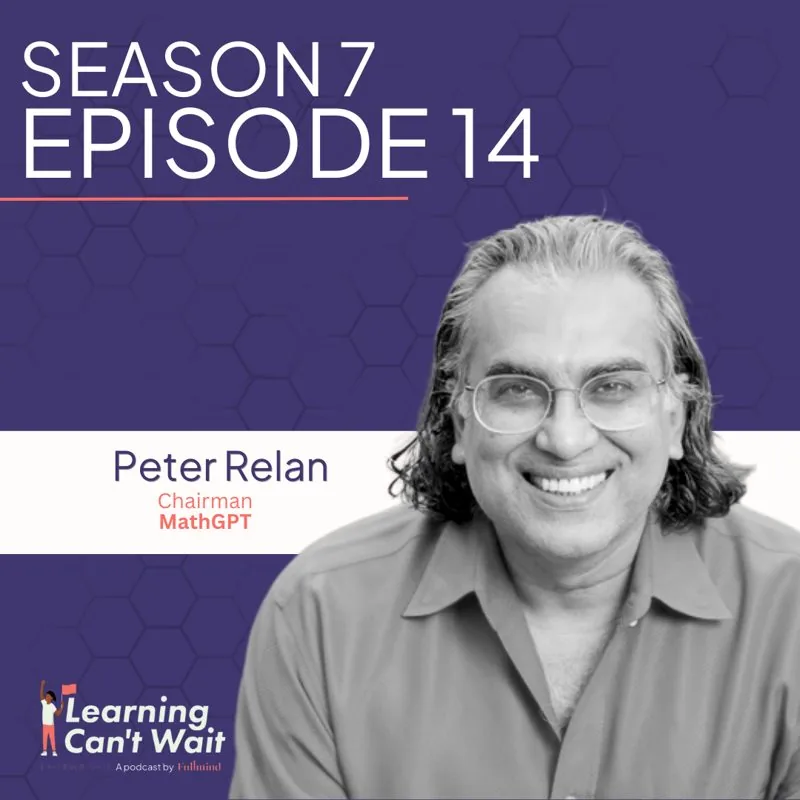
Peter Relan: MathGPT, AI in Education, Equity in Math Education
- Peter Relan
 Hosted by Hayley Spira-Bauer, Chief Academic Officer at Fullmind
Listen now
Peter Relan: MathGPT, AI in Education, Equity in Math Education
Episode summary
Peter Relan, chairman of MathGPT.ai and founder of the YouWeb incubator, recalls growing up in a Delhi refugee settlement, a seventh-grade math teacher now 101, and tutoring UCLA students who abandoned STEM majors after one failed midterm. MathGPT.ai targets community college algebra, precalculus, calculus, and statistics, starting with the instructor: it ingests course materials, generates quizzes, and provides a cheat-proof Socratic tutor with accuracy guardrails and suggested questions for shy students. With first-time pass rates as low as 14%, he sees equity upside and a Stanford outcomes study underway.
Key takeaways
- Students make life-altering major decisions after one calculus midterm; college math is an equity gateway
- AI should scale great teachers and give them superpowers, never replace them
- Start with the instructor, not the student, or students will chase shortcuts to a grade
- Guardrails ensure accuracy and instructors control how much tutoring students receive per assignment
- Make math relevant by reframing problems in students' hobbies; AI can generate those variations instantly
About this episode
In this episode of Learning Can’t Wait, host Hayley Spira-Bauer sits down with Peter Relan, chairman of MathGPT, to explore how AI-powered tools are transforming math education. Peter discusses how AI can alleviate the burden on educators by automating course management, generating assignments and quizzes, and providing Socratic-style tutoring that encourages critical thinking—without giving away answers.
They also dive into the broader impact of AI in the classroom, including its role in addressing equity gaps in community college math courses, improving student engagement, and supporting instructors with trustworthy, guardrail-protected AI. Peter shares insights on the importance of making math relevant to students’ lives and previews an upcoming Stanford research study on MathGPT’s outcomes.
Tune in to hear how AI is shaping the future of math education, why trust and efficacy matter, and how teachers can leverage technology to improve student success. Plus, a promise—Peter will be back to share real-world data on MathGPT’s effectiveness!
Full transcript
Transcript generated from the recording; minor errors may remain.
Hayley Spira-Bauer: Welcome to the Learning Can't Wait podcast of Fullmind. At Fullmind, our vision is to ensure every child has access to an exceptional education. Each episode, we will be joined by Pathfinders within and around the education space who are bringing about transformational change. On behalf of deserving students, I'm your host, Hayley Spira-Bauer. Welcome back everybody to the Learning Can't Wait podcast. I have an incredibly exciting guest for you all. Today we have Peter Relan, the chairman of MathGPT.AI, and the founder of YouWeb Incubator. Welcome Peter.
Peter Relan: Thank you Hayley, and I really appreciate you inviting me here. I'm excited to talk about math and AI and let, let's jump in.
Hayley Spira-Bauer: No better time than today to talk about math and AI. There is not an episode that goes by lately where we don't touch on AI in some way, but it will be the central theme of our conversation today and I'm really excited for you to talk about what you're working on and why you're working on it. But we'll start off with our typical first question. Peter, how did you come to be the personal and professional version of yourself?
Peter Relan: That's a really interesting question and it actually does tie to mathematics to some extent on a professional basis, I came here at 18 to from India to attend college, and I graduated from UCLA and I was good at math, and so I ended up choosing a STEM major and doing well in it. But during that time I was also a math tutor and I saw a lot and I was doing computer science and I saw a lot of students who were struggling and literally making life decisions based on whether they could get through one midterm in some algebra or calculus class, and they'd say, ah, this is too difficult. I'm just going to switch to art history or psycho, not that those are incorrect or bad majors, but I could see that this is a difficult topic for many people at a time of real gateway in their life of where they're going to head. ([02:18](https://www.google.com/url?sa=E&q=https%3A%2F%2Fwww.rev.com%2Ftranscript-editor%2Fshared%2FNkt-H955f1Qb-eG_9VBaLywGAzPU3ZTaQP6gL-ftcOD3AVHujJvYux9pBeE2bPJwxaIQPjlgpkb-UEdPggE1PzJxZfQ%3FloadFrom%3DDocumentDeeplink%26ts%3D138.57)): So that got me interested. As already doing computer science, I've always believed personally in education, changing lives completely. I am the child of refugees in the India Pakistan split. My parents had nothing when they came to a refugee settlement in Delhi and they lived there for what, close to 15 years before they moved out to a real home that they could call theirs. And I was born in this settlement and we came from poor resources. What changed our lives, all of the siblings is education. They saved up money to send us to the best schools while living in a very slum like environment. So I'm a big believer in education, changing lives, solving even equity gaps. I love math, and today I'm here to use AI professionally as a professional to bring this enormously important subject, especially in America, and make it possible for everybody to choose whether they want to be in a STEM profession as opposed to feel they have no choice. So it's kind of interwoven my personal life story, the importance of education, personally, the importance of math education in allowing people here to be part of the future.
Hayley Spira-Bauer: Peter, thank you so much for sharing that story. It's an incredibly powerful testament to the power of education. As you say. You shared an anecdote before we started a recording about your teacher. Where is she now?
Peter Relan: So the reason I got good at math is in my school that I went to, I met her when I was in seventh grade and she's 101 now. I met her in seventh grade. We're talking 50 years ago, and she still in Delhi, in India in not teaching of course, but that's what changed the course of my love for math was this amazing teacher who is alive today and I can still send her a message if I want about how I changed my life. Teachers are incredibly important in this world of AI. I think a lot of people think AI is going to take away jobs. We're not going to try to do that becausewhat you're trying to do is scale great teachers or create great teachers and give them superpowers.And I look at my teacher who's 101 now, I would hate for anything to replace her. That would be the worst thing in the world. We don't want to do that.
Hayley Spira-Bauer: I love that. We'll touch on this topic in just a second. I want to dig a little bit more into your history though, because I do think there's so much of your story that serves as foundational steps towards what you're doing today. You're not new to the tech space. You've been working in tech in various ways for a couple years now. Can you talk about how the experiences that you had before the work you're doing now with MathGPT led you to this particular question that you're answering?
[05:00] **Peter Relan:** Yeah, I mean, it's a great question. I reflect on, it's a bit of a miracle I am where I am. I think there's a lot of luck involved. There's hard work involved. There's hopefully some smarts involved. I'd like to think. But essentially I started my career working for a startup at the age of 21 when I graduated and I got a feel for Silicon Valley startup work, but I ended up then soon going to Hewlett-Packard for many years, which in those days was sort of the godfather of Silicon Valley. David Packard started it from Stanford, and I learned a lot about the importance of how Silicon Valley as an innovation engine, right, was sort of the art to so many technical innovations. So I fell in love with Silicon Valley. I fell in love with technology, working at the place where it was founded, really 1931 during the Great Depression is when they started Hewlett-Packard. ([06:29](https://www.google.com/url?sa=E&q=https%3A%2F%2Fwww.rev.com%2Ftranscript-editor%2Fshared%2Fpp7VlToh2CfD-NuhCf9yPya4wt04nPdGw6GQ1csaok3lEdhirThjmqCl7JhVtkGgyGq8E4-yA4xSqITnbgtuJe_thrM%3FloadFrom%3DDocumentDeeplink%26ts%3D389.18)): Then I went to Oracle, did a bunch of work for Oracle. Larry Ellison, the boss of Oracle, was recently in the news and he's working with Sam Altman on the Stargate data center. So he's still at it at the age of 80. Amazing. And so I literally learned about tech from some of the greats and being in there, I was a vice president of internet at Oracle bringing internet technology. So once I'd fallen in love with technology and the innovation cycle, I then decided to get into startups, and that led me to founding an incubator, helping entrepreneurs start their companies. That is an amazing experience and that is where I discovered the entrepreneur who helped start MathGPT. So for me, the love for technology, which came from being good at math, so it starts with being good at math, love for technology, and then startup experience and then sharing that. ([07:31](https://www.google.com/url?sa=E&q=https%3A%2F%2Fwww.rev.com%2Ftranscript-editor%2Fshared%2FUH8XB9LMkAF9JwCk2s1N3FUtftje1AjU9vvIOzTQ1SUQ4ega4HvpSV5gXB8AShbW4zO9X5Q_5Y3MtMuOqp2ykDcDM0s%3FloadFrom%3DDocumentDeeplink%26ts%3D451.67)): It's my way of educating now is like I've done well, I can now go back to the same community of technologists and say, how can I teach in a way, but I'm not a certified teacher, so I'll teach in this mentoring way by running this incubator and that I've been doing for 17 years now. We've had some good hits, including one you may know of Discord, which is a big chat platform. So it kind of brings great founders to us who want to learn, and then that's how we got into the MathGPT world. You could see that the trajectory from love of math to this, to that to
Hayley Spira-Bauer: Technology
Peter Relan: To an incubator. There is a very interesting twist to that, which is my journey as a math tutor when I was at UCLA in college. So that I can certainly talk about if you're interested. Yeah,
Hayley Spira-Bauer: Let's hear it. I think we're all leading to this question of what is MathGPT, why now and what is the future of teaching and learning in mathematics? So tell us about your time as a tutor and then we'll dive into the rest.
Peter Relan: Okay, great. Yeah, I love this part of my journey. I was 19 years old and I was good at math and I was surrounded by a lot of brilliant students, but also students who were struggling with math. So I'd run into people and say, can you just help me with this math or that math? I had a small reputation in my part of town and campus, and so I officially became a math tutor. Now, what struck me was a lot of math education and math tutoring is focused on early school and middle school and high school, and there is an assumption that by the time you're in college, you're either good or you're not. That assumption bothers me because you are also by that time making decisions about life. Am I going to be a STEM major? Am I going to be a doctor or a nurse or a electrical technician? ([09:28](https://www.google.com/url?sa=E&q=https%3A%2F%2Fwww.rev.com%2Ftranscript-editor%2Fshared%2FuuYbV648pdfwnpzP6Zg9p6YNzj3y31_JEaTKCX9xDJDJFxiFbQypnUm8i4coURxBey0__2OEZzgG0n57aJTENHhaDps%3FloadFrom%3DDocumentDeeplink%26ts%3D568.32)): Should I even do full four years of college? Should I, this is that age. And if there is a pre-baked assumption about this, it feels irrecoverable. I'm sure you've been through the school of college, if you've been through middle or high school and you don't feel you're good at math, it feels irrecoverable. Ah, I don't know math, so I'm just going to be this major or that major. And I started to see that phenomenon and that to me was unfair. Just because you didn't have great math skills earlier didn't mean that you had to switch, even though you might want to aspirationally be in a STEM field or a STEM related field. So I used to see these students say, oh man, I really messed up that midterm in calculus or algebra. You know what, Peter, I'm just going to switch to this other major where I don't have to take these classes. And to me, it occurred to methey're making life decisions based on one day, and that was where I really realized the importance of math education, whether you do it early or whether you do it late, but the gateway period of college really became my central focus. I could see that's the last chance or almost, I mean, you can always do adult learning later and professional courses,
[10:00] **Hayley Spira-Bauer:** But it can be really expensive. So let's talk a little bit about MathGPT. Its goal for, I know a lot of it is centered around community colleges and ensuring that students have what they need and really trying to democratize education. So let's talk about it. What is MathGPT? Why was it created? I did a little blurb there, but I know you'll do much better than,
Peter Relan: Okay, you have the focus. So the focus because of my experience at UCLA is higher ed, so much of our focus today in math learning is everywhere else K through 12. If you look at all even previous podcasters, you'll see that they are, when you've hosted them, they've hosted speakers who are talking about middle school or talking about early school. Everybody's focused there. We found that very few resources were being applied to higher ed. And to me, higher ed isn't just the classic, oh, are you going to a top a hundred university? To me, it is the broad based community college system. It's one of the best in the world we have, and certainly in California we have one of the best. So to me, it occurred that there's 10, 15 million students in these community colleges. First year, second year students, and so many majors are dependent on taking statistics, college algebra or calculus, so many majors, even nursing, right? ([12:02](https://www.google.com/url?sa=E&q=https%3A%2F%2Fwww.rev.com%2Ftranscript-editor%2Fshared%2FfYK1zV0Dg8OzoixqYgGezv8tUDyctJE7zJmNpAMqxT7bIgswtLlI-K-8yjRUyYZYn1hKknjx9bP36rZh_OrcymFz054%3FloadFrom%3DDocumentDeeplink%26ts%3D722.62)): So what MathGPT does is say, let's focus on these fundamental math courses. We're not focused on advanced mathematics for PhDs or mathematics for aerospace engineering or whatever. We're focused on college algebra, precalculus calculus and statistics, and providing first the journey begins with the in structure. So our goal is take these core subjects that are required for so many professions when you go to community college or college, start with the instructor, give them superpowers to make their students better. It's that simple. I've found that if you start with the student, you will find students who want to take the shortcuts because they have a tough life. A student is sometimes working part-time, sometimes not taking these courses, getting discouraged. So if you come straight to the student, they will look for the fastest way to get their grade and move. Whereas if you really want to make the math literate math learning oriented, it starts with the instructor. ([13:03](https://www.google.com/url?sa=E&q=https%3A%2F%2Fwww.rev.com%2Ftranscript-editor%2Fshared%2FixnlQ1lMPOmodbxDQLGlhhcNWKANvMc4ae_y1WlrMIq0KIgSFIgfM2yD64O6wfKWT_F9hPe5D1p-04kNbwiiAwjVefw%3FloadFrom%3DDocumentDeeplink%26ts%3D783.52)): So MathGPT is an instructor focused tool that gives students an AI tutor, which the instructor controls and assignments that are tutor, which the instructor controls. So it gives really an instructor the ability to run a classroom much more scalably, much more efficiently than students coming middle of the night saying, oh, I got this quiz and I don't know this. And the instructor's like, how can I help you at this point? Now it's a human scalability problem, right? So that's what MathGPT solving is a human scalability problem for these amazing instructors who are doing the best they can for their students. Then I can get into the features and what exactly it does, but I wanted to give you the philosophy of MathGPT where it's focused and why,
Hayley Spira-Bauer: Peter, I think we have more in common than folks might believe, and I'm going to ask a question that's very leading, but it'll illuminate why I said I think we have more in common than folks might believe, which the question is, do you think that AI can replace great teachers? Peter,
Peter Relan: Great question. I will start out by saying no, it is not the goal and it is not a noble goal. I know that AI brings automation. We know that there's no issue with recognizing that certain jobs that AI will actually automate away the teaching and instructor's job is, in my opinion, sacred because there is something more going on there than the delivery of content and tutoring. There is a relationship being built. There is a confidence being built on an interpersonal level between an instructor and a student. That is really a human connection. So the goal of AI, when people talk about, oh my god, AI will take over the world, it'll take away all the jobs, dah, dah, dah. There are jobs that you really do want to protect and you want to make AI their assistant, not the copilot, if you will. You cannot take away a teacher's job, in my opinion, having been a tutor, having taken lessons from a great mathematician and great math teacher, there's too much of a human element involved other than the math content itself that instructors bring and carry that it is not replaceable. So we basically came to MathGPT with the idea, we're not going to replace the instructor, now let's talk and how do we scale them? Great teachers, if they can be scaled, are amazing. They can reach more people more efficiently. So that's kind of the heart of it. I'm a big believer in this. We will be stuck to this theme for a very long time that this is about enabling and scaling instructors not replacing them.
[15:00] **Hayley Spira-Bauer:** So let's talk a little bit about a novice community college teacher who's using MathGPT. How might they use it in a given classroom to support students and what could we expect outcomes wise from their implementing that tool?
Peter Relan: Yeah, that's interesting, especially your last question about outcomes. So let me come to the first part. So the goal of MathGPT wasn't to fundamentally change the way they teach as much as to scale the way they teach and to make it more efficient. So if you look at how a typical community college is, structure would teach a class, they would pick a textbook, they'd pick their materials that they want to teach, right? Let's say it's precalculus or statistics. They know they've taught it before. They'll have some lecture notes. They'll have some textbooks. They'll want to give assignments throughout the quarter or semester. They'll want to have to grade them, and they're used to both in class questions as well as offline questions and office hours. This is their life. So you just take a look at their life and you say, at every point in this life, how does AI help? ([16:51](https://www.google.com/url?sa=E&q=https%3A%2F%2Fwww.rev.com%2Ftranscript-editor%2Fshared%2FkfXh2wjgfjxBEkcHYVgWlaOpoAkzoia4--I4qar-Sslk8cr5pPQi2jaJKoikXP2qx_xpaoolgYETVohVoLMA0YBaNkc%3FloadFrom%3DDocumentDeeplink%26ts%3D1011.41)): So what we do is tailor MathGPT AI for each part of their life. There are three parts of their life course management we call. So with MathGPT, you can upload your textbooks, your PDFs, your lecture notes, click suddenly, the entire thing is automatically durable. So now what you've done is you've said, Hey, I have this great content. If you can't find me in my office hours, and if you can't reach me in the middle of the night, you have something by your side 24/7, which understands this content automatically and it will be able to teach you concepts, give you examples, work through practice problems all the time. So that's the first thing. Get your course in and make it durable, which is what they do anyway, but now we've scaled it. So we always come back to now we've scaled it, now we've made it more efficient. ([17:40](https://www.google.com/url?sa=E&q=https%3A%2F%2Fwww.rev.com%2Ftranscript-editor%2Fshared%2FYM7HO05cTvHeBqRfXNybmY1_6B3j4brgZpZBWCBrr44hLd2mPnspPDcNsfvwFT4zsy0ND63nUahDm_68kw3WRTlPj78%3FloadFrom%3DDocumentDeeplink%26ts%3D1060.76)): Second thing, every two, three classes, they have to give a quiz. They have to give assignments. So here we go. We had a built-in AI-based assignment and quiz manager or test manager, they just have to select, given this content that I've entered, generate a few interesting problems for me for this quiz, generate a few interesting test questions for me with multiple choice click. Now they have those. Again, this could take them several hours. We made it a click of a button, scalability and efficiency. And the last piece is a conversational AI tutor that is cheat proof. It is Socratic. It does not give you answers. It does not even solve problems for you. It keeps asking you questions in many different ways. How would you do this? What would you do if it was like this? Oh, you didn't get that right? Well, what if you did this instead? ([18:38](https://www.google.com/url?sa=E&q=https%3A%2F%2Fwww.rev.com%2Ftranscript-editor%2Fshared%2Ffxi125fdRHV-eiL30a_KB-ob-2m_yRV8UymyBCljpZSBHP870Ltk6EbsgkV55OnVXC0jLMZo5JGzGD7tC5A2Spwwa1E%3FloadFrom%3DDocumentDeeplink%26ts%3D1118.07)): That's how the conversational tutor works. And so they suddenly have a way that they would have answered the questions for the student because professors don't want to, instructors don't want to just give the students, here's how you solve the math problem, or here's how your quiz is solved. So we took all three aspects of their life, which is course management assignments and grading, and then answering student questions. And we embodied it in MathGPT with everything being controlled by the instructor, how much tutoring they can get, how many sessions. You don't want the students to become completely reliant on the tutor to help them with everything. So you can control how much tutoring you offer per assignment, for example. So that was part one. I think you had a second question about outcomes, right?
Hayley Spira-Bauer: Outcomes. What outcomes can we expect from obviously some scalability and time savings. You've emphasized that very clearly, and I can see that's one of the big benefits of being able to use AI to supplement a teacher's workload. Any others that you would expect?
Peter Relan: So yeah, so I think they do want their kids to do well. There's no question whether it's high school, whether it's middle school, every teacher wants great outcomes and results. So first is our thesis statement is, look, you can't have good outcomes if the teachers and instructors are overburdened at can't handle the class. A class consists of three or four classes at any given time. It consists of let's say at least three, the below average student, the at grade level student, and then the above grade level student. So there's below grade level at grade level and above. If you're taking a precalculus class, there could be below grade level students who are not even familiar with the core stuff in college algebra that's needed for pre-calculus or the stuff in pre-calculus that's needed for calculus. So now you have three classes you're running, and that's quite common. ([20:30](https://www.google.com/url?sa=E&q=https%3A%2F%2Fwww.rev.com%2Ftranscript-editor%2Fshared%2FNoEaODJbH1QfsslrCVGKwJG_I4G2Hbu0xQUnAkyxWkQMszjZaEaff3-QyOBhqcwPc6KgPkRxDDmIfkhD0-I5a_ozRrk%3FloadFrom%3DDocumentDeeplink%26ts%3D1230.72)): We hear that there's just always these three levels. So now the first thing is don't remove the overburdening of the otherwise. They can't get great outcomes, and that's what we did with this efficient workflows. Now they have time. They can look at the analytics of everything that MAD GPD provides, what student was struggling in what area or was the entire class struggling with this one lesson that we gave? They get real time analytics, so now they can plan better for their next class, right? Oh, this quiz I gave on the last lesson on let's say some concept in pre-calculus. The whole class was just struggling. All the students were just not able to get the quiz mad. GPT was giving them hours of tutoring and they still couldn't get it right. So they get that data. So the first thing is change as you go along to the level of students in the class. ([21:27](https://www.google.com/url?sa=E&q=https%3A%2F%2Fwww.rev.com%2Ftranscript-editor%2Fshared%2FU-IsG5J8fNiCxeu0uXeWubBbmi4jQ2ECjI8Fjl-PH8PaOXzdWwxENmEeCS3LWVUVfAK1LHkoVjf3qoqfnrdvljkzNQw%3FloadFrom%3DDocumentDeeplink%26ts%3D1287.4)): By definition, better learning, better use of your time. We've got so many professor quotes saying, first line of defense, MathGPT is amazing. Before they come to me, they get to work on it themselves with this conversational tutor, and they're so much better prepared when they come to me with their final question on if they can't understand something. So that is many outcomes. I mean, we all know that the governments and all the agencies that monitor this want final outcomes, which is grades and math scores. So we're in hundreds of classrooms today. What we have seen is lots of quotes and direct reference on the many outcomes, how their students are just fundamentally at a better place than before MathGPT. This year, we're going to be working with a really great research group at Stanford to measure the quantitative outcomes. So I wish I had more in quantitative outcomes for you, but it's coming. It's
[22:00] **Hayley Spira-Bauer:** Coming soon. It's coming. There's
Peter Relan: A little ellipses. Yeah, I got you. Absolutely. Yeah. The actual, what were the grades before and after for those who took MathGPT, those who didn't, this year's work and we're pretty confident it will be good, but we have to prove it. What we want to prove is that the final outcomes, which determines careers, your GPA and whether you get through a class, but the low hanging fruit to me is obvious. There are states in which community colleges are telling us their first time pass rate of a math class in year one of community college is 14%. So we know there's low hanging fruit here. I mean, we don't have to wait very long to take that 14% to a higher number. It's so low. And these are particularly states where there is an equity gap where a lot of the students could be from disadvantaged minority groups. So we are definitely looking forward to publishing some. I mean, I know that that data is going to be great, but we'll have it back. Maybe we'll talk again at the end of this year and we'll have the data for you.
Hayley Spira-Bauer: Sounds like a promise for those. That sounds like a promise.
Peter Relan: I may have to eat my words on this, but I'm pretty sure I
Hayley Spira-Bauer: Don't. No, listen, at the end of the day, teachers have a lot of tools at their disposal. They have a lot of materials and resources, and with the advent of generative AI and the way that it's proliferating in the education space, it has the potential to do so much good in the support of great teachers, and we have to be judicious. We have to know that our tools are working and that they're benefiting kids and that they're making teachers' lives better. And there's many ways to quantify that, but the fact that you all are pursuing study with Stanford is a really good indicator that you too care deeply about outcomes, and that this isn't just about pushing your tool and getting it to be widespread. Those two things have to go hand in hand. Especially today as we're seeing the education landscape change so dramatically with our political climate, there's a lot of uncertainty. So knowing that your tool is effective and implementing when implemented correctly is very important. Peter, I have a question for you. Another question for you. What is your favorite feature of the tool?
Peter Relan: This is amazing. So it turns out that whether you're in middle school or high school or elementary school or college, there is this notion of a shy student. One of the things that everybody's pointed out, there are two I will talk about, okay? One of them is for the student and one of 'em is for the teacher, for the instructor. So for the student, it turns out that when they hit the button saying Ask MathGPT, they could be looking, reading a chapter, they could be looking at a lecture node, they could be solving a problem. There's always this button, 24/7 Ask MathGPT, right? And what I love is as soon as you hit that button, it knows where you are because you are in the right part of the application for that, for your content. You are assignment. And he immediately says, I'm here to help you. ([25:39](https://www.google.com/url?sa=E&q=https%3A%2F%2Fwww.rev.com%2Ftranscript-editor%2Fshared%2FN-uI9mPJLrG-TpUpBO25WbYm7kUEFPW9taYbz33SGvfhmTfES1u6D6Wd7tuX-U5LC5HNszTrCBtAruME-pyWvacJlHQ%3FloadFrom%3DDocumentDeeplink%26ts%3D1539.23)): What would you like to know? Here are three interesting questions that you might want to ask. Imagine the experience of somebody who is simply asked, what would you like to know about this? What problem do you have? So many students have told us we don't even know what to ask. Sometimes we look at something and I don't know how to phrase what I have in my mind. So what we've done is make it really easy for this student to immediately engage to, here are three interesting questions that people ask about this problem or this assignment or this content and the engagement is amazing. Then it's like a quantum level hire because they don't have to that shy student who didn't raise their hand in class because they weren't sure
[25:00] **Hayley Spira-Bauer:** That wasn't me. But yes, I know about
Peter Relan: That. I know it's not us. That's why we're on podcast. But for there's not people like you. And so many students have written to us that I can talk like I've never talked before because I know that I'm not embarrassing myself. This is just a private session with MathGPT and me. We call it MG inside the product. So between and me, I can say anything, and it's so infinitely patient, and it just waits and it keeps suggesting more questions. I feel literal this,I feel liberated to learn.So that to me is that we always looking for the human. Where does the emotional connection come? Right? And when I mentioned AI cannot replace instructors, well, we still try to be as connected to that student, so we meet them where they are. This generated suggested questions isn't amazing. I mean, it's changed the picture from engagement, let's say, of one X to like three x, right? ([27:16](https://www.google.com/url?sa=E&q=https%3A%2F%2Fwww.rev.com%2Ftranscript-editor%2Fshared%2FlpdgiyHjpeOnWkD8Y_oBrSo5tlDXdoa_OsDTnI98CrgSS_PrhuskNikp4ld4ksl7Eb5tikcxGj81NFqrpyAekeQn788%3FloadFrom%3DDocumentDeeplink%26ts%3D1636.11)): That's for the student. I love that feature. It gives me goosebumps. The idea that students who are shy, who are embarrassed, who feel ashamed that they don't know math, boom, they engage, right? And second, for the instructors, there's a theme right now that AI is not trustworthy. Instructors are worried. They're simultaneously curious about AI. But remember the most trite example? Calculators? No calculators in class, yes, calculators. It's inevitable. Instructors are a little paranoid about AI because one, they also feel, is it going to replace me? Two, they don't trust it. There've been too many examples of AI having gone off and done some weird hallucinations, they call them, right? So for the instructors, the favorite feature that I love is we have created something called guardrails. It makes sure that once we absorb the content into MathGPT, a hundred percent accuracy, it will be guard, railed. We check everything and we make sure we will not make a mistake when delivering tutoring or the lesson, which has been a problem in generative AI because of this famous, the word of the year in 2023 after ChatGPT came out by the Cambridge Dictionary was hallucinations. It was everywhere.
Hayley Spira-Bauer: And that
Peter Relan: Caused a bit of a can we trust this technology? And what we say is MathGPT technology that instructors trust and students love. So those are my two features. I love guardrails for the instructor. It's cheat proof, it'll be accurate. And two, for the student, it'll suggest questions for you all the time so you can be a shy student and still get great. And so we hope that's what impacts the outcomes. Back to your original question, we'll come back to that.
Hayley Spira-Bauer: We sure will. Peter, I appreciate the way you think about how teaching and learning can look different and for whom it can look different. When we talk about community colleges and we talk about entry math classes, those can be costly, taking up much of the available funds that students have to pursue their degree, and often results in students not finishing their college degree as a result. And so this is an equity question, and I know that that is central to your work and central to your life and your life's work. So thank you for touching on that in your conversation today. For my question, I'm wondering for you, what advice would you give a teacher starting their career today, perhaps teaching math at a community college?
Peter Relan: Yeah. Well, I think first of all, the teaching math at community college is a challenging job. Let's all recognize that if one of our other community college systems we saw has a 14% first time pass rate, that's a huge problem. And as you said, it is a problem that costs students money. And so we have a community college teacher, first time teaching math or whatever. It can be challenging to understand already walking in the class that this is a class half of whom who may not get through this class. I mean, how unmotivating can that be if you're a teacher saying, look, half of this class is not going to make it no matter what I do. And that's the history of the education that they've seen in that college system. So our advice is this one, let's be aware of the risks, but please embrace AI. It makes things better if done right? I mean, all technology has that nature. Every technology I've ever encountered. Today, we have mobile phones. It's an amazing technology that has brought people together closer. You can call your friends or your family anytime, anywhere. We also know that it's caused addiction and some created a video generation with TikTok and short video formats where people have stopped reading books, which you and I grew up absolutely devouring books. And now we have people who can refinish a book.
[30:00] **Hayley Spira-Bauer:** So
Peter Relan: You know that as well as I do, right, that this is a technology that could go bad or could go well. So from our perspective, embrace it. If you can truly trust that it will not be misused, please embrace AI. That's my first point and that's MathGPT. It sounds like a plug for our product, but I genuinely believe that this is the problem with all technology and you have to vet yourself and trust it. And if so, embrace it. That's my first point. The second point is I actually believe that you can turn math from, as a community college teacher, from a subject that people hate and just are struggling with and just like, oh my God, I wish I could just get through this and someone please help me write with this thing that I have to do. I have to take statistics to be a nurse. ([32:18](https://www.google.com/url?sa=E&q=https%3A%2F%2Fwww.rev.com%2Ftranscript-editor%2Fshared%2F0gfDaVsw71ZgissQ9kkypvQA-3-aYQgXIdCBCoSwxFv4dzhX_EVkE0dqAqL_5tmAh9nxp9Gbop8YRksMawPb3YJmg5k%3FloadFrom%3DDocumentDeeplink%26ts%3D1938.01)): I'm never going to use this stuff again. One of the things that we allow instructors to do in MathGPT AI is take give you practice problems and assignments, and you can choose, oh, I'm a sports person. Can you reframe this math problem in terms of let's say a swimming pool and its length and how long it would take me to do 16 laps if I'm linear equations. So suddenly the technology can become very relevant in your life as opposed to this. That's what I would encourage. Make the problems and the topic relevant. If you don't make it relevant. It remains like so many students say, well, I'll never use math again, and that's a problem. So my advice is use this tool and say, Hey, describe the way you'd like to solve this core math concept in life and hobby terms that you'd like, and the AI will then give you that problem that way, and really use that capability. You don't have to now design 16 problems in sports and gardening and this and that. AI will do that. So why not make it relevant for the student? So those are my two things, right? I use it if you trust it, make it relevant for the student. Suddenly we have, I think, a game changer in this gateway age of early college in
Hayley Spira-Bauer: Math. Peter, it has been such a pleasure meeting you and interviewing you on the podcast today. Thank you so much for joining us.
Peter Relan: Thank you. It's been a pleasure for me and what a great topic. And I just love your other podcasts as well. So I'm hoping to get all these podcasts together out to your audience, and let's make math, especially American STEM education better together. Thank you.
Hayley Spira-Bauer: I love it. Thank you so much. And a reminder, everybody heard it, Peter's coming back. So
Peter Relan: Without come data,
Hayley Spira-Bauer: Stay tuned for part two.
Peter Relan: Thank you. Thank you very much. Thank you everybody. Talk to you soon. Again.
Hayley Spira-Bauer: Thanks for listening to the Learning Can't Wait podcast. If you like what you heard, please rate, review and share this episode. Be the first to know when we have a new episode by subscribing wherever you listen to podcasts. If you'd like to be a guest on the show or have a suggestion for an episode, email us at podcast Fullmind Learning.