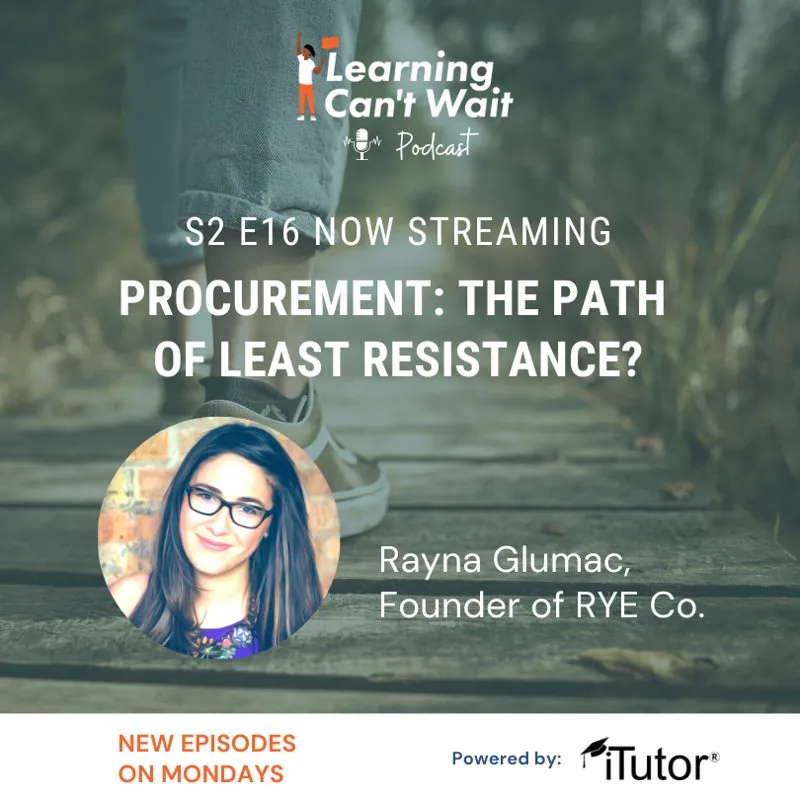
Learning Can’t Wait · Season 2, Episode 16
Rayna Glumac: Professional Development, Parent Involvement, EdTech Procurement
- Rayna Glumac, Founder of RYE Co
 Hosted by Hayley Spira-Bauer, Chief Academic Officer at Fullmind
Listen now
Rayna Glumac: Professional Development, Parent Involvement, EdTech Procurement
Episode summary
Rayna Glumac, founder of the edtech consultancy Rye, describes how mentor Julie Dixon showed her a career beyond the classroom and how a dual law and education degree shaped her nine-year business. Her state of the union calls for mandatory parent training in pre-K through first grade, better childcare, and higher teacher pay. She explains why procurement has surged since the pandemic, from data privacy checks to reimbursement-based ESSER paperwork, why most bids are now pre-approved lists rather than purchase orders, and lays out five rules for pilots that lead to purchase. She predicts the edtech bubble will plateau, not burst.
Key takeaways
- Data privacy reviews and reimbursement-based relief funds pushed RFP paperwork from 3-5 forms to 7-10
- Roughly 96% of bids are now pre-approved vendor lists, not direct purchase orders
- A real pilot runs at least three months, states usage expectations, and names a trigger for purchase
- Startups cannot sole-source a multi-year contract; districts fear the fiscal cliff
- Parents want to help at home but need training in early literacy and math
About this episode
Host Hayley Spira-Bauer interviews Rayna Glumac, Founder of RYE Co., with 18 years of experience in leading education companies, to discuss how schools make decisions about EdTech tool adoption and more. Tune in!
Learning Can't Wait is brought to you by iTutor.com.
Full transcript
Transcript generated from the recording; minor errors may remain.
Welcome to the Learning Can't Wait podcast, an iTutor production at iTutor. Our vision is to ensure every child has access to education regardless of circumstance. Each episode, we will be joined by Pathfinders within and around the education space who are bringing about transformational change on behalf of.
Students, I am your host, Hayley Spau
Learning Can't Wait. Podcasts. Listeners, I have to tell you that just joining this conversation today, I had to stop myself from laughing because the pre-call for today's guest was funny, humorous, entertaining, and no, and contained a lot of important information and knowledge, which I. You'll find as you listen to our speaker today will be true for you as well.
let me please introduce Rayna Glumac, the founder of Rye. Rayna Glumac, welcome. Hi. Thank you so much for having me today. It is an absolute pleasure to have you on the podcast today. You and I talked, I don't even know, maybe almost two years ago at this point. And a lot of things transpired since then, including the growth of your organization.
You gave birth to a little one. What else am I missing? Lots of growth, but also growth in like our, our field. I think education has completely transformed in probably the two years that we've been chatting. There's just been so many changes in what's happening in our classroom, what's happening in our communities.
Covid made a huge impact to all of those. So excited to kind of get into it today and talk about where all of these different avenues collide. I'm definitely, I was vested in education before, clearly a lot more now that I have my own child and trying to navigate this. It definitely adds another lens to the work that we do.
I think it's impossible to talk about the work that we do without talking about the changes over the past two years. I'm so glad you named that. I'm excited to dive in with you. So the first question I always ask our guests is, how have you come to be the professional and personal version of yourself? . I have to say that my personal professional is probably so intertwined.
I dunno if they're separate entities of themselves at this point. I think building a business and being an entrepreneur is deeply personal. I think a lot of it's also built on relationships, which goes down to who you are as a person authentically, and the type of work that we do, especially with the ride consulting practice, consulting's giving advice, right?
It's people really truly reflecting on your knowledge that you have, how you share it, and the insights that you provide. So I think. For me, a big part of my pathway has been people in my professional life getting personal and really sharing with me their experiences. I came, I started my career. I totally thought I wanted to be a classroom teacher.
That was always the plan. I met my professor my second week of college, Julie Dixon, who's an author now at Houghton Mifflin Harcourt, but originally Harcourt. And Julie explained to me that there was a life outside the classroom, right? And she took me into her personal world of I write textbooks and I do professional development, and she mentored me.
I worked at Harcourt as an intern, went on and taught. Then I worked at Pearson and I had an amazing, amazing boss who personally took a vested interest in me in educating me about the field and the market that was in education at Pearson. And that gave me such insights to later building my own business that I've now had for nine and a half years.
You know, it's so funny that many people think the only way to be in education is in the classroom, and while a large part of it is being in the classroom. I've heard this a couple times now on the podcast where folks are saying, there are so many different ways you can impact children. And through the.
Creation of content, curriculum, materials for students that we know from research is sometimes just as if not more important than how it's being delivered. Right? It's a, it's a cohesive, collective body. So I love that you're naming, this is what I thought about my future, and there was a bend in the road and this is how I landed here.
Definitely. I think a big thing that people don't realize, and look, my entire team at Rye is all teachers, right? We're all former classroom educators, and here we are doing the business side of education and our clients usually fall into two boats, right? They're either educators that need help with the business concepts of applying and scaling and growth.
Or it's business people who lack the educator voice. Right. And that's definitely a part of the work that we do. It's really filling in those gaps for these folks. But I think being a teacher, you learn so many key skills that could be applied to so many different areas. You can think on your feet. , we understand compliance like no other.
Right? Every other day is something else. Being thrown at you. We're able to present, we're able to learn, we're able to bend. There's such many key skills that come from educators and I think the interesting and sad thing what's happening in our classrooms now, right? We have so many teachers who are looking to leave and people outside of education are A, seeing the amazing skillset these people have, and B are are giving I think, a lot more attention to the needs of educators.
That was denied for a long. , I think a lot of people excused and didn't quantify and qualify the work the educators do, but it was different when it was happening in your living room and you saw it firsthand. I could not agree more with that. And it's both sad and heartening that at we're, we're getting there, we're getting to a place where people are starting to understand, and like you said, quantify the challenges that face teachers today.
So let's. Go back still in your own journey in education. I'm wondering if you could reflect on your own schooling and share which moments stand out as most transformative for you as a learner. Definitely think the biggest thing for me, twofold. So one in high school there was a program called Wise. I was really fortunate that lets you intern into.
Different career fields to figure out what you want to be, which was incredible. I thought I wanted to be a classroom teacher. I had a good feeling about it. And this experience for me was twofold. My sister's eight years younger than me, which is a pretty big age gap now. It's great. But when I was in high school, I mean, my sister was in elementary school, it wasn't super cool, and I actually interned at her elementary school, so I got to drive her home from school twice a.
Which I think looking back before I left for college was a huge bonding thing for us. Mm-hmm. I think for her, it was super cool to have her older sister pick her up, which most college kids wouldn't have. High school kids would've had that opportunity, but because I was interning in our school, I was already there.
I was able to take her home, you know, which was great. We had this bonding time and it also gave me the opportunity to really figure out, I wanted to be with a little bit more of a hands-on. A lot of us go into college not having a clue of what our career field actually means, and I got to work in Miss Evie's classroom, a third grade classroom in a local elementary school, and experience education in Florida.
You go, a lot of kids go directly into their college of whatever it's going to be. So at UCF, I was directly into the College of Ed and it was really helpful because I kind of knew going in, okay, I want to be in education. This was reaffirmed for me and I had that experience. So that I think was really meaningful and helped me figure out where I wanted to.
And I think the other thing was honestly meeting Julie Dixon, she was incredibly huge factor in me figuring out, and she followed me. I mean, she actually came here a few weeks ago. She was doing a PD in Colorado Springs and came over and met my daughter that she's still a huge figure in my life, but she really gave me this opportunity to see outside and, and she was really great at saying like, look, I'll introduce you.
Me getting an internship, me doing everything was on my. And then later on I taught first grade and then I went back to school and I actually got my law degree and my master's in education. And Julie was the one who really helped me figure out this dual degree. So I got my law degree at one university, my master's in Ed at another.
So she helped advocate so I could get this jd, m e d, from actually two different universities. And then I applied to the ABA for a certification and she was my advocate for that as well. So she's played a huge role in my education in helping me. Think outside the box. Wow. Everybody needs a Julie Dixon in their lives, it sounds like.
That's incredible. . And I'm just thinking about mentorship and like female mentorship. I, I, you know, you've had such a great kind of archetype for what that looks like. Do you do your own mentorship now to, for other people, women, or different? Population. Yeah, so I'm really fortunate through our work with RY now, I collective in a lot of our learning arm, we work with almost, I wanna say almost everyone from an education accelerator standpoint.
So we're collaborators with AWS. We do a lot of mentorship, mentor hours with them in the US and Canada. We do StartEd for years now. I know we both had mentioned working with StartEd and doing some stuff there. I think we've been working with. Oh my gosh, almost eight years now, which is wild. And so we also do Ed Inno.
We've done a lot with LearnLaunch, AT&T Aspire when they're around now, project founded. So it's been a really great opportunity to work with founders as they go. And then for women entrepreneurs, I always have a strong passion. When I lived in Chicago as part of WEM and doing mentorship with them, and they still send me lots of fabulous females who are doing some great work.
That's incredible. I love that you give back the same sort of valuable insights and direction for folks as they're on their own journeys. That's pretty cool to hear. And I always love to know about different organizations that are supporting people in their journeys, on their career paths to make education better for children.
Cuz ultimately that's why we're all here completely. So what, oh sorry, go ahead. No, I just think it's really important and the education's evolving so much and I think we have a bigger voice than ever now to really make an impact and a change. Speaking of a bigger voice than ever, and what we started our conversation with today, which was talking a little bit about the pandemic.
If you were to give a state of the Union on education today, what key points would you make this be so loaded? Okay, so I mean, I always wanna challenge guests around. Yeah. So I would say first, and this is, you know, I understand now I'm a parent saying this. . I'm also a former first grade teacher saying this, but I do think we need to give parents the tools to help their kids.
I think the biggest thing saw during the pandemic,there's no such thing as virtual kindergarten. I don't care how great of a kindergarten teacher you are. Parents are involved and parents want to be involved, but parents also need a little bit of guidance. I always use this, this example, but just cuz I drive a car does not mean I'm a mechanic.
Just because you went to school doesn't mean you know how to teach school or what should be involved in c. I think that we need to do mandatory training for parents in pre-K through first grade. Some sort of guidance like how to read with your child at home. Here are some great tools to do it. I think my brother laughs.
I can make the very hungry Caterpillar last like three hours. Like I can read , I can read a story that lasts a very long time. I'm an only picture books at the moment with my daughter, but I could really go, you know, we're gonna talk, we're gonna have some wonderings. We're gonna walk through the book.
What do you think this book's gonna. About right. Awesome. Conclusion. Some hypotheses, we're gonna sound out, some words we're gonna count. How many butterflies are on this page? Like really vesting in it. And it's the one thing that's very funny, when my, any of my friends or family see me read to children, they're always like, how do you know how to do this?
I'm like, well, I was a teacher. Right? And I think we need to help parents with those skills so we can reinforce them at home. Parents want to be involved, grandparents, guardians, they just need that support and what that looks like, and I. Honestly, to make up for these learning gaps that we have and just for strong foundations in general.
We just need to help parents understand what they are. We've done a lot of involvement in the teaching and learnings of what happens even with math time. All of these things we need to help parents understand so they can support and reinforce this at home. But to do that, we need better childcare so the parents can also have the access and the time to do it.
I mean, here I am so fortunate to be a founder and to work from home and have flexibility, but it's child finding childcare is a beast. And it is expensive, right? And it's expensive. Incredibly expensive. Completely. And I mean, again, I am 16 weeks into this venture, of being a mom. But I, you know, I have a couple of other mom friends I've made, and they have older kids.
We're toddlers, they're constantly sick, constantly home like, what are the solutions here? You don't wanna send them sick and. We just don't do a really good job of doing it. And it's really interesting. We've been fortunate as a business, we have a lot of clients in other countries and to see insights into how they treat childcare.
I mean, two of our biggest clients are based are are Swedish, and it's just very interesting to see how different it is and what care looks like. They were also shocked when I was back at meetings two weeks postpartum cuz they have a year. But yeah, it's extremely different on how we handle it. So I would say my big thing for a State of the Union address would be, Mandating parent and gardening the education on these early grades and then providing the childcare and fostering that to do so.
I think it's really big. And then my soap box will always and forever be paying teachers better and making it a respected profession. I mean, I'm really excited. I'm going to Japan and the end of the year and I'm going into a school and I wanna see, I mean, In Japan, teachers are respected. It is a years, it's a TED career and it's so different here in the US and I, you know, unfortunately I built a business out of incredible women who have left the classroom who are want, will want to still work in and be involved in education in a different way.
And you know, I get these women cuz they get frustrated in the classroom, then they look for something else and they find me. But the, the reality is, is that we don't, and I, the other thing is, How did this not come to more people's forefront when we're thinking about the pandemic? So if your job is being a teacher and now you're virtually teaching and you have your own child at home, like you would hope that it would've been a little bit more of a light bulb moment.
No. Everybody has quickly forgotten what year one of the pandemic was like That is a theme amongst all my friends and all different professions, all different parents, especially women, mom. Everyone has forgotten the journey. First of all, they, they, for, they've forgotten how much they were in awe of teachers, right?
Yes. Oh my gosh. This job is so hard. Wow. I'm seeing it great. It was amazing seeing like all these TikTok videos and all these things on Instagram, like these amazing teachers, like, can we bring that back like a, can we have a highlight reel just to remind everyone of like the teacher in like full scuba gear in her living room, like doing a space and science.
Like can we please bring that back? Cause I think people need to remember like how amazing and incredible these. Are that are doing things for your children. Yeah, absolutely. I could not agree more. I love that you're going to Japan. I have a connection to Japanese teaching. I brought a Japanese math curriculum to the United States at a fou school I founded and or with the colleagues that I founded it with.
I didn't do it myself. But have you ever read, Educating Hearts and Minds? No. Okay, great. Pre-read for your trip to Japan and for all of our listeners, Educating Hearts and Minds speaks to what schooling is in Japan, how it's, you know, kind of implemented differently, valued differently, the reverence and respect for teachers.
Quick read, really enlightening and something I love to recommend because it was very impactful in how I think about education. I'm literally writing it down. Okay. Yeah, that my, my plane read. I'm gonna have like hours of silence. I don't know what to do. I'm probably to kinda put a lot of sleep. Sounds like a really good plan for a new parent,
It's a very, very delayed, delayed honeymoon. But yes, very excited. Oh, I love that. Okay, well I can't wait to hear about your trip and about your thoughts on this book when you get back. Let's, so, you know, we're talking a lot about. The regression, the advancement of education during the Pandemic Post pandemic.
I love that you named parents as really a source of light and a source of investment for how to change the state of affairs and well, you first kind of named it as a problem area, but then gave really concrete solutions about how we can move forward. Let's shift a little bit to Ed EdTech. We know that EdTech tools were.
The, adoption of EdTech tools during the pandemic exploded. There are some really good facts and figures on this, and really good information on this. I'm sure that you could quote all of them off the top of your head, but what I'm curious about is what you see today, right? It's 2022, nearing the end.
We're about to hit 2023. How are schools making? Decisions about tool adoption today. So I like how you said schools, because sometimes it's at a school, sometimes at the district, sometimes at the state. Welcome to the US we're the land of opportunity and a lot of different pathways to go about it. I, I will say I built a business off of a really big problem, right, that people have to solve, which is procurement and purchasing and navigating that process.
And they make decisions on a lot of different, A vast majority of decisions right now are going through procurement. And procurement is the fair and equitable purchasing process, and the reason we're seeing an increase in procurement are twofold. One, data privacy loss, right? We're seeing a huge need.
There's been obviously lots of, I don't have to quote that. There's tons of news articles about all of these issues that we've had around data privacy and of. Typical us. We have a national data privacy plan, but we have states and districts that can choose to apply that differently. So the interesting thing, when I have international clients come to the us, they're like, oh, everyone's common Core.
It's like, yes, but then people are chosen to implement it differently. National dpa, yes, but there's nuance amount across, so Right. Helps with that tech check. Right? It helps school. Go through the process to understand even if your solution is free, highly discounted. And this is where I really wanna enforce this.
They still have to check to make sure that student data is safe and secure. And so this is something that the procurement process kind of helps regulate. The other thing is because we had this huge edtech boom. There's only usually one tech support office within a district. And so by going through this process, they're also able to ensure they can support this technology in classrooms.
If there's issues and people don't think about that piece, even someone like a Khan Academy that's free usually has to go through a procurement process to be checked. So there's the data privacy factor. The other reason we're seeing a huge increase in procurement is the emergency relief dollars. So difference between ESSA.
Which is your Title I. Title II, IDEA and ESSER, Emergency Relief. Those are reimbursement based funds, so the paperwork and the forms that have to be done to get those funds back. So kind. These schools are giving edtech companies the opportunity to help fill them out. So thoughtful, typical just facts and figures.
Typical RFPs. Prior to the pandemic, we saw three to five forms. Post pandemic. We're seeing seven to. Huge increase. And again, that's wild jump. It is. It is. And it's good and bad, right? I think there's a lot of pros. There's a lot of cons. There's also more procurement happening. There's more processes for procurement happening, which is why, so I think that is really important to think about for the decision maker.
So there's more procurement happening because of data privacy and technology. And because of the way that the reimbursement is happening of these funds. The other thing you need to think about with procurement is that we're seeing a lot more of what we call listing based, or we call them hunting licenses here at Rye bids.
So essentially what this is, is you get approved. Usually it's district level and you're pre-approved on a list. It does not guarantee a PO or contract that is. And of course, every client comes to me and they're like, well, I wanna direct to PO Pre pandemic. I would say 70% of things were listing base, 30% direct to PO contract.
We're probably now at more like 96% and 4%. And I think the big reason for that is this 4% textbooks, chicken sandwiches. People are very distinct. They want one chicken sandwich vendor for their district. We see it all the time. . It's just easier. So think about it as also like large, like an L M S system.
Usually a direct, we're gonna pick one vendor, one winner, and go supplementary curriculum, professional development, instructional tools. We wanna give schools choice on what fits their needs, and I think that was something that we were really good at during the pandemic is identifying, hey, it's not one size fits all.
It could be one size fits all of a district that has four schools. It's not one size fits all for Chicago public. , right? And so giving schools more autonomy in that choice. And so what's happening is the district's kind of making a pre-approved list of what those vendors can be. We're checking the tech, we're checking the standards, alignment, all of these things.
Check out. We got some, you know, guaranteed pricing. Now schools, you pick what you need. And so we're seeing a lot more procurement, but unfortunately it's not tied to directly POS and dollars, which is hard for startups, right? It costs money to do procurement. There's no freebie way of doing it. So that's something that I think has been really interesting.
There's definitely more, I will say this. I think there's less direct PO contracts also provides more variability in the market. Right. It's more opportunities also for early stage companies to get their information out there. You know, I, I just posted McKinsey's half term report for the stimulus money and the spending on it.
So, you know, we're talking about how there's more money than ever. You're, you're making a clear distinction between ESSA and ESSA and yet, There's a clear concern that is surfacing about the lack of spending or the lack of utilization of the available funds during this first tranche of ESSER funds. How does that, I mean, does that resonate with what you are seeing?
How does it, like, how do you see a solution to this problem? I think there's also a lot of problems identified before you can solve 'em. Right. I think it's, it's not just one big high problem. I think one, what we have heard from multiple conversations with people at districts in a lot of different positions is that A, the reporting isn't super clear , so I do think more is being spent than what's being told, but.
With that, it's still not anywhere near what was expected. Right? My personal gut tells me that we will extend the money past 2024. It'll be extended to 2026, similar to what was already done based on construction. Right? For the construction stuff, we said, Hey, there's supply chain issues. If you are doing remediation to your building, making things safe, whatever, we can extend this out to 2026 that's already been ratified.
We're good to go. I do think the rest of the dollars will be there. I think the issue is the bottleneck because of the reimbursement. A welcome to the us. Everyone's doing it differently. States and districts are doing the process of this paperwork differently for everyone. The difference with s dollars, we've been doing it for a while.
We know how to get it done. ESSER, it's a whole new process and pathway. They use the same formula that they use for Title $1, but that's the only semblance there in regards to how it's done. So I think that's part of the issue is people don't know, districts don't know, states don't know how to navigate the process to get the funding.
This is something that unfortunately, edtech companies are gonna have to solve. We do a lot of what we call funding alignment documents, , where we help companies literally identify, okay, I can fit into the following funding buckets. We do a national one and then we. Pacific and then you, our clients are using this tool to go have these conversations with districts to say, Hey, we apply to your ARP dollars, the following ways.
Please use this document to copy and paste into your form. You're doing their homework. But I think they need help because we know also districts are severely, severely short staffed. How many more. Feel good today. Articles we need about the principal riding, the driving the school bus here, like I saw that yesterday, so right.
So we're asking for more from these districts to do in regards to paperwork formats, things like that. But then we're giving them less people, less support. So that's a big problem that we're trying to solve. The other thing was with good intentions, a lot of states and districts put. Parameters on the spending they didn't want to see go anywhere.
No, that's such a good point. And I'm sure that's a challenge that many organizations are facing because the best tools are not the ones that remain stagnant. They're the ones that improve to the needs of schools and teachers and students. Right. So a really, really good point you're making there that I think.
Like you said, best of intentions, maybe not best of applications. A hundred percent. And look, I think they were trying to say, I also think the other big thing, and I want people to understand this, is people are looking to sign multi-year contracts because they are afraid of like the fiscal cliff. And so what's happening with that is that it's scary to sign a contract with a.
Company with a new concept, a new unproven piece of work. And I think that's issues that we're also having, and I'm hoping by the 2026 extension, we'll make that a little bit easier. Also, fun fact, for early stage startups, you cannot sole source a multi-year contract. Sorry, it's the lawyer tidbit, but I promise.
No, I mean, your background is so unique. I don't think that many folks that are talking about these topics in this field have the same kind of education and lawyer background that you have that you were able to marry in your schooling days. So I appreciate that insight. No, I'm glad this is helpful, but I would say I probably answered that one question literally six times a week, so there's more I can get it out.
You're, you're really, you're, you're putting the message out there and, and you know what, you also speak a lot though, related to this particular topic about the power of a pilot. Can you tell our listeners about what this means and how you've seen pilots implemented success successfully? Oh, fabulous. I love talking about pilots.
So we're actually doing a pilot workshop leader, later this month through Rye Collective. But a big part of pilots, pilots should lead to purchase. It is a quality over quantity play. And the reason is, and I'm gonna totally, I'm just, I'm just giving all the negative Tennessee right now, but like Tennessee requires 10 references for some of their work.
That is really hard for an early stage company, but you can use pilots as a reference. So if you have a p a pilot that really shows best practice of your implementation, that can be used for procurement based references, which is really important. Cause I would say 98% of RFPs require at least a minimum of.
So super important to have. I would say every company should have like five on hand. So what I say, a quality pilot, I'm meeting the following things. Three month minimum.It takes three months to show fidelity of implementation of a product.If it's less than three months, you might have a trial, not a pilot on hand.
I understand there's products, a nuance to it, but at the end of the day, as a teacher, I will tell you. It's one month for me to learn about your product, another month for me to put it into action. Third month is being implemented with Fidelity, minimum three months. A great time of year for these types of things is right when we're coming up.
So we're doing a procurement workshop now because you should be talking about procurements in December, January, implementing in February. So you can get like a February, March, April, March, April, may going on. Teachers are confident in their classroom, they know their students. They're able to really implement in a really great way.
The other thing that you have to think about, couple other. Identifying your best practices. I'd be shocked at how many pilots I see that don't tell you, Hey, you have to implement our product three times a week for 20 minutes or twice a week for 30 minutes. Giving those best practices and parameters is super important.
You're not gonna get KPIs and outcomes if they use it once every six weeks, right? You wanna make sure it's implemented the way that you intended. Also what the tech specs are, right? Do they need one-to-one computers? Do they need an iPad? What are those things that are required to implement your pilot successfully?
Identifying data and survey information. What are you getting out of this pilot? It's also a good trick. You can use data collection and survey collection to lower your cost. . So for example, if you wanna ask teachers to do a pre and post survey, principals can mandate teachers to do that. Can't mandate students, can't mandate parents.
We can mandate teachers. So saying, Hey, we're gonna do a pre-survey. It's gonna be 10 questions, it's gonna be two weeks prior to the pilot starting. We're gonna do a post survey two weeks after, also 10 questions. Survey Monkey, here we go. And we need 80% of the teachers to. If they get that 80%, maybe you're taking money off the cost of your pilots.
How you get to a lower cost for a pilot implementation from a full cost. So a good example for that, let's say your pilot's like five bucks. I'm gonna take $2 off of 80% of your teachers respond to our pre and post survey. That has value to you as a startup company, right? You need that survey feedback.
Maybe you'll take off, maybe you want this sur this thing to be free. I don't love free, but that's fine. Maybe take $3 off. That principle's gonna be a reference for you. Hey, the video testimonial. Cause we know that reference is really helpful for procurement. So key thing is you want them to know what your cost will be.
Cuz hopefully that pilot goes into purchase, right? That's the really important part. You want that pilot to go to the next step, but they also have to know what's gonna cost. You can discount it, you can make it free, but get something in turn for it and make sure that actual dollar amount is on there and specify, do you need NWEA data?
Do you need other pieces? For you to be able to show the impacts and growth, and then put a trigger statement in here. So the fifth thing I always say for pilots and to make them successful is if reading scores are increased by 30%, then what happens? Is the principal gonna extend this pilot to three other classrooms?
Are they gonna purchase a certain amount of licenses for, three classroom licenses for next school year? What's the next step from the pilot if the outcomes are made? You're not, you're gonna get people who are not gonna like it. Then it's not a good pilot for you. Yeah. This is really, you know, important insight that you're sharing about procurement pilots, all the, all the kind of levers that allow tools to get into the hands of students and teachers and school districts.
And I think it's, it's really important, you know, We keep alluding to this edtech bubble and the reasons why we have to have some constraints on it for data privacy reasons. I personally always go back to how many things can a teacher remember to keep track of and still be effective. Like I think about that consistently, and then you get down to the student level.
Hopefully you have single sign on, so your kid only has to remember one password. But then how many different ways of operating in a space can a teach a student keep track of as well? So I wanted to shift for kind of the last section of our, our conversation to this idea that is being discussed, that the edtech bubble might burst.
How are you feeling about that statement? That I'm seeing as like a headliner every couple weeks? Yeah. And can you, do you think that it's true? I mean, I completely resonated everything you just said. In my classroom. I had a peanut butter and jelly board. Peanut butter was your username, password was your jelly, and the kids had to take both off and bring it to their computer.
Cause the single signon wasn't a thing. I'm really sitting this up right now. I'm dating myself. But it didn't exist. Right. And you had. Password and, and your sign on. So look, I started my business in the bubble, right? I think 2013 we had the Introduc introduction of Common Core and SaaS Technology, and then all of a sudden you could be an edtech startup in your mom's basement in Oklahoma and you could sell in Hawaii, in New York, right?
That was the first bubble that burst.I think right now it is a bubble. I don't think it's gonna burst. I think it's gonna plateau.I think we've hit our, we've hit our limit. I think, you know, the pandemic created a. The release of funding created an opportunity. Right. And I think visibility into teachers and parents needing new tools really hit.
I think right now we're waiting for the evidence to tell us what's gonna survive. Right? I think we're getting back to where the evidence, and again, pilots help us build evidence, right, is really gonna start to shift and weed out what companies are gonna say, what companies are gonna go. I think there is room for everyone.
The benefit of this bubble has, its pushed its way into creating more opportunity for smaller companies and for smaller entities to get into the marketplace and get visibility that wasn't there before. But do I think there's gonna be a lot of new companies in the next two few years? No, I think we're gonna kind of suss out where we're at and people's evidence is gonna help support where, where is need.
We're also missing a ton of data on what the kids actually need. Right now we're, there's a lot of like lights being shown on like, yes, it's math, it's literacy, but what are parts of literacy are needed? How are they needed? What does that instruction look like? It goes back to my, what I really want, you know, education for parents to help support these kids to be able to do whole child learning approach.
But I, I think that. It's a low burst, it's more of a simmer. And I think we're gonna try to figure out where the evidence shows us where the growth in need is. Well, folks heard it here first from Rayna. You know, it's a, it's not a, it's not a burst, it's a simmer. You know, I think there's a, there's a lot of truth in what you're saying, and one of the, one of the kind of like points that I've been making often lately is it's cool that we have people with lots of ideas.
To build new tools. I love that. I love innovation. I do. And what we really also need to do is think about what exists today, what we can get rid of, what we can advance, and what we can align right there. I'm actually leading a conversation with, one of the folks from. NewSchools Venture Fund on the topic of coherence and how right now, because there's so many tools, there's just a lack of coherence at every single level.
And so, you know, you name the, the third, there might be this plateau and we have a need to just kind of pause and evaluate and use the data to inform what we do moving forward. And I literally could not agree more. We're at a really critical time in education. If we don't take action to define what we need for the future, we've missed a huge window of opportunity to make our system better for the children that we serve.
100%. And also not every idea is a business. We do these things called landscape analysis, where we kind of come in and we showcase what RFPs you would've addressed if you were in the market pri previously, which is helpful to know like what schools are asking for, right? Even from a minimum requirement standpoint, from a training standpoint in regards to your product.
And then we pull like, Who got an award. And so it ends up being your competitors. Right? And it's shocking how many times we do these and clients are like, I didn't think they come into us. And they're like, oh, we have no competitors. We're the first one in the market. And then . And then we're like, well, you're doing it differently, but here's 10 other companies that have similar ideas.
Right? There's room, there's, you know, there's a Chick-fil-A lover for every, you know, McDonald's devote tea, right? We need to understand what sets you apart and where, what fits the need and where the research shows effective outcomes. I think that leaning on research and ending the, the crux of our time today, together today on the topic of research is my favorite place to leave it.
But I have one more question for you, Rayna Glumac, which is, what advice would you give a teacher starting their career? I'm gonna go to my favorite teacher, Bill Nye, and his quote is, everyone you will ever meet know something you don't. I think the best thing about teachers is that they're always learning and they're curious and just to keep that alive and don't let that settle.
I have friends who have taught kindergarten now for 15, 20 years. God, I've been outta a classroom a long time, , and I'm like, how are you still like excited about kindergarten? You're still in the same grade and it's. Always learning and evolving and doing something new, and I think don't lose that. I think it's really easy sometimes to be a little spared about what's going on, all the different pieces, but to really always stay curious and excited to learn more things and about how it evolves and education evolves is just really, really important for a teacher because you wanna ha instill that in your students and model that as well.
Ooh, kindergarten. That was the hardest grade I ever taught. Like hats off to your friends that are still in it and curious. And those are exactly the kind of teachers we need in front of children every day. There's a reason I stopped at first grade. I couldn't go lower, but. But Well, I mean now I look, I'm like, I don't know how the pre-K teachers do it.
I'm looking at preschools and I'm like, , bless you. . Bless you indeed. Rayna Glumac, it has been such a pleasure having you on today. I am so grateful you shared your very busy time with the listeners of the Learning Can't Wait podcast. Thank you for joining me. Thank you so much for having me.
Thanks for listening to the Learning Can't Wait podcast. If you liked what you heard, please rate, review, and share this episode. Be the first to know when we have a new episode by subscribing wherever you listen to podcasts. If you'd like to be a guest on the show or have a suggestion for an episode, email us at podcast.
Your campus needs teachers now and we've got you covered With over 1500 state certified educators from across the us Ready to serve both your part-time and full-time requirements. ITutor is perfectly poised to virtually meet all your academic needs with live educators in and around school hours.
Learn how today at itutor.com.