
Learning Can’t Wait · Episode 193
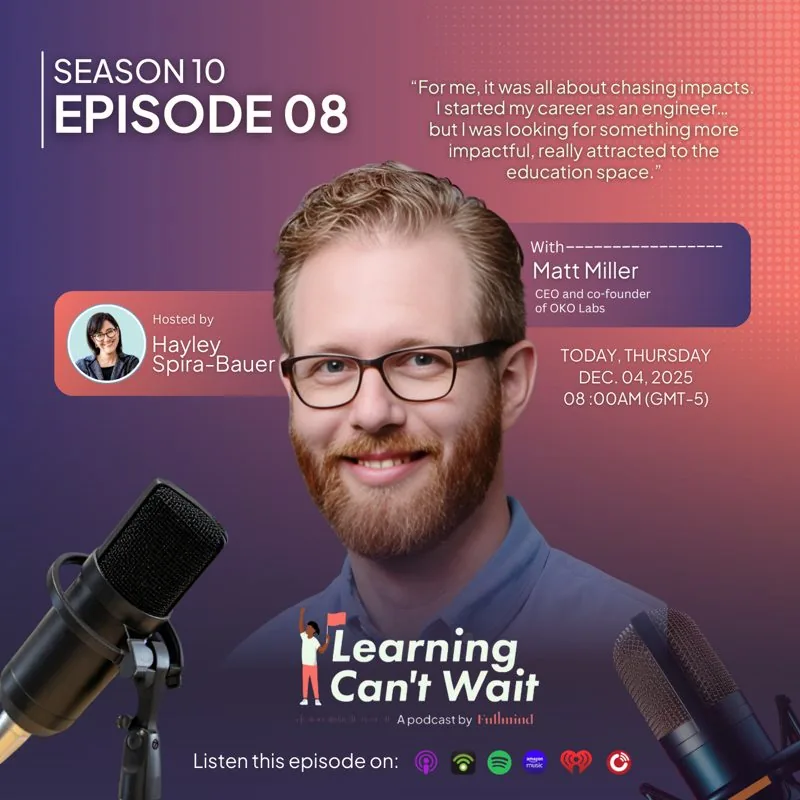
Matt Miller: Collaboration, Small group learning & EdTech innovation
- Matt Miller, CEO and Co-founder of OKO Labs
 Hosted by Hayley Spira-Bauer, Chief Academic Officer at Fullmind
Listen now
Matt Miller: Collaboration, Small group learning & EdTech innovation
Episode summary
Matt Miller, CEO and co-founder of Oco Labs, traces a path from machine learning in network security to a decade at Wireless Generation and Amplify, and now to an AI that facilitates small-group learning. When he asked educators what they would do with an extra set of hands, nearly all said pull a small group, so Oco facilitates collaborative math activities that build academic skills alongside collaboration, communication, and math identity. He discusses the edtech storm of budget uncertainty and consolidation, the rise of outcomes-based contracting, co-design with the Joan Ganz Cooney Center, research partnerships showing learning gains and reduced math anxiety, and advice for founders.
Key takeaways
- Wrapping a general model in a thin vertical veneer isn't enough; tools must be rooted in the discipline's needs
- Educators overwhelmingly want help pulling small groups; Oko fills that gap
- Collaborative facilitation normalizes productive struggle and builds math identity
- Evidence, cost-effectiveness, and coherence with curricula will decide which edtech survives
- Founders should do stage-appropriate research from day one and seek evidence-aligned funders
About this episode
The episode of the Learning Can’t Wait podcast features Matt Miller, CEO and Co-founder of OKO Labs, discussing how his team is innovating in education technology with a focus on tools that genuinely support teachers and students. Miller shares his journey from engineering and AI to educational impact, highlighting OKO Labs' strategy to empower small group learning and foster collaboration skills. The episode explores current challenges in EdTech, the evolution of AI, co-design practices, and Matt’s view on sustainable, research-based innovation in a rapidly changing market.
Full transcript
Transcript generated from the recording; minor errors may remain.
Hayley Spira-Bauer: I haven't, I haven't had, I haven't had. Welcome back everybody to the Learning Can't Wait podcast. I woke up so excited this morning to record this episode for a host of reasons, but most of which have to do with the guest who you're about to meet is incredible, an incredible leader, an incredible thinker. And I'm just so thrilled we finally made the time to sit down and record. So I'd love to welcome Matt Miller, the CEO and co-founder of Oco Labs to Learning Can't Wait. Hey, Matt.
Matt Miller: Hey, Hayley, great to be here. I also woke up super excited about this this morning to get to be here with you.
Hayley Spira-Bauer: You know, it's taken us a lot of time to get to the microphone for this episode, but I say there's no better time than the present to do this.
Matt Miller: 100%, let's do it.
Hayley Spira-Bauer: So in full disclosure, Matt Miller and I know each other as I'm an advisor to Oco Labs. I am obviously going to gush about what Matt and the team are building. And I'm gonna let Matt do that. But what I think is really compelling about this conversation is the approach that the team has taken in building the tools for schools that they've built is really unique in the sector and helps to clear out a lot of noise. So Matt, I'm excited for you to be able to share that story on the podcast today, but I want you to start off by telling us, how did you get here? How did you come to be the personal and professional version of yourself?
Matt Miller: Yeah, I love that you always start with that question. For me, it was all about chasing impacts. You know, I started my career as an engineer. It was in the like late nineties, early two thousands. I was working on some AI and machine learning stuff, actually at the time that I found intellectually really like interesting and was applying it to challenges in network security and detecting sophisticated hackers on computer networks. And it was fun, it was interesting. Co-founded a startup back then with my advisor from grad school, but our customers were very large banks. They were the government and the military who were looking to protect against these very sophisticated threats that we were able to detect. And after a kind of base hit exit from that startup, I was looking for something more impactful, really attracted to the education space and came to what was then called Wireless Generation. And later we became Amplify and spent about a decade getting like really steeped in education and education technology. We got to touch a lot of products there starting from the sort of core of Amplify's DNA and like assessment and intervention solutions and then curriculum solutions and games portfolio, a bunch of, got to build a big education data platform in partnership with the Gates Foundation. So just really got to touch a wide variety of things. And I think the arc for me over that time and since has been just getting closer and closer to the teaching and learning moments and where like the real impact happens in the classroom and really getting to kind of turn my skills as a technologist and as a product developer towards like solving these persistent challenges that stand in the way of impact and learning gains and engagement for kids. So that's, yeah, that's what really animates me.
Hayley Spira-Bauer: Okay, so you just shared that you were talking and learning and thinking about machine learning and AI before the ChatGPT explosion that brought it front of most people's minds. So let's talk a little bit about in your position and also your own experience in history, what has changed and what has remained the same in this sphere of emergent technologies as it relates to the way we see it right now?
Matt Miller: Yeah, I mean, so much has changed in the power of the tools. You can sort of trace back to like the neural networks that have been around for decades, like some of the core techniques that are used, but in the AI that we know today, but the power of the models that we have today, the volume of data that they're trained on, the pace at which they're moving, the ease with which application developers can integrate them into their solutions is just worlds beyond where we were a couple of decades ago when I started working in the space. So tremendously more powerful. I mean, that's why you're seeing so many solutions popping up. I think the thing that remains the same is that as a product developer kind of leveraging AI, you still need to be rooted in the challenges, the needs, the problems that you're solving for. And there is this temptation when you've got this very flexible, adaptable, like generalized model in say, ChatGPT or Gemini or Anthropic to just kind of wrap a thin veneer for your vertical on that and kind of unleash it. And that doesn't really cut it because you really gotta be oriented towards the particular solutions, the particular language and vernacular and regulatory constraints of the space that you're working in. So, for example, in education, there's been a lot of criticism for the sort of erosion of critical thinking when chatbots are used in an educational context and just are giving away the answer to kids who are using them and adults who are using AI. And there's some evolution there. We now have models that are trained on more sort of Socratic data sets that come from tutoring. Like I love the emergence of TeachLM out of Stanford. And that's a good example of taking the right approach and really focusing on what are the unique needs in a particular space and evolving solutions. So that I would say is the persistence through line for me.
[05:00] **Hayley Spira-Bauer:** You covered a lot there, but my big takeaway from the conversation is how we're using the technology in order to affect change in classrooms. So then bring us to what problem were you solving in the creation of Oco Labs?
Matt Miller: Yeah, so the problem that I'm solving at Oco Labs really came from talking to educators as I was thinking back in 2019, 2020. It was again, still kind of ChatGPT explosion. Some of the technologies were around, they existed, they weren't usually popular yet. And I was thinking about like how they would really impact again, those teaching and learning moments in the classroom. And I decided to just go out and ask a whole bunch of educators, like dozens of educators, education leaders,what would you do if an extra set of hands showed upto help you in the classroom one day? And what I heard time and time again was I would pull a small group. And there was no surprise, like we all know as people in education and educators that small group work is like such a powerful technique for reaching each and every learner and differentiating your instruction. But what I found as I dug deeper was that it was a, like really, really hard for many educators to pull off effectively. Like they didn't have those extra sets of hands in the classroom, we're stuck being the sage on the stage. And they didn't have the resources to help them do anything different. The curricula don't support it, there are really no supplementals out there that support small group work as a first class citizen. And so that really got me like digging into this, first the small group challenge. What I realized though, as I continued to peel back the onion is that, what you can do in a small group is leverage the social power of the group, leverage it to exercise collaboration skills, communication skills, critical thinking, along with academic contents. And so, really saw this opportunity in between all the whole classroom kind of sage on the stage and smart board type solutions and all the one-to-one, you know, chat bots and intelligent tutors and other supplementals, and really focus on the small group work as a lever for simultaneously developing both academic skills and competencies with the kind of durable 21st century skills that we know kids really need to thrive in their life and their careers.
Hayley Spira-Bauer: The way that the tool promotes collaboration is what hooked me and has me lit up. Talk a little bit about why collaboration and how it like really resonates in the social emotional space of bringing academics and other aspects of children's learning together.
[10:00] **Matt Miller:** Yeah, you know, it's interesting. We didn't actually start on Oco Labs with a highly collaborative model. We just started with a somewhat more structured kind of learning experience. It was very turn-based. We had Oco Labs managing turns and using computer vision to detect hand raises and other gestures to facilitate turn-taking, kids would take turns solving like a puzzle or math problem. And then when we started getting Oco Labs to ask open-ended questions, like, how could you explain your thinking? Or does anybody in the group have an alternative solution? We saw kids kind of light up when they had the opportunity to share their thinking with one another, when they had the opportunity to support one another or ask a peer for help and frame a question to the group. And we're like, oh, yes, of course. There's something here. When we sort of give kids agency, we normalize productive struggle by encouraging them to ask questions and not just focus on the right answer and interrogate their misconceptions and wrong answers and identify assets. Like that just really lit up the group. So we found that it was just both a powerful tool for engagements and getting kids to really, you know, sort of lock into the learning experience and the academic content, often challenging, rigorous, and also simultaneously develop deeper conceptual understanding. So they kind of evolved over time and we've really leaned into that. So now, like, you know, an example of a learning activity that we've evolved to from a very turn-based kind of collaboration mechanic is a consensus building mechanics. We have a game called Let's Talk, where, you know, the group, small group, typically three to five kids, they're presented with a math challenge, puzzle, assessment, or practice item, depending on what's selected by their educator, and they're first asked to kind of try it out on your own. You know, don't worry about getting the right answer. Think about the problem. Think about some questions you might have about it if it's challenging for you. And then after a little bit of time in sort of personal independent reflection on the problem, we then move into team time, and we prompt the group to try and solve it together, see if they can figure it out, and have a whole bunch of facilitation moves that are all kind of research-backed. And more recently, what we've done to support sort of social-emotional learning more deeply, we actually received a grant from the Math Narrative Project, phenomenal sort of research-backed initiative to help build students' math identity and counter some of the negative narratives out there around math identities and who can or cannot be good at math and what it means to be good at math. So we've infused a lot of those learnings to help build a growth mindset, help build that positive math identity, encourage the use of mathematical language throughout our facilitation. So it's turned into a much more fluid, dynamic, kind of open-ended sort of learning experience in Oco Labs, all facilitated by Oco Labs as the AI kind of supplementing the teacher in the classroom.
Hayley Spira-Bauer: You know, I learned Every Kid is a Math Kid from Shalinee Sharma in her book, Math Mind. Big, big fan of the book, but it's funny because I have a home where my two children love math and it's actually the other one that I have to convince them, like not you're a math kid, everyone's a math kid, you're a reading kid and a writing kid and that's so funny because for me, like it's my sweet spot, but they are leaning in hard to, oh, I'm a math guy, I'm a math guy. But I know not every kid feels that. So you really have to foster that and make sure that we give children the ability to see their identity as multifaceted, not just, oh, I'm a soccer player, as kids often defer to being, or like I'm a theater girl or a theater guy, but having these multiple identities by getting success and feeling success in the areas they don't previously feel it.
Matt Miller: 100%, 100%. And I hear that from students all the time. You know, we do a lot of co-design work. I love to go into classrooms and see Oco Labs in action and debrief with kids afterwards. And, you know, I was hearing from one girl in, and she told me that she just, you know, had not been a math person. You know, really didn't like it. And when her educator, teacher introduced Oco Labs into the classroom and she got to learn with her peers and talk with her peers, she was like, I don't feel afraid of making mistakes anymore. I enjoy it more. I love getting to talk about it. My friends can help me out. I'm now helping out my friends. And she's like, I just want to do more, you know, do more of this and learn in this social context. So one of the ways I think about it is that we all know about now about the 5% problem where so many like edtech interventions are built for kind of the 5% of students who are intrinsically motivated to learn through that modality. And they don't end up, you know, the 95% don't end up getting the adequate dosage because they're not engaged by that model. Like we're really building for the other 95% and building so that they can learn. Today it's math, in the future, talk about this more. You know, we really see it expanding across subjects. Learn in a social setting. Learn through collaboration and simultaneously practice those typically like black box sort of skills of collaboration, communication, critical thinking, problem solving, productive struggle.
[15:00] **Hayley Spira-Bauer:** You know, Matt, you've alluded a couple of times here to the growth of the market in edtech with tools that are AI, like origin is AI or they're AI wrappers. And, you know, we could probably talk for days about why that's concerning. But I am curious because you know a lot of folks in this space, both CEOs and founders themselves, but also funders and nonprofit leaders. I mean, you are deeply, deeply woven into the fabric of education, despite you not being an educator yourself, you've really, you've spent your career caring about how to solve problems with kiddos. And I'm curious, where do you think the space is going? We've had a little bit of a high and a low in terms of investment cycles and a hype cycle with AI. And now we have a federal government that's, you know, leaving lots of questions for folks. So what do you think is coming? And how are you like approaching the continued forward momentum of what you've built with that in mind?
Matt Miller: Yeah, I mean, we're in a storm right now for sure. But, you know, I take solace in the factthat all storms run out of rain eventually.And, you know, but that is, I think, also an informed position. So my take, you know, looking at the space is the challenges, the needs, which we talked about earlier, you know, the gaps that core curricula leave in helping educators to truly like metabolize new ways of teaching and learning and implement, you know, discourse-rich, you know, small group work in their classroom. Those needs are persistent. They still exist. We still have, you know, a saddening number of students proficient on NAEP in both fourth and eighth grade, you know, in both math and literacy. So we have these persistent challenges. And yes, we've just, you know, thrown in a whole bunch of budget uncertainty to school systems that they have to grapple with in solving those challenges. But, you know, all of the school leaders that I know are motivated by outcomes. When there are solutions that, you know, have evidence that they work, and they have evidence that they can be absorbed and metabolized by educators in the classroom and by school systems and be adopted, and they have those proof points, and they present a cost-effective way of solving those persistent challenges, I think there's still space for, you know, edtech vendors and solutions to thrive. And, like we'll also see, because it's harder to be a startup, it's harder to break through in sort of a budget-sensitive climate. We'll also see a lot more consolidation. We'll see a lot more, you know, companies either folding or getting gobbled up. We will see, one of the things that, you know, the paths that we've taken, we'll see a lot of companies seed strapping, like being highly capital efficient, like maybe being a little more patient with how they achieve growth, but ultimately breaking through, you know, just by being creative, being capital efficient, and, you know, building an evidence base, showing that you work, and, you know, gaining more and more school partners over time. I think the other important trend I see, which I think will help enable some of the consolidation, which is probably ultimately healthy for the market, is the sort of elevated importance of coherence right now. We've had over the past several decades due to just the fragmentation of our education market, different state standards, different policies, like different ways of procurement processes. Like it's a very fragmented market from state to state, and often from district to district. That has led to fragmented solutions that, you know, have been one district building for a, you know, sort of unique way of teaching and learning, that then like don't translate as well, and don't work with the other tools, and curricula, and place somewhere else. Like we're starting to see a lot more attention on coherence, being able to integrate, and align at a minimum with the standards, and the next level with the scope and sequence of particular curricula, so that it's easier for educators to absorb and make use of some of the critical supplementals that fill gaps left by their core curricula. So that I think is an important trend as well.
[20:00] **Hayley Spira-Bauer:** I totally agree. Like with everything you've said, I feel exactly the same. I had a chance to sit down with the outcomes-based contracting folks, that I met through Erin Mote at TechWeek, and it was such a fascinating conversation, how they operate. They basically have schools in mind, and go to vendors, and say, the school needs your tool. Are you willing to do outcome-based contracting, so that they can implement quickly? And you know, that's a win-win for everyone, especially if you deeply believe in your tool, but if you don't, I guess it's a problem for you. You know, I think it's so funny. I've been in EdTech for about nine years, and watching some people drive head first towards research orientation, while others just kind of stagnate, it is really coming to bear right now, with schools being strapped. And also like with the elimination of ESSER funds, you know, earlier this year, at the end of last year, as it slowly started to dry out, schools had to get rid of tools. So to your point, they are not getting tools, that were rid of tools that work for children, which I mean, is a great bet to make. Let's build tools that work in schools, and help kids grow. Like that feels really solid to me. That's a platform I wanna be on.
Matt Miller: Yeah, 100%. I mean, it's great to like underscore the importance of evidence right now. And I do love the sort of growth of the outcomes-based contracting movement. Another Oco Labs advisor is Raymond Pierce, as the president of the Southern Education Foundation, which is the home of the center for outcomes-based contracting. So huge fan, and actually, about a decade ago at Amplify, we tried to engage with districts in an outcomes-based way. And at the time, districts were really ill-prepared to do that. The idea that you would structure an agreement that you pay X dollars flat, and then you'd have to pay more dollars based on outcomes, like it was anathema at the time. And it's great to see a lot more districts figuring out how to procure in that way. And then on the other side of the market, a lot more vendors being willing to play ball, and stand behind their outcomes, which we 100% are. I think it still needs some maturation. There aren't that many districts out there that are yet doing OBC. It's taken a little bit more root in tutoring, a high-impact and high-dose tutoring models. A little bit less in supplementals, where it's traditionally a little more challenging to agree on what the outcomes are, and the ability to isolate the impact of supplementals on those outcomes. But it will get there 100%, and I'm really excited by that.
[25:00] **Hayley Spira-Bauer:** No, it is so exciting. It definitely needs time to take root a bit more. And I think there are still folks that hear OBC, and they're like, what? But there's enough movement in the right direction that it has me really excited. We can continually offer schools great options that we know work for kids, and that aren't just to cover bases, which can often be the case. Matt, you've had a lot of experience here in the space, just really developing tools in partnership with school districts, and based on need and this co-design process, which is not new, but is, I think, unfortunately underutilized very often in edtech. Talk to me a little bit about how co-design has helped what you've built in the past, or even now evolve, and why you continue to lean on co-design as you build.
Matt Miller: Yeah, so one of the first things we did at Oco Labs before we really allowed the product to get built was to engage in a whole co-design cycle in partnership with the Joan Ganz Cooney Center at Sesame Workshop. And so we worked with researchers, we worked with educators, we worked with kids, and went through a very exploratory and really fun, but also sometimes really challenging process of imagining what Oco Labs could be. And so co-design is very much at our core. We actually recently just went through a new cycle of co-design, imagining some of the future ways in which Oco Labs can show up in the classroom. So it's been a through line in our work. And I think we've done a good job of pairing that with actual evidence collection, like in school systems. So it's great to be informed by co-design and co-creation. A lot of what we see in Oco Labs today really came out of those sessions with kids, with educators. But you also gotta be rooted in the literature, the research, like what works, what we know will work. That's where a lot of the learning activities that we facilitate, the facilitation moves themselves, that's where they all come from. And then you gotta actually measure and say, does this work? And so we've been fortunate to have a long-standing research partnership with Hamilton County Schools in Tennessee, with Condesi Schools, a phenomenal charter network in Atlanta, where we've now conducted multiple studies showing exciting learning gains when kids are using Oco Labs in the classroom. And also really importantly, to speak to those social-emotional benefits, reductions in math anxiety. That was like elated when we did pre and post surveys. And when we saw those results, it was like, yes, this is what we have been working towards. So to see it born out in the evidence was phenomenal. And we're actually preparing now for our first randomized control trial that we'll be doing in the spring with Hamilton County. So stay tuned for some even more robust evidence.
Hayley Spira-Bauer: You know, I can't wait to see.
Matt Miller: Yeah, yeah.
Hayley Spira-Bauer: You know, Matt, you've touched on a lot of what are kind of gold standards for tool creation and how to exist in this ecosphere. I listened to a lot of people share how they're building, what they're building, both on this podcast, but also when I'm out in the world and I have my own experiences. I'm curious what advice you would give an EdTech founder who's just entering the ecosystem today. That's my question. That's my tweak, as you know.
Matt Miller: Yeah, yeah, I love it. I got two pieces of advice that are complimentary. One isit's never too early to do research.You know, it starts with being research-backed, understand the literature, steep yourself in the learning sciences, you know, engage with the research community. There's a lot to learn there. I get it being like a technologist coming to EdTech, like you want to go fast, you want to build product, you want to be responsive to user needs, but triangulate that with the research. Engage in co-design, which is a research-backed practice. And there's always, as you go down the path of building a product, building a business in education, there is always stage-appropriate research. You want to measure impact all along the journey. That can be done internally. You can start to introduce some kind of pre-post types of measures that give you leading indicators of learning gains and engagement, whatever it is that are your levers for impact. But there is always stage-appropriate and budget-sensitive research that you can do to start to demonstrate why what you're doing works for yourself, for your investors, for your customers. Speaking of investors, that's my second piece of advice. There are funders out there who are aligned with an evidence-backed approach. It's not necessarily the big VCs that everybody wants to court and get those big checks from, but we've been very successful in finding not only equity investors who care about evidence, but also non-dilutive grant funders, like a Small Business Innovative Research Grant from the Department of Education, IES under Ed Metz, the amazing Ed Metz. Actually, let me say that again. I just want to back up to the funder. Just pause for like three seconds. Zach, we're gonna say that again. Go ahead. Okay. And there are funders out there who are aligned with an evidence-backed approach. We've been really successful in not only garnering equity investors who care about the evidence, but also non-dilutive grant funding from the Education Department, IES under Ed Metz, from the Gates Foundation, from Accelerate, who's been a phenomenal funder of ours, New Schools Venture Fund. So there are dollars out there that can support the sort of evidence-based approach, and I think it's much more aligned with the sort of pace and needs of the education market.
[32:00] **Hayley Spira-Bauer:** Amazing. Matt, you've given such great insight into building in today's education environment, but also really good advice to other founders and champions out there. Thank you so much for coming on the podcast. It was as great as I hoped it would be and knew it would be.
Matt Miller: Awesome. Thank you so much for having me, Hayley. This was a long time coming, and I'm glad we did it. What a fun conversation.
Hayley Spira-Bauer: I know, and we could talk for days about all these things. But I really had to cut myself off. Often when Matt and I see each other or connect, it takes way more time than we were planning, and it's always such a fruitful conversation, and I learned so much and I feel so much joy. So thanks for coming on the podcast and sharing that with our audience.
Matt Miller: Thanks for having me, Hayley.
Hayley Spira-Bauer: And thank you everybody for tuning in today.