
Learning Can’t Wait · Episode 196
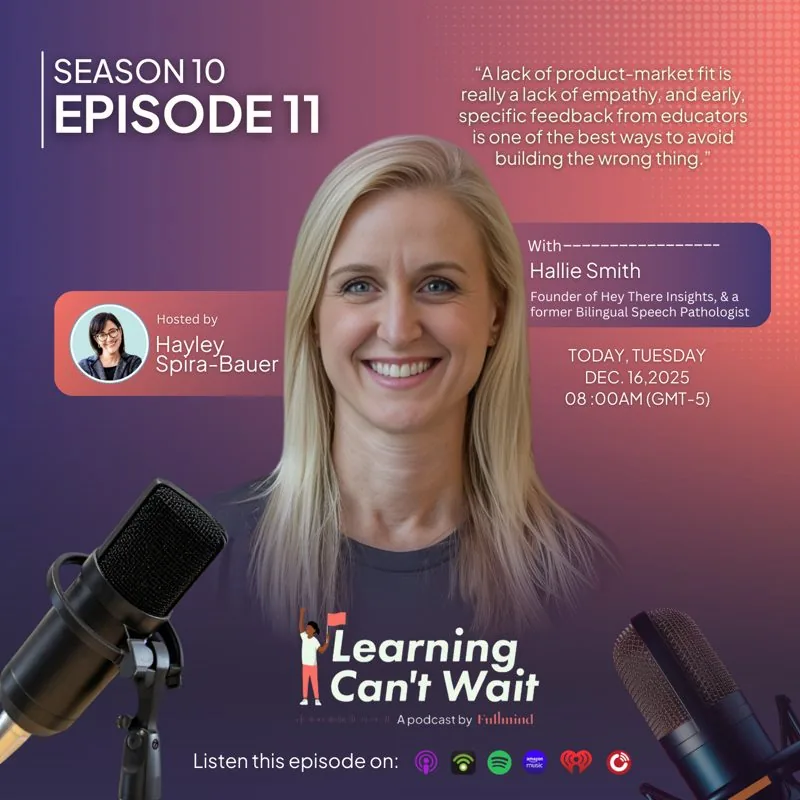
Hallie Smith: Product‑market fit, Educator feedback marketplace & Edtech empathy
- Hallie Smith
 Hosted by Hayley Spira-Bauer, Chief Academic Officer at Fullmind
Listen now
Hallie Smith: Product‑market fit, Educator feedback marketplace & Edtech empathy
Episode summary
Hallie Smith, founder of Hey There Insights and a former speech-language pathologist, describes an unusual path: 20 years at a reading intervention company, seven years as an SLP in San Diego Unified, then back into edtech marketing. A week after launch, she explains the marketplace where educators get paid for product feedback and founders get unbiased insight, built quickly with a two-sided marketplace platform and AI. She shares early reception, unexpected use cases like companies routing their own users through it, and advice for founders to get feedback early and make every research question specific.
Key takeaways
- Edtech is far more crowded than a decade ago; building is easier, getting educators to use a product is harder
- Founders consistently lack unbiased educator feedback, and educators are tired of giving it for free
- A lack of product-market fit is a lack of empathy; feedback early saves expensive engineering time
- Companies are using the platform to pay and manage their own users' feedback more easily
- Make each feedback project narrow and specific or the data will not point anywhere
About this episode
The episode follows Hallie Smith’s journey from two decades in reading intervention and speech pathology to becoming a fractional marketing leader and founder of Hey There Insights, a new marketplace that connects edtech companies with educators for paid, unbiased product feedback. She explains how advances in technology and AI have lowered the barrier to building edtech tools while dramatically increasing competition and making it harder to get educators’ attention and authentic input. The conversation highlights why early, specific, and compensated educator feedback is essential for true product‑market fit, reducing costly engineering missteps, and building tools that actually address on‑the‑ground pain points in schools.
Full transcript
Transcript generated from the recording; minor errors may remain.
Hayley Spira-Bauer: Welcome back, everybody, to the Learning Can't Wait podcast. We have my name twin on today, although pronounced a little bit differently, but she's more than just my name twin. We have Hallie Smith, the founder of Hey There Insights, and a former speech pathologist, joining us here today. Welcome, Hallie!
Hallie Smith: Hi, everybody!
Hayley Spira-Bauer: You know, Hallie, last week you made an announcement. And I very quickly messaged you and said, can you please come on the podcast and talk about this? It is so rare that I'm able to capture what's happening in real time on the podcast and release the episode, so all in, from the time you made this announcement to the time this episode goes live, we will be under 2 weeks' time. So this is live, coming at ya. Yeah. So why don't we start off, and I know that you have a lot to talk about as it relates to the platform you just released, the Hey There platform, but start us off by painting a picture and telling us, how did you come to be the personal and professional version of yourself?
Hallie Smith: Okay, Well, first of all, thanks for having me on and reaching out and, sharing this new service with everyone. So, I took a little bit of a different path than other people who have ended up in EdTech, I would say. I think a lot of it, people started out as educators and ended up kind of transitioning to the edtech world, andI started in ed tech, transitioned to be an educator, and then got sucked back in.So, I actually worked for a reading intervention company for 20 whole years, and in the middle of that, because they… sort of sold and targeted speech pathologists, I was exposed to this whole world of language learning and literacy, and I just fell in love with it and decided to go back to school and become a speech pathologist. So… In the middle of working for that company, I went to school and ended up becoming an SLP for San Diego Unified for 7 years. And I really credit that time to understanding the on-the-boots experience on the ground, you know, day-to-day life of an educator, and when some things were changing in the last funding downturn, and I actually got the opportunity to come back in-house full-time to the EdTech company, it was called Scientific Learning, and I started working on the marketing side, and realizing that I understood educators and could get them to kind of pay attention. So, that's what started my marketing, marketing career, so to speak, and I've been doing that ever since. And so, I… think I come at EdTech from… that perspective that a lot of educators come from, right? Which is, like, what's valuable to both sides. How can we make the biggest impact for students, or save teachers time, or help parents? You know, just, we're all kind of in this profession to help. So, I'd say that's a relatively short version about where I came from.
Hayley Spira-Bauer: Well, you have the inside and the outside perspective, right? So, because you began your career in edtech, and then went into becoming an educator. It really… and then went back to EdTech. I think it's probably even more unique than most folks who start in education and then move to EdTech, in that you probably had a lot of the perspective of… Who you were selling to, or who your organization was selling to. Under your thumb while you were working with kids. How do you think the industry has changed since your first step in EdTech.
Hallie Smith: I mean, so much. There's so much more competition, there are so many more barriers to entry in terms of getting traction with schools and districts, you know, just email spam blockers, and… You know, we used to… run webinars at Scientific Learning and get 7,000 people to sign up. I just cannot even imagine that happening now, because you can't even get your emails through to them, right? So… It's just a lot harder now, because it's so much more crowded. So I think on the one hand, the barrier to entry for edtech companies is lower because they can develop something much more quickly, like. Just because of advancements in technology, but the part where you… make the actual product useful to educators and get them to use it? That's a whole different thing. That's a whole different ball of wax. I think that's much harder now.
Hayley Spira-Bauer: Thinking about the level of competition that exists today versus even when I started in edtech, which was 9 years ago, and ESSER funding played a large part in the proliferation and creation of edtech companies, so truer today than it ever was before, and I imagine the boom we'll see while funding is more restricted at this moment in time, I imagine the boom we'll see from AI and the proliferation of edtech tools as a result of AI is also going to really, forever shape the trajectory of this space.
[05:00] **Hallie Smith:** Yeah, for sure. I think… just tying into what I just launched, I was just telling my sister I would not have been able to create that as quickly and seamlessly as I did without AI.
Hayley Spira-Bauer: What did you just launch? Tell everybody about it.
Hallie Smith: So, I launched a platform called Hey There Insights. It's a marketplace for educator feedback, although I am starting to, uncover some other use cases beyond feedback. And… so about 18 months ago, I branched out on my own as a fractional marketing leader, and I had a client, can't even remember which one it was, and they needed educator feedback. Like, they needed teachers to look at the messaging, or look at the product, I don't even remember specifically what it was. But I had this idea of having a marketplace where educators would provide feedback, they would get compensated, and edtech companies would get the insight that they needed to build their products. But I was busy building the agency, and things were kind of taking off, that has gone really well. And so I just kind of shelved it. And then EdTech Week happened, and I have this monthly meetup with other, EdTech sales and marketing people, and the topic came up again in the end of October, and people were saying that there was this theme they were noticing at EdTech Week where founders were not getting enough feedback from educators. And I got off the call, and then… something else happened. It was just, like, a couple little signs where I thought, you know, I'm gonna look into this. I'm gonna dig in and see if I can pull this off, basically, and kind of pull it off, you know, relatively easily. And, So that's what I ended up launching, just literally a couple weeks later, and I have a real bias to action, so I launched it without having everything super buttoned up and polished, just to kind of see what the reception would be. I'm a big believer in product-market fit, and you want to see if you have something early. So, That's what I launched last Tuesday, just 7 days ago. Hey There Insights, it's called.
Hayley Spira-Bauer: So how did you build it?
Hallie Smith: I used a platform called Sharetribe, I think the URL is mysharetribe. It's a two-sided marketplace software that is built for this kind of interaction. Which of course made the process, like, so much easier. And you customize it to your needs, and inevitably, you know, I thought it was going to… work perfectly, so I got, like, 90% of the way, probably in 8 hours, very quickly. Wow. And then the last 10% has taken, I don't know, 40, because the devil's in the details, and, you know, when I got into it, the platform didn't quite have the terminology for educators, or… the interactions on the projects didn't quite work the way that I wanted it to. So, but that's the platform I used, and they have tons of marketplaces on, like, everything from, like, bike parts to… I don't… to, you know… prenatal care, I mean, they have everything, so it's just a platform. I think it's actually out of Helsinki, which is interesting.
Hayley Spira-Bauer: Cool. So you manage building it, getting that last 10% done. It's been live for a week. What's the reception been like from the space?
Hallie Smith: So it's been very positive. One thing that happened probably about 3 days before I launched it, which was another good signal, is an educator named Courtney Bach posted on LinkedIn about how she was tired of being asked for feedback for free. And…
Hayley Spira-Bauer: I saw that post, that's one.
Hallie Smith: Yes!
Hayley Spira-Bauer: Yeah, that's when I first learned that you were launching this new tool.
Hallie Smith: Yeah, so it had over a thousand likes, it had, like, over 50 reshares, and that obviously got me excited, because I was about to launch the actual thing that would compensate educators for their feedback. So… So, I put it out there, I've had some, you know, I've offered free listings to get it started. And I've had good initial reception. I've had 9 projects posted. There's some people that are taking a little time, you know, kind of trying to figure out exactly what they want to post, and maybe it's, like, a little bit premature, they want to do it, but they're not quite ready. There are about 20 educators on there, and I really haven't started promoting it yet. My whole plan was to start with the projects and then go out and find educators, but when people have heard about it, they've told other educators. I think that's how they've, kind of. Come through, and people are starting to engage through the platform, like, independently. So I can see, you know, kind of on the back end, all the correspondence that's happening already between educators and founders, and that's obviously very cool, that's the whole point. And, the payment process is really seamless, So yeah, I mean, it's going. I'd like to get… probably, like, 20 projects would be my sweet spot, just so that when I really go out and start investing in driving educator signups, that they are excited to get in and bid, basically.
[10:00] **Hayley Spira-Bauer:** So first, Hallie, you're a marketing leader, what's the website? Tell us where to go to find it!
Hallie Smith: So it's heythereinsights.mysharetribe.com, so eventually it'll just be heythereinsights.com, but it is in a little bit of a beta version.
Hayley Spira-Bauer: Hmm.
Hallie Smith: So that's the current URL. You know how software platforms are, it's like… every piece is an upgrade, right?
Hayley Spira-Bauer: Sure, sure. No, I'm still in that, like I said, in that… You need to figure out if you have that product-market fit you spoke about, and then you're going to be willing to invest more resources.
Hallie Smith: Exactly, yep, and then, like, you know, the next phase, like, involves upgrading to Zapier, and, like, it's a whole thing to kind of take it to the next… to the next level, which I probably will be doing.
Hayley Spira-Bauer: Yeah, I mean, already I could see such a use case for this. Hallie, one of my favorite questions that doesn't… not everybody likes that I ask is.
Hallie Smith: Yeah.
Hayley Spira-Bauer: How many educators are on your executive team? When I meet… when I meet early edtech companies, or any.
Hallie Smith: Yeah.
Hayley Spira-Bauer: How many educators are on your exec team? And if the answer is zero. How are you collecting insight about what pain points actually exist in schools today? Even so, an organization like Fullmind, for example, has me, but I haven't been in a classroom in 9 years. I haven't been in a school in 9 years. We have other team members that have been more recently, but when I was the only academics team member, my experience was relevant, but I wasn't still living and breathing. Plus, if you haven't been in a classroom or a school since COVID, I'm talking about two different apples and oranges here. We're not talking about the same game anymore. So, I find it so important that EdTech companies have insight from folks that have their boots on the ground, so they can build their product in meaningful ways, not just what they think is a good idea. This is so cool to me, Hallie!
Hallie Smith: Okay, so a couple things. So, a couple comments on that. So, Matt Greenfield, of Rethink Education, I have no connection to him, I'm just connected to my LinkedIn, but he posted this report on learnings from having worked, you know, a long time in edtech. And… one of his first points was that a lack of product-market fit is a lack of empathy. And that really stuck with me. I was like, wow, that is so true! And it's because people think they can… And, you know, for good reason, think they can improve an educational system or improve educators' lives. And then, I think they get blinded by their own ambition, sometimes. And they go out and they don't get product-market fit, right? So, the second thing I was gonna say is… I have gotten comments on the… my release posting, on the LinkedIn posting, with people saying, I'm bootstrapped. And I'm like, okay, yeah, I understand that, buthow much money are you going to waste by not getting feedback early?By not finding product marketing? So I think… and then… and then also, I'm like, I'm also bootstrapped, right? Sure. Like, we're all bootstrapped. We're all kind of doing this, on our own, right? Or a lot of us are, not everybody. And so, I just, when I thought about that, I thought, wow, that is… not the right way to think about it, just to be fair, you know? The amount of… The value on getting early feedback is… Huge. Because, obviously, it's going to prevent you from making mistakes.
Hayley Spira-Bauer: Well, I mean, you know whose time is the most expensive in any edtech company? But… is the engineer. And so…
Hallie Smith: Oh, God!
Hayley Spira-Bauer: You have engineers, hours spent on building tools that turn out not to be valuable.
Hallie Smith: Right. Like, to your point, you may as well invest that money a little bit earlier on and get that feedback. And there are so many points of friction, right? So there's… there are so many points of… or opportunities for feedback also. So let's say, you know, a lot of the companies that have come forward and wanted the free listings. Have a product built, but there's friction on the sign-up process, which everybody, you know, faces. You know, every product-led growth-type company I've worked for, we're always, like, tweaking the onboarding process to try to reduce friction and get people to that aha moment as quickly as possible. So, that alone, that one little step, that can make or break you, right? Yeah. The product is super powerful. So, I just… I think there's a lot of different ways this can be valuable, and mutually beneficial, right? So I'm hoping that the mutual benefit has exponential, sort of. Virality, right?
[15:00] **Hayley Spira-Bauer:** Yeah, that network effect of a market.
Hallie Smith: Marketplace, exactly. Yes, exactly.
Hayley Spira-Bauer: Hallie, tell me about what use cases have evolved that you weren't expecting in the past week.
Hallie Smith: Yes, okay, so the main thing that's come forward, which I was not expecting. Was people saying, I do have users, so I was kind of expecting that the people to come forward would not have access to educators, and that has not been the case. The people that have come forward do have access to educators, but they've already used the product. And they… Believe that those people who've already used the product are not providing a fresh, unbiased perspective.
Hayley Spira-Bauer: Hmm…
Hallie Smith: So… whether… so the word that keeps coming forward, because I've tried to meet with everyone who's posting a listing, is bias. They're like, I want feedback that is unbiased. I want teachers, or admins, to tell me the actual truth and not spare my feelings.
Hayley Spira-Bauer: Okay, I like those leaders. I love that!
Hallie Smith: Yeah.
Hayley Spira-Bauer: Unbiased feedback. That's awesome!
Hallie Smith: Yeah, so one of, one of the, the companies, it's called Stickety, She also said that this sort of posting her project on my platform, and then sharing it out with her users would make her feedback process a lot faster and easier, because… if you have ever gotten feedback on a marketing or product side, you then end up spending all this time, like, send me your email, and let me send you the gift card, and let me, you know, you'd spend all this, like, time going back and forth on just getting the person the compensation, or you're coordinating on trying to get to the people, right? So there's just… Yeah. That's a use case that I was not anticipating either, that people would want to post a project and share it with their users to facilit… to more easily facilitate the back and forth, because the payment is in Stripe, and it's quick, right? It's easy, it's… that's what the platform is built for. So those are a couple things that have come forward.
Hayley Spira-Bauer: That's really interesting. I am super excited that I'm getting to talk to you so early, and I know that when I next see you, because I get the chance to see you pretty often, through one of the groups we're both a part of. I know that I'm gonna get a very different story, like, Hayley, I have too many organizations trying to come on board, when do I cap it?
Hallie Smith: I think so.
Hayley Spira-Bauer: I anticipate this to be something really valuable for the EdTech ecosystem, in that I believe it is a major pain point for organizations in their growth strategy, and now there's a place they can Go and get help. Quickly.
Hallie Smith: Quickly. Yeah. That's… I think just, like, reducing, again, sort of using that word friction.
Hayley Spira-Bauer: And reducing the friction on feedback, right? Yeah, I talked with.
Hallie Smith: A product, like a VP of product on Friday that we had connected prior to me even launching this. And he said that they were paying $15,000 to $20,000 a year to use, a different platform, just that's non… that's not educator-specific. And… that was exciting to hear, because with one that is educator-specific, then, you know, to have that same kind of value, I had not really considered that people were Investing that heavily in platforms just to help them Get feedback, and do user testing.
Hayley Spira-Bauer: That's very cool. Hallie, you know, this is a quick conversation, so you could share with everybody about, hey, their insights. Can you tell me, as a final question, what advice you would give an EdTech founder who is… Trying to build the best possible product to help teachers and leaders and students in schools.
Hallie Smith: Absolutely, I think it ties back to what we said before, which is, obviously, the more feedback And conversations and experiences you can have in… with your ideal customer profile, the better, the more insight you're going to get. But I also think… That when you go to craft your project that you want the feedback on. I… I feel like earlier in my career, I made the mistake of… asking questions that were not going… that if I got the answer, they were not going to lead me to the… to any clear outcome. Right? So, like, you build a survey, and you think you've gotten… you think you're going to get answers to the questions that you need answers, and you're going to be sent in a particular direction. Inevitably, the questions are not specific enough to actually send you in any given direction, and then you just have more questions. So what I've been encouraging the founders I've talked to this week is justget super specific on exactly what you're looking to accomplish with this one project.So if it's onboarding. Are they activating… you know, at a higher percentage than your control group, right? Just get… just get, like, as narrow and as specific on exactly what you're looking to accomplish, because if you don't do that, you're gonna get sort of, like, gray… data, for lack of a better term. Sometimes. Sometimes. That has happened to me. And so, I would say, yeah, get as much feedback and have as many experiences as you can with the group you're trying to help, and then when you do go to set up projects to elicit feedback, make it specific. And obviously, there are people who specialize in this, so I'm not saying anything, like, earth-shattering. This is a whole art in and of itself, right? But…
[20:00] **Hayley Spira-Bauer:** Oh, it's a good… it's a good reminder, and… One way to gather some of that data, as we now know, is to go to https:// heythereinsights.mysharetribe.com. Hallie, thank you so much for coming on here and talking about this incredible new platform you've built. I'm excited to have you back in a few months when it's really taken off.
Hallie Smith: Thank you so much, Hayley! I really appreciate it.
Hayley Spira-Bauer: And thank you, everybody, for tuning in.