
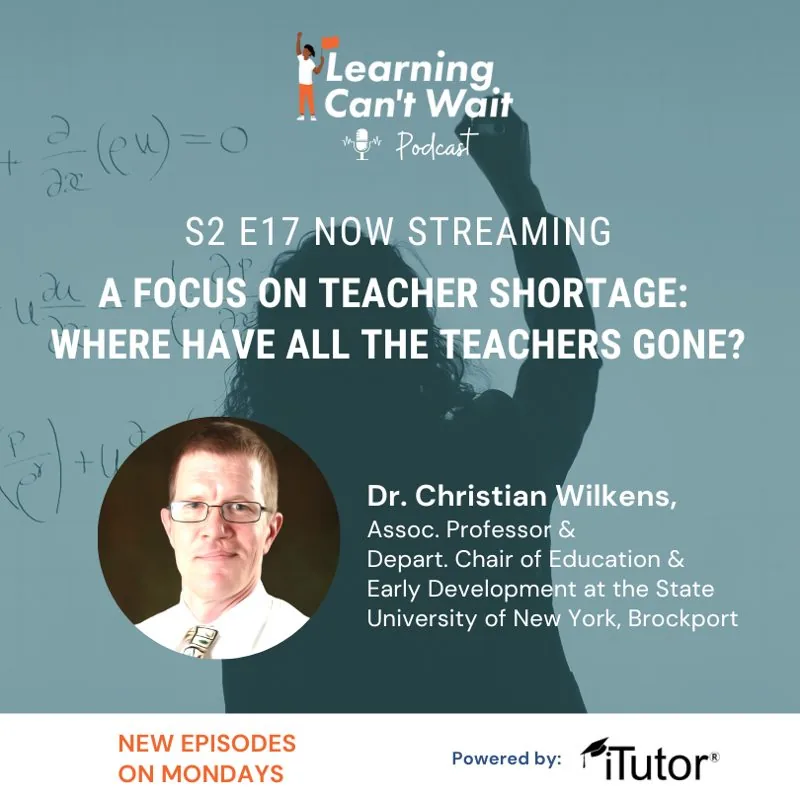
Learning Can’t Wait · Season 2, Episode 17
Christian P. Wilkens: Teacher Shortage, Education Inequality, Education Workforce, Diversity
- Christian P. Wilkens
 Hosted by Hayley Spira-Bauer, Chief Academic Officer at Fullmind
Listen now
Christian P. Wilkens: Teacher Shortage, Education Inequality, Education Workforce, Diversity
Episode summary
Christian P. Wilkens, associate professor and department chair at SUNY Brockport, traces a path from aspiring veterinarian to the Mississippi Teacher Corps, high school science and special education, and teacher preparation. He explains why the pandemic revealed teachers' value and deepened inequity across America's fractured, localized system, and describes rural Alaska districts where 75% of teachers are on temporary J-1 visas from the Philippines. Teacher prep enrollment is down a third nationally, yet Brockport grew 36% in five years. He welcomes apprenticeships that lower entry costs and diversify the profession.
Key takeaways
- Teacher prep enrollment fell about a third nationally since 2010, but Brockport grew 36% in five years
- Shortages are many shortages: special education, STEM, world languages, CTE, and under-resourced places
- Alaska imports teachers; one district relies on J-1 visa teachers who must leave after three years
- Apprenticeships and residencies lower the cost of entry and could diversify a 79% white workforce
- Retention depends on working conditions and feeling effective; preserving the status quo is a weak case
About this episode
We’re excited to introduce you to Dr. Christian P. Wilkens from the State University of New York, Brockport! His extensive research focuses on school leadership and school choice. He also serves as a school improvement and literacy coach in rural Alaska and consults with school districts in special education and teacher recruitment.
Tune in as he gives us a 360 perspective on the cause of teacher shortages.
Learning Can't Wait is brought to you by iTutor.com.
Full transcript
Transcript generated from the recording; minor errors may remain.
Hayley Spira-Bauer: Welcome back everybody to Today's episode of the Learning Can't Wait. Podcast with us. I have Dr. Christian Wilkens and Associate Professor, and the Chair of the Education and Human Development Department at SUNY Brockport. Chris. Welcome to the podcast, Hayley. It's a pleasure to be invited. Thanks. I'm. So excited You're here today for a host of reasons. You traveled through time and space to make sure you were home today to be able to record, and for that I thank you, and i'm excited for you to share a little bit about as we talk all of your work in education with teachers and the teacher pipeline. I think today's episode, entitled, Where have all the teachers gone? Is going to be an interesting one.
Dr. Christian Wilkens: Well, you certainly landed on a topic near and dear to our hearts. So i'm glad you're highlighting.
Hayley Spira-Bauer: Well, to start us off. I think it's always helpful for our listeners to get some context on our speakers, so i'd love, if you could please share how you became the professional and personal version of yourself.
Dr. Christian Wilkens: Well, it I I would say it. It was kind of an accident. I was supposed to be a veterinarian as I grew up. That's what I always wanted to be. But in college I started to Ta. I was a teaching assistant for an intro biology class, and it turned out I loved it. I loved working with students. I loved figuring out how to explain complicated things quickly, and I just really enjoyed spending time in a learning environment. So I got off the veterinary Hamster wheel and landed in teaching down in the Mississippi Delta as my first teaching job and have grown from there, and I I keep learning new thing. I never meant to end up in college either. And yet here I am.
Hayley Spira-Bauer: You never intended to start in a college yourself or a tender college. But now here you are. Wow! That is a different trajectory than I think. I was anticipating that you would share Here, Talk to me a little bit about now that you are working at SUNY Brockport, and your experience how you came to lead a department that is so focused on developing teachers
Dr. Christian Wilkens: Well again. I'm. Still not sure about that they haven't fired me yet. But I was hired as a foundations teacher, so I I came to Brockport after having taught both at the high school level in science and in special education, and my day to day is supposed to be teaching, like intro to teaching those foundational diversity and education sort of classes, and I've had a great time doing that. Our department is fairly big. One neat thing we do in college, which we never do in K-12 schools is we rotate leadership. So I got here. You know, part of the part of the job here is to write and publish and get tenure, and once once that was wrapped up on my end Um! I I landed in a leadership role, not really intending to do that, but more as a caretaker than anything else, and I I still feel that as a responsibility like I care about my colleagues, I care about the profession. I want to do right by everyone. Um! But a neat aspect of the work that I never expected is that when you rotate leadership there's an accountability to each other that, I think is not necessarily felt elsewhere. Like a school principal, is never going to step down and be an English teacher after they're done. Principling that just almost never happens, but it does here in college. And so the the people I'm supervising right now whether i'm accountable to them immediately or later. I I am aware that these are always going to be my colleagues, and this is always going to be my department, to whom I own my best service. So it's It's been a lot of learning the pandemic has been interesting and scary in a lot of ways. I know we're going to talk about that. But the the context of higher ed has been eye opening in that sense for me
Hayley Spira-Bauer: It's almost as if you slipped in that notion of how Schools, K-12 schools don't operate with rotating leadership and secondary education does. I wonder if that's a model for the future?
Dr. Christian Wilkens: Yeah, I I have no idea. It's how it was when when I got here. It's how it will continue after I step down as chair. I I I do see it as a strength here. But it it would take a little bit of reinvention to apply that to A. K-12 model. I think.
Hayley Spira-Bauer: I bet that's true, I bet that's true, indeed. So i'm. I'm thinking about your own schooling, and how your path took on a different journey than you are anticipating. When you think back to your own time in school, were there moments that stand out as transformative to you as a learner?
[05:00] **Dr. Christian Wilkens:** I think so. It. It turns out my best teacher. I I like this question. I I thought about it a lot. My best teacher in high school is actually my cross country coach. I love it. Tell me more. He was a guy coach call. He always emphasized improvement right like I was slow and pathetic when I joined the cross-country team sophomore year. And yet he was unfailingly positive, he said, Everybody can get better. And that's the fastest people, the slowest people like me. We can all get better if we work hard and have faith and support each other. So he was a big fan of teamwork. He was a big fan of of investing yourself, and gradually improving in that. And that really stuck with me. And, as far as I can tell, he's right, and and he's right in all kinds of domains. That that certainly helps me. And yeah in college I just remember watching a whole lot of Bill Nye, and and just find finding humor and inspiration and finding people who are passionate about what they do and just want to share that joy like, Why Was this Tv show such a head? Well, because pretty clearly Bill and I loved the heck out of what he was doing, And I think we all feel that in the class when teachers are the same way.
Hayley Spira-Bauer: So I I don't know watching Bill Nye And being on the cross-country team, those were transformative for me. My dad always laughs, but I tell my son, you know there's always going to be someone faster than you. And his new thing is to tell me like Name the Peak athlete, or watching soccer right now. It's the World Cup. Oh, no, it's better than Ronaldo. It was okay. But okay, maybe there's one best, but like after that oh, everyone has one better than them, and I think it's a good lesson that it's not about comparing yourself to others. It's about being the best version of yourself, which is really hard for a six year old to grapple with. However, maybe retrospectively, he'll have a realization, just as you have it. I'm grateful You're sharing that as a parent. It really uh
Dr. Christian Wilkens: It really strikes home for me. Well, I mean when you're six. You're supposed to climb up on top of whatever's in front of you and look down on stuff that that's, I would say, developmentally appropriate. He's fine. Yeah, I mean, he's on it. You're right. You're right. But in terms of Bill Nye right to go to your second example.
Hayley Spira-Bauer: Who you can tell when a teacher loves what they do. You can, you can tell when they love their students. They love their content. They get excited about getting students excited. Oh, man it it. It's tough to think that this profession, and obviously we're that's our topic today, this profession. It has so many more teachers who maybe don't feel that passion today for a whole host of reasons we'll get into. So maybe maybe we should just get into it like if you are going to give a state of the Union on education today. What key points would you make?
Dr. Christian Wilkens: I? It's hard to do this without a long historical wind up. Um! But I I would say there are a couple of clear opportunities right now. So you were there, you remember, in two thousand and one no child left behind. We all decided the teachers were a big problem. Um! And for a long time they were the focus of a huge amount of effort to improve student learning like, if teachers are the problem, all we've got to do is make sure that teacher quality improves, and then everything will get better from there.One gift of the pandemic, I think at least early pandemic is that we all realized how deeply valuable teachers actually are.You know, when when we didn't have them for a few months, or even in a couple of cases, a few years. Parents, communities, all of us realized. Oh, no! These are central human beings to our lives. We need them and we need them good at their jobs. We need them ready to inspire our kids. And we have pretty hard data now with the recent NAEP release that when we don't have them, or when our learning environment changes drastically like things, don't go well. So I guess right now. The state of the Union in teacher education is that we're aware of the value teachers, and I think everybody's rooting for us. Um! They might have different ideas about what to do from here, but I I think there's more consensus now about the importance of quality educators in all manner of senses, not just from the technical like, are they the top notch college graduate, but, like, are they good with our six year olds? Is a a deeply important question. I guess the other thing that's become obvious because of the pandemic. We've always known we We have this incredibly distributed model of public education in the United States, like New York, State alone, has seven hundred different school districts, plus both these plus private schools, plus kids who home school, it's it's it's really fractured. And so the experience of kids is really deeply variable, and we've seen that through the pandemic kids in wealthy districts who are surrounded by families who have high educational attainment. They've done fine, you know. It was a disruption. It was an inconvenience. Somebody like being on zooms all day. But those kids did. Okay, It was all of the communities who were under resourced. Going into the pandemic Low income school serving a lot of title. One kids communities of color students with disability. They got underserved throughout the pandemic, and they're coming out worse on the other side. So I I think right now. We're all seeing the harm that that incredibly localized system of public education can do if you just let it keep running like the haves keep having and the have not continue to face harm. So I This is not probably at all popular, but it's a clear argument on my end, anyway, for a more coherent centralized system of public education that has a much stronger Federal role in addressing inequalities. We don't have that now. I I think it's pretty clear to my thinking that we'd need it. Whether or not we've got the stomach to go after. I have no idea
[12:00] **Hayley Spira-Bauer:** An episode of the podcast that's being really very shortly is on this exact topic fractured learning and education. Today it's actually at the school level, so like the learning experience, how varied. They are within a school building, no less at the Meta level right? Which is what you're naming amongst schools or between schools, is an even greater amount of variance as you as you're needing. Your expertise is, of course, in New York State, but you have some experience in rural education as well. Right? You've you. Recently I alluded to your travel plans. You recently got back from Alaska, where you do some work with schools. Tell us a little bit about how different the experience for teaching and learning is in Alaska versus here in New York, and how you think the pandemic affected that community as opposed to what you see in New York.
Dr. Christian Wilkens: Yeah, I mean it. It's interesting that jumping between Macro and Micro. So So in my community, I'm: i'm just outside Rochester, New York. There's a a street Monroe avenue that goes between one of the wealthiest communities in New York State, Pittsford, and one of the lowest performing districts Rochester, in New York State. They're two miles apart, so you can drive from one community to the next and get a world class education. Or Ninety-nine of the kids go to college, and we just got New York State testing data released last week where two of the kids are proficient in math, and the Rochester City School district. Just two percent same is true if you look across it Alaska and New York. So i'm. I'm back from Kalskag, which is in the southwest region. In New York State historically. Anyway, we've we've had an oversupply of teachers, so we have a lot of colleges. We have a lot of universities. We grow a lot of teachers here, and that has generally kept up with demand from school districts. So people go to college Here they gain teaching credentials, they get hired, and, in fact, there's more of them than New York State can hire, so they go elsewhere. They go south, they go west. They follow demography in Alaska. They don't grow that many teachers there aren't that many colleges and universities. They only supply about twenty of the teachers they need. So Alaska is an importer of teachers that used to be fine when the oil prices were up and salaries were good. It isn't any more, and Alaska got away with future pensions. And so right now the teacher shortages up there are huge. They're ongoing. They are going to be multiple years continuing into the future, and what I saw in my district is really common throughout Alaska. The district is importing a lot of teachers from the Philippines, so seventy-five of the teachers in the district where I work are on J. One visas from the Philippines. They have temporary credentials that that is not a pathway to citizenship. So none of these teachers are staying. They can stay for three years, and then they gotta go home. And so this is kind of analogous to you know. I'm sure you've pondered programs like Teach For America or my teacher. Prep. Program was a Mississippi Teacher Corps at the University of Mississippi. The sort of temporary. Get them into the classroom for a little while, but don't expect anybody to stay. Alaska is doing that almost statewide right now. Knowing from day one that these are not people they can keep, but they need people in front of the classroom.
[15:00] **Hayley Spira-Bauer:** It is a very, very unique set of circumstances that are not unique across the part of America that is very rural. I had a conversation with a gear up leader from the State of Montana who shared a similar. I need to import teachers, although they're not using the same model as what you're naming in Alaska. They are really challenged by teacher shortages and just due to the geograph the lack of geographic or, excuse me, population density in the rural parts of the State, which are actually higher levels of lower lower levels of density than Alaska statewide in Montana they are facing some significant need to attract people to the to the field, to the geographic region. In order to serve students. And you know the challenges that, like teachers, can't be invented out of nowhere, Right? You. You can't just produce a teacher overnight, so it definitely feels like what you're naming from the communities you're working with in Alaska is an attempt to rectify a significant problem with many, many barriers in front of them.
Dr. Christian Wilkens: Well, what I think what you're talking about as well is, is common across all States and Territories in Washington, Dc. It takes a long time to grow a teacher, and so you'll see different jurisdictions chasing different ideas like Florida, has become notorious for their hey? If you served in the armed forces. You can get an emergency teaching credential just by signing on the dotted line. Because I guess the theory is you can manage a class. You see places that have really high capture rates of charter schools like in Washington, Dc. Or New Orleans, or across Michigan or Arizona, where you don't have to have a credential to start teaching. But like Alaska's J. One visa heavy approach the question of retention and effectiveness immediately comes up like, Okay, Maybe we can fill today's needs. But are these going to be people who are any good at teaching? And will they want to stay? Kind of become tomorrow's question, and and that that does speak to. I. I think we are at a serious crisis point, for a lot of schools and rural schools are certainly being hit as hard as anyone,
Hayley Spira-Bauer: Absolutely you. So earlier as you started to describe what your work is in Alaska, you mentioned that there's a little bit of a surplus in New York State. So you know there are some trends that we're noticing in the teacher. Prep. Space. Let's let's talk about those trends first, and then we can dial into New York State, which is a bit of an outlier in some sense. So so what are the trends. You know you're You're in higher education. You're helping teachers become teachers. What do you notice is occurring in the fields around you?
Dr. Christian Wilkens: One of the big trends over the last ten years has been enrollment to clients in teacher Prep. So nationwide, we're down about a third since two thousand and ten. The and that's that's true. In New York State as well we are. We are down substantially over the last decade or so in terms of who signs up and says, Yeah, I want to teach the and that's overall, right. But but teaching Isn't any one specific thing right? You need math teachers. You need third grade teachers. You need science and technology. You need special education teachers. And so the teacher shortage is likewise a bunch of different shortages. And So, too, is the landscape variable, like a lot of people want to become elementary teachers, and a lot of people want to become high school social studies. Teachers. I don't know why social studies, but that's really common. I don't mind, but that's not where the jobs are like. There is huge demand for special education for world languages, for science and math teachers. For CTE teacher like current and technical education teachers, we can't find nearly enough of them. Nor can we find enough people who want to teach in cities or world places like There's really high competition still for suburban jobs that pay well that are stable that have a professional workforce that can do things like mentoring over time. And there's very low supply in some of the stretched and under-resourced environments like like rural Alaska, or like Rochester, New York, so that the overall decline is real, and that's made all these very specific localized subject area, or geographical shortages even worse. Um! So we we see in in Rochester, for example, nobody's coming into the bilingual education, pipeline. And so what is the city district? Do they hire anybody who can speak Spanish or Napoleon, or whatever the language background is teaching background. Be damned. You just need someone who can speak the language and talk to families and kids. Is that good for kids in the long term? No, but it it's hard to blame people for doing what they have to to keep the lights on and and the wheels turning.
[20:00] **Hayley Spira-Bauer:** So yeah, sorry to jump around from your You know it's It's impossible to talk about this topic in a focus manner because of all of the different components you're naming, and it's funny, honestly like the debate that went on over the the middle part of or sorry beginning of the school year in two thousand and twenty-two around. Is there a teacher shortage actually infuriated me because there has always been a teacher shortage. It is not in every subject, it is not in every I it's on every socioeconomic region. It is in historically marginalized communities in particular certification areas. That's not new. However, the pandemic did exacerbate a lot of the issues that we were facing one, because conditions have become more challenging within schools. Right? There was a recent article published actually just at the end of last week. Chris, you and I haven't even had time to talk about it by Annenberg Center about what is happening to the prestige of the profession. And why are folks shying away from becoming teachers right? That that relates to the enrollment issues. You're naming so so none of this is new, but it is. It is getting worse. As time goes on. However, an interesting note. This is not what SUNY Brockport is seeing. So talk to me a little bit about the trends that your community is noticing at home.
Dr. Christian Wilkens: Yeah, we're I don't. Anyway, we've been growing. I I don't know why our our enrollment has gone up in teacher education a little over thirty-six percent in the last five years, like we. We have seen strong entrance into Teacher Prep at Brockport, both at the undergrad and graduate level. So we've got traditional high school kids are coming to SUNY Brockport, and they're saying, I want to teach career changers like adults are saying. You know what I have a degree. I went out into the world. I worked for a while, and now I know I want to go into education. I don't have great theories about why we're heading in a different direction. You know, if you talk to my colleagues, they tell you I we're awesome, and our reput, I I think, to an extent we are responsive to a local or regional market. Right? So for a long time we had oversupply of a lot of different kinds of teachers. So our biggest program is in childhood education. A lot of our graduates took degrees, got certified, and then had to go elsewhere for their first teaching jobs. You know they go to North Carolina. They go to Georgia. They go to California or Alaska, and they come back after gaining a couple of years of experience and being they could now be competitive in a local job market with teacher shortage is becoming so known. Like everybody knows we need more teachers. Now, I think it's clear to college students and adult learners that you can get a job right. You can go and get a teaching credential, and you can stay local and get a teaching job now in a way that you couldn't before, so I I guess my my strongest theory is, people are aware of market conditions, and they're aware that schools are looking and and that's even true, likeevery single one of our math and science teachers is getting job offers before they finish student teaching.Our Spanish and French teachers are all getting job offers before they Student people are like, Oh, you exist, and you have a heartbeat. Come, sign on the dotted line. It's not great for kids in schools, but from a person who wants a job standpoint. This is a It's a very obvious and good time to get into the field,
[25:00] **Hayley Spira-Bauer:** You may not be able to pinpoint exactly why Brockport isn't facing it. I think you you've proposed a few good theories about the origins of the success that SUNY Brockport is seeing with recreating and attracting and retaining teacher talent, or soon to be teacher talent. But what's really mind blowing to me as I listen to you is how these folks are getting jobs before they're even done with their formal trainings.
Dr. Christian Wilkens: Well, and you and I have talked about it with with iTutor along the way. The The landscape of educational or occupational opportunity for people going in education is huge now. They can stay here in Western New York. They can pretty much name a context where they might want to teach. You know. I talked to college students all the time now about how they can go teach in other States, and they're like, really. I kind of want to go live with my sister in North Carolina, and that's easy. We can figure out the reciprocity, and you'll get work down there. So okay, it opens up their opportunities in ways that I think weren't real to them before. And now the cost of all of that is that schools all over the place, and kids all over the place need quality people, and are really struggling to find them. So they're I don't feel great about that element of it. I feel great for our graduates in that They can immediately get work and make a difference in kids lives in a way where you know they may have had to substitute teach for a while before they really got a real chance.
Hayley Spira-Bauer: The landscape is definitely changing again. Pandemic was a little bit of an accelerant on that. As there are a lot of a lot of other factors. I'm: Curious what opportunities you think there are to improve the teacher. Pipeline.
Dr. Christian Wilkens: Well, one of your questions that that you mentioned earlier is about apprenticeships and and different models that will get teachers into the field. I'm. Super excited about them. So in terms of what's good about what's happening right now. There's Federal money there's State money, and there's local money being invested into apprenticeships and residencies right now in a way that I've never seen before. So, for example, the United States Department of Labor right now is pushing a whole ton of money into teacher apprenticeships which have a couple of cool features like number one. You're absolutely right. It takes a long time to grow. A teacher that comes with opportunity costs right, like. If you have to go to school for four years and spend tens of thousands of dollars to get a teaching credential that limits who teaches right. If you can't afford those costs, either in time or treasure. You won't become a teacher, and so apprenticeships offer a different model that give income during your teacher preparation, so that I I think we'll see the door is wider open to more entrance into teaching than it's ever been, and especially a more diverse group. So teaching is notoriously white. It's about seventy-nine white right now. It's also disproportionately female it's about seventy-six percent nationwide women in teaching and that doesn't match the kids right. We We now have a P-12 population that is majority non-white. It's half young men We need a much more diverse teaching force, and I think apprenticeships are one way that could really support entry into the field among people who never would have taught before. So I love as much as I'm. Coming from a traditional college teacher Prep. Side. That is not the only way to get into teaching full disclosure. I went through Mississippi Teacher Corps I'm married to a TFA alum. There's still these alternative models that Don't come with high entry costs, I think, on to something that's really important and valuable, and I I would say, let let's go for and see where we get I don't know what they'll mean for teacher effectiveness, or teacher retention down the road. But right now we know we have huge huge issues in attracting people to the profession in the first place. So why not?
[30:00] **Hayley Spira-Bauer:** I think you're naming some significant. I like ideas that are being you implemented right now around the country with outcomes that we still are questioning. However, I like the way you're saying, Let's try it. Let's study it. Let's check on its efficacy. I also am really grateful for you, naming the need to increase the teacher diversity one because of the lack of it right now to because of the research proven benefits for particularly children of color, to have teachers of their likeness in front of them in the classroom. I think it's a often overlooked need. And so, as I explore more about apprenticeship models, they're newer to me as a human. That is one that I am excited to explore a little bit further, and the opportunity and upside there. So thanks for naming that for our listeners today, and for me,
Dr. Christian Wilkens: You know I, this is going to sound like I'm slagging on my profession, and i'm really not. But it. It's hard to look at our current landscape of student achievement and outcomes, and be terribly proud of where we are yet right like this. You look at our recent two thousand and twenty-two NAEP long-term trends. We are not where we need to be right, like kids deserve so much better. And so any argument that just says, Well, we can't possibly do anything new we need to preserve the way things are is is suspect right? So I i'm all for new models that get new people into the field, because it's a very weak case to say. Well, we ought to just keep doing what we've been doing. We we know that we will get incredibly unequal results with kids if we just kept doing the same things over and over. So I I am optimistic about new and creative ideas. I i'm worried about how we take care of teachers. You know one one of the things that i'm sure you've been thinking about a lot is what it means to be a teacher right now, and I know that's not our topic right now. But, teacher, What a short it! What a teacher shortages Do they make teaching right now harder because everybody's covering for everybody else? Um! The experience teachers are mentoring all these newbies. It. It's hard to be a teacher right now. So so to an extent, what am I worried about? I'm. I'm worried about not just attracting new teachers. I'm worried about retaining the people doing it right now. And as far as the research goes, the reasons we are able to retain people is is, if they have good working conditions, you know. If they like their jobs, if they feel like they're effective, they stay. The second they feel like they're not effective anymore. They go do something else.
Hayley Spira-Bauer: It is a very concerning topic talking about the teacher Pipeline talking about the conditions of teachers today, and I also agree with you wholeheartedly, Chris, that anyone who thinks we should continue on the path we're on right now is sorely not looking at the full landscape of education in our country, and the impact we're having on children. And the impact we're having on the people who are expected to teach children, if ever. And I feel like my listeners who listen to repeated episodes, and maybe it's just my mom. Hi, mom, um! We'll say they hear me say this all the time, but if you aren't here to continually improve. Then you're in the wrong profession. Education should be about growth, growth for students, growth for teachers, which is what we call professional development very often, but also growth for our model to reflect what the current science tells us, and what we see is not working. And so I think you and I could probably spin off a few episodes, talking about growth and and how and why, and Iv. Eight on all sorts of initiatives and efforts, we see happening, whether it be right here in the United States, or even across and overseas that are worth exploring. I don't know that we have time for it today. But I am. I am very much aligned with you that we really all need to take pause, and if not now, when, because this is the right opportunity for changing a lot of what we see around us.
Dr. Christian Wilkens: Yeah, agreed I i'm, i'm circling back in my brain to to Bill Nye right. Who I I blame to a certain extent for for me landing in this work. Um! We need to make sure that there's joy with kids every day, you know, like like you mentioned kids know when they walk into a classroom, if their teachers want to be there, if their teachers are stress, if their teachers feel confident and joyful in the work, we need to make sure that every kid does have an opportunity to have that teacher in front of the classroom. Who's sharing that excitement? Who's loving what they do, and loving the heck out of the kids? And And I know that feels very squishy when we're talking about numbers and retention and recruitment and apprenticeship models. But but that's the heart of it right. You You have to have good caring adults with kids every day, and I I guess i'm agnostic on the model that gets them there. And right now we we don't clearly have enough of them. And so I I think it's a good time to be talking about expanding the models and expanding who teaches?
[35:00] **Hayley Spira-Bauer:** I love that you know it. It's a perfect segue for my close-up question, which is what I always ask my guests. But it's a perfect segue, because there are teachers in during the field every day. So we know that, you know there are still thousands of teachers every year becoming teachers and entering classrooms for the first time. So what advice, Chris, would you give a teacher starting their career?
Dr. Christian Wilkens: I thinkyou've got to find joy in being around young people?This may seem obvious to someone like you who's been thinking about education and doing it for so long. But i'm telling you, Hayley, every semester We have student teachers who come who come to class, and they're like, I guess I didn't realize what this was going to be like. And and you asked them a little bit like, What do you mean? What are you talking about? People don't know what teaching is like until they try it, and what it's like is you're spending all day every day with young people, right? You're in a room You got five or fifteen or twenty-five kids that you've got to motivate, and inspire and engage like all day long every day the kids keep showing up, and if you don't love that, it's not the right work, and you've got to find that out somehow. And so I I guess my best advice is, people are going to tell you eight thousand things right like Use this curriculum, or use that approach to classroom management or do that professional, whatever it is. Sure they're probably all fine ideas. The thing that's going to keep you doing it, and that's going to keep you good with kids is if you love being around those kids. If those learning experiences are meaningful and fun and engaging, you're going to love what you do, and you're going to keep at it, and you're going to work hard to learn more and keep growing in the profession, so
Hayley Spira-Bauer: I I hate to be as simple as like, find joy in the work, love being around kids, but that that's kind of where i'm coming from. But given what we know to be true about teaching. That is the work. So I I think it's very apt for you to close on that note and to share that piece of advice. Chris, I love hearing your perspective, and I'm grateful. You joined the podcast today to share about what you're noticing in the fields. You're in it really close to some of the challenges that are being experienced by schools around the country, and also what hope you have for the future and ideas you have. So thank you so much for joining today.
Dr. Christian Wilkens: Well, Hayley thanks it's. I mean, this is work I love, and a whole dear to my heart. So Thank you. It's it's
Hayley Spira-Bauer: It's been a pleasure. And hi! To your mom also my mom and all the other listeners joining us today. Thank you for tuning in.