
Learning Can’t Wait · Season 12, Episode 10
Peter Bahr: Homegrown talent, Career pathways & Work-based learning
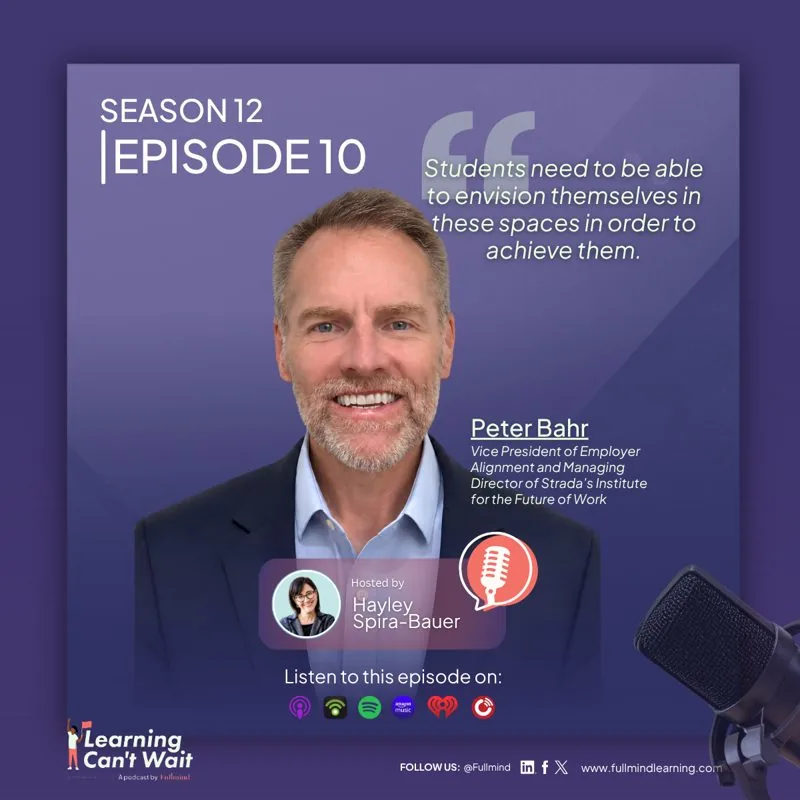
- Peter Bahr, Vice President of Employer Alignment and Managing Director of Strada’s Institute for the Future of Work, joins Hayley Spira-Bauer
 Hosted by Hayley Spira-Bauer, Chief Academic Officer at Fullmind
Listen now
Peter Bahr: Homegrown talent, Career pathways & Work-based learning
Episode summary
Peter Bahr of Strada Education Foundation shares his path from community college and wastewater treatment work to a PhD and a career studying education-to-work pathways. He walks through Strada's Talent in Motion report, which found two-thirds of college-educated workers still live in the state where they attended high school, ranging from Michigan at 72% to Colorado at 36%. He urges K-12 educators to talk early and concretely about local colleges and costs, tells policymakers to build on data rather than anecdote, and calls for internships across fields.
Key takeaways
- Two-thirds of college-educated workers live in the state where they went to high school
- Homegrown talent rates range from 72% in Michigan to 36% in Colorado; economic opportunity drives moves
- Teachers should talk early and concretely about nearby colleges, costs, and aid
- State policy should rest on actual retention data, not brain-drain anecdotes
- Internships and mentorship should be the norm across every field of study
About this episode
In this episode of Learning Can’t Wait, Peter Bahr, Vice President of Employer Alignment and Managing Director of Strada’s Institute for the Future of Work, joins Hayley Spira-Bauer to explore how education can better connect students to career opportunities. Drawing on his own experience navigating college while working full-time, Bahr discusses Strada’s research on interstate talent migration, including the finding that 55% of college-educated workers attended both high school and college in the state where they currently work. He explains why developing local talent matters, encourages educators to introduce college and career pathways early, and urges policymakers to base decisions on data. Throughout the conversation, he emphasizes transparent information about college costs and career prospects, meaningful work experience, and mentorship as essential supports for students building their futures.
Full transcript
Transcript generated from the recording; minor errors may remain.
Hayley Spira-Bauer: Welcome back, everybody, to the Learning Can't Wait podcast. I am honored and thrilled to introduce you to our next guest. We have Peter Bahr, the Vice President of Employer Alignment and Managing Director of Strada's Institute for the Future of Work, joining us today. Peter, welcome!
Peter Bahr: Mmm, thank you for having me, I'm thrilled.
Hayley Spira-Bauer: I'm really excited to have you here, both because of the work that you're doing, and because of the report that was recently published. Before we jump into all that, I would love to know a little bit about you. How did you come to be the personal and professional version of yourself?
Peter Bahr: Oh, I love that question, thanks for asking. I… I am something like the poster child, maybe, for the work that Strada Education Foundation is doing. I… came out of a, you know, lower-middle-class family, you know, didn't have much or really any information about the connection between college and work, how to navigate those pathways, what my options are. It was all very, all very obscure. Of course, on the flip side… on the backside of that, now, having studied higher education and workforce for… the workforce for a very long time, I can see it all very clearly, how things… map from, you know, school to work, but as a young person, and so many young people in our country don't have a clear picture of that, and I didn't. You know, didn't have much support from my family. Going to college, was actively discouraged in some respect, and ultimately ended up meandering through four years of community colleges and a couple of years at a broad-access public four-year institution while, you know, doing what so many students do, working full-time. In my case, I… much of that was working full-time as a wastewater treatment plant operator. And commuting, you know, just the whole thing that folks really have to do when they're trying to go to school and trying to find their way to the right career path for themselves. Ultimately, us, Providence intervened, and… opened my eyes to the opportunity to pursue a PhD program in sociology, and I picked the nearest one, because I figured I would continue working full-time, as I had been doing for all of these years. Turns out you can't do that. I tried to do that for a year as a full-time doctoral student, teaching part-time, etc, etc, and you just, you know, you kill yourself trying to do that. It's awful. So eventually, I let go of my wastewater treatment job, and… And I just continued in my program, studying, sociology, studying, you know, quantitative methods, and trying to answer the question that I've always been obsessed with, which is, why do people do what they do? How do they… how do they chart the paths in their lives? How do they sequence the events? What are the implications of the decisions they make, and so on. But then while I was there, I was so accustomed to working, I just couldn't give it up, and I had a chance to take a position as a researcher initially with the California Department of Education, and then with the Chancellor's office for the California Community Colleges. And I was brought on board there to, utilize their, what was, at the time, a relatively novel idea, a longitudinal data system that had information on all the community college students in the state. And California is remarkable in many ways, but the California Community College system is the largest post-secondary system in the country, maybe the world, it's enormous. I think 117 community colleges currently, you know, millions of students and so on. And so I was there to help the chancellor's office make sense of what these data could tell us. And what I saw in the data was my own life. I saw students, meandering, struggling to find their way. Working while they were going to school, changing programs, you know, in programs that weren't aligned with their employment, and so on and so forth. And, and I think that… that just kind of opened up the world for me about how research could Answer the critical questions that students need answered, that workers need answered, that employers need answered, policy makers, instructors, institutions, like. The data are there, we can use those data to answer the critical questions that… that people need answered. And so I've been doing… working on that now for in excess of 25 years, I think.
Hayley Spira-Bauer: You know, when I hear a story like that, and how your brain felt tickled by this, you know, enduring question, and how your path was forever and is forever in search of an answer to that question. It speaks to me on a level as an educator and as a mom. That's what I want for the students I teach and the children in my home. I want… and around the world. I mean, I want kids to be so curious that they seek out pathways and opportunities to answer those questions, so I appreciate the way you shared your story, because it really resonated with the type of parent and teacher I want and strive to be. It's really meaningful.
Peter Bahr: It's inspiring the love of learning. Like, if we can help people, not just learning the topics that are presented to them, but learning anything that they encountered, right? This is the great human endeavor, is the ability to see something. Find it interesting, be inspired by our curiosity, learn it, master it, and then help others do the same. So, it's… it's wonderful.
[05:00] **Hayley Spira-Bauer:** So, when we talk about your work now at Strada, can you fill us in for how are you still asking and answering those questions?
Peter Bahr: Well, I, backing up just a little bit, my first, you know, finishing my PhD program, my first job out of graduate school was a faculty member, a professor in sociology at Wayne State University in Detroit. Fascinating place to work, you know, at one of the, you know, few urban research institutions, and it's a university that serves students that are very much like the path that I had been on, students who are working and carrying, you know, family responsibilities, you know, all the way from first-year undergrads all the way up to PhD programs, trying to just juggle life while they're going to school. And then I had a chance to go to the University of Michigan and serve as a faculty member there in the School of Education. It's a very different student population, as you can imagine, elite public university. And what I built there at the University of Michigan was a pretty strong portfolio of research on the education-to-work connections, particularly in the broad access institutions, community colleges, you know, the regional four years, and so on. Not exclusively focused on that, but largely trying to understand this space. And so, then I had a chance to come to Strada and join a colleague here, Heather McKay. In, you know, effectively relaunching the Institute for the Future of Work here. And the Institute for the Future of Work is a think tank embedded in this, nonpartisan, you know, national nonprofit foundation, and it's… the charge is academic quality, rigorous, field-leading research on the critical questions that, in fact, I had been grappling with all this time. And so what I brought into Strada was, you know, my experience, a number of, like, lines of research. Partnerships, you know, with states around the country, to develop large-scale research to answer these critical questions. And so, coming to Strada has been marvelous, because it's allowed me to kind of scale up everything I had been doing at the university for so long. And, and, and sort of inject it with the, incredible. Energy that Strada brings to everything that the organization does.
Hayley Spira-Bauer: You know, recently, there was a publication from Strada called Talent in Motion, Interstate Migration of College-Educated Workers. Is it a problem for college-educated workers to move between state lines? Like, what's the kind of, like, takeaway here at the highest level, and then we can dig in. You know, a layperson might not think this is a problem, so why do we care?
Peter Bahr: Yeah, I mean, that's such a good question. It is not a problem. In fact, it's wonderful that in America, folks can move to follow workforce opportunities or job opportunities. But from the standpoint of state policymakers, state policymakers are trying to make investments to build the economic… the workforce talent, the college-educated talent that we… that each state needs, and local economies need, to thrive, right? Like, the thriving economy, the resilient economy is built On this college-educated talent base. And so states are making investments to the tune of, like, maybe $150 billion a year, or something like that, in trying to build… in higher education, trying to build up this college-educated talent, but they're doing it largely blind. They don't have the information that they need about where their college-educated workers actually come from. So that's the driving force, the big picture driving force behind this report. And the interesting thing that came out of it Was that despite all this attention to drawing college-educated talent from other states. A lot of talk about that, like, how do we bring in college-educated workers from elsewhere? Or the loss of the college-educated workers that we're producing, that in fact,a majority of college-educated talent across the country is built right at home.Comes from the state's own high schools, and often their own Colleges and universities, which is. Exciting and exhilarating, and it tells states something about where they need to be investing to make sure that they can maximize the growth potential of their economies.
Hayley Spira-Bauer: Yeah, that number that I, was kind of looking at as a headline when I first looked at the report was that two-thirds of college-educated workers still live in the state where they went to high school. As someone who spent their career studying this, did that number surprise you, or did it confirm something you already suspected?
Peter Bahr: On one hand, you're like, well, of course, of course that it's their own high schools, but on the other hand, that's not what you hear in the day-to-day discourse or in the press, and so I was surprised, actually. I suspected that there would be a lot more mobility. And that college-educated talent would be built, you know, like you hear, the sort of recency effect of what you heard on the media last. I thought it would be built largely from… from importing talent. And there are states that… that are heavily… whose, you know, college-educated talent base is heavily built from import. Importing, you know, workers from elsewhere, but that is not the norm. And in fact, as you said, two-thirds from a state's own high school. 55% of college-educated workers attended both high school and college in the state in which they currently work.
[10:00] **Hayley Spira-Bauer:** You know, Michigan's one of those states that has, like, a very high homegrown talent rate, but Colorado doesn't. So Michigan's at 72%, Colorado's at 36%. What accounts for that disparity? Is it schools? Is it the economy? Is it culture? Or is it something else completely?
Peter Bahr: Yeah, that's, we're trying to figure that out. You can imagine with a report of this size, I think we were… 67 pages or something like that, enormously long. We had to stop at some point on all the questions we were trying to answer, but the work actually continues, and we already have a second wave of this work well underway, where we do a number of things, but one of them is to try try to understand more about why those differences are so large between some of these states. I mean, some are, you know, some states are relatively similar, but there are some of these large gaps. And, you know, some of it's probably industry-based, some of it's the nature of the industries that are… exist in these places, some of it has to do with the productivity of the state's own post-secondary institutions. Like, how many graduates are they producing? If you have a relatively low… number of graduates coming, you know, relative to your larger population, coming out of your own four-year institutions, then, unsurprisingly, the share of your college-educated talent that's coming from out of state is probably going to be larger. So I think that's definitely a component of it. And we're looking at the other factors that are associated with it. We see a number of, like, state-level factors are associated with things like college retention, you know. Retention after graduating. I mean, you know, strong economy, you know, good, nice temperatures, you know,
Hayley Spira-Bauer: I was thinking about the temperature there. Michigan, though, has 72%. It's really cold in Michigan!
Peter Bahr: Nice to the thumb.
Hayley Spira-Bauer: Summer, cold in the winter.
Peter Bahr: It's a lovely state. I gotta say, when I… when I… I lived there for a number of years before I now moved to Virginia, and when I, first met the woman who would eventually be my mother-in-law, she said, oh, the four seasons are lovely, they're lovely, you're just gonna love the four seasons. But having come from California, where there's basically two seasons where I lived, I thought, no, I don't need four seasons. Two seasons was plenty. But she's right, it is lovely there. It does get cold, but I don't think that that's… that turns out to be an association But when we ask why people actually move across state lines, the number one reason is economic opportunity. Across the board, regardless of age, temperatures, you know, the weather is a very low Consideration when we're asking people why they're moving across state lines, and it really is for the economic opportunity.
Hayley Spira-Bauer: You know, I live and breathe in the K-12 world. It's where I spend most of my time thinking and learning, so I really appreciate the opportunity to think beyond the K-12 world. I guess I would start by saying… or ask… asking you, what are the implications? Like, what are the lessons that K-12 educators who are listening to this episode and reading Strada report, what should they be taking away from this information that you're sharing here?
Peter Bahr: Yeah, that's really good. My recommendation to K-12 educators looking at these data and looking at this report and the larger set of findings is, is to talk with your… whether it's kindergarten or 12th grade or anywhere in between, talk with your students early and often about College, college opportunities. The connection between college and work, and do so in concrete ways that highlight the specific institutions in your state and near your school. And I think I have two teenagers, two younger kids and two teenagers, a freshman and a sophomore in high school, and just recently, my 14-year-old daughter has begun asking questions about college, and here she is in a house with two college-educated parents. Her father studies education and work, and, you know, her questions are. You know, very… you know, I would… I don't want to say simple, they're complicated questions, but they're, fundamental questions, and I think he or she has access to all these resources, intellectual resources. And I am… I can answer her questions, but many, many young people, they don't have answers to those questions, don't have someone they can ask, and so their teacher is going to be a primary source of that information. I would say lean into that with the specific examples of your regional institutions, your community colleges, your public four years, the ones that are right there in your own backyard.
Hayley Spira-Bauer: I think I'm particularly excited about the CTE movement and the general workforce readiness push that's happening nationwide right now, in part because There's a huge emphasis for youth to understand what's possible, and to get involved in their community, and see what work looks like in their own backyard. And it really speaks to the point you're making here, which is exposure, exposure, exposure. They don't have to decide their path when they're 14, but they should know what paths exist, and they should have experience and know people in these roles. So they can explore and determine and have my ultimate goal in education, choice.
[15:00] **Peter Bahr:** That's right. Yeah, I'm 100% with you on that, and I think getting down to the nitty-gritty on some of the issues that can be obscure for young people, I think about the very first question my daughter brought up was she had noticed that a public institution in a neighboring state had a sticker price, right? An annual price of attendance of $62,000 a year. And she's like, my gosh, Dad, that's so much money, how could we ever pay for that? And I said, well, first of all, almost no one pays the sticker price. Right? In fact, that that's this, you know, we're trying to fix that problem. It's not actually trying to make all of that more transparent, but almost no one pays that. You know, there's grants, there's aid, there's, you know, there's federal grants, there's… and I said, in addition, you know, let's look right here in your home state. I think you'll find that, you know, University of Virginia, George Mason, Virginia Tech. You know, or even Northern Virginia community colleges. These are… this is going to be much less expensive, because you had in-state tuition advantage. But these are things that are not obvious, right? And so I think getting peop… getting individuals these… getting students, young people, this information early, as you said, to explore how education is connected to work, and what opportunities can be open to them in the various paths that they might consider, and then how it can be made a reality, like. Financing it, paying for it, you know, being able to complete, being able to do the other things they need to do in life, I think making that a reality is really important. Folks need to be able to… students need to be able to envision themselves in these spaces in order to achieve them.
Hayley Spira-Bauer: I think you've given us a really clear answer for talking to K-12, talking to post-secondary. What about policymakers? What should they be taking away from the research that was published?
Peter Bahr: Yeah, we, we did not prescribe any particular policy recommendations, because every state is so unique, and in addition, we need to understand this interstate migration, you know, question even more thoroughly than we do from this report. But the key takeaway for policymakers is look at what… look at what the data can tell you about your state. Right? Look at where your college-educated workers are actually coming from, look at your actual college post-graduation retention rates, andbuild your policies on information, not anecdote.And for instance, on this is having lived in Michigan for a number of years. I heard so often about the terrible brain drain in Michigan, that so many students who graduated from college left the state. But in fact, when we look at the numbers, the real numbers, you can see that Michigan's doing pretty well, actually. Above average retention rate of its college graduates. And that's… I don't know that anyone knew that until we saw that, right? Because everyone assumed… it seemed as if everyone assumed, or the discourse assumed, that this brain drain problem was particularly pronounced in Michigan. Now, there's other challenges there, like… folks are retiring across the country, folks, especially in the Midwestern states. Folks are retiring and leaving the workforce sometimes faster than they can be replaced by new college graduates. So, there is a, you know, you can be losing your college-educated talent base, but for reasons other than brain drain. There's other factors happening.
Hayley Spira-Bauer: Yeah, and often policy is… you know, decisions made at the top with input from what's on the ground, but then it takes a long time to go from idea to practice. So, in the next, you know, 10 years, based on this information and some of the details you've shared and advice you have for K-12 and post-secondary and policy. Ideal state. Wave a magic wand. What happens in the next 10 years that really impacts the young people that are in schools today and thinking about their path in the future?
Peter Bahr: Man, that's… envisioning a perfect future.
Hayley Spira-Bauer: I know, right? It's good to dream, though, people. It's really good to dream.
Peter Bahr: Let me dream. I would say really transparent information for both below the college level, and even in the college level, but as early as possible. Really transparent information for students at the K-12 level and their families about the educational opportunities that exist. What they actually cost and where financial assistance can be obtained. I think making that very transparent is key. The second aspect is also about transparency, making it very clear what kinds of occupational opportunities or professional opportunities exist in the labor force and are growing. What their wage profiles look like, and what are the educational paths to get there, right? Like, there's a fair amount of evidence now, some from Strada, some from other research teams, think tanks, and so on, that a lot of college graduates are coming out of college and not able to get college-level jobs. And so we have this misalignment between the college graduate… what college graduates are studying, the fields that they're training for, and the actual jobs that exist. And that's an… that's an information gap, right? That's…
[20:00] **Hayley Spira-Bauer:** Absolutely.
Peter Bahr: We're missing that information that we need to get into folks' hands. And then the other piece of the puzzle that I would put in this is work-based learning. And this gets… this phrase gets tossed around, but let me just put it in concrete terms. Your college education should be aligned with workforce opportunities. It's not the only thing that drives the content of your college education, but it is a critical thing, because the vast majority of people are going to college in order to improve… to secure or improve their occupational opportunities. So a critical piece of the puzzle is it needs to be aligned with the occupational opportunities that actually exist, and you need to be connected with those occupational opportunities before you ever get out of college, right? Like, that's the work-based learning piece. That's… Colleges, in partnership with employers, making sure that graduates have actual work experience, have a chance to work in those settings, experience them, see them, learn from them, and be ready to launch into them upon graduation. That's what I would like to see.
Hayley Spira-Bauer: A selfish plug here for the importance of doing that, even within the field of education. In my line of work, what I see very often is we see these regionalized teacher shortages. And I think that's a whole other separate topic, but I am particularly passionate about students having opportunities to see the beautiful sides of being an educator, and it's often… not afforded to kiddos or to even young adults until it's kind of too late, and so therefore, even though we have the right number of people graduating from programs nationally, we are experiencing these regionalized shortages, and it's just something I'm extremely close to in my work at Fullmind. But feels so passionately, because being a teacher is the most important job, and it is a wonderful job. I loved being an educator in the classroom. And so just making sure that that light gets shown on that is really important to me.
Peter Bahr: I'll endorse that, too. I think you're absolutely right. Having young people having a chance to see the full range of occupational opportunities that would appeal to them, or that are of interest to them, very, very important. And teaching clearly is a critical piece of that puzzle.
Hayley Spira-Bauer: You know, Peter, I feel like we could talk about this report and your work at Strada for days, and yet… these episodes are a limited time series, and so I guess I would, you know, ask you one final question, and I told you a question that I might ask at the end in advance, but I'm going to tweak it, because even though my standard question is, what advice would you give an educator starting their career today, I think I would rather ask you. What advice would you give a professional who is, or a young professional, who is thinking about their future, what to do, where to land? You are the expert on this topic. Help us… help us kind of Make sense of the data and information we have before us, and help young people know where to look and what to do in order to find a place that makes them happy and gives them opportunity.
Peter Bahr: That's so good. I mean, part…the first thing is know that it's knowable.I would say there is lots of information out there, and I think it can be daunting to even begin a search to try to figure out what can be known on this. But, you know, with development and AI-based tools and improvements and search engines and so on. Like, we can learn an awful lot without ever leaving our offices or our homes, right? Understanding what the opportunities are out there. The other one I would say is reach out to employers. Look for those opportunities for internships. I mean, you think about, engineering is one of those fields where internships tend to be pretty standard. You know, summer internships for people who are engineering undergrads. And I would say that internships should be the norm, really, across fields of study, in my view. There should be an opportunity for anyone, whatever they're studying, to have a chance to work in the field that they're training for. And then I would say mentorship. That's another word that gets tossed around, but looking for more senior people, in your area of work that can advise about the pitfalls, the opportunities, where your education and your professional experience may take you is It's, again, part of the human experience, helping, helping younger people make a path for themselves.
Hayley Spira-Bauer: Peter, you're such a wealth of information, you're so passionate about this work, it is the most fun type of interview I get to do. Thank you so much for coming on the Learning Can't Wait podcast and sharing about your life's work, and also this recent research that Strada just published.
Peter Bahr: Yeah, thank you for having me, and maybe, think about having me back when we get our second, second piece of workout on talent, migration. I'd be happy to talk with you about that.
Hayley Spira-Bauer: You know, from your mouth to someone who's listening's ears, we'll make it happen.
[25:00] **Peter Bahr:** Thank you, Hayley.
Hayley Spira-Bauer: Thank you, and thank you to everybody for tuning in today.