
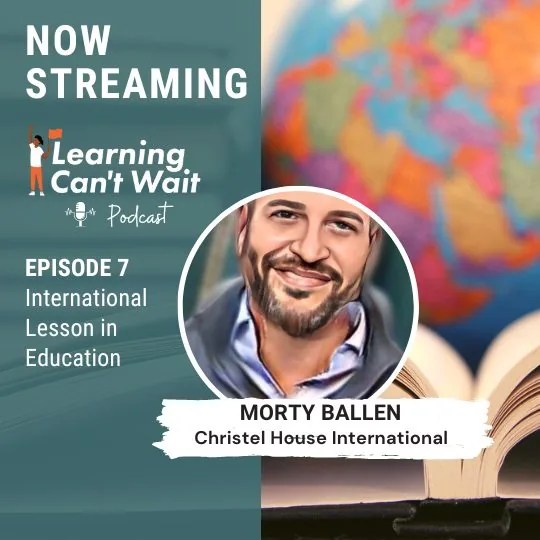
Learning Can’t Wait · Season 1, Episode 7
An International Lesson in Education
 Hosted by Hayley Spira-Bauer, Chief Academic Officer at Fullmind
Listen now
An International Lesson in Education
Episode summary
Morty Ballen traces his path from a 1992 Teach For America placement in a recently desegregated Louisiana high school, to teaching fifth grade in post-apartheid South Africa, to founding Explore Schools in Flatbush and growing it to eight Brooklyn schools serving 2,000 students. Now leading global academics for Christel House International, he argues schools everywhere are about people and trust, that the charter-versus-district binary was a mistake, that those closest to a challenge should drive change, and that the best innovation is follow-through.
Key takeaways
- Explore Schools grew too fast in the go-go charter years; stable infrastructure took years to catch up
- Framing charters as better than district schools was a false binary; the goal is a constellation of options
- Christel House works with students from age five to 23 and measures economic mobility, not test scores
- The people closest to a challenge should design and implement the change
- Know your why and figure out what keeps you in the game long term
About this episode
How do American schools compare to those educating students around the world? In this episode, Hayley Spira-Bauer interviews Morty Ballen, the Senior Vice President of Christel House International. An organization dedicated to transforming the lives of children by breaking the cycle of poverty. Morty will share his experience teaching, founding, and leading schools around the globe.
Learning Can't Wait is brought to you by iTutor.com.
Full transcript
Transcript generated from the recording; minor errors may remain.
Welcome to the Learning Can't Wait podcast an iTutor production at iTutor. Our vision is to ensure every child has access to education regardless of circumstance each. We will be joined by Pathfinders within and around the education space who are bringing about transformational change. On behalf of deserving students, I am your host, Hayley Spau.
Welcome everyone. I'm so glad you're joining for today's episode with Morty Ballen, the current senior Vice president of Global Academics for Christel House International. Morty, welcome. Hey, Hayley, how are you? Great. Happy Friday. I'm so glad you're here today. I know you and I have known each other in the New York City education team for a very long time, so, so much like myself, Morty is a.
Teach For America, certified teacher and And by certified teacher. What I really mean is that you began your teaching career as a Teach For America Corps member in 1992, where you started teaching in Louisiana. Is that right? Yeah. Two things. The first thing I was struck by was how few resources my students happened to have, have, just by virtue of where they happened to be born.
Like I could not believe that my students were reading you. Textbooks from like the 1970s and the other, and that sort of lit a fire, I guess. And I guess the other piece that was really stark for me was, baker High School had been desegregated in 1988, and then I was in 1992. Really surprised that.
Just four years prior was a desegregation plan as a liberal Jewish Yankee, I, I thought desegregation ended, you know, way earlier and every interaction was filtered to the dynamic of race. So just as a 22 year old, I just became really. , I guess, aware and sensitized and, it was, it was challenging and confusing.
let's contrast the teacher just coming from Louisiana and going to South Africa. Can you like paint a little picture for everyone listening about what the experience looked like for the communities you were serving? Sure. There was a travel bug. Actually it, I just wanted to be in South Africa because I wanted to see what dismantling apartheid looked like in a school.
So, I mean, this is pre-internet. I, I still am not exactly sure how I got there. I like faxed and I. Rotary telephones and rubber bands and spackle. But I end up in a school called the Salt Pike Educational Center, which taught kids from the township of Haa, which is outside of the city of Kimberly in South Africa.
And I taught fifth and sixth grade for a year and a half. It was a profound experience and I felt very fortunate the students and families with whom I was working, I mean, always feel fortunate to work with the students and families with whom I work, but in South Africa it. I remember I was teaching history, to my fifth graders, and there's about 35 students in my class, and we're gonna start a unit on apartheid.
And I asked the question, all right, everybody who knows what apartheid is, let's access our background knowledge. And that one hand went up and my students did not know about apartheid because their parents were not talking about apartheid because of the risk of punishment or being taken by the police.
This moment of being, how do I know more about your history than you do was and, and the power of censorship in South Africa was a big sort of eye-opener. And I guess the other piece I remember is so much of our work as a class was about this idea called masakhane, which is a Zulu word of building together.
And that's what the country was doing. And it was just, was very inspiring to feel like I was part. An effort to build together, with people who, who look different than me and different backgrounds and different histories, but, but we had the sort of shared goal of, of building a, a, a better world. It was, it was, it was really great.
I miss it sounds like you were at the right place at the right time to really have a front row seat to fundamental systemic change in a nation that really was ripe for. Like you said, coming together and building community. Yeah. And it was through the lens of school. Right. Because I mean, ultimately I'm a practitioner and I, I, I like teaching and I like the mechanics of school and I like that schools are, are practical places where things have to happen.
So it was, it was this sort of macro reason, but with a, a really practitioner lens and came back to the states, say, taught middle. In New York City, sixth and seventh grade, learned that I am not a middle school teacher. Many people are middle school teachers. I'm not one of them. And then I earned my master's, degree by principal's license at Columbia University Teachers College.
And by that point I had taught for six years working with students. In under-resourced communities and wanted to be a principal and decided that what was most important to me was working with a team of adults who showed the same high expectations and were aligned around the same values. So I. , I decided to open a charter school and, and again, the reason not that sophisticated, I just wanted to be around people with whom I felt aligned and I didn't feel like I could do that in, in a, a traditional district school.
Nothing. Not to say that I think traditional district schools are, are bad or substandard. I just wanted this opportunity to, to, to work with the community. So I wrote an application to Explore Schools, which opened in 2002, and our mission was continues to be. To provide our students with the academic skills and critical thinking abilities to succeed in a college prep high school.
So for 10 years, I, I led Explore Schools serving students in Flatbush, a amazing, the biggest Caribbean diaspora outside of the Caribbean, right here in Flatbush, New York and central Brooklyn. Did that for, 10 years, and then the next 10 years I worked to expand, Explore Schools from one school to a network of eight schools.
So today, Explore Schools serves 2000 kids in eight schools, all in central Brooklyn. And I'm just really proud to, I'm on the board and I'm very invested in, in the work that, that the students and teachers and families are doing. I, so I, I will say I have been to a school within this network. It is really a breath of fresh air in terms of how.
Teachers and school leaders are thinking about pedagogy and practice. What I think is really interesting is, the way you described charter, charter movement, like when you founded Explore Schools, it's in a really different place than it was when Explore Schools was founded. Can you describe what the climate was like for charter school founders and participants?
Yeah, for sure. I think Explore Schools was like, I think Explore was the 12th school chartered in New York and, you know, so, so just to, to start like, you know, I was a person who was recruiting students and families on the A train and sort of, Hey everybody, let's start a school. If this was pre Chancellor Klein, and we couldn't find space and we had to rent space from the Catholic church.
And then Chancellor Klein became chancellor. And then there's this alignment of resources and political will. At the city level, the state level, the federal level, and it was like the go-go days of charter expansion. So around 2010 after explored, been open for eight years, there's a lot of pressure and a lot of resources to grow and grow quickly.
And we did. And you know, I think we grew too quickly. And now that we're on the other side of. I'm so glad that we grew because we're serving 2000 kids. But it was, it was a lot of growth and it took a number of years following our growth to build the infrastructure that our students and families deserved to have the kinds of stable schools that I believe Explore Schools are now.
But it was a really sort of heavy, exciting time here in New York City and a lot of fun and really hard too. Yeah, there there was a was and still is, but was then a lot of energy behind. Ways to reimagine education. New York was an epicenter for it with the charter movement there, and I think it did a lot to advance as we talk about innovation, right?
A lot to advance how people thought about schooling and what communities needed to thrive. That I think we're all still grappling with today. I hundred percent agree with that. And you know, I think getting sort of a little bit ahead, but following explorer, I started working, I just became really interested in the global education sector and I found that there are a million.
Which is a huge number of low fee private schools serving families and providing families with educational options in places like India and Sub-Saharan Africa and Latin America. And the low fee private school movement is very similar to the charter movement in that it provides families with options and provides families.
Who may not have the resources to go to expensive schools with options. And one, when you're talking about lessons learned and the role of school, one thing I remember when I started this work, globally, which was two years ago, I found, I, I joined an organization that is called Global Schools Forum.
And Global Schools Forum is a member organization for these networks of low-fee private schools. And I remember thinking, gosh, you guys have such an opportunity here because if there's one thing. We shouldn't have done, which we did do during those days in New York City, was this ongoing comparison between public schools and district schools.
And it was this false binary and it was not about the big idea, which is creating a constellation of great options for families and kids. So I remember starting this global work a couple years ago and they're like, you know what, any observations from your side about advocacy and about how to grow the low fee private school movement?
And I remember saying like,Don't say you're better than the government schools. It just, it doesn't get anyone anywhere.So anyway, that, just thought about that as, as you're, you're asking me about, about, that chapter here in New York City. . Well, and you're really bringing us to this theme that I think we, the listeners here, are gonna be really interested in, which is your perspective.
Having done a lot of work in schools of the United States as well as international schools. You know, you're currently the senior Vice President of Global Academics for. Christel House. So you talked a little bit about Global Schools Forum, I believe while you were there, you were working with Christel House.
Yeah, so I was at Global Schools Forum. I was, I was working with these networks of schools globally and I learned about this organization called Christel House International, based in Indianapolis. And I recruited them to be members of Global Schools Forum and Christel House International, you know it, that player had been sort of working, I guess in the charter sector.
20 years I'd never heard of them. They run a, a network of charter schools in Indianapolis, but they also support and run a global network of schools, in India, South Africa, Jamaica, and Mexico. And Christel House's mission is to break the cycle of poverty and our approach. To break the cycle of poverty is to work with students from age five to 18 and then work with the alumni from age 18 to 23 for five years to support them with their college and career readiness path.
And there's, I guess, three things that I just was so compelled by. One was a global network of schools. I, I know no other organization that is, is they network, sort of like a CMO here in the states, but a, but a global CMO to this idea. Of working with students deeply from virtually age five to 23, and are all.
It's not about test scores, right? It's about actually moving up economic deciles and, and our graduates having hope and making life plans. So the aperture is just so much wider than what I was used to in the charter sector, and I applied and started about nine months ago. And feel really fortunate to be contributing to, to what I think is a really important mission and also.
Just to be able to think about education globally as opposed to what I was doing for many years, which was domestically. I guess it's, it's been a very exciting aspect of the work. Yeah, and I think that as I listen to share your experience, it really speaks to, for me, where we may be going wrong. You're ideally valuing as the key metrics of success for.
So, yeah, which is it? It's sort of like, Big question, like what do we have in common? What is actually similar with schools around the world and what isn't in common? And, and I obviously, I only have a small perspective, but I think we have more in common than not. And schools are about students learning and, developing their own agency and teachers having opportunities to develop and leaders having opportunities to develop and working kids families, and.
Personnel working together to literally support our future and 30% globally, we don't have in common. Right? South Africa has different standards for graduation than Mexico, which has, you know, different third grade standards for reading than India. But that's 30% and 70% of the work is the first component that I named that Schools are places to really think big picture about.
Big picture's, not the right term, but schools are an opportunity to really transform lives. I mean that that is I, and I believe that that schools more than any other institution, and maybe except family, Can profoundly and do profoundly impact the trajectory of kids lives. And that is what I'm, I'm, I'm most, I guess, energized by, in, in, in, in, in my own path.
It sounds like what you, when you look back to it, what for you, in your perspective, has changed about education? So what has not changed? You know, I guess in, for, for me and just speaking from my experience is, schools are about people. I, I like schools are, if anything, they are about people. They're about students and teachers and families, and that's what brought me to Baker High School in the first place.
Or it's what brought me to teach Hebrew school before that and be a camp counselor before that is I just, I like working with people and it sounds cheesy and cliche, but I think action happens. Through and with relationships and through trust, and that has been a thread, a very consistent thread that that's the.
Accelerant to move forward on achievement and goals is trust and relationships and humor and, and being human. And I, I, so I think that's the same. I think goals are about people and have to be about people. I think what has changed, which is sort of no different, even reading about it in teachers college when I was at grad school, you know, the swing from.
Empirical quantitative data equals school success. To know it's not quantitative data, it's community and community building that makes success to know back to quantitative data. So there is this, yo-yo that I remember reading about, about Ed Reforms and US College in, in, in 1995. And boy, that's like bearing out now on 2021.
Ah, no, that's, that's, I wanna go back for a second. I wanna talk about the pendulum, the yo-yo as you name it. But I also wanna talk about, you said it was cheesy to lead with your love of peace. Maybe like, or like alluded to it being cheesy and I think it is the opposite of cheesy. I think it is probably what has led to a lot of your impact being so profound.
and I think that for those folks who are listening who know you, they would probably remark that it's, I they continue to wanna work with you or befriend you or connect with you. I know for sure it is the reason why we are talking right now. That's very nice. I, I appreciate what you're saying. You're right.
Like it does nobody any good to undersell like percent the value. And the belief is, is around, is around relationships. So we're talking globally. I appreciate, and stand, stand by that, which might sound a little bit different for what I'm about to say, but. Schools are local phenomenon. So at Christel House, yes, we have a global network of schools and the network is an accelerant and the network, helps leaders to create knowledge with one another.
But at the end of the day, you know, It is up to the schools and in our network we, we sort of put our money where our mouth is to make the decisions about curriculum and use of time and and standards and the school culture, the adult culture and the student culture. And that's the right answer because it is, you know, there's an a principle in equity.
The folks who are closest to the challenge need to be in. To be the solvers of the challenge. And when you think about schools, whether it is their schools and, and the Christel House network or schools in New York City, it's the principal, it's the teachers, it's the families, and it's the kids who need to be driving whatever.
The reform or the change is because they're the ones who gotta manage the change and they're the ones who gotta implement the change. And they're the ones who are gonna benefit from the solution. So I think if there's one place I'd like to see the yo-yo rest, it would be that local empowerment piece and having the faith and trust that the people closest to the challenge are best positioned to solve and implement the.
I absolutely love that. I know you and I, the last time we spoke, we're talking a little bit about innovation and I think this ties to that notion about innovation that you named for me. So I'm gonna ask you that again because I, I really want our listeners to hear it, but what does innovation mean to you, Morty?
So, the, one of the mothers of my daughter, her name is Tracy. We talk about this a lot. Tracy is the chief academic officer, rich in public schools. And in our conversations we've saidthe best innovation is follow through.And if we need to do something sort of that, that's really gonna work and, and, and move the needle.
It's good implementation, and good implementation means that folks have been invested and are part of the change that is happening. So when I think of innovation and, and I, I think of like my days as a school leader at Explore Schools, you know, take away the best innovations were happening, teacher to teacher.
Like when Ms. Arroyo first grade teacher was doing something differently about how she's grouping students because she was a hub. Practice migrated to Ms. Wong's classroom and Ms. Wong was innovating in her classroom because she was invested in the relationship with Ms. Arroyo and she was invested in the change and, and that's honestly how change would happen at Explore Schools.
And our job at the Network became less about what is the best idea and much more. How do we implement this change so that it sticks and people are invested in the change. So it's not a very sexy answer about innovation, but that really sticks with me that when I, when I think about that question that you asked, 40.
I love that it really beats too, like really trusting people and you're coming back to this central idea that it's the people and the communities and the follow through that matters most. So if I take away anything from, you know, your thoughts on innovation, it sounds like the message here is to invest in people, trust in people, and let them know you trust in them as you execute on big ideas.
Yeah. Yeah, I think that's right. And I think, you know, I, I think the, i I think the, the, the, the friendly amendment I would make is, it's just as important that. Like, not only that, I'm trusting them. Not only that they trust me, but I trust them. I mean, it, it's, it's earned. So it, and that's why, that's why processes of change, I think are slow because good relationships, it, they just take time.
And building trust just takes time. And if change happens because there's trusting relationships. If that's the building block, then it's just, it is gonna take time. So let's be o And I know there's sort of urgency, like kids are not reading and doing math and like, if we don't sort of take the time as the grownups to, to be, thoughtful about the change, it's, it's, it's, it's not gonna have, it's not gonna move the needle.
So there's this healthy tension. It is a tension, sort of going as, as, as fast as we can and as slow as we must. But, I, I, I, yes, and I, I agree with, I agree with what you said. So as we're wrapping up, I know that one of the things I really like to hear from our guests about is what advice they would give an educator starting their career.
So I, I really appreciate that question and like I had one answer, but now I just thought of something else. I mean, my, my first answer that I was thinking about leading up to the conversation was, I think you gotta know your why. Like you just have to know why you are in education and. You know this Hayley, like, boy, this work hard , you don't have a really clear why.
It's just easy to give up. So I guess one piece of advice is just really dig deeply. Why are you doing this? Like, why not do something easier? Why not something that pays more? Like, so what is your why? And then I guess the second thing, like, gosh, I remember my first year of teaching was just so hard and I, my classroom management was terrible.
I started teaching Julius Caesar in October and it was Mardi Gras and I was still like on at three. It was just, it was so long to do everything like really bad . Exactly. And like what kept me was camaraderie with other teachers. And you know, I guess it goes back to her saying like, relationships and friendships and not taking myself too seriously because the big idea was to get up every day and do it.
And if you,I take the work very seriously, but I don't take myself too seriously.And if it that, Help me to stay in the game. So I guess that my other piece of advice is what do you need to do to stay in the game for the long term? Because students don't need folks leaving or, or taken off, who, who have committed to, to be in education.
I don't think I could name a more timely. Like statement around educators right now, given this Great Resignation every single industry is experiencing, and I love that we kind of are ending with this notion of connection and knowing your why. I think it's profound. I think it is easy to overlook, but so very important for the students that each and every one of us are serving on a daily.
Yeah. That's awesome. Yeah, no, thank you for that connection, the, the big picture. This is great. Thank you. Thank you so much. Thank you so much for sharing with everybody. This journey you've been on and continue to take it is an incredible story of being outside of myopic view of where you live and really exploring the world to help inform.
What's best for children. I am so grateful you agreed to join us all here today in this episode. Awesome. Have a great weekend.
Thanks for listening to the Learning Can't Wait podcast. If you liked what you heard. Please rate, review and share this episode. Be the first to know when we have a new episode by subscribing wherever you listen to podcasts. If you'd like to be a guest on the show or have a suggestion for an episode, email us at podcast@itutor.com.