
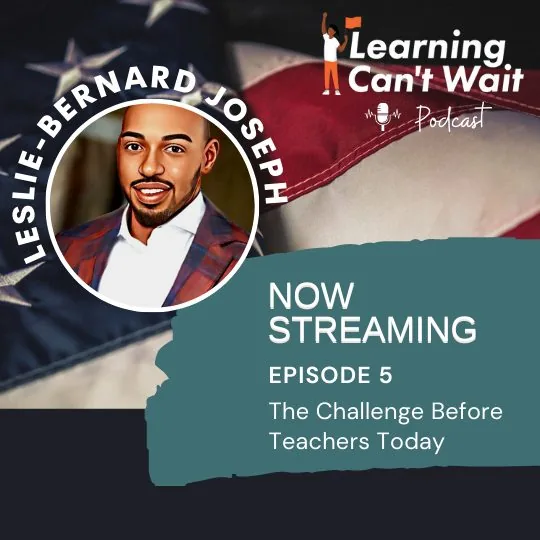
Learning Can’t Wait · Season 1, Episode 5
The Challenge Before Teachers Today
 Hosted by Hayley Spira-Bauer, Chief Academic Officer at Fullmind
Listen now
The Challenge Before Teachers Today
Episode summary
Leslie-Bernard Joseph, CEO of Coney Island Prep, recounts being bused out of his Queens district as a child and how that shaped his belief that opportunity should not require leaving home. He describes education's shift since 2006 toward equity language and leaders of color, warns that parents and students have been left out, and calls the talent market frightening. He explains Coney Island Prep's trauma-informed, joy-centered approach, a K-12 SEL curriculum built on the hero's journey, redesigned classrooms, and the honest, messy work of supporting exhausted teachers.
Key takeaways
- Equity clarified whom outcomes are for, but the language is overused and has drifted from its core
- Leaders proximate to a community experience its challenges differently and are most invested in solutions
- Trauma-informed practice is not curing kids; it equips them with tools to master their own future
- Coney Island Prep's SEL curriculum frames each student's growth as a hero's journey
- Permanent change needs teacher, student, and family voice, which is slower than immediate relief
About this episode
What is the “American Social Contract”? Is it still as prevalent today as it once was? CEO of Coney Island Prep, Leslie-Bernard Joseph, speculates that the labor shortages we are experiencing today are a direct result of the unraveling of said social contract. Do you agree? Join us in this week's episode as we try to “unravel” both the philosophical and practical implications of this concept.
Learning Can't Wait is brought to you by iTutor.com.
Full transcript
Transcript generated from the recording; minor errors may remain.
Welcome to the Learning Can't Wait podcast an iTutor production at iTutor. Our vision is to ensure every child has access to education regardless of circumstance. Each episode, we will be joined by Pathfinders within and around the education space. Who are bringing about transformational change? On behalf of deserving students, I am your host, Hayley Spear Ofour.
For today's episode, I have the honor of being able to introduce Mr. Leslie-Bernard Joseph, the CEO of Coney Island Prep. Welcome, Leslie. Good morning. Thank you. Yeah, of course. So those of you that are joining us right now may be wondering who is Leslie-Bernard Joseph? Well, currently he is the CEO of Coney Island Preparatory Schools, located in Brooklyn, New York.
It is a school district that currently has about 1100 students, soon to be 1500. When do you expect that growth to be accomplished? Over the next couple of years. So I would say three to five years. 1500 is a long ways growth from when you began Yes. As a founding dean of the school with 95 fifth graders.
Yeah. We were a very humble one hallway school, with three classrooms with kids. So we've definitely come a long way to four schools now. And I cannot wait to talk about all the ways in which you have come a long way, because I know there are many. But before I do, I wanna give a few more pieces of, of background about you, Leslie-Bernard, you are a Brooklynite yourself.
Born there, but raised in Queens. Mm-hmm. , you went to public school for much of your life, but wound up transitioning to a private boarding school in Massachusetts. And eventually wound up at Princeton where you studied politics in African-American studies. Went on to Stanford where you collected two more degrees, a master's in education and a law degree, and you did a few stints in a couple places after you gathered those degrees.
But ultimately, you've now wound up back where you began the roots at Coney Island Prep, and now you are leading the entire network as the CEO So how? It's been crazy. It's been a crazy ride. That's, I, I've known you this entire time, like full transparency. I've known you since before the Coney Island Prep days when you were at a public school in 2008, 2006 in the Bronx.
Sorry, 2006, 2017. Eight we go way back. Yeah. Right. This is a long road in education. So can you, can you tell our guests here, how did you wind up here? Like how did education become the journey that you've taken? Sure. First of all, thanks again for having me. Hey, it's, it's really a privilege to be here.
And, going back with you 15 years feels like a short amount of time. Like, I definitely don't feel that old. So I guess I would say that like, for so many people in education, this work is personal for me. I grew up. A single parent immigrant household, but both, my mom and my dad are from Haiti, but I grew up with my MO raised by my mom and two aunts.
So I'm first generation American and I, my mother had me zigzagging across the district in Queens trying to find the best schools for me. So I grew up in a district that was 99% black. , by the time I was in third grade, I was in my third public school a time I was in fifth grade. I was getting bused out of the district to a district that was predominantly white in age.
so at a really young age for me, I just sort of intuitively or implicitly understood that like if you wanted an opportunity, then you sort of had to leave home for it. And that's what my schooling experience was like transitioning from. Long walks and bus rides out of the district to, a public school that was an hour away from middle school.
I ended up with a scholarship to 10 private boarding school in Massachusetts, and that was certainly culture shock. It, it was, it was an expensive, like tens of thousands dollars tuition school, and I was not from there. I'd never seen so much grass. But I think again, for me, just sort of crystallize this idea that, you don't have to only leave home for opportunity, but this education game and journey in America is really sort of built on.
I think the trajectory of me from New York City public schools to Deerfield Academy, to Princeton to Stanford, I never felt like I was the smartest kid in my class. I was never the hardest working. I was just lucky enough to have the mom that I had to have the onset. I had to push me on my journey. And so I studied politics in African American studies in college, and I got tired of reading about all the problems that saw in this country, and I wanted to do something about it.
And I felt like in teaching at my classroom and my four walls, I could do something to remake this country as it. And that's how it started for me. That's how I met you at Teach For America. That's how I ended up in education. The story changes a little bit in terms of why I stayed, but I think for me it just starts first and foremost with this experience of challenges and poverty and struggle and knowing that things weren't fair and wanting to do something about it, and having been lucky enough to have the privilege to do something about it, but being surrounded by people was sort of expected to be in these places.
And, and I just knew intuitively some, something was wrong with our education. And I think that point you're naming here about your intuitive realization is actually a profound one. In part because sometimes as adults, I think we forget that kids know what's going on. It doesn't fly over their heads. , you know?
Mm-hmm. Children are smart and they make connections, and so I bet you are not alone in the realization and the understanding of educational inequity in America specifically. Right. That's the system that we're kind of grown within and and growing within. I think children understand just like yourself, even at very young ages.
Why? Some parents are, are doing what your mother did and busing them around the city and forcing opportunities that weren't within their zip code, perhaps that they were born into a hundred percent. It gives children not enough credit when we assume that they don't get it. So I just, I think the point you're making is a, is a really big one.
Yeah, I'm, I'm sure it'll come up again. It's something I firmly believe. Yeah. So, you know, you've been in education for 15 years, but you've already described, especially given the way that you've studied, over your time in college and beyond. I'm wondering how you think that education has changed since you actually became a professional educator 15 years ago?
Yeah, it's a great question. So, to answer that question, I think it helps to paint a picture of when I started teaching. So I started teaching in the mid odds. This is, you know, the heyday of Mayor Bloomberg's administration. It's after his first term, but before you know, the second and. Joel Klein is Chancellor of New York City Public Schools, an esteemed attorney and, litigator, but not necessarily a teacher and an educator.
This is a few years before President Obama would win his first term launch Race to the Top. And it also coincides with, I guess what I would call the boomy years in charter school movement in New York City and other cities across the country, like, new Orleans in particular stands. , I started teaching in, a district public school.
At the time, it was one of the largest in the city, over 1500 kids, K through five in a massive building in the Bronx of Grand Concourse and another trailer in the schoolyard. There were ten fifth grade classrooms on my hallway, and of the 10 classroom teachers, six of us were Teach For America corps members in our first or second year.
This is my experience. I think coming into public education sort of personally and in New York City back then, the rhetoric and approach education was for good and for bad. Making a pivot to business principles and philanthropic frameworks and theories on management to outcomes and measurable results.
I think the phrase or core value at Teach For America when we joined was this idea of like relentless pursuit of results. RPR. Yes, I remember it well. . And so that, that was the idea that outcomes for students and school performance in particular, they matter tremendously and those outcomes should, and were always measurable and usually in the form of test scores.
So I think that was one thing that was true, when I started 15 years ago. I've seen in terms of like what's changed over the past 15 years or what have I seen, I've seen two big shifts that I would say I, I agree. One, I started teaching and since I've started teaching, and I'd say there are two other shifts that I'm aware of, the first shift is around a focus on equity.
I don't think that that was language that we used in 2006, and to me, equity is a clarification on whom those outcomes are meant for. And the idea that those outcomes mean nothing. If we're not clear about eradicating opportunity. Across lines of difference, including race, income, IEP, and special needs status.
But equity also implied to the allocation of resources, support kids who need them more. So I think that emphasis gives us a different language to talk about what schools are supposed to do and how we should support schools, but also what the public should expect schools, how we should hold our leaders, leaders accountable and politicians accountable in terms of supporting schools.
So I agree with that. I like to focus on equity. I think we are overdoing it, however, in terms of how we speak about it, and I think we've lost the core of what it means. The second big shift that I agree with that is a recognition in the role that educators of color play in leading high performing schools come from this recognition that, you know, schools belong in communities, and if they're going to be led by people who care about those communities is what Bryan Stevenson says.
You know, the people who are most proximate to the harm are also one of the most proximate to the solution, and they're most deeply vested in finding the answer to solving those problem. . So this recognition that educators of color matter has been a shift that wasn't true when I started in 2006. And I think you've seen the pivot in lots of different areas and arenas.
And so I think it's, it's a step in the right direction for sure. So proud of that. I think as I'd say, as the pendulum is sprung. Your point about student voice and parent voice re. , we've largely sort of left parents and kids outta the equation. As we've further professionalized and further pivoted toward business principles and teaching has become more complex.
And so the way that we talk about outcomes, the way we talk about equity and what matters for kids is not always grounded in what parents say and what kids say. And I think we are certainly going to lose this generation, or we're gonna repeat sort of the steps of the past in terms of school's failing or repeating harm if we don't listen.
And I'd say the last shift that I'm worried of is on everybody's mind right now is today's talent market. It is frightening out there. Some of this is because we failed to make teaching as sexy of a profession as it was 15 years ago. We've created lots of different pathways into the profession, but we haven't made them sustainable pathways, and we haven't sort of answered the question around attrition for folks who enter the impression within the first five years, and I would say we're late to having an answer.
What teaching should look like in a digital age. We're late to having an answer on how we correct schools of education to change, not just for theory, but for practice, particularly in the places that see the highest teacher turnover and have the lowest salaries. In a lot of ways. Everything you've named here, unsurprisingly, I feel like they're connected.
Right. So this idea that the one that you just ended with, that that teaching isn't as appealing, isn't as sexy as it used to be or as it needs to be, is related to the other piece too, about the role that educators of color need to play should play in education for the benefit of the communities they serve.
And then larger. As you get bigger picture about this, it's. Schools need to be these community entities, and we need to be valuing the people we're serving, right? At the end of the day, schools exist to serve families and children. They're not here to paint a larger political picture, and I think that that's what we stepped away from personally as we look to this.
So I, I do think that every single one of the, the kind of items you've named here as how it's changed are. Can you talk a little bit about how you see, particularly the point about educators of colors being commu, educators of color, being in communities, as well as the relationship with how we've lost our sight on how we treat educators, compensate educators, rev educators are connected.
Yeah, so I will, I guess I'll sort of use an, a different analogy. Think about big tech for example, and I think you expected, anticipated, and love the convenience of this disruptive. That seem to put the customer first. It was all about like, I'm putting these resources at your fingertips and you get to do whatever you want with them, and you get to control how you own, own and quotation marks, how you, at least you share content and how at least you deliver information to other people and share them with the people that you most wanna connect us.
And over time I think we've become aware that this comes at a price and this comes at a. And the focus has seemed to become more on profit advertising dollars, and we recognize the harm that it's caused. I think the same is true and happening and has happened in education where there are lots of different aims and goals that we have around education.
But first and foremost, it was supposed to be about kids and investing in the next generation and empowering and preparing could have taken many different trains. It could have been to become better citizens and learn what it means to be an American and success. It could have been about creating an opportunity where there was none.
Making sure that, America continued to be a land of opportunity. And then at times there was just the more calculated economic endeavor of you get an education so you could get a good job. I don't think that's somewhere we lost that, about what kids want and what kids need. And it has become about what do schools need to do to perform while and stay open?
What are the test scores that kids are getting? How are you making sure the kids are. , and I don't think that that is true of the reality for teachers in the classroom or kids or their families, but we've built so many constraints around what it makes on how it's possibly to be a successful school, thatwe've almost completely silenced kids and families from getting what they need and what they want and what they deserve.
It's too, it's too hard to change curriculum in the moment. It's too hard to opt out of a test. It's too hard to actually stop what you're doing in the middle of the school day and say, you know, we're gonna focus on just what you need right now. Certainly this has all come to head cuz of Covid, right? I think the last 18 to 20 months has showed us, oh this is completely broken and untenable and we, we can't change fast enough.
And so we're at this bellwether moment where we know that what we have is not working for kids and families. We know that we are not prepared to take on the trauma that kids are experiencing new schools. We know that the systems that we have in the past aren't going to account for what the test scores were supposed to be.
I say that in heavy quota. But we don't have the structures in place to change fast enough. I didn't, I didn't answer part of your question. Like you also asked about leaders of color, and I think there's both an expectation and an understanding that when you are most connected to a challenge, then you experience it differently.
And so yeah, it isn't just a job for me, the kids in Coney Island live at the last subway stop in the community. That seems so. From the privilege and opportunity of what people, when they think of the rest of New York City or when they think of Manhattan. And I know what that's like growing up in Queens.
And there's this idea that like your community is forgotten that in order for you to progress, like you have to leave the hood or you have to get away from where you're from. And that's not what I want for our kids, and that's not what they want or expect for themselves. And so it's about, as a leader of color, it's about having that connection.
With my kids. And for the first time being in a school community where there are lots of parents who are Haitian and speak, and being able to connect with them in that, that immigrant experience, it matters to me and it matters for our kids and it matters for our family. And there's a reason why when you think about Coney Island Prep and you think about the work that your team is doing and that you are leading there, there's a, there's a word that was left out of the narrative, narrative as you described the work, which was joy.
And I think that there is a joy that your community is building even during this really dark time of a pandemic that. Emotionally, socially, financially ripped communities apart. That I think is so important to name, right? Because at the center of the work, and I remember one of the first things that we learned in Teach For America, one of the first things I was asked when I was hired after my first public school job was, can you bring joy and curiosity and love of learning into the field?
Like continue to expand on what your colleagues are doing, and can you bring like that enthusiasm to the classroom and to the school? And to me, like understanding the pivotal role that you play, that your colleagues play, that your team plays, and also helping students be kids. Kids be kids is part of the equation of how we bring it back to the kids and their families and make this and experience that.
Transformatively changes their own narrative, right? Their own story of how education impacted. So, so can you talk a little bit about that and like what that looks like at your, in your community and what the vision is for how it feels in Coney Island Prep? Yeah, so this is actually one of my favorite weeks of the year.
We're talking about Joy. So we are headed into Halloween weekend and. Like nothing brings me more joy. Well, there are lots of things that bring me joy, but this is one of my favorite weeks of the year because I literally go full out costume Comic-Con style like every year for Halloween and just show up in schools in ways that are absolutely ridiculous to our staff members.
They're like, I, why is this man walking around? Excuse. Crawling around the hallway in Spandex and Spider-Man, like this is just not normal . But it's, it's dope, I think for kids to see the leader of the school in that way and have high schoolers from years ago, giving me the Wakanda salute from walking through their campus as Black Panther.
So I'm, I'm excited this year to reveal my costume again. And I think that's part of what Joy looks like at our school for both teachers and kids. It is showing up authentically is who you are. It. Classrooms that are decorated not just in books, but in Marvel movie posters or in every ridiculous internet meme that you could find, or with sports references, if that's what the teacher's about, whatever the teacher is about.
It's like bring your whole self to the classroom. Because that is how you're gonna connect with your kids and how your kids will understand that they're learning from an actual human being. But it also sort of unlocks, it gives kids permission that they may not have had in other spaces to be their whole selves.
And so we talk about authenticity a lot at our school. We talk about joy a lot at our school. We talk about culture and race and equity and, and teach kids explicit about what does it mean to code switch? What does it mean to manage. Who you think you are academically and personally with the different person that you might be at home.
So I think Joy looks like finding your own voice and living that authentically every single day. And for those of you that cannot see with over Leslie-Bernard's shoulder, I'm believing there may be a mask from a previous series costume that is that Yes, that is, that is a Black Panther helmet over my, I guess left, no right shoulder.
There you go. Right shoulder . Yeah. The other mask is, is somewhere in the room. So I'm, I'm excited about that. But, If you wanna see past Halloween costumes, just, you know, find me, and I'm really happy to share pictures. They may or may not be available on the internet already. All right. So it's just a, a homework assignment for everybody listening.
Yes. But I think there's, there's this thing that I need to name, right? Because. Prioritizing joy doesn't mean erasing trauma. It doesn't mean erasing the, the pieces you unique about racial inequity and financial theories and all these really important concepts that, especially right now where students, teachers, school leaders have been really slugging through 19 months of trauma after trauma, after trauma.
It's a both and so. Mm-hmm. . Let's talk a little bit, you mentioned before that that covid is a bellwether moment. Let's talk a little bit about the social and emotional aspect of learning joy, school-based, kind of creation and how that plays out in your vision for incredible schools. I'll start with our vision for kids, which is where we.
And end with what we've learned over time. And I think what all schools are learning over time about our adults and our staff, I'm very much of the mind that of never letting a crisis go to waste. And so Covid created the opportunity for us to do things that I had wanted to do and believed in in the past.
So, There were some things that were, we did out of necessity, which was we were a lot more responsive to parent and families. We were able to find and fundraise money for parents to give micro grants directly to get them through the pandemic and make sure that we are financially taking care of our families.
The bigger piece that we invested in is pivoting our schools, having a more trauma informed lens. One of the challenges with being trauma informed, By nature of the work, educators care deeply about their kids and want them to be well. But like teaching, being trauma informed does not mean that you are curing kids.
It does not mean that you are giving them the answers. You have a better lens through which you can diagnose and recognize some issues that are coming up. But it's our job to prepare and equip kids with the tools to be the masters of their own future. . So when you're asking about like what does social-emotional learning look like, what does trauma-informed practices look like?
For us, it looks like school discipline policies and classroom management policies that recognize that kids are supposed to be kids and their responses come from a place. Are those responses developmentally appropriate? Cool. Proceed as correct the child's behavior if it is dangerous. Point out where it is helpful or productive to they want to be point out where it might be un.
Where a kid's behavior response comes from a trauma-informed or comes from perhaps trauma, then I think the question comes, becomes around what are the skills and resources that you could use to help you cope with whatever issues that you're dealing with until you feel fully in control? That's really what schools are about in in some ways when it comes to social-emotional learning.
Unfortunately, there are lots of schools where adults are trying to assert power over kids. To get compliance so that I can teach you and get you through the lesson. And kids are trying to get some power and control over their lives and their understanding and their academics. Removing that power struggle means that like schools are just a place of play and joy and discovery.
There's, I'm, as a teacher now, I'm no longer trying to get my kids to sit down. I'm not trying to get them to do work. And the kids are not trying to misbehave, we're trying to push back. No, it's just this is a place where we're just both trying to push boundaries and figure stuff. And like that element of play you just sort of expected under this place.
Like it's really clear in sports, like the boundaries and the rules are clear. But everybody now, even if you're in sort of like implicit competition, you are just trying to do the most fantastic, amazing thing possible in pursuit of this goal, which is winning points, whatever it is. And that's the element that we want to create in our schools.
This is a playground for you to discover who you. And that social emotional learning comes in discovery of like who you are individually, who you are in terms of your racial identity, who you are in terms of, in respect to your community, in respect to your friends, and how do you figure that out? How do you figure that out in this idea of like your past and what your future looks like.
So our social-emotional learning curriculum, It is actually a curriculum that we, we sort of wrote K through 12, and it incorporates elements of curriculums like Teaching Tolerance, CASEL standards in terms of self-efficacy. But the thing that I, I love most about it is this idea of incorporating narrative elements of a hero's journey.
So the hero's journey is the, the narrative storytelling arc of your hero. Experiences a call to adventure that they at first resist, but then must go through with their friends and their friends, help them discover and unlock gifts until finally they reach the climactic moment in the story where through everything that they've learned over the course of this journey, they have to use their talents to get through some impossible challenge on their own.
And they emerge out of this cave and this challenge, a different person, but called back home. To leverage their gifts and their talents to do something incredible, amazing from their community. And you can see it in everywhere, from every superhero tale to Harry Potter, to Lord of the Rings, to Star Wars, whatever it is.
And it is just such a clear and powerful story for kids to tell that every single day we call you from home or you're being pushed out of your neighborhood, or something is happening with your family and you are trying to figure. Your place in the world and you will only figure it out with your friends.
But there is a part of your journey that is uniquely individual to you. And so yeah, the cave could be trauma, the cave could be a challenges you're facing in your community, whatever it is, that's how we want to teach and that's what we want to be at the center of our teaching. And I'm so excited about this and I think on the day to day I get frustrated.
It is so hard for us to make this real in our school and our classroom every single day and what we're doing right And where, where it is amazing. You just feel it as soon as you walk in the room. And where we are struggling, it's because trauma doesn't just impact kids. And the more that we. Inform and equip adults of, with this language around trauma-informed practices, the more adults realize that they're also not okay.
And it's really hard to pour everything that we have into our kids when adults themselves are struggling. And so what we've learned from Covid is thatthe adults are not okay.So that is sort of, it's challenging, like how fast we can do the work. I'm gonna pause you for a second though, because there was a lot that you shared and I just need to name that.
Watching you come alive as you talk about this hero's journey and how it lives and breathes as a viable way of thinking is inspiring. And I think that for the listeners that are joining us, they're probably thinking the same. And what I wanna just name too is that I'm imagining where you see it living and breathing and viable.
It's not a quiet. Like, I think people think of their childhoods and their schooling as quiet learning environments, and I would bet that you would say that's the opposite of what your school should be like at any given time. I, I mentioned never letting a crisis go to waste. Covid and social distancing meant that our clo, our crowded classrooms and our desire grow meant that we needed new space.
So, new space meant that we were lucky enough over the course of the pandemic to find a building. We had to renovate that property to get new furniture, and it was imperative for us to design classrooms that looked and felt different. If you 20th century classroom, right, you'll see 1920s, thirties, forties, fifties, sixties, through the.
Rows and columns of desks that face forward as if it was the opening scene of the Simpsons. The only difference between the twenties and the nineties is that it's not all white men. Still the same number of kids in the classroom. Maybe they are all the same age now as opposed to the one room schoolhouse, but the classroom was more diverse.
The kids staring at the camera, they still don't have smiles on their faces. And. In our new building, our classrooms look bananas like the furniture. It's just weird shapes. The chairs are not all the same. We have stools that are impossible for you to balance on. And so you walk in and you just see a third grader like rocking back and forth and like wobbling on the stools if they're buoying an ocean, and it's like, yep.
Like this is just, it's weird. There are different spaces and it creates a sense of ownership, right? Like the classroom is built and designed for. , it's colorful. There's stuff everywhere. There's things for you to touch, move, play with, and the configuration means that like it is harder and challenging for adults.
Now, I think my favorite classrooms are the ones that I go into in which I don't hear a lot from Teachers. Kids are busy talking. Teachers are doing very little. It's not that there is an instruction happening, it's that kids are in charge of the instruction, right? They are in charge of explaining.
They're holding the marker at the whiteboard. They're touching the screen. . And in the places where we are struggling, it feels like kids are at their desks just on laptops or just listening to the teacher. It's not that those moments can't be useful, but I wonder how much are the kids owning the moment?
And I think that's the challenge of what we're looking for and what we're trying to do. We're trying to create something that requires a lot less control for adults, and that's a lot harder. And it's coming at a moment when there's so little that's predictable and there's so little that we have control over.
And so to ask adults to take on that risk feels like a lot. Well, and first of all, I appreciate you painting that picture because I can see it in my head. I, I better listeners, can see it as well, and. That's the kind of classroom I want my kids in, right? Like that. You think about that, you want your kids in a place that meets their needs, that sees them as individuals.
Not having uniformed seats means that students can choose for themselves the type of seat that best supports their learning. And when you talk originally about creating school environments for students and families, that is. The latter part of what you're saying goes back to, again, I, I don't like to just talk about the positive cause I could do that all day, and I think you could too.
But there's this real moment of burnout and crisis in Yep. All professions, but especially education, which the teachers have had to endure a significant amount of on the fly, expectation changing over the past 19 months. . I don't know of any educators who have come out unscathed. So how do you talk to teachers right now?
Like what does it sound like when you address your community to help buoy those that are feeling really challenged by what's before them? The immediate answer is we're still fig. I'm still figuring it out. Teachers need to hear that they are being put first in this moment and that they're being thought of and cared.
I'm still finding my voice in the right tone in that, not because I don't care about teachers, but because I, I think kids first, and I have to remind myself that we don't have to do everything all at once. It's not possible for us to pour into and support our kids unless we take care of ourselves. It's not to say that, I don't think about our staff.
I think about them every single day. It's they, they're what keep me up at night, but I'm still very much finding my. Thinking into making sure that it lands in the right way for teachers. Because everything that I just spoke about that I was excited and came alive about can sound really stressful to you right now,
And so, yeah. What I communicate to my teachers and hoping to continue to communicate to them is that we are really trying to find and strike the right balance between immediate change that provides relief in this. That supports teachers and makes the job easier and more sustainable and permanent shifts.
The challenge that we face right now is that permanent shifts, if we want them to work for our kids, then it requires teacher voice and input, and it requires student voice and input, and it requires our family voice and input, and that process is democratic and messy and takes a really, really long. And to the extent that you want change faster and you need it now, we can't do both.
We can't remake the school as teachers want it, as kids want it, as families want it without them being involved in the process and asking them to be involved in the process is slower and asking more of their time. And so there's a little bit of patience that we're asking for in terms of immediate shifts.
it's both asking for permission and trusts. We're gonna do everything that we can, right? To make things better for you. It is not going to be everything that we could do because we've gotta rely on you on that voice. So trust us that we are doing the best that we can. All that we can, but there's other stuff that you want that we believe in and we agree with you, and it's coming.
The process is getting there and making it sustainable is just, it's harder and longer. And so if we want different systems, we gotta change what those systems are. And that change means everything that you're used to is going to feel uncomfortable, and we're trying to balance. , the discomfort that people can handle right now and that they want versus the things that are like, this is crazy and hectic.
And so I think that's where we're really figuring it out in terms of like communicating the right sort of care with our teachers. And if I'm being honest, we did a better job of it during Covid than we did now during Covid. It was easy to say, we're putting your health in safety first. Stay. , you need different tools and resources to teach from home.
So you don't have to ask for an external monitor, we're shipping it to you. Cause you need to be able to see all of your kids' faces on the screen and see all your lesson and navigating everything else like that felt like a no-brainer for us. And so those are the things that we had to invest in. You can't teach all day without ordering lunch.
Like whatever we used to do in school, we had to ship it to people's homes. And that felt reasonable and fine and great, and people loved. Covid looks different in schools. And so that has shifted into we wanna meet every single one's individual needs to, we have to do what's right for the school as a whole.
So telling people, our schools operate best if we have everybody here every single day. And the only shot that we have of that is getting everyone vaccinated. So you have to get vaccinated. And if you didn't agree with that, it felt like we didn't care about the individual anymore. Or if we said, you have to wear a mask, but you didn't agree with that, you whatever the rules.
They were no longer individualized, so that communication of care got lost in translation. Burnout is real just because the entire country is recognizing that commuting long hours. For not great pay, not being able to have childcare, not being paid enough if your city is unaffordable. Not having the time to do things for yourself is exhausting.
But there's also this principle of demoralization, which is, I can't access all the benefits and the things that I was supposed to for my job. And so a combination of burnout and demoralization meant people are leaving. I think you see it in our schools where things are going great. People are still tired and exhausted, but they're staying.
Where there is a crack or an inkling of we don't have it together operationally, they're chucking up. Two fingers induces and they're like, I'm out. I'm not. I will not wait for you to get it together. This needs to be predictable for me, cuz the rest of my life is really hard. We have, as a school, as a network, a long way to communicating that same priority around making things right for teacher in every corner of every campus.
There are places where we get it right, and there are places where I want so much better for our people and in absence of that, kids are suffering. So that's a lot of humility there, right? Like not every school leader would get up and have this moment of, we're doing some of it well, but there's a long way for us to go and this is something I'm constantly thinking about.
So, On behalf of like the people who you, who you support. I just, I wanna say thank you for being humble there and just really sharing what's keeping you up at night and where the challenges are. I would imagine that school leaders all over the country and all over the world are feeling similarly to you.
It is this impossible, tight tightrope walk of health safety. Academic growth, social and emotional growth. Supporting the trauma of every stakeholder. It's enormous. The enormity of it is overwhelming in and of itself just thinking about it. But living it every day is truly like a, a a, a, I don't know, Sisyphus kind of, I don't even know if I'm saying that right.
So we're definitely pushing a boulder up in endless hill tight rope walk feels. I would just imagine a tight rope run. It's just, we've been in a sprint since March, 2020, and folks are tired and exhausted, and we realize we don't know when this is going to end. And even if it did end, the changes that we need to make aren't ending anytime soon.
And so telling people that you had a buckle in for a long ride when they're exhausted feels crazy and untenable, but I don't know. Anything other than being honest with people. It's like, excuse my language for your listeners, but the shit is hard. Yeah. And it is not gonna get easier anytime soon. But that's the only way we get to the other side.
I feel like I need to take a deep breath because that level, yeah, that level of transparency and that level of pure unadulterated truth is the only way forward. We, I think, lied to ourselves a lot at the beginning of this. And it's led to where we are today. And so the only way forward is that sort of truth and honesty.
And you know, I know we're nearing the end of our time together right now, and I wanna, I wanna ask you something that is slightly different than what I had intended to end with, which is mm-hmm. , the school leaders listening here are probably like, ding check. Yep. Mm-hmm. . Ah, yep. What would you say to an educator though that's just starting out in their.
Right now, October, 2021, in the middle of what has been already a very challenging two years, but how do they best support students, communities, colleagues, school leaders as energetic new teachers? I would say to a new teacher just starting out in the profession, I would sayteach like you mean it.It's easy today to.
Education doesn't happen on Instagram, on TikTok, on tweets, or in short takes. It is long grinding, invisible work in the classrooms with just you and your kids. And so the theory of like what should be true and what you want to be true is always that practice is always gonna be different, but the work for how you get there happens.
Every single day and like that kind of commitment, it's required to be excellent in every single profession. So I would say teaching like you mean, it is learning your craft inside and out. Learning your content expertly so that you can then go forth and break every single rule in the book to create something beautiful.
Like I'm a superhero guy. We've talked about superheros. I'm also a sports person. Like to use a sports analogy, I would. . You look at a Steph Curry example, like you have to learn the mechanics of shooting so well that you can almost never miss, and then break every single rule about where you take shots from and how you move the ball, and how many shots you take and what points you score.
That's what teaching should look like with our kids. You don't teach your subject, you don't teach your content error. You don't teach for a test. Learn all of those. And then bend. Break every single rule to make sure every single kid in your classroom gets what they need. Right? Hayley needs something different than Leslie.
[student] needs something different than [student]. [student] needs something different than [student]. Every single kid needs something different. Do whatever you can for them. Like that's what teaching like you minutes. So I wanna end with what you shared here, which is you want, you want these teachers to learn everything, but then bend and.
Every rule, and I think that message is a perfect one for people that feel committed to change. Many of the topics, which I think we could go on for days talking about, but bend and broke every rule. Leslie-Bernard Joseph, I. I just could listen to you share the stories of how you're making change in your community that you're serving this, the ways that you've impacted people, many of whom I'm sure you don't even realize have felt touched by your brilliance.
Forever. But I just wanna say thank you to sharing for, sharing that with the folks who didn't already know you, who very soon will be hearing more and more about your transformative leadership. Thank you so much for joining me here on the podcast. Appreciate it. Thank you for the opportunity. Take care everyone.
Good luck. Thanks for listening to The Learning Can't Wait podcast. If you liked what you heard, please rate, review, and share this episode. Be the first to know when we have a new episode by subscribing wherever you listen to podcasts. If you'd like to be a guest on the show or have a suggestion for an episode, email us at podcast@itutor.com.