
Learning Can’t Wait · Season 1, Episode 10
Learning for Life
 Hosted by Hayley Spira-Bauer, Chief Academic Officer at Fullmind
Listen now
Learning for Life
Episode summary
Jonathan Beauford, who leads performance equity work at Google, traces a circuitous path from NYU admissions and business school to building Harlem Village Academies' college success program, leading College Track's San Francisco site, and running Google internships and computer-science programs for underrepresented students. He argues every person is great at something and the job is bringing it out, that scaling impact requires a clear theory of change and the skill of influence, and that DEI starts by abandoning the myth of objectivity. He questions biased success metrics, calls love a strategy with long-horizon outcomes, and urges schools to borrow UX thinking to compete for student attention.
Key takeaways
- Treat others how they need to be treated: the platinum rule over the golden rule
- Scale impact with an explicit theory of change linking inputs to sub-outcomes to long-term goals
- Influence is part of every educator's job; practice it without feeling manipulative
- Education over-sorts students by negligible innate differences instead of building environments for growth
- Schools compete with social media and gaming for attention; borrow UX and engagement science
About this episode
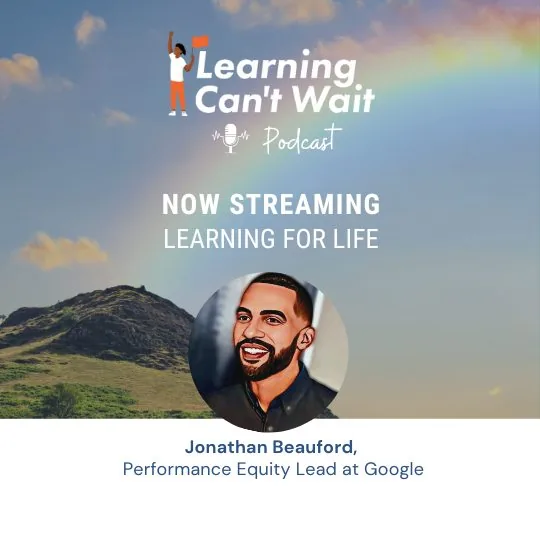
Are you leading your life with a theory of change? Jonathan Beauford, Performance Equity Manager at Google, believes investing in people is investing in the future. Jonathan has spent his career creating more diverse, equitable, and inclusive professional opportunities for individuals of all backgrounds. In this interview, Jonathan walks us through the steps he’s taken to help students and professionals connect the dots, and forge their own paths, in the pursuit of making a positive impact in the world.
Learning Can't Wait is brought to you by iTutor.com.
Full transcript
Transcript generated from the recording; minor errors may remain.
Welcome to the Learning Can't Wait podcast an iTutor production at iTutor. Our vision is to ensure every child has access to education regardless of circumstance. Each episode, we will be joined by Pathfinders within and around the education space. Who are bringing about transformational change? On behalf of deserving students, I am your host, Hayley Spau.
Welcome everybody. Thank you so much for joining today's podcast. I am beyond excited to bring back someone that I met about a decade and a half ago. Jonathan Beauford, welcome to today's event. Hey, Hayley, so excited to be here. Thank you for making me feel old right off the bat. I mean, that wasn't my intention, but as you say that, I'm starting to reflect on how I'm progressing up there, how we're all progressing up there.
But I think that just means that we've accomplished a lot. Let's phrase it that way. Totally. I like that. Positive mindset, very important. Absolutely. So I think, we'll give the spoiler alert to everybody who's listening today, but we met while working at a charter school in Harlem, and your experiences in and around education.
Emphasis on both there I think are some of the most fascinating of those I've heard in a particular person's journey. And I'd love if you could tell our guests exactly who you are, what you do, and why you do it. Yes, thank you. Fascinating is one way to describe it for sure. Circuit circuitous. In another way is definitely non-traditional.
So, you know, my history in education started, you know, professionally working in undergraduate admissions at NYU, thinking about enrollment management, student recruitment, touring the country, talking to high school counselors and high school students and their families. Reading hundreds applications a day, making decisions.
And so, it wasn't from a traditional educator standpoint, but prior to that and throughout that, I'd been volunteering for a number of nonprofits, mentoring students, tutoring students, getting some experience on that side of things. And then obviously I went to business school after that, which is the clear next step,
But now I felt like in my experience working in education open to that point that there were a lot of best practices from the private sector that could be brought into this space. Increase, you know, organizational effectiveness, efficiency, taking a lot of good ideas and hard work and passion that people had in the space and making them, you know, improving the execution and the scalability of them.
After business school, I thought I would go into consulting for a little bit to continue to learn those best practices. But I did my summer internship there and, and honestly didn't like it that much. So I went straight into nonprofit management where I met you at a Harlem Village Academies. So I was tasked with starting up.
The, our college programs there, which was, you know, the charter network as you know, focused on, you know, had schools from elementary school students throughout high school. We had maybe one or two graduating classes by the time I joined, but didn't really have a formalized college counseling program, and more importantly, a college success program to take the students that had graduated through college to to increase the rate at which they earned their degrees.
And so that was my first experience. Managing people, you know, building a program sort of from scratch. It was incredible. You know, obviously it was based in the high school and so had very much, in-depth experience and touchpoints with the students on a daily basis, with the teachers and, and really felt embedded in the school in an important way while still working across the network and, you know, with partner colleges and institutions and mentors and funding organizations, et cetera.
So that was an excellent experience. I moved out to the west coast. For unrelated purposes, honestly, just because there was no winter out here and and visited for so many years and I was like, it's wonderful out here. Some of my best friends are out here. I don't need to subject myself to winters anymore.
And that was right after there was like a polar vortex or something in in Connecticut. That was the trigger point for you? Cause that's the, specifically that specific weather incident. Exactly like whatever a polar vortex is. I don't need to have those in my life on an ongoing basis. So moved out here and then, in San Francisco, I led the, San Francisco branch of a national nonprofit called College Track.
That was a college access and success organization. So it was a standalone site, physical site that served students from eighth grade through college graduation, you know, holistic services, everything from tutoring, access extracurriculars, financial support, career support, obviously college counseling and college support once they were in college.
And so, What got to lead a team of about 50 employees, kind of build up, you know, our programming there, in a strategic way. And then oddly enough, I had been in touch with a recruiter from Google for the past, like four years leading up to that, from when I was in business school and just never really imagined what I would do at Google with the background I had and like what I thought Google did, which was search , you know, and like the Gmail I was using.
And so this, recruiter was so patient, was so, thoughtful, was really meeting me, where I was at, and continued to kind of send me roles to try to get closer to things that I could see myself doing. And eventually sent me a couple of roles that were focused on, student programs that, that really stood out to me.
I ended up starting my career at Google, managing these internship programs. So both the recruiting aspect and the student experience. That were really focused on underrepresented students, and getting them into non-technical, so business related internships at Google in that summer before their junior year with the focus of, you know, obviously getting them that great experience, but also, you know, lining them up to potentially get full-time jobs at Google or elsewhere in the tech industry.
So that was an incredible experience to just get. Experience on that other side is my first glimpse at like, okay, I've been working so hard on the other side with the students to try to get access to college institutions or workplaces and now, you know, being on this side, we really view workplaces in some cases as the kind of end goal right, of education, whether it's.
During high school to get internships or the whole reason to go to college in a lot of cases is like, oh, this will benefit your career, or this will give you access to more careers. And so, it, it had been great to get that experience. I did that for three years and then transitioned internally to a talent development focused role that was really about building programs for high school students.
So getting more back to the core of what I was doing, Dean, not that circuit. Really connected. There's a theme here, I'm telling you, makes so much sense, . But these students are ones that, you know, were interested in computer science but didn't have much experience with it. And so as they were entering college, we did summer programs with them at Google offices at their, Universities as well.
And the goal was again, to increase their exposure, their confidence, their sense of community, their skillset within computer science at this really critical early point as they're going into introduction CS courses, which in many traditional colleges is a, is a weed out course. And you know, I can understand why it's a challenging path to pursue, but one that could be incredibly fruitful and have a lot of options for folks on the table.
Exactly. And so our hypothesis is that, you know, if we can get students through those first rocky years, you know, by having this sort of experience, by going into that experience with a supportive community, by having mentors at a place like Google, and then ultimately, you know, getting them access to internships immediately too, after their freshman year of college, you can start doing these internships in, in tech and having that as a, as a motivator as well.
And to, you know, Moving forward, forward. So that was kind of the extent of the education experience. I pivoted internally a couple years ago to focus more on performance equity. So it's really focused on, people that are already at Google and how do we maximize, you know, the, our performance management systems there.
So yeah, that, that's the path. And , I, yeah. But Jonathan, as I hear you say all of this and as. You know, have talked to you previously about the journey you're on. I, I get this theme of success, helping people be more successful at their every day and in their future. How does that land with you? Do you feel like that's a cognizant theme that you're leading with, or is that maybe just a kind of undercurrent of everything you do?
I feel like you should have written my LinkedIn bio. I think that's a great connecting thread for sure. I don't know if it was intentional, but it probably came out of just a natural sense of that's what I'm drawn to do. I feel like, and it's how I view the world. And so in all of the roles I've been in and spaces I've been in when I've had the opportunity, I think I try to focus on like seeing the best in people.
Great potential in everyone. And the challenge is always how do you bring that out of people in a specific environment or to accomplish a specific thing, you know? I wonder if as you've worked in all these places and spaces with people of different ages, you think the answer to that question you just named, how do you bring it out in people if it's different?
What would you say? Is it the same for K-12 as it is for students in college, as it is for people in internships, as it is for people in their career? Or is it drastically different depending on their developmental phase? I would say. . Yes. Both , the foundations are the same. Like everyone's a, a human at different phases, right?
And you know, I'm very much a fan of like inner child theories and psychology. And so just because you're adult doesn't mean your inner child just disappeared. So a lot of the same core needs that drive your behavior as an adult are based on childhood experiences and core needs around safety, around love, around value, and, you know, Legacy, even, you know, as you get older.
And so those don't change in terms of the needs. Those definitely change with the time, but also with the individual. So I think you can focus on some of these universals, but you always have to meet everyone where they're at, not make too many assumptions and approach each person as an individual. . Cuz for some students what's gonna unlock their engagement or their motivation is very different than others.
And that's the same with adults as well, or college students, working professionals, et cetera. And so, you have to start with that sense of empathy and understanding that you're dealing with a person that does have these core drivers and is also very unique. And can be coming to the table from a variety of environments.
You know, if you're an educator and you're working with younger students, you know, you're working against malnutrition, sleep deprivation, , you know, potentially childhood trauma. And so it's not just like folks are entering the classroom in a, in a blank state, and those things are probably a little bit more acute at those early stages versus if someone's already a working professional, you know, they may have.
Different levels of stability, around some of those core things. And different skills. They've developed, different supports, they've received different coping mechanism, therapies, whatever it may be to help them be more successful at ha handling those challenges that either are handed to them or that they encounter.
So yeah, I think that's a really fair statement. You know, I heard something, I was talking with my colleagues yesterday about the golden rule. We learned when we were little, treat others how you wanna be treated. Now that's not the rule anymore. I've heard this statement that they flipped it and said it's the platinum rule.
Treat others how they need to be treated.Exactly not how you need to be treated. And it's like decentering yourself and centering the person who is receiving service or receiving support. Yeah. I, I love that. That's an excellent level up. I think the golden rule can still work. It's a making the assumption that one, you love yourself.
Not everyone does, right? Honest, true. Yeah. Honestly. Yeah. And you believe in yourself . And just at that level, you know, if you think about what you want afforded to you is grace and patience and understanding and someone to really see you and believe in you. So in that sense, yes. You know, I think that can still.
Inform a great deal of successful strategies right off the bat. And then, yeah, the, the work from there is, okay, let me meet this individual, figure out exactly what they need, and if I'm really in service of them, to get them to a different point or to accomplish a certain thing, I have to, you know, base it on what they need.
And you've obviously done this not just for individuals, but at scale, right? So building the college access the two and through program at Harlem Village Academies moving onward to your next endeavor. When you are at College Track and now, you know, at Google, it's not that you've done this for one, one person at a time, how?
For folks that are listening that are in the space of, of demanding and supporting and building success for other people. How do you do this at scale? How do you do this for groups of people? How do you create processes and systems that ensure. This type of personalized help and attention for everyone?
Yeah, great question. I think the first step is just recognizing that that's your task really, is to build processing systems that will live beyond you and that change how things are experienced by a larger group. Of folks, again, both currently and in the future. So if you're focusing on that, you know, when you're experimenting with individual tactics or you find, you know, pockets of innovation or success, your mind will immediately go to How do I codify this?
How do I scale this? How do I turn this into a system or a rule or a policy? And so that's an important mindset to have. There are a lot of practices that, that help you do that. One that I've always leaned on programmatically is solidifying. Clear theory of change. You know, I read a social, a Stanford Social Innovation Review article like early on in my career and that really stuck with me, and it sounds so obvious, but so many programs even at companies, you know, lack this basic foundation of a, a hypothesis of.
This action A, leads to B, leads to C, leads to D, you know, leads to E, like E would be our goal. Let's say our long-term goal, but you haven't really mapped out what are some of the sub outcomes that will get you to that long, long-term goal, and what are the key inputs that will drive those outcomes and y.
And so something as simple as that, I've found really transformational because it allows you. To build things more systemically. It allows you to reference things such as like guiding principles that are part of those key inputs that you can build on and flex in different ways. But they are still, still have this strong core that's based on a researched, experienced hypothesis about this action is gonna drive this out outcome or result, and that's gonna have a, you know, a domino effect for this, this, and this.
So there's a way to add more rigor to that, whereas most people, . They get some of the inputs and they're like, yeah, we're gonna do this. And then it's like, magic's gonna happen and then we get this outcome. Like, you really need to connect those. Not quite, yeah. . Yeah, exactly. Like how do you think this is gonna lead to this, and why do you think that?
So that's an important one. I think the second one is focusing on influence as a big part of your role, no matter what your role is, even if you are a teacher, , you know, you play a role in . Your school leadership and influencing district leadership politics. So a lot of the practices and things that you wanna have in place, most of the time, you know, you're not gonna have singular power over these things.
And so the more you can not view that as a kind of dirty game and something to shy away from, we tend to call it like internal politics or, you know, playing the game or blah, blah, blah. But really it's just, you know, influencing people to make decisions that you think favor what you wanna see happen, ultimately, what you think is best for the populations that you're serving.
And so view that as part of your job, like practice it, learn that skill. It doesn't need to feel manipulative. You can still be your authentic self in it with practice in terms of how you engage with these folks and why, especially when you're not doing it for personal benefit, but you're doing it again.
Create better outcomes for the people you're serving. Cuz ultimately that's how you're gonna solidify a lot of these cultures and systems and practices and policies is, is, through influence. You're naming so much here that we could probably spin off and make six more podcasts. But one I wanna, one I wanna hone in on a little bit, especially as it relates to your current role, is this idea of what inputs you need to create in order to build systemic change and progress and proof.
One of them, and I think we'd be remiss if we didn't talk about it a little bit, is attention to privilege and equity and diversity and inclusion. Mm-hmm. Can you talk about what, in like your brain and in your world, that looks like, what it sounds like, what it feels like, because. , it is very much a buzzword now to talk about DEI.
And so let's use this space for the people who, who wanna talk about and learn and grow and help their organizations better serve diverse populations and diverse communities, with some of the knowledge that you've gained. Yeah, that's a lot to boil down. But I would say at the core of diversity, equity inclusion is a recognition and a centering of sub subjectivity.
Honestly, I do think a lot of our issues stem. Our core clinging to objectivity as this myth that we can be and we can create things that are objective in, in any way. Anything objective in any way, right, is essentially impossible if it's created by a person, , or executed by a person. And we haven't fully grappled with that yet.
And so once you let go of that, you can pretty easily understand. Each human experience is very different. Obviously every experience is shaped by that individual and you know, their perception is their reality. And so how do you build that would then employ you to think about, okay, diversity just means differences, right?
So obviously people are all different. How do I make sure that. , I'm valuing those differences and actually making the most of them in, in, in our space. You know, equity is essentially, like you mentioned, everyone has what they need specifically to maximize their success, and so that is obviously very individualized.
It's very subjective based on that person's needs, and inclusion is just a sense of belonging and making sure everyone. Feels psychological safety. The environment is nurturing and supportive of that person bringing their full potential to this space. Cuz we also take that for granted that someone would want to give so much of themselves to a given, whether it's a workplace or a school experience, when really like that person's energy and talent and potential is kind of sacred.
That's them, that's their life. . Absolutely. Absolutely. , we need to earn their contribution, their commitment to giving it to, to you or to giving it to that specific space. So that's what I view inclusion as. I appreciate you naming that and also the point you led with, which is this is not something we could dissect and totally, you know, share out in a 40 minute podcast on, on a, a very broad range of topics.
But all of these matters, I think when you're working with kids, become magnified. So to go back to a comment you made earlier about the developmental changes that, that students are overcoming throughout their childhood, the ch the, the traumas they may be facing, the food insecurity, et cetera. This is a, a very hot topic in education today where there's a charge for educators to lead with more empathy to understand.
I, I like the term objectivity that you used to understand. The experience they have is not the same as their students, regardless of the similarities they share and, and maybe. Paths that that align. But I wonder how, if at all, your perspective has changed being school-based to school adjacent to supporting kids in programs, as it relates to any and all of the topics we talked about, or as it relates to innovation in education.
Do you think that you've changed how you view what is best for children throughout your career? And if so, how has that. Yeah, I, I think I definitely have, and that's such a great question to reflect on cuz it's important to name it. And I think honestly, even me, in early stages of my engagement education, I was still focused on the measures of success that we set as an institution.
Whether that was grades or acceptance to four year college, or graduation from four year college, et cetera. Whereas, you know, now and back then, I had a sense, obviously through my personal experience and just like my learning and looking back systemically to understand that all of those measures to my point, are not objective.
And we spend so much time focused on evaluation and sorting by innate ability, which is my opinion, negligible differences across people and less time focused on environments. Leaning into learning and development. And again, thinking about that problem I just mentioned of like, if everyone operate from the assumption thateveryone is great in a specific way, find out what that is and bring it out of them.
W we can't do that if we spend so much time focused on the evaluation and assessment and sorting, and so much of education is focused on that. And I think I. Got caught up in that early on too, because that was, you know, you give me a goal, I'm gonna try to hit it if I'm leading these programs. You're motivated.
Yeah, you're driven. Exactly, exactly. . So, but I think as I've gotten the benefit of getting some distance from it is really being able to reflect on that. And you know, while I was in it, I was still cognizant of like, the things that felt icky saying like, yeah, I can app optimize these goals, but also I'm gonna focus on loving this student and also I'm gonna focus on if going to college right now is not the best choice for you, I'm not gonna force that.
You know? Right. I'm gonna put you in a bad financial situation. I'm not gonna force that just to make the numbers look better. You know? So I always had that, I think tendency, but. . Now I'm way more focused on like, okay, systemically, that's just an entirely, you know, the approach that I talked about is just entirely missing the mark and we can be more outcomes based.
That's not the measures of success. Don't need to be these again. Kind of made up bs, honestly, kind of measures. You can say that here. This is a safe space. , creating, testing, you know, all the measures that society put in place that are very subjective, clearly demonstrated to be biased, founded in racism.
Honestly, we don't need to continue to stand on those, especially as like education becomes more decentralized. It's direct connections to the work. Increase with online learning with for-profit institutions and companies actually leaning into the training and education space and thinking about, okay, is the goal to get a job?
If so, let's directly connect those things. Or what is the goal to do? I believe it's to have in improve the ability of someone to do something, right? Yeah, absolutely. Like what would be the point of education, if not right. Let them choose. Let them choose the path they want to go down. Give them the ability, give them the, the skills, the talent, the, and I specifically love the one you named Love, and I know that the Rent song is like playing in my head as I say it, but how do you measure love, right?
Because you cannot put. An OKR or a KPI on love for kids. Like there is something deep and rich and true about loving a child as they are growing. That is inexplicable and I don't think is something you can measure, or correct me if I'm wrong, is there a way to measure it? I think there is, but I also think.
It's a, I think it's a lie that like, oh, everything important can, needs to be measured . Fair. Fair. I think, again, part of the overreliance on data and the obsession with data and analytics has gone a bit too far. When there's so many things that you know, we do as people that we can't even begin to wrap our minds around or quantify or measure.
And then we pretend to understand all of our world by leaning into things like data analysis. So I understand the motivation to do that, to feel more control and. Feel like you understand everything, but the truth is you don't and you never will. And , at the peak of our accomplishments now and our progress within science and math, we understand a very, very, very small fraction of the world.
And that includes the human brain and emotions. And so let's have a little humility when we approach these spaces where we're working with humans in that we don't fully understand everything that's going on and definitely can't measure it accurately. But I do think for the goals of the program, if you have a long enough time, horizon one.
The, the measure of love is baked into that, cuz again, my hypothesis is, you know, yes, it's great. I can love someone just to love them. Through the nature of the program, I'm loving them because it's a strategy, likelove is a strategy.In this case, it's too, it's what I think is required to get the outcomes that we desire.
And so it doesn't mean, again, that they're gonna neatly fall into whatever these submeasures are that you set up. Like are they coming to the site every day? What's their attendance record or. You know, again, are they getting to free year college immediately? Are they staying, you know, in a four year college each year, this semester, next semester?
It's like some of that granularity. If you kind of fade that and think about long-term goals, then you can get more accurate measures of like, was this strategy effective? Because that was the path for that person, right? Like so much, if we don't focus on that, we tend to sort those students out as failures and only serve the students that can meet these short.
Bars, that just, you know, tend to again, sort students out instead of working with them to give them what they need. So that's one way to measure. And then obviously, you know, surveys are always a way to help reported, like lots of surveys, lots of feedback, , gather all of it, done a survey or seen a survey that has asked the student, like in a program that, do you feel loved in this?
You know, I think that would be a great question to ask . Yeah, I think it would be phenomenal. How, how does, how does the person that you named that you feel loved by, how do they show it? How do you know they love you? Right? Like, I don't know. I also think there's this emotional intelligence that we can help grow in kids by naming that for them.
That like, we value this, we value that you feel loved and that you know someone cares about your wellbeing and your success, however you define that. And so we're gonna help and measure our own efficacy at making you feel that way. I love you. You said this thing before, which is everyone is great. It's everyone is great.
You have to find that out what? Find out what it is and bring it out of them. And I love that. I think it relates to this notion you are naming that like our systems are corrupt and we are all people, not numbers. And so even when you scale things and make them big, , everyone at the end of the line, that last stakeholder, each end user is one person who matters.
Hmm. Yeah. Yeah. That's important. . And it's difficult if you're passionate about a certain space, you wanna maximize impact, right? And you wanna scale things, and then if that becomes your world, you can get overly focused on the numbers and you know, your only representation of. , your users or your, you know, the people you're serving become these numbers.
And so that's always an important thing to go back to is. Identifying and honing in on an individual there, just to keep some connection to what that experience is and the people you're serving and the impact. Because even if it's, you know, oh, only 10% of students, blah, blah, blah, or 10% of this and that, you know, we view that as a failure.
But again, if you talk to one of the people within that 10%, and you can see if some, you know, that something's life changing to. Why minimize that, you know that that's incredible, . Yeah, absolutely. How many stories do we have of people that were in the smaller part of the percentage that have done amazing things, incredible things that no one ever thought possible of them?
is that's, that's the story at the end of the day. And like, I feel like my heart has grown 10 times over during the course of this conversation. Jonathan, I feel like you're leading. So many important efforts in and around education with people at the center of them, and I, I think that's incredible.
That's really truly incredible. I, I imagine the impact you're having, whether you know it or not, on so many people who surround you. It's just, it's. . It's amazing. It's incredible. It's really great that someone as as impactful and as big as, as Google has someone with your lens leading important in initiatives and efforts and programs.
I appreciate that. Thank you, . It's one of my criteria for professional endeavors, in addition to enjoyment and growth is impact. So, you know, I'm just not gonna be motivated to do something if I don't think it's gonna have a meaningful, positive impact. And again, at this stage in my, my career, I have the fortune to be able to pick and choose opportunities.
Ways of working that I think will maximize that impact. So it comes with all that growth and all that perspective that you're naming, right? There's so many, you've put a lot of seeds down in the ground that you've followed along the way in order to to, to be where you are and, and really pick and choose where you put your energy and attention and effort.
And that, that's a message onto itself for, for kids or even for educators. Mm-hmm. . I wonder if you think about educators today. And how your journey as an educator has, has morphed and shift, and as you name been circuitous, what would you advise someone starting out an education who wants to have a global impact?
What would you suggest that they do or pursue, whether in the classroom or beyond the classroom to help them on their journey? Yeah, I mean, well, one to start, you know, my, my mother was a, a New York City public school teacher for my entire life, and that she retired in that role, . My sister has been a teacher, for a long time as well, and so, There's always someone, there's always someone who is who you can point to.
I love it. I love there. This is a theme for me, Jonathan. The people who are not teachers themselves will always say, well, someone I love deeply pursued this path. And it's, it's such a noble path. Yeah. And I think anyone who has that touchpoint has deep respect for that profession, cuz you know it intimately.
And so I wouldn't. Count myself as an educator per se, and I don't think I'm deserving of that title, you know, compared to what real educators do, day in and day out. And so I think like one, you know, recognizing how important your, the role you occupy is in that space is even when the signals you get every day might be.
con might contradict that , both in terms of how you're treated, how you're paid, how society views you, even a lot of like education strategy, focus on like teacher assessment and weeding out bad teachers and all this and that again, instead of focusing on environments and learning and development for, for teachers and educators.
so starting, you know, solidifying that understanding of what you're doing is extremely valuable and taking that responsibility seriously. , I know we're all humans as well, and you need your rest and recovery so that when you're showing up in these spaces, you are being your best self. And unfortunately, when you're working with young people, the bar is higher in terms of the energy you need to bring to a space, the, the love, the kindness that you need to consistently bring to a space because one or two words or statements or things here and.
Really impact students. And you know, I've had experiences in my career where I remember specifically one, you know, line specific lines said by teachers or other educators to me that have impacted how I viewed myself in the past. I've taken. So that's a huge responsibility, you know, and I, I know it's, not an easy way to carry.
But if it's one you choose to take on, then you know, there, there's things you gotta do to, to make sure you, you live through on that. So starting with that and like really solidifying your base, your self-care so that you can continue to show up in that space in the way you need to, is a good one. And then, like you mentioned, I think.
Viewing your role is beyond, you know, I know you're, you're the kind of, you run your classrooms, obviously . But thinking about beyond that space, your ability to influence, again, systems, structures, policies within your school, within the district, et cetera, and recognizing that education sits at the intersection of.
So many things, whether we like it or not. You know, you, you are involved in health, mental and physical. You are involved in economics and housing and, family, dynamics, and workplace. You're like, education is, is, you know, everything shows up and is relevant in that space. Yeah. And so, , unfortunately, that's something you can't choose to ignore either.
And I understand that's not a fair bur burden as well, where it's like we can't be teachers and babysitters and counselors and therapists and you know, career coaches and all this and this and that. So I get it. But to be versed in those categories at least is gonna help you be a better educator at the end of the day.
Because the world unfortunately isn't, you know, categorized into these things, right? Like students show up with everything whether you want them to or not. Mm-hmm. , a hundred percent. Yeah. So those are, yeah, some, I guess, key pieces, but again, I wouldn't even. Qualify myself as an educator. I only know from the outside looking in of what that experience can be like.
And you know, I've done some afterschool programs trying to teach courses and taught like one college course in HVA for like one session a week. And it was rough . I was gonna say, how did that go? I recognize I don't have a lot of the core skill sets of a, you know, an. Well, it, you know, you're being humble and you sure have a lot of them, but I.
You know, there's this piece of all of this, which, you know, you say there's a lot of burdens that educators carry. And so the folks who support and lead educators need to recognize that too, and society needs to recognize that. Mm-hmm. So. We could have a whole other discussion, I'm sure about how we, how we revere teachers, how we treat teachers, how we compensate teachers.
It's a common theme on this podcast that we need to be doing better as a society. I can't imagine. But I wonder now, like if you could take anything, you know, you're in the private sector and. I'm wondering if you would take anything from the private sector to advise school leaders and people who support teachers in how, this is like the opposite of the question now.
Like how they can better ensure the e emotional nurturement, the success, the, the psychological safety of their teams. Especially right now, after the past two years that teachers have really endured what, what, what could you maybe. Bring to them that you feel like might be really impactful? Hmm. I don't know how impactful it would be, honestly.
Cause I'm not sure the private sector has done a great job, , but you know, that's fair. That's a fair statement. . Yeah. Honestly, I mean, but where you can provide flexibility, you know, that's always important. I know it's can be difficult in schools when you have to think about. Finding coverage or, you know, finding a substitute teacher is a lot different than finding someone to cover this project at work.
sure, people need to step away. They need to step away at the end of the day and like them being there is actually a net negative in some cases. , , so ha for having that flexibility, again, just starting with caring about the people first. And again, you know, you're not driving robots here to, you know, keep churning out these outcomes against everything else like
And so I, again, I think even the private sector wasn't as, Quick and as comprehensive in the recognition of like how impactful the last year and a half has been on individuals, you know, mentally, but also physically, logistically. Like our lives has cha have changed drastically. And so the more we can at least pay attention to that, the better.
I also think, I mean this is not necessarily to do with self-care, but it could help just with the effecti. One of the, one of the best things I would love to see in, you know, migrate from the private sector to education is like UX and psychology, honestly, about user engagement. Like businesses for better and worse have kind of perfected the ones that are successful engagement
Wow. I think a lot of times education is trying to optimize for that and they're not one, they're not recognizing that they're competing now. Social media with the internet, they're competing with entrepreneurship, with stock trading. They're competing with so many other things that are like, Optimizing, grabbing and keeping attention.
and, you know, we, we can demonize social media for it or we can compete with them like we need to, right, right. To create experiences that are more engaging, user experiences, you know, a technical discipline that is really focused on that. Right. And so I don't think, we can't ignore that in education.
I'm sure it shows up in edtech in places, but. You can think systemically about it too. And you know, think like why would, if, if a student wasn't forced to be at school, would they come voluntarily and why, you know, how have I set it up? Set up an experience that that is that compelling, you know, to, to engage them.
Because if you look at what they're able to do in other places where they, their engagement has been optimized, and there's teams. Scientists, essentially. And technicians working on keeping, capturing and keeping their intention and engagement, they do well. They, they show up well in those spaces.
Right. They're, they're engaged, they're active. They're connected. They're, they're participating. That's absolutely true. They'll show up to school and we think, oh, well they're just, you know, they have ADHD or something, or they can't focus and blah, blah, blah. Yet here we go with those categories again.
Right. Exactly. But they're clocking hours on social media or in gaming. Because it isn't, it's provide, it's meeting some certain needs, social status, you know, it's providing some sort of engagement, mental stimulation, challenge to accomplish things, you know, sense of connectedness. They have. I was, I was gonna say connectedness I think is, is huge on that front.
Exactly. So the bar is high for what education is competing with now, probably more so than it's ever been. And so I still think we kind of need to catch up to that and start to really. That's about all you need to fight if you really want to capture the engagement and energy of students. Jonathan, I feel like we just ended with like a little bit of a bomb here, right?
So we got this theme about caring about teachers and caring about people, and caring about them as individuals, which has been throughout this conversation. But then you end it with something that is so big and so powerful, which is to think about the ux, the user experience. If you're, if you're listening to this podcast and you're not really familiar with what that term means, There's a go do a deep dive.
There's a deep dive on Google itself. Actually, you could probably spend hours learning about what UX is and how game designers utilize the, the psychology and science behind it. And teachers more than ever are now pursuing UX degrees and, and studying user experience in order to. Either optimize their classroom or also, you know, exit the classroom.
Mm-hmm to help build better system structures and tools that teachers can use to engage kids. So I feel like it's a great place to end our our chat today because it is one that leads to a Pandora's box of thinking and for our listeners and for me. And so I just wanna say, Jonathan, thank you so much for joining us today.
I am so grateful that you were here on today's podcast. My pleasure. Thank you so much for taking the time to talk to me. It's been great to honestly just reflect on the my own experiences and to share them with the hopes that any part of it can be helpful to, you know, anybody working in this space.
Again, I think it's just so important, you know, as a society, like there's no way we can make progress from where we're at now to all the things we need to see happen without thoroughly investing and thinking even more drastically about how we revolutionize develop. Are young people and adults, honestly.
So this is like the core. This is . This is the battleground. I think , absolutely. This is the work that I will almost guarantee that every single person listening here today is invested in because. It's our duty. It's our duty to be better than the people before us and to leave the world better than how we came into it.
So I really appreciate the work you're doing and for you sharing all of that with her. Listeners, thank you again, Jonathan, and thanks for everybody who tuned in today. Thank you. Thanks for listening to the Learning Can't Wait podcast. If you liked what you heard. Please rate, review and share this episode.
Be the first to know when we have a new episode by subscribing wherever you listen to podcasts. If you'd like to be a guest on the show or have a suggestion for an episode, email us at podcast@itutor.com.