
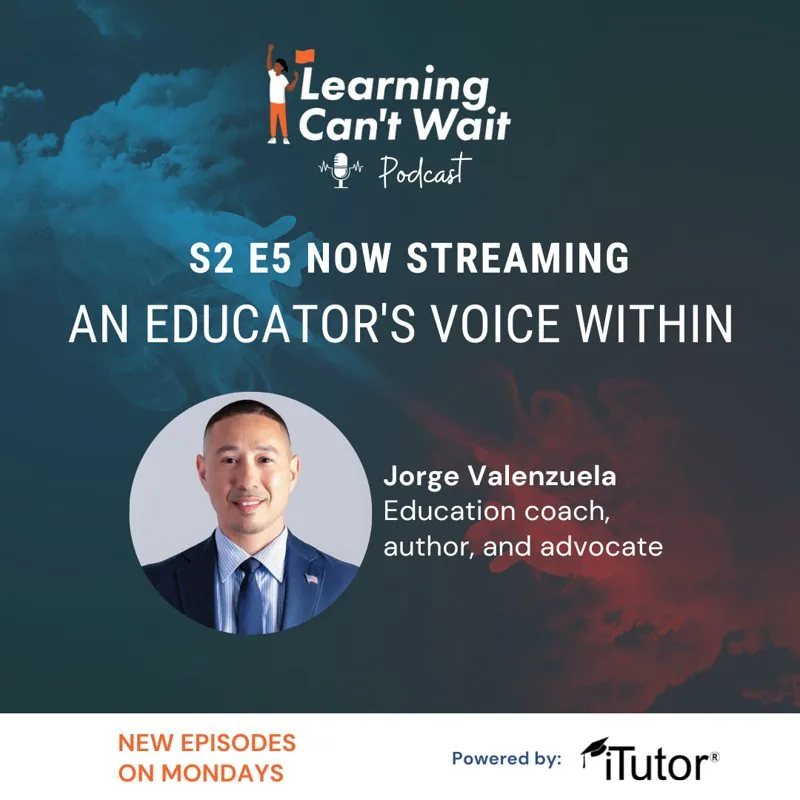
Learning Can’t Wait · Season 2, Episode 5
An Educator’s Voice Within
 Hosted by Hayley Spira-Bauer, Chief Academic Officer at Fullmind
Listen now
An Educator’s Voice Within
Episode summary
Jorge Valenzuela, CEO and founder of Lifelong Learning Defined, explains how quarterly learning walks helped all 50 Richmond City schools earn accreditation around 2010 and became his action-research model for co-creating professional learning with teachers. He describes training with the Buck Institute, now PBLWorks, and argues project-based learning needs a recipe: the project is the unit plan, not the product, so start with one a semester. He discusses his ISTE environmental science book, an upcoming Solution Tree SEL book, the aunt whose summer job offer made him a teacher, and advises consultants to follow their inner voice and help the person they used to be.
Key takeaways
- Learning walks every nine weeks plus data debriefs beat PD designed far from classrooms
- There is no book or presenter that can save a school without its context; co-create instead
- Treat the project as the unit plan, not the product; start with one per semester, two to three weeks long
- PBL is the most compelling way to teach environmental education because it ends in a call to action
- Serve the person you used to be; passion sustains the hard work consistency requires
About this episode
Learning Can't Wait podcast welcomes Jorge Valenzuela, the lead coach at Lifelong Learning Defined. As the author of numerous books and host of the SEL in Action podcast on BAM Radio, Jorge has made a career of using action research methodology to help school leaders and teachers reach their unique success paths. Jorge's work offers professional development on behalf of ASCD, Corwin, Instructional Innovation Partners, Premiere Speakers Bureau and Solution Tree.
Learning Can't Wait is brought to you by iTutor.com.
Full transcript
Transcript generated from the recording; minor errors may remain.
Welcome to the Learning Can't Wait podcast, an iTutor production at iTutor. Our vision is to ensure every child has access to education regardless of circumstance. Each episode, we will be joined by Pathfinders within and around the education space who are bringing about transformational change on behalf of.
Students, I am your host, Hayley Spau. I am so excited to be talking to you today. Jorge Valenzuela, the CEO and founder of Lifelong Learning Defined. We are brand new to each other, so I wanna say welcome and I'm so excited to hear your story because this is really gonna be the first time that I get to learn all about how you've built an incredible organization.
Oh, thank you so much, Hayley. It's an honor to be here. It's a pleasure. And let's jump right in. So, Jorge, you know, when I, I actually put a call out on my LinkedIn community and I said, who do you know that is moving the needle and doing great things on behalf of children? And your name came up and I started doing a little bit of a Google search.
And you have quite the background in and around education. Why don't you tell us how you got to where you are today? Yeah, so I started out as a teacher. About two decades ago, almost, two decades ago. It's like 19 years and I wanna say my seventh or eighth year, I became a district administrator where I became responsible for 40 other teachers.
We had a director that was really bent on making sure that. The content area specialists and the elective specialists work together so that we can visit schools every nine weeks, like every quarter visit schools, doing something called learning walks. And in those learning walks, we would get to know our teachers, their needs, also the kids, and then we would go back, have a data debrief, and then make sure that everyone on the team is saying and seeing the same things.
And then we would design the PD solutions and embedded, embedded PD on, on supporting them. We got a lot of success in around 2010. We got all 50 schools in Richmond City Public schools fully accredited with a model like that. And I guess, That really stuck with me. And as a specialist, I would support my teachers in their curriculum, in their trainings, equipment, materials, you know, supplies, things like that.
And then eventually I hit a wall and I realized that I didn't have the skillsets that they would need in order to do project-based learning. I looked around sought. An organization, back then it was called Buck Institute for Education. Now it's PBLWorks, and I joined them around 2014. I got into the cohort, I think it took me about 10 to 14 months, and when I became very proficient in their PBL framework, I started facilitating workshops around the country.
I started really slow, but around the fifth year. I got a handle of it and something inside me said that you, you have to go do this full-time. I started doing that and I began writing articles or blog posts around that time, and from there I got invited to write books. Visit school districts, other schools that I would've never planned to visit.
And eventually I formed my own company. It's called Lifelong Learning Defined. And since then I started doing that action research Learning Walk as just an instructional innovation model for helping schools, number one, understand what they really need, and then number two, make a plan on how to go about it.
So yeah, I mean, my. I'm approaching my fifth year with Lifelong Learning Defined. I recently opened Instructional Innovation Partners, which is a nonprofit and with Dr. Sheldon Eakins, and my plan with that, now that I've experienced success, is to help other educators that want to do what I do, but may not have that big picture to help them.
With my coaching and using my models and my systems so that they can develop into that business owner that is doing their own thing in an efficient, effective way that is truly helping schools. I wanna, I wanna first of all say congratulations because this is, this is hard work, as I call it, , and this is hard work.
Also, make sure the, the heart and the heart are clearly defined. But it also is work that is rooted in what is happening in classrooms. Right? So you're going on these learning walks. This is not PD that's created in the ivory tower by folks who have been out of classrooms for a really long time. Can you talk about why that learning walk process is so important to creating powerful and effective?
Yeah, so one of the things that I learned in the PhD program is how to create knowledge and how to learn knowledge, and there's a process. You have to look at what's been done. You have to, so if you're exploring a topic, whether it's PBL, SEL, tier one, instruction, ex, you know, whatever it is, you have to look at what's been done.
Most likely there's a model, a system, or a framework that's already been. Some other researcher, but now we have to adapt it and tweak it and collect data for my specific context. And so anything that we do, right, like you know, data is variable. What we see today may not be tomorrow. What we see in Los Angeles may not be in Virginia.
So by doing learning walks, Visiting teachers, hearing from them, seeing, you know, learning from them what's needed. See,teachers are the most prominent experts of the kids.So if we're supporting teachers, then how can we have our finger on the pulse of what that teacher and that school needs? If we're not visiting classrooms, I don't think we can.
Right, because there's a, there's a level of differentiation required. At the, at the very basic, like the, the first building block level that you're, that you're doing. I would definitely think it's impossible to get a full handle and being that we saw success back in 2010 with our schools, you know, it's just, it's something that I just continued doing and it's been very successful for me because it's allowed me to really co-create with, with my.
Instead of me coming in and, you know, dropping information for them, it's more where we co-create. We are learning together. We take some of what they do well, some of what I do well, and then it, it becomes synergy. There's no presenter, there's no book, there's no pd. There is nothing that can save your school, especially if they don't have the context.
Of your school. So it's gotta be a collaboration. The same way a thriving classroom is a collaboration between the kids and and the teachers. And so the same way with a thought partner slash consultant, I have this really defined memory that you just like brought out in my brain of being a teacher.
Receiving a PD book on how to teach reading, writing about students that were so fundamentally different than the ones I was teaching. Mm-hmm. And I thought to myself, how is it that they're possibly accounting for the cultural differences of my student, the life experience of my student, the needs, the resources that my school has available?
And the answer was, they, they weren't. And it, and it didn't work. And now these, these. Curriculums are being disproven publicly, and I remember sitting there and having this moment of what you just said is like, how could it be real for a teacher if it's not real for the community? Well, I think we have to start somewhere, right?
And I think we have to try things and I think that we're a product of what we know, right? And, but we have to go back and, and, and understand how knowledge is created. Now, if someone isn't in a graduate program, it's gonna be very difficult to understand how knowledge is created unless if. Building administrator is doing a book study based on that new thing that, that they're doing PD on.
Right. And they're looking at the research, they're looking at the practice. It's being modeled for them. They're implementing, looking at the data, not just academic achievement, but student engagement. Like there's a correlation there, right? Like you can't have them achieve if they're unengaged. And from looking at data that way, and then, Looking at our own impact, our own practice, then that makes it easier for us to tweak, adapt, level up, and improve and even fail.
LikeI have failed way more times than I've succeeded, but because I failed a lot of times, I'm starting from experience every time. And I think that's an important thing to understand and you won't understand that if you are. Involved somehow in that action research process. My job as, as a coach, as as a facilitator, is to walk them through a process like that, and a lot of them, you know, if they have a doctorate, then they kind of realize, oh, okay, okay.
So we have a problem statement where we are, where we want to go, how we think that we're going to get there, the behaviors and objectives that we want to see. Okay. And the learning walk is, it's gonna provide us those, you know, look fors and, and that formative assessment or that assessment of what's actually happening in opposed to what we wanna see happen.
And so that, I think it probably should have been done that way, , all along. I, I know in some spaces it is happening that way. But yeah, across the board it's not, and you're trying to change that. Oh yeah, I w I would love to see it happen one day, but you just do your work and you put the right stuff out there and you hope it sticks.
So let's talk a little bit about project-based learning. That's the, the acronym PBL. For listeners who are maybe not experts in education, but are curious to learn more about what's happening in schools today. PBL stands for project-based Learning. Talk to us about why this is the pedagogy that your insistent belongs in schools.
Well, I don't think it's the only pedagogy I, well, it's a form of experiential learning. Learning by doing, and also with reflection for metacognition. I love PBL. I think it's an amazing instructional approach. It's research based. However, I don't think that everything. It should be a project or it needs to be a project.
I think if teachers are starting PBL and they've never done it before, I think that number one, they need a recipe for it. They need a framework. Like if you're in your kitchen and you wanna make lasagna or you wanna make a dish that you've never done before. You may have all the ingredients and all the tools, but with no framework, with no recipe, we're not gonna get very far.
So if we have a research informed approach to what defines the student experience in a project, but also some general guidelines for how I should start, Then I think that with time practice and repetition, we can get better and better, and I tell teachers all the time thatthink of your project as your unit plan, not the product.
A lot of times we see kids making a product. Building something, doing a presentation, a performance task. And we call that the project. No, that's a product. The product or, or the project is the entire process. So I'd say start with one a semester or one every nine weeks, and don't do it for more than two, three weeks at a time, but, It's like anything, right?
You have to know where you want to go. So if I want to be a PBL teacher, I know that I have to travel this path. If I want to be anything, if I want to accomplish anything, I just have to know where I want to go, and then take into account two major things. Number one is I know where I wanna go, but not how to get there.
So instead of trying to figure this out on my own, find a mentor, a coach, a resource, someone that has already accomplished what I want to accomplish, and then I want to consider my energy. If I'm inspired, if I'm motivated, if I'm feeling good, then I'm going to do the hard work that's required to achieve my goal.
If not, then the energy will probably be like, well, I don't wanna do this today. I'm tired. I wanna watch Netflix Falls to the bottom of the list. Right? Yeah. Right, right. So it's just those two things, and I think that there's a lot of good resources out there for PBL, my work being one of them. So I encourage everyone to take a look.
I have an article on Edutopia. It's called A Simple Framework. To implementing PBL. It's on Edutopia. It's my work, and it uplifts the high quality PBL framework and of course that there's other organizations out there as well. I wanna talk about your most recently published book, the Environmental Science Book, it feel.
I'm assuming that's the most recent publication you have of books. Is that correct? I have one in the pipeline that I knew that was going to be the answer. That's why I'm asking . No, no, no. So Solution Tree is, is publishing my new book. It's on SEL social-Emotional Learning, which is also discovered through through action research.
That'll be out in October or November. But the Environmental Science book, it's a special book. It was, it fell into my lap. One of the editors at ISTE was like, Jorge, I have a brother. He's an environmental. Science teacher, this is such an important topic. What do you think about it? And I. Looked at it and said, man, I have a lot on my plate, but this is something that I know it's important and I can look back one day and be very proud of.
I reached out to this amazing guy, I know his name is James Fester, and he's an expert in all things, parks and nature in the environment, and we sat together and we. Agreed to write the book in three parts. You know, part one is just basically, Defining PBL environmental education and some of the big lifts or the big things that someone that is teaching it should really consider like climate change, sustainability, human impact.
And then part two of the book is a project that. Dives deeper into those topics, but it provides an adaptable PBL unit that any teacher from any grade level can adapt. And then part three of the book is getting into, field research, SEL and ways of working with technology, with an environmental education and the inquiry process.
And yeah, it's, it's an amazing book. I. I get to speak on it sometimes and help teachers in adapting the projects in the book. And yeah, it's on ISTE, it's on Amazon and on my website. It feels really timely to have a book about environmental science and helping schools and teachers to make that education real for kids.
You know, I, I know there's a ton of content out there and other validated sources that could be used, but I, you know, right now we're, we're in a little bit of a precipice with our environment. So creating content that is really dramatically challenging how we teach this to children so that it's more engaging, which like maybe is a broad generalization, but from my perspective of being a classroom teacher and a school leader, PBL classrooms had higher engagement.
You know, that's that for me, that felt really, it brought learning to life. Yeah, there is definitely research by the Lucas Education Research, which is an extension or the research arm of Edutopia, that that has shown that PBL is the best way to teach environmental education because it makes it compelling.
It, it focuses on having young, young people exploring an environmental issue, but most importantly, explore a solution. In collaboration with others. So they're thinking about ways of becoming a conservationist, of really creating a call to action that is going to extend beyond the project, beyond the classroom, and getting other people involved.
And if you think about it, that's how environmental scientists, engaged the public, right? Like they have the research. They have their work that they're doing, but there's a call to action. It's not just exploration, it's, it's developing a solution. And I. I'm not sure how the book is being re being received everywhere, but I do get feedback from folks that are passionate about it.
But you know, definitely this is the, probably the final generation that has to make a decision of about climate , you know? So it's so dark, but it's so real, Jorge, it feels like, oh yeah. Yeah. It's like a bold statement, but it's a very real statement. Yeah. I just try not to. Too emotionally involved in the things that I can't control.
Yeah, yeah. Yeah, it sounds you're, you're chipping away at the parts that you can control, which is equipping teachers to have the tools to teach students. So that sounds like it's within your realm of, of control right now. Yeah, I think so. So, but yeah. But at the end of the day, like it's a big country.
There's. I wanna say 200,000 teachers or, or 2 million, I forgot what the number is, but there's a lot of teachers out there and there's a lot that need to be staffed. So, so I, I can only do what I can do and on my social media, you know, put it out there and, and hope that it helps someone. I mean, that's really what I do is anything that I write.
It is really meant to just be a way to do scholarly service, but to put the information out there for someone that will never meet me, and if it can offer them a step-by-step inspiration, something that they can use as they're learning their own way, then I think that's important and I feel blessed. You know, everyone I have on my podcast has a story about what led them into education and how they became a teacher.
And I'm curious if you have or you recall a defining moment that you realize, oh, I, I need to be in a classroom. Ultimately, now you're in many classrooms, but in your early footsteps into a classroom, what, what led you there? . Yeah. So I'll say to anyone listening that you have to pay attention to that voice within saying that you need to do something.
And there's research that shows that the more that you can, you know, quiet your inner storm and listen to your gut, your intuition, it's there for a reason. Right? And I can't like, you know, validate this, but it's been my experience that you have to. Listen to what is coming up over and over again, and then, you know, doing it.
And if you don't know how to do it yet, just find a person, entity, resource, book, whoever that has already done it, and then just follow those steps. But you have to tweak those steps as as you go along. Well, anyway. My major was computer science, stem ed, and I never thought of becoming a teacher. Now, I was told a couple of times that I should consider it, but it was never something that was inside of me, I would say, that I saw for myself.
I had an auntie who passed away now about five years ago, and she was a teacher and she told me one day after I graduated and I had a job lined up and everything that I think you'd make a great teacher and. I didn't see that for myself at the time, but she made a really great offer. I think it was 36 50 an hour for five hours a day for four days.
And if you add that up, that's like $700 a week for four, five weeks. So I said, man, that's a great deal. That's a lot of money. So I'm gonna try that out and after five weeks I'll go back and follow my intended career path. Well inside of me, I always had like a chip on my shoulder feeling that I wish that my parents would've been better parents and better friends as I got older, and I never told anyone that, but that's just something that I, I felt when I got into the classroom, I met 25 kids that I realized that some were marginalized in a way that I hadn't been.
I've always been the type to want to help people and they changed the entire trajectory, not just of of my career, but also my life. And I got that inner voice in me saying that this is what you need to do. As I learned to trust that voice. And trust my expertise and become more confident, not just as as a teacher, but as a person.
As a man, my voice has changed and said, you need to help teachers. You need to help politicians understand this. You need to help superintendents. And you know, I know how to learn. I know how to create knowledge. I know the process, the action research process. So it's all about. Really convincing another person, whether it's a team superintendent, a teacher, a student, to allow you to work with them and learn that together.
I appreciate your vulnerability in sharing that story. I know sometimes when I bring people back to their childhoods and I'm asking them to share what brought them to education, in some cases it's, you know, incredibly heartwarming, and other times it's more challenging, but, It. It's cool because I think, you know, right now we have a teacher shortage.
You named it a few minutes ago. We have, we have schools open already that have vacancies in the hundreds, and so we need teachers. Teachers are a vital part of our society, and so if others who are listening are not yet teachers, but feel called to listen to their voice. In inspired by your journey, I think that's amazing.
So I appreciate you sharing that. Oh, it's my pleasure. So what's next? Like, what's the grand vision for. For you and for Lifelong Learning Defined where, where do we see you in 10 years? How is, how is the organization changing? Like what gets you most excited about the future? Yeah, so I, I'm just excited about the, right now, I'm very confident in what the future holds.
because we have a process. We have a way that we want to get there. Now we don't know how we're gonna get there. Think of what Wayne Gretzky said. I'm a great hockey player because I skate to where the puck is going to be. So if you do your work, you do the work. And, and Michael Jordan said this. He said, you don't try to chase rewards and, and, and prestige.
You do the work and then all that's bestowed upon you later on. Right. And so I have saw that by doing the work, the hard work, you get more opportunities. You, you, get to help more people. So I don't know exactly like I know the system I have, right? Instructional coaching, you know, the model, actual research.
I'm writing books, articles, doing really meaningful. And really compelling PD and now showing other people how to do this. So I think that by the age of 55, and this is my goal, I'm saying it right now, I'll stop writing. I'll stop facilitating workshops and focus more on helping young consultants, young teaching coaches, instructional coaches on doing what I've done.
But in their space, in the way that they, that they want to. So whether that improves a school, whether that improves a business model or plan or whatever, that's fine. But I think that's my way of giving back because I learned it the hard way. Right. But I've had a lot of success. Well, I've had a lot of helping hands, but I've, I've done it the hard way.
A lot of it. Was l learning on my own, having to figure things out. I'm still figuring things out. Like I can't say that, that I figured everything out, like branding, you know, marketing, social media, like I don't have all those things down packed, right? Not as down, packed as, as as my client list. But what I will say is that our purpose.
Should always be to help other people and we should exploit our uniqueness and the thing that we can help other people solve. In the service of other people. So this is what I know how to do. So I think that that's what my future holds is to one day just do this, but to show other people never stop teaching.
Right? You're one, once you're a teacher, you're always a teacher. You can take a person out of the classroom, but you can't take the classroom out of the person. That's, I mean, I hear that a lot. I, I really do love the attitudes you shared from Wayne Gretzky and Michael Jordan about, you know, skating tour the puck is gonna be, and also not doing it for the accolades and yet, You know, it's important to recognize talent.
You, I mean, you've amassed quite, a set of literature and resources to help teachers, and I think that's worth celebrating. I mean, this entire podcast exists to celebrate people who are doing the work and the, the hard work as you name. So grateful for what you've built and excited to follow what comes next.
Oh, thank you so much. Yeah. I. I had a person that reached out and she did a great article. It got a lot of great feedback. And she was so excited, and I said, well, that's great and it's a wonderful piece and it's gonna help a lot of people. But can you do it again, again, again, again and again. That's the thing, right?
Like I was inspired by, by, Drake, you know, Drake is a rapper, but I'm a fan of anyone that's excelling at what they do at a, at a high level, and I learn from their stories. And look for the parallels in our journeys and see what I can glean, so that I can learn how to do things better. And obviously Michael Jordan is a person that I've been, you know, studying for a long time.
But you know, Drake said that when he became artists of the decade, and if you look at the numbers, like his achievements, he's not the biggest rapper. He is the biggest. In music period ever. And one of the things that he says is that his first single, it was a good one. He said it was a cute one or whatever.
And then the second one was great, but can you do it again and again and again? And it's dedication to, to your craft. It's dedication to what your purpose is and how you want to help other people. And have in, you know, creating something that is helpful, that is useful, and that when you do that, you are not really looking at the greatness of that one thing.
You did that thing well. You got all the feedback, other people looked at it, it's polished, it's done, but now you're on to the next thing. And I think that that's an attitude that has helped me a lot, and it keeps me humble, it keeps me grounded, and it keeps me just never being complacent. And I think that, you know, Pharrell said this, don't ever be complacent you.
You have to act like this is your first opportunity. Your first said that, you know, that sort of fortitude and resiliency through the ups and downs I imagine. One that takes a lot of, like, like we've talked, you talked a little bit about earlier, like internal strength and, and kind of know how for what the end game might be or where, where you're going and, and the process.
What advice would you give a maybe an entrepreneur or a, someone who is looking to. Outside of where they started. So maybe getting into consulting as you named that you wish you had at the beginning of your journey. Yeah. I don't think you can look at another person like you, like you can be inspired by another person, but you can't really look at someone and say, I want to do what they do.
No, I think that is back to the inner voice, what I just mentioned as far as being resilient and, and being consistent is impossible. If the passion isn't there for what you're doing, it's impossible, and that's never a material thing. Steve Jobs said something along the lines. By the age of 25, I made a million dollars.
By the age of 26, I made 10. By the age of 27, I made a hundred. I would've did it all for. I would've did it all for free. And I think that when you follow what your passion is, then you're able to put in the hard work. And if you're not able to put in the hard work, then maybe that's not your passion. So if you're not sure what, what, what, what your passion is, I think that there's another principle that we can think about.
You are uniquely and powerfully position. To help the person that you used to be. So at one time I was the teacher that needed help. At one time I was an administrator that needed help at one time. I, I didn't know how, how to be a good husband, how to be a good father, all those things. So you basically should take your expertise and your knowledge and your passion and use that to help the people that need it the most.
In opposed to looking at, at someone and being, well, I want to be them. You have no idea how many doors were closed in that person's face. You have no idea what amount of sacrifice, how many hours went into their day, you know, building their businesses. So I think it's that inner voice, right? That thing that you love to do.
You know, follow that thing, you know, and then, I don't wanna say exploit yourself, but exploit yourself or use yourself in, in the purpose of helping other people achieve that thing that you've already achieved. This feels really timely, as a conversation, as we think about, you know, going back into this school year and just the challenges before us, we've.
Very long, three years of a pandemic, and you know, now we're somewhat in an endemic mm-hmm. . So I think people are recalibrating, right? They're recalibrating about what their expectations are for the future. They're recalibrating what education should look like in the future. And so I think it's timely to name that there are strengths in, within all of us that speak to the versions of ourselves that existed before that could really help us reimagine what.
The future looks like in our own purview, in our own environment, whether it be a school or an agency or an tech company or just, you know, in graduate school. I think that that is like huge for folks to realize and, and I appreciate the way you phrased it. Yeah. I like, I know a lot of people that, that had already been working hard.
So when the pandemic sent them home for a while, they were able to, to, to, pivot because they have been doing the work. And, and when you've been doing the work, you may not know how to get there, but you know where you want to go, right? And then you learn how to pivot in, in the, situation. But if that wasn't a part of your life, Then some people sat, sat on their hands and they weren't able to really pivot and they weren't able to really figure things out.
But that's okay, right? It's never too late to figure out what it is that you really want to do, and I think that it's not just about being an entrepreneur, being a great teacher, it's just about working on yourself as a person. . And if you do that right in tandem with what your professional life, like your personal and, and you're professional, then I think you've got it made.
And we've lived a life that is worth talking about. That's why it's called Lifelong Learning Defined. I figured out for myself, I want to say, around 20 14, 15. What my per what, my personal, and what my professional goals were and what my journey was. So I called it a company like I named the company. What I would hope that I can now do for other educators and other people I.
And I don't know what that will look like, but I know what the framework and the model looks like. Right. And that's all you really need, I think. So you have another book coming out this fall about social-emotional learning. If, if folks wanna read your content upcoming, I know you mentioned a piece on Edutopia.
There's quite a few pieces on Edutopia they could check out. But where can they hear you speak next? Where, where's Jorge gonna be sharing some of this information and maybe talking more in depth about the frameworks and mindsets? Wow. So I'm gonna be all over. I'm, I'm already booking like, you know, different states like Nebraska, Chicago, online in New New York.
But what I'm gonna do is I'm gonna drop. A link to my speaker's page and feel free to share that in the notes. And it's got a ton of options that the speaking options and them coaching options, and you'll see that there's several strands there that can be for administrators. I'm teachers to the entire staff, you know, conferences, workshops, and yeah.
That's something that you can share with your folks. I absolutely will. I know personally, I feel like very inspired about , just the personal journey you're naming here and to me on a, on a level. I don't think I anticipated when we answered the podcast recording today, , but I, you know, it's, You know, people that are committed to doing work to help others have really good intentions.
And so it's really great to hear you share about how you built what you've built and what you're continuing to build ultimately to serve others. So I'm really grateful that you came on the podcast today, Jorge. It has been an absolute pleasure. As I mentioned, really transformative internally for me as much as I'm sure it is for the listeners today.
Well, I appreciate that. To all the listeners, thank you for taking your time to hear this podcast and I hope it becomes your, your most listened to podcasts up to date, and I hope your next one with whoever that is, becomes even more listened to than this one. Appreciate that. I don't know if the listens and downloads will be just for me playing it back or for my, you know, whoever else is listening, but I'm definitely gonna be a repeat listener on this episode.
Thank you again, Jorge, so much for joining. It's been a pleasure having you on.
Thanks for listening to the Learning Can't Wait podcast. If you liked what you heard, please rate, review, and share this episode. Be the first to know when we have a new episode by subscribing wherever you listen to podcasts. If you'd like to be a guest on the show or have a suggestion for an episode, email us at podcast@itutor.com.
This episode has been brought to you by iTutor, your online solution for sourcing highly qualified educators. Join districts all around the nation that use iTutor to connect with thousands of licensed educators who fulfill both core and supplemental instructional needs. Choose iTutor Online education when learning, can't wait.
Now I'm back to this episode.