
Learning Can’t Wait · Season 1, Episode 17
Lessons from the BX
 Hosted by Hayley Spira-Bauer, Chief Academic Officer at Fullmind
Listen now
Lessons from the BX
Episode summary
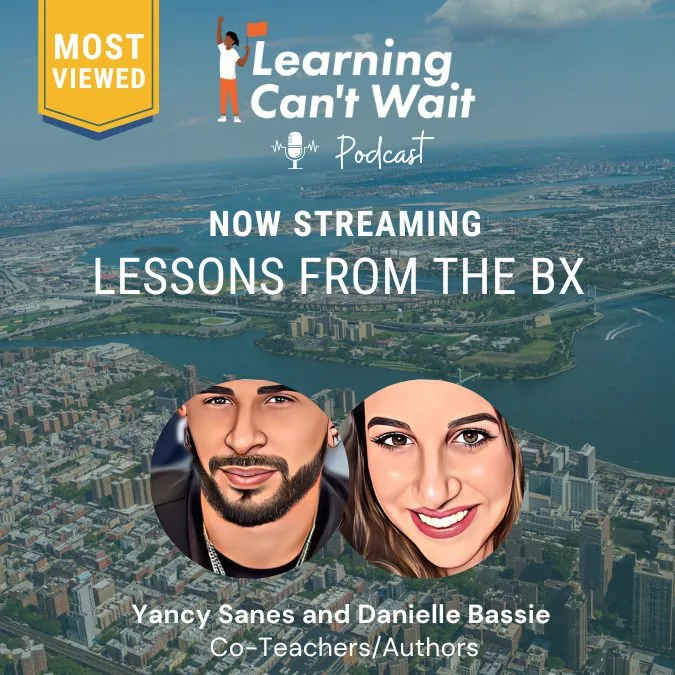
Danielle Bassie and Yancy Saines, co-teachers at Fannie Lou Hamer Freedom High School in the South Bronx and co-authors of South Bronx Adventures: Teaching During a Pandemic, describe a team-teaching partnership in which students cannot tell who leads. Yancy, a former student at the school, insisted on equal footing from day one. When COVID hit, they spent weeks checking on every family's food, bills, and health before teaching, then required cameras on and kept near-perfect Zoom attendance. They discuss their students' social time warp, their own mental health, why every classroom needs two teachers, and advise new teachers to walk in confident and remember their why.
Key takeaways
- Team teaching means both teachers lead; students shouldn't be able to play mom against dad
- Family wellness checks on food, bills, and health came before any remote content
- Cameras-on requirements and consistent routines produced near-perfect attendance when peers saw two students
- Putting ego aside and letting each student find their person is the heart of co-teaching
- Ninth and tenth graders returned developmentally time-warped after missing years of in-person school
About this episode
Thrive or survive. Succeed or fail. What did co-teachers and co-authors Danielle Bassie and Yancy Sanes do differently during the initial school closures in March of 2020? What efforts did they put forth that allowed their students to thrive in a difficult situation and rise above to achieve success rather than flounder to failure? Listen to this episode, Lessons from the Bronx, and find out!
Learning Can't Wait is brought to you by iTutor.com.
Full transcript
Transcript generated from the recording; minor errors may remain.
Welcome to the Learning Can't Wait podcast, an iTutor production at iTutor. Our vision is to ensure every child has access to education regardless of circumstance each. We will be joined by Pathfinders within and around the education space who are bringing about transformational change. On behalf of deserving students, I am your host, Hayley Spau.
Welcome everybody to today's episode of The Learning Can't Wait podcast. I am very excited to have two authors with us today, Danielle Bassie and Yancy Saines. Welcome. Welcome. How are you both doing? We're good. Hi. Thank you. As I said the last time we met, I'm really shocked and surprised that you decided to record this podcast in the middle of a school day.
for listeners, they're not just authors of a, of a book. They're actual teachers teaching in the South Bronx. How's the school day been so far today? Like, are we ready to record and tell our listeners about how you, how you survived teaching in a pandemic? Yeah, I think it's almost better for us to record in the middle of a school day cuz we feel like we're in it and we're like, everything's fresh on the mind and it just feels natural to do it like this.
Well, and you're gonna be telling everybody about how the two of you, your collaboration, your communication, Really helped you succeed and helped most importantly, your students succeed during a extremely traumatic, an extremely traumatic time. 2020 2021. I think we all know we're talking about the Covid 19 pandemic crisis.
So before we get into that, why don't we just start with a brief bio? Danielle, why don't you tell everybody a little bit about how you came to teaching? Sure. So I am in my 14th or 15th year teaching. Is it a debatable number? Like are we, I think I started in November. I was like a mid-year teaching fellow.
Oh. So I always sort of forget exactly where I am, so I'm somewhere in there. You lose track after about seven, and I've been teaching at Fannie Lou Hamer since 2010, but I started teaching in 2007. And I came to teaching actually kind of by accident. After I graduated from Penn, I went on to do some environmental activism and some corporate work, and I, I fell into teaching because my mother was a high school math teacher where I went to high school, and she always said, you should be a teacher.
And I rebelled and didn't listen, but eventually after the other things didn't work out, I was like, fine, I'll do it for a couple of years. And here I am, 14.5 years later, still doing it and loving it. And yeah, I started here at this school, my Forever school in 2010, which is the same year that Yancy came into teaching at the same school.
Wow, you're doing the intro for me. So, Yancy, tell us how you, I don't even need to be here on today's episode. . We're so used to just talking into each other. Alright, well, well that's, I, that's part of the magic you're going to share with everyone. So, Yancy, I, I don't wanna take away from your intro. Why don't you tell us all how you fell into teaching, with Danielle, but really into the profession itself.
All right. Yeah. So this is my fourth year coming into teaching now. It's been great. I've been teaching with Danielle. Ever since I started, so the way I got into teaching. So it's been weird. It's like a long journey. My brother was diagnosed with autism when I was 10 years old. He was one and a half, and ever since that day, ever since he was born, I've been raising my brother and helping him develop across the, these years, seeing how he's grown and just making him from.
Reaching these little goals to reaching higher goals and reaching these bigger academic goals and reaching out to him that way. Helping him be a better person, better student, better, better learner. So I w went into college working with student thinking, oh, I wanna work with students with disabilities, maybe younger kids, but then I was in high school, and so like Danielle mentioned, in 2000.
She joined Fannie Lou Hamer. I also joined Fannie Lou Hamer, but I was a freshman. I think I actually said you started your teaching journey in 2010, but yeah. No, you were a student. You were a baby freshman. Yeah, so I started Fannie Lou Hamer. She started Fannie Lou Hamer in 2010 teaching. I started 2010 as a student freshman in high school.
I graduated from the high school in 2014, and I just loved my high school experience. I loved the teachers I had, and they also pushed me into going into teaching like, oh, I think you'll be a really great educator. So then I finished college and in 2018 I started teaching here at Fannie Lou Hamer and it's.
Crazy because even though I graduated in 2014, I've still have some of my colleagues were once my teachers, so there's this funkiness to it. Not me though. Yeah. Danielle was not my teacher. I was gonna be, my next question was Danielle. He said, thank God you heard that right? He said, thank God. And during college he tutored at Fannie Lou Hamer, just for some.
You know, for a job, and I think that's maybe what made you switch between like kids working about elementary, kids school and high school. A high school. Yeah. Like I barely left this school. You can say like . I started in two. Really planted. Really planted there. We didn't let go. I started in 2010, graduated in 2014.
I came back working in this school at 2016. My other brother also came to this school and graduated in 2016. So we was all still connected. Came back in 2016, got hired as a college. That went on to becoming a tutor assistant teacher in the classroom. And then that's when I got like my real hands-on experience in teaching in high school.
And I just, instead of working with students with disabilities in elementary, I just really fell in love with the high school setting. Well, I appreciate you both sharing your journeys to where we are today and let's, let's like ground ourselves a bit. So where we are today, why you wrote a book is the two of you teach in a classroom that supports.
Students with disabilities and students that are, what would be the correct term you would use? Do we just say general education students? We actually teach students with disabilities, English language learners, and then gen ed students. Cool. So that that's sort of amalgamation of students in a classroom, that heterogeneous type of learning environment.
We know research tells us as educators that that's good for kids, it's good for all the kids in the classroom and it comes with the added benefit of having two teachers. So Danielle, what is your area of certification? So I am a certified math second secondary level, so seven to 12 math education. And Yancy, you are a certified in special educat.
Okay, great. So two teachers, two different types of certification to support the diverse needs of their learners in their classroom. So this is for our non, our, our listeners that are not as familiar with education. That's the environment we're talking about. Now, let's talk about pre pandemic life. So you had some time together teaching.
What was, what is co-teaching, as we call it, co-teaching, like in. A typical school year. I, I like to laugh cause I don't even remember what that feels like. But a typical school year, what is that? How do you function? What, how do you make it work? How, how do you get the greatest success out of that partnership of two adults in the classroom with students?
For us, the thing that works and the thing that we maintain that all co-teachers should wanna do is team teaching, which is the style where you're both equally involved in delivering the lesson and the activities. It's truly. I don't even wanna say it's like 50 50 cause it's like a hundred, a hundred.
You're both like fully on all the time. Like there is not one person in front of the room. It's like the two of us have gotten very good at just like almost circling the room together. Like no one can see me doing this motion, but like opposite one another. Circling through equally. Yeah, definitely.
That's what our co-teaching classroom looks like. You know, there's this stigma around special education teachers and gen ed teachers where like gen ed teacher gets placed as the lead teacher, but if you come into our classroom,our kids cannot tell who's the lead.And if there's a title as lead, like we're both the leaders in the classroom and that's what they see.
They don't, it's very hard for our students to play Mom and dad. I think the most important part of our co-teaching relationship, how it works is just communication. Like we speak all the time, figure out the wants and needs of both of us and what we expect. So there's no room for kids to play. Mom and dad.
So when you're in the classroom, when you're physically there, you've named a lot of things that you do, right? You, you're using proximity, you're moving around the classroom. You're openly, I'm assuming, I'm assuming, right? You openly communicate in front of the children so they know you're on the same page.
We sure do. And then I'm sure there's, you know, there's the off periods like you're having right now where you're sitting together. What does an off period look like when you are in the same physical space? So it's tricky because Yancy does not only teach with me, so he has another, he, he follows the same group of students.
He has another co-teacher also. So there's a tremendous burden of planning on him. And I think when we first started, the first two years, we used these off periods to plan. To sit and be like, this is the content we're doing. And something Yancy and I have always been very good at is like I will take the time to teach Yancy any of the content that he is not yet familiar with, and he will take the time on his own to learn it and ask questions so that he's fully prepared.
Walking into the room now, you know, four years in. He's an expert at the content too. And so at this point we use our planning periods to debrief the class, you know, as things that we noticed with the students, interactions we saw, things that might happen. More of like the micro level, what's happening day to day as opposed to like the macro, like what do we need to teach?
And also just to like, to take a breather. Take a breather because mental, we're in a pandemic and, and mental health. Yeah. Right. But, but we're right, like we're gonna get to the pandemic cuz that's like a whole, what you're describing right now is, typical school year before we went virtual. Yeah. I, I guess it's true now.
Cause y y'all are both in person and together. , you know, you don't have the added layer of stress y of, you know, a, a virus running rampant through the world. So this is, I think, really helpful. Right. And, and now let's like pause for a dramatic effect. Covid hits in March, 2020, and everybody shifts to virtual.
What was it? In the initial phase of the pandemic for you and your colleagues to shift to virtual and at the height of the pandemic, what was, what was the atmosphere like? Paint us a picture of, of how that was. It was just a very stressful moment, like it was almost like a culture shock. Like we're changing from one thing to something completely different and it was basically sink or swim.
Like, figure out how you're gonna figure out this new mode of. I think at first in the beginning, we really didn't think it was gonna last very long. So Yancy and I made three weeks worth of videos for our students and we sort of said, this is just a stop gap until we're back together and. . You know, I think we both remember I was very pregnant at the time, and so we put on the board behind us, like, imagine when Danielle's gonna be 34 weeks pregnant, 35 weeks pregnant, and by the time she's 36 weeks pregnant, we will be back.
And so in the beginning it was really like Yancy says, sink or swim, try and make sure everyone is okay. So that was our biggest priority in the beginning, was not teaching remotely, but we spent a solid two to three weeks. With our other teacher, Sarah, who does humanities, checking in with every single student and their family and asking questions like, we were just like, Hey, is everything okay?
Do you have food at home? Has anyone been exposed to Covid? Does anyone have Covid? What can we do? Are bills paid? How? Is there any way that we can support them in any certain type of way? I remember there was a time where groceries were getting given away for free, and I would just like get groceries and just take it to a different kid every.
So just make sure they were good. We weren't more concerned about teaching. We just making sure our kids first, like their health was first, their mental health was first. Everything, all those necessities first before we went into, all right, let's start teaching content. So that was like the first month.
And then at some point, I think we got the cue from our principal, like, this is not ending this year. So now we have to get back to, you know, teaching and learning. And so then it really became, okay, how do we do this? How do we take all this culture and community that we built in person and transfer it to Zoom?
And it was a lot of trial and error of technologies and experimenting and does this work, does that work and scheduling, and how do we get kids to show up? And, and then it became, How do you teach online, which is think was probably like April to June of that first year was like, let's figure it out. Yeah.
That's a lot to digest, right? We're talking about, I use the word trauma, but I mean that sincerely, like serious. Traumatic shared experience for students and, and the world really, during March, 2020 and AP and April, 2020 and, and beyond. But I, I love to hear the emphasis that you placed on the wellbeing of students first and foremost.
So just saying thank you for that, because it feels like, it just needs to be said that the wellbeing of of our students is primary before their academic achievement, cuz they go hand in. Yeah. Thank you. Thanks. We agree. So, so you wrote a book about teaching in the pandemic, right? When April, may, June hit, teachers were struggling because of this transition that you named.
Why weren't you struggling? I mean, I wouldn't say we weren't struggling. Maybe we just hid it well, better than others. Others, , but. What we noticed was, yeah, other teachers were struggling, so were we, but we were finding little successes and just capitalizing off of that. So then we noticed like we, we had like weekly meetings with other teachers and we were hearing like, oh, we only had two kids show up to our Zoom and Daniel and hi.
I had almost near perfect attendance. So then we started realizing, oh, this is working for us. This is working for. And one of our dreams was always like to write a book. And I told Danielle like, one day we should write a book together, like about teaching. And Danielle, Danielle was like, yeah, sure. But we don't really have a theme yet.
So like we can't just jump into it and say we're gonna start writing. So then. Eventually I was just like, what if we write a book about co-teaching during a pandemic, because we're doing so well at it right now. And the reason we both wanted to write a book together is because despite the fact that we share a math and science classroom, we both hold undergraduate degrees in English and creative writing.
So it's one of our little shared similarities in quirks. I think also for us, Our relationship carried us through.There's a tremendous amount of safety to experiment and to succeed or fail with one another.And, and we just found ourselves, and also with Sarah, like I said, who's our humanities counterpart, like taking risks and daring like we, like.
A big risk was we decided our students had to have cameras on in. Their cameras weren't on, they couldn't stay in the class. And when we would share that at staff meetings or with other teachers across the city, it was very taboo. And it was very like, how dare you have that requirement? But we, we all sort of got on board.
It took some convincing, but the three of us got on board and we figured out a safe way to do that for students and how to use our capital to do it. And it made all of the difference for all of the other successes and. I think that's why ultimately we did better is because we felt like we could take risks and we would support each other, whether the risk sunk or slam.
Yeah. That's powerful. You know, in anything in life, if you don't have trust and you don't have that safety, you, you likely won't succeed. So what, what do you think your students were, were thinking and feeling throughout this? Experiment, like national experiment, not the Yancy and Danielle experiment, but this national experiment or, or actually like necessity of virtual learning.
Like how did, how did, what were they saying? I'm, I am confident you took their temperature on this. We're kids. I think were just like scared in the beginning. I'm not gonna say like every kid loves to be in school, but our kids like enjoyed being in our class for the most part. And then when they said, oh, we're going remote, they didn't know like how to function in school.
At home and they were scared. They were like, when are school's gonna open up again? When are school's gonna open up again? Like it's not gonna be the same being in Zoom. But me and Danielle really tried our best to make it seem like they were in the classroom. I think at first it was almost like, Woohoo, we get to stay home.
Like I can log on from my bed and my pajamas, and then that novelty wore off real fast and there was a lot of. I'm tired of this. I don't wanna do this anymore. Can I come in please? Can I come in? And we started to have, when it got a little bit safer and a little bit warmer, opportunities for kids to come in person outside and learn outside of space distance.
And they. Would all show up like perfect attendance every time because they just missed being around other people. You know, they missed the little things that happened in a classroom like flirting or arguing or all of that stuff that is not academic. That is. So necessary for teenage development and they really, really missed it.
And so, yeah, we tried to foster it on Zoom, like, oh, I saw you, you know, staring at so-and-so's little rectangle over there. Do you have a crush? But it's not the same. I'm just like, I'm, I'm like thinking about that moment and, and I'm not sure whether to like laugh or die. , I'm sure listeners too are thinking of their own high school experiences and, and.
What it might have been like to have conducted some of that while from and their own homes, maybe next to a parent online or, or a sibling online. Yep. Yep, yep. Yeah, it's a lot. And, and so what did, what was the culture in your school like? What were you sharing out best practices with your colleagues? Were you sort of ostracized because you were feeling good about the, the path forward?
Like, sounds like you're in a pretty supportive community, but what, how did, what was the vibe then? I think teachers felt in general, very stressed themselves, you know, as just individual people. As humans were stressed and worried about the pandemic and how it was going to affect their families and themselves.
And then as professionals knowing that being in person is just the best option for students. And so I think there was a lot of stress around that. And then also what is the whole world or the whole country saying about teachers and whether or not we should be in. So there was just like a lot of stress.
From all different angles and like, yes, we were meeting together often as a school community to try and support each other and share best practices. I find that teachers don't, myself is like, number one, don't make great students. Like whenever I'm in a meeting, like my camera's off, even though I have, I tell my kids their camera needs to be on.
And so I don't know how successful those meetings were, but there was definitely an attempt to keep the community together. Right. Yeah. So if everybody who is listening today buys your books and buys your book and reads it, what are you hoping they'll get out of your book? What, what are you hoping the takeaway will be for, for the reader?
I honestly, I think our book can be read by any audience. Like it does not have to be a teacher. I think a student can read it. A person who is not in school can read it. Just to learn about the experience during that. And know that they weren't alone. Like everyone was struggling, everyone was trying these new things.
There was a lot going on. But also to hear the little successes that we went through during teaching, during the pandemic, and just anything they could take away from it. Learn from what we had to offer. I think we have some nice moments in it where we talk about our own mental health and you know, our students' mental health, and I think that that was something.
Felt very important to us to share. Because yeah, like Yancy said, especially during the pandemic, it was so isolating and it can, it can very much feel like we're all alone. So knowing, hearing that even, even these two people who feel like they did a good job and we're very successful, we still struggled with our mental health and we're still very human.
I think is something I want people to, to hear. I love that. I love. , you know, I'm listening to you and I, I'm thinking about what children need, but now I'm, I wanna like shift the lens a little bit given what you just shared, Danielle, about what teachers need, right. There's a, there's a crisis in teaching right now.
The NEA just completed a survey, and I talk about this a lot, but 55% of teachers respondents said that they were considering leaving the profession earlier than they had planned. Y'all gonna quit? I'm not. You know, I, I mentioned when I said how I got into teaching, the teaching was supposed to be a two year thing for me.
It was supposed to just fill some time while I figured my life out. And for me, it's, it's what my soul is drawn to and it's what I'm good at. And I don't think I'll even ever leave this school. This is home for me. And it just, it feels right and perfect, and it has been. . I've gone through some really hard things as a teacher.
You know, I've been at different schools, I've had students pass away. I've had really hard things happen. I had a pandemic, and yet this is what I am meant to do. I think for newer, younger teachers who have less, you know, sort of roots in the ground, it's a harder question to answer. I mean, yeah, it's like Danielle said, it's a harder question to answer, like, I don't know where I see myself 10 years from.
But I love teaching. I love what I do. I think I'm good at it. Really good at it. , thanks. Meant to do it. I'm clearly not leaving this school like I'm basically the baby of this school, . But teaching is not easy. It's not an easy profession, and the pandemic sucked a lot of joy out. It definitely did. But if I ever leave teaching, it's because I just want something different, something more.
Like, I feel like I fulfilled that goal, fulfilled something in my life with teaching, and I just wanna try something new. But I do enjoy teaching. I don't plan on leaving it anytime soon. It's not a mark on your character if this isn't your forever path, right? Like th th this generation, your generation, I say this, but your generation and the generations that are coming up in, in professional settings right now are likely to change career paths.
So how then, Do you feel about this school year? Right? Like I, and now I'm bouncing back to, to where you are today. Like, you know, that NEA survey occurred really recently, so we're not post pandemic, but we're in a new phase. Year three, season three of our pandemic . How much is that? Like how difficult? Has it been to return to establish some normalcy amidst school closures and teacher shortages and Omicron variant?
Like tell, talk about what that's like and how that impacts either your level of exhaustion or your like motivation to continue. You know, I say this year is my most difficult year ever. I think it's much more challenging, like coming back. They get say, they get, quote unquote out of a pandemic, but we're still in, in a pandemic.
Things are weird. Teachers have way more responsibilities than they did before the pandemic or even during that Zoom pandemic time. So it's much more challenging, but you have a co-teacher and we rely on each other and make things a little bit easier and make sure we still have successes in our c.
You know, I mean, even the students see it like we rely on each other and they rely on us. They have two teachers in the classroom because I think even our students are different this time around than ever before. Yeah. Speaking to the, how the students are, so we teach ninth and 10th grade, and so before this year, our students hadn't been in person school since like sixth or seventh grade, and.
So they, they're basically like time warped and so it's, we've never had to teach middle schoolers before and they're missing this huge chunk of like, very important developmentally socialization and sexual education and all of this stuff that has been very apparent in teaching this year. And so just for that reason, it's been super hard.
And then, yeah, it's like this weird in between where we're. Getting outta the pandemic, but not quite out. And like everyone has to wear masks and we have the police wearing masks and everyone got Omicron. And I got Omicron and kids are out. And it's, it's very, it's been very, very hard. And again, I have the roots in the ground from teaching so long that has made it easier for me than for other teachers.
And I have Yancy, which has made it infinitely easier than if I didn't. But it has been. A very, very hard year. I think that's what it, oh, sorry. Yancy. Go ahead. I was just gonna add on like very hard year and I think the thing that we hold onto the most is just relationships. Those relationships is what gets us to the next day.
Mm-hmm. And just move forward. Relationships between me and Danielle, relationships with colleagues, but also relationships with our students. At our school we have like this advisory program. Where kids follow like the same advisor for two years. So Danielle's an advisor and she has like a set of 15 students.
I'm an advisor, I have a set of 15 students, and they have us either for most of the day or, or even the entire day. And those relationships you get to foster throughout two years and you've become so close to them that you see the student grow. They work with their teacher and. They're like the reason you can be excited about coming in on a particular day, like a certain student, knowing that they have, like we just did a panel earlier today, like knowing that my student X was gonna do a panel, like was something I woke up really excited about today.
So yeah, it is the relationships. I think that is the takeaway I got from your book is just the importance of investing in people. Yeah. Right. Everybody's a stakeholder in a school. The custodial staff is a, are, are a team of stakeholders. Yeah. The, the teachers are a team of stakeholders, the students, the families, the community, the principal, the admin, the everybody is a stakeholder and the strength of that relationship really dictates success.
Yeah. I think relationships was a big part of our success. I always say,Every teacher needs a co-teacher.There should be two teachers in every classroom, no matter the need doesn't need to be, have students with disabilities. Even if it's just a gen ed class, there should still be two teachers in the classroom because now you're reaching almost every student or all students in the class.
I think that's the success Danielle and I have because I'm able to reach certain students that are different than the students she's able to reach. I think also something that. Made us so successful together that we would want other co-teachers to try is putting our ego aside. So like there is definitely a type quote, you know, quote unquote , a type of a student that Yancy is very easy, easily able to reach that I'm not, and like I know that they're gonna love him more.
And I, and that's great as long as they have someone. I'm fine. Whereas I think sometimes you'll find with teachers, they get sort of possessive about relationships or students and like, no, that's my advisor, or that's my kid, or whatever. And we're sort of like, sure, we would love every kid to love us, but as long as that kid has their person, we're good.
And if I see that kid like upset in the hall, I don't need to like step in and be their savior. I can say, I'm gonna go get Yancy for you cuz I know that's who you need and who you want. And that has been, we've always been on the same page about that and I think that's made all the difference. No ego, amigo,
I, I, so I actually founded a school where the model was two certified teacher. Didn't have to be in a classroom with students with disabilities that led the classroom, and that is what you're naming right there, that like understanding that you're not always the best person was huge and really conveyed a lot of what was success that I saw in my own classroom in the my colleagues' classrooms or lack thereof.
Yeah, it's hard. It's really hard to stomach when you feel like a professional who has done something, especially a seasoned teacher, Danielle, like yourself, that you were able to understand the value and power that Yancy brought to the table. I think that speaks volumes and it, it really like allowed for your own collaboration and.
Because I could imagine another world where Yancy walks in the classroom and the person who'd been teaching for 10 years was like, this is how we do it. Get on board. Yeah. It doesn't sound like that's what happened. It. No, that did not happen. It was almost the opposite. It was the opposite. . I had that. Ok.
Tell us more about that. . Danielle has better rec recollection, so I'm gonna let her go for it. Okay. I have like a steel trap memory, so Yeah, I mean, I've had other co-teaching partnerships and we recently did a PD where we spoke to people about co-teaching and what we hear across the board is, Content teachers are bossy, special education teachers are lazy and like that's the stereotype.
And it's very easy for people to fall into those roles. And I had had some co-teaching partnerships before Yancy that were less successful because I wouldn't give up ownership. And because they didn't, you know, demand ownership, you know, both ways. And so I. . Yancy was going to be my co-teacher and although Yancy and I came in in 2010, and although it is a very small school, I could not have picked Yancy out of like a gym full of kids.
There's no way. And I probably vice versa. Yeah, I did not know what, but I had heard, I had heard about him and he had heard about me. . And I still remember I was like cleaning out my closets at the beginning of August, whatever. And he just walked in and I thought he was a student, cuz I think he was dressed very casually and he was 22
And he was just like, so how's this gonna go? And I was like, what are you doing in my room? And he was like, us teaching together. I'm Yancy like, how's this gonna go? I just want you to know, like I plan on being at the front of the room too, and I was. Oh, hey, okay. Yeah, sure. Sounds great. Help me clean out some closets.
And it was just like the confidence and the very clear like, I'm doing this with you. The energy, like it was a very clear like energy vibe, click from the get-go. Like he was not going to sit in the back of the room and continue to be a tutor. He was fully engaged in being a co-teacher. And so, yeah.
That's how that started . Yeah. You know, like I had, I had that fear of like, oh, they don't, they're not gonna wanna share their classroom. And I was like, that's not happening. Like I know my personality and it's very. Dominant. Dominant. And so Danielle's personality is very dominant too. So no way , we definitely had to go in and I was like, you know what?
I'm setting my standards like I'm gonna be in front of the classroom too. I'm gonna teach some stuff that I wanna teach. And it's about setting those expectations and talking to one another to make sure that we're equals, I'm not being looked at as less of because I'm young or because I'm a brand new teacher, or I'm sped or a person of color.
Like no going in confident. Say your needs and once sounds like you did that and, and listen all your relationships, all the better for it. That's like a, you know, another good takeaway, right? It is for teachers to be affirmed in their strengths, to also show some humility in their areas of growth. I know you named earlier on that Yancy was unfamiliar with the content at the beginning, but was dedicated to learning it and now after four years feels, you know, really confident in delivering it.
Everybody's going to have weaknesses in the classroom. And strengths, yeah. Is just like our students. Yeah. And I think that we also are lucky that we compliment each other well. My strength is his weakness. My weakness is his strength. But we also haven't just sat back and been like, well, that's my weakness.
You do it. Like it's been very much like, oh, that's my weakness and I'm gonna learn from Yancy and I'm gonna get better at it. So, I think that's been nice too. We, we push each other to not just like, be like, yeah, it's my weakness. You got it. We push each other, actually grow through it and get better. So if you two, were going to give advice to a teacher or an educator starting out their career today.
Right. 2022. What advice would you give them? I was gonna start off by saying runaway, but I'm just kidding. Kidding. Seems a little dark. . This is our last question. Yancy. Leave the audio. Runaway. Runaway. No. I think, like I just said, like you have to be confident walking into your classroom. Something. Like I said, I never really left this school, so like a lot of my colleagues at first, when they first met me just had that vision of me as a student, and it was up to me to show them like, no, I'm an adult.
I'm your coworker now I'm a teacher. And definitely in the beginning it was a mostly white staff school. And I struggled with like internalized racism. Like I grew up in the Bronx, I went to a Bronx school, I'm a person of color. I struggled with that eternally. Like no, I'm not as good as them. And I had to get that outta my head and be like, no.
I'm just as good at the as them, I went to school for this. If anything, I also relate more to the people that the kids that come to this school, because I've been through the same thing they've went through, are going through. So just walking confident and be yourself and. I don't know what else to add, but I think that's great.
The opposite of runaway, actually the opposite of runaway like stand firm. Yeah. I think I agree with Yancy that it's important to advocate for yourself and to, to sort of own your role in the school. And also like when you're first starting, everything is really, really hard. And so if it's something that you think you believe in, you should, you know, not run away.
You should stick through it and fight and. Perpetually be open to grow. We talked about how everyone is a stakeholder before, and you know, there's that saying when you have children about, like, it takes a village. And that's true of education also. It takes an entire community. And we are a community school and we do have, you know, no ego, and we rely on everyone and anyone to help us reach the child and to make them.
Better. I also just have advice in general for like more veteran teachers and you know, I think that comes from my experiences of teaching with Yancy and that's just especially two teachers who are white and teaching in areas like the South Bronx, like. If you are getting into it, or you're doing it because you think you're gonna live out some Hollywood fantasy and you're gonna, you know, be like Freedom Writers or anything else, like it is the wrong reason.
And don't do it. Don't get into the job for that reason, because the kids deserve better than that, than to live out some fantasy of yours. And I think we see that far too often and just be open to grow and learn and, and remember why you're there, which sounds really corny, but is like, like I said, I woke up this morning excited for X to panel.
because that's the reason I came to school today. And so yeah, that's my Not to over reduce your response, but remember your why is the most common answer to this question when I ask, these are folks that I talked to, folks that are in the classroom, out of the classroom, 40 years out of the classroom and remembering your why, right?
Remembering the thing that brought you to education. Yeah. Remembering, whether it be the student, remember it being what you think you can do. To help children succeed and what you think TE students can do in their, their limitless potential. Just remembering that I think is a little bit of a combination of what both of you shared, and I'm really grateful for that.
Yeah. Thanks. Thank you. Yeah. See, and Danielle, I, I know folks are going to be wondering after listening to this, excuse me, I know folks are going to be wondering after listening to this how to read your book. You can purchase it on Amazon. It is called South Bronx Adventures: Teaching During a Pandemic, and it is authored by Danielle Bassie and Yancy Saines.
Thank you both so much for coming on the podcast today and sharing your stories both about teaching in a pandemic and your own journeys in education. I was very, very inspired listening to you both. Thank you so much for having us, Hayley. Thank you. We appreciate you. An absolute pleasure. Thanks everybody for listening today.
Thanks for listening to the Learning Can't Wait podcast. If you liked what you heard, please rate, review, and share this episode. Be the first to know when we have a new episode by subs. Wherever you listen to podcasts. If you'd like to be a guest on the show or have a suggestion for an episode, email us at podcast@itutor.com.