
Learning Can’t Wait · Season 2, Episode 3
No More Female Leaders, Just Leaders
 Hosted by Hayley Spira-Bauer, Chief Academic Officer at Fullmind
Listen now
No More Female Leaders, Just Leaders
Episode summary
Laura Slover, CEO and founder of CenterPoint Education Solutions, traces her path from teaching ninth through twelfth grade English in Colorado to Georgetown policy school, 15 years at Achieve working on standards and the Common Core, and leading the PARCC assessment consortium before launching CenterPoint in 2017. She explains why alignment between curriculum and assessment is a fairness issue, why schools lack assessment literacy, and why she would evolve standardized tests toward cultural relevance rather than discard them. On entrepreneurship, she credits role models, teams, risk-taking, and partnerships, and advises new teachers to find the joy in their students.
Key takeaways
- Alignment between what is taught and what is tested is a fairness issue and a time-saver for teachers
- Assessment literacy means understanding test types and purposes, then knowing how to act on the data
- Civil rights groups back assessments; the answer to bias is better design, not throwing tests out
- High-quality curriculum as the central focus is a real advance over hunting through a textbook
- Leading requires people, risk, accepting failure, and losing your ego; you go farther together
About this episode
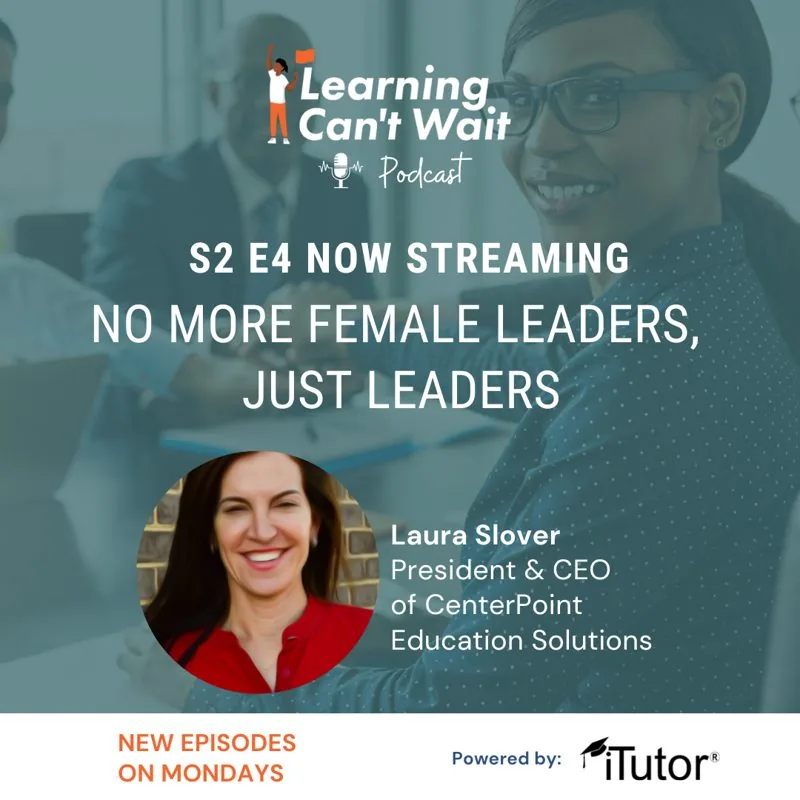
This week’s episode of the Learning Can’t Wait podcast welcomes Laura Slover, the President and CEO of CenterPoint Education Solutions. Our host,Hayley Spira-Bauer interviews Laura Slover about her thoughts on leadership in today’s educational society. Are we so far past the days when women weren’t allowed to hold positions of power? If so, where are we now? And at what point will a woman stop being ‘a female leader’ and simply be ‘a leader’?
Learning Can't Wait is brought to you by iTutor.com.
Full transcript
Transcript generated from the recording; minor errors may remain.
Welcome to the Learning Can't Wait podcast, an iTutor production at iTutor. Our vision is to ensure every child has access to education regardless of circumstance. Each episode, we will be joined by Pathfinders within and around the education space who are bringing about transformational change on behalf of.
Students, I am your host, Hayley Spau. Welcome back everybody. I am especially excited to introduce you to today's guest, Laura Slover, the CEO and founder of CenterPoint Education Solutions. Welcome, Laura. Thank you, Hayley. Nice to be here. . I am so excited to have you on today for a host of reasons. One of which is that the title of today's podcast, which I don't know that I've actually revealed to you yet, but I'm excited to do it right now, is no more female leaders, just leaders.
Mm-hmm. , and I'm excited to have you on talking about this because when I first was introduced to you, which was via LinkedIn search history, I saw. A woman, and I'm gonna use the term woman to kind of start us off here, but a woman who had accomplished a lot in the education space, who I just felt I could learn from, grow from, and be really able to admire their work.
And now I see that the term that I put in front of it, a woman leader is exactly. The wrong way to introduce you. And so we're just gonna go with leader today, . Okay, I got it. And I just wanna say that it was great that you reached out to me. I think that showed a lot of moxie and I love it. Moxie's a term that I think is a, is apt to describe my, my level of energy.
Sometimes I'll take it, I'll definitely take it. So Laura, you like many of our. Began your career as a teacher. So what led you to the classroom and onto your journey That, that I've been following and I'm sure a lot of our guests have followed today. Well, I started out wanting to be a teacher because my mother was a teacher.
My mother was a teacher, my father was a lawyer for, so those were my two career choices when I, you know, spent early years wanting to be a teacher. In high school and college, I decided I wanted to be a lawyer. And then at the end of college I reverted back to wanting to be a teacher because I had a, a phenomenal experience over the summer before I graduated working with homeless and adjudicated youth in the Washington DC area.
And these were kids who had grown up about five miles away from me and whose reality was, Strikingly different. And from that minute I was inspired to become a teacher, to help all kids have advantages. Have the advantages that I had, and to really be able to pursue whatever they wanted. Wow. So, , you had these great models of people contributing to society in different ways in front of you, and there was the turning point in your own education that made it abundantly clear which path you wanted to pursue.
So what was it like your first year in the classroom? Can you share a little bit about your own experience standing in front of students and moving forward? Absolutely. I loved being a teacher. I taught. I student taught for a semester and I taught for four years in Colorado in a public school, and I taught.
Ninth graders to 12th graders. I had the full range of students, and I think probably my first year both my biggest joy and my biggest challenge were my freshmen. They know enough to be super smart and engaged in class. , and they're still young enough to not worry about being too cool, but they're also a little squirrely and they have a lot of energy.
And so we would, we would go back and forth between these intense fantastic conversations about literature, short stories, Romeo and Juliet, where they were super engaged to moments where they couldn't sit still in their, in their seats. And so I think for me, the, the first year was an eye-opener on how.
Kids are, and now, by the way, I have a 14 year old who's gonna be in ninth grade. So I am about to enter old circle, old circle, full circle. How exciting and, sponge-like students at that age are, and yet how other things, social lives and other things get, get very distracting. , you're probably not alone.
For those that are listening that have had, have taught high school, especially ninth graders, while I have not taught ninth graders, I taught fifth graders when they're in their first year at a middle school. And I can draw parallels to what you're sharing. Yes. So it's, but there's something about that challenge that you clearly don't shy away from.
In teaching the ninth graders, they probably presented the opportunity for you to figure out what it is that made them tick, both academically, social and emotionally, all the pieces together. I made a goal after my first quarter, which was kind of a rough start. I think every teacher has a, a little bit of, adjustment, but I made a goal to know at least one thing about every kid so that every time I saw them I could make a personal remark.
How was. Your weekend, you know, how's your grandmother? How was your, you know, I lived in Colorado, so what, where did you ski this weekend? You know, whatever their interest was. And there were a variety of interests, of course. I was connecting with them on a, on a one-on-one level, which I think really helped me engage people and bring kids into conversations that they might not have been comfortable with Other.
Feels like a good life strategy, but especially a strong teaching strategy. We know today there's a huge emphasis on the importance of social emotional learning, rapport building with students. It, it wasn't very popular or common to talk about that when I was in the classroom, but thankfully now it is more common to make that front and center for teachers.
You know, as I name this, this item that is definitely a barrier to teacher success, which is getting to know kids and having them trust you. I'm wondering, when you were in the classroom, what you felt was a barrier to either your success or your peer success with their students or in the school. I think one barrier for me as a new teacher was just that I didn't know a lot.
I, I didn't know what I didn't know, and there was not enough. I felt isolated. Looking back on it now, I can't believe that schools in that day, and it was not a knock on my school. I, I worked at a fantastic school with a great principal, but there were not. Opportunities for connection, even within our department, the English department, and certainly not across the school.
So I think that teacher mentorship programs are, are really important. I also think I hadn't really learned the art of engaging with parents. And now as a parent, I know, I know what questions to ask teachers. Also, I'm an educator, so I, I'm pretty good at relating to and engaging with, with, with my student, my kids' teacher.
But I did not know how to really deal effectively with parents to bring them into their student's learning experiences. And I wish I had known that a little bit more before I'd started because your par, the parents can be your greatest ally. And they have high expectations for their students and they also have high expectations for you as the adult in the, in the classroom.
And there were certainly some tense moments with parents that I wish I'd had navigated differently. I absolutely think about over the past three years of the pandemic, how vital, but also challenging how much of like the volume must have been turned up on that. Teacher student relationship first when the kids were home with their families during the first part of the pandemic.
Then in the enduring part of the pandemic, when families are, you know, obviously in some ways showing it differently than others concerned about their kids' academic success, their social emotional being, it must have just, like I said, the volume must have been turned up for teachers on how important that relationship is, that that tri.
I, I totally agree. And just going through the pandemic, both, from the, from the CenterPoint standpoint of working with educators and from a parent standpoint of working with educators through my daughter, I, I cannot say enough about how the, the steep climb that educators have had through this pandemic and what heroes they are for going through that.
And I know that everybody's focused right now on turnover. People leaving the classroom. But I like to focus on, first and foremost, the incredible job people have done through, through really challenging circumstances. And yes, we're gonna have a shortage now, but we have to remember that there is a pipeline behind that.
We just have to move people into these roles and set them up for success. . So you're starting to touch on the work that you're currently doing, but I think there's a bit of a journey from the classroom to CenterPoint that would be really helpful in folks understanding what has become what, what seems like a crux of your career.
I won't give away that major theme just yet, but why don't you share us for us a little bit on the path from the classroom to where you are today in Educat. That's great. And I, I should just say that I, one of the reasons I became a teacher, just going back to your original question, was because I had such fantastic teachers, and so in the vein of honoring teachers, you know, I became an English teacher, and by the way, I majored in English and college because I had four fantastic educators in my life.
Dr. Katzenbach, who taught me grammar, Mr. Thomason, who taught me to write Mrs. Yor, who taught me how to think critically and sort of analyze text, and then Mr. Herscher, who just made. , everything's so fun and made me really experience the joy of literature. So I wouldn't wanna be in a conversation about no great teachers without mentioning those, those fantastic teachers.
So my path from I, you know, I entered the classroom in 1996. And then for personal reasons, decided to move from Colorado back to Washington, DC and I enrolled in graduate school. I went to Georgetown Public Policy Institute and got my policy degree and so. I am one of those people who now have two masters and no PhD.
But that's not a bad thing. It's not for everyone, but it's not a bad thing. And I started working at an organization called Achieve and Achieve was a policy and advocacy group that also developed a deep practice in content around standards, assessments, and accountability. And I worked there for 15 years partnering with states on their standards, making sure they had high academic standards assessments.
Making sure states had high quality and aligned underlying, underlined assessments so that they were fair and equitable to students and actually measuring, what teachers were teaching so they were useful to teachers. And then accountability systems that. Valued not just seat time and completion, but also preparation so that students would go on to be successful in college credit bearing work and in high skills.
High wage jobs. So I was at Achieve for 15 years and two of the probably most well known efforts that we participated in were one the Common Core development process, which, was a faster, and those listeners probably know it well. You know, young, younger listeners may not. Also, maybe also, that's right, that's, I have talked to a couple people who.
Oh yeah, the Common Core. Huh? I heard about that. . I heard about that. I read in a textbook once with a, yeah. . It was a little bit of a dagger to the heart because I , I did spend, I bet, I bet. So much time working on that. And then I started getting involved with the PARCC consortium, the Partnership for Assessment of Readiness for College and Careers, which is a mouthful, that's why we called it PARCC.
And that was an effort to work with. To build assessments that they held in common so that they could compare performance across schools as well as covering mastery of the standards within those states. So the states had common standards. They measured them, with a common test, and then they reported out results with a common benchmark and a common framework.
It was a fantastic effort, and I think states and the country really learned. A lot about where, what students knew and could be able to do really actually, and how that compared to other states. , which was really for me, both a technical challenge of how you build an assessment that can do that and be used by multiple states, but more importantly, an equity and social justice work around making sure all kids had access, were held to the same standards and therefore had access to, to quality education and that where they didn't.
A light was shined upon them and resources could be, could be directed to those challenges. So from there, that's 20 years of my work life was spent focusing on state policy and practice. And then in 2017, a few of my colleagues and I launched CenterPoint. And CenterPoint has just turned five and I'm really.
Yes, and we have really made the shift from thinking about state policy and practice to thinking about implementation support for educators in schools and school districts who are working to implement high quality curriculum aligned assessments, classroom assessments, district level assessments, and then the professional learning to pull that all together, particularly through assessment literacy, which helps educators.
Look at their assessment results, and there's a lot of assessment results because kids are taking a lot of assessments. So how can we use those effectively, make the most out of those data, and then use that information to go back and strengthen instruction? It's the kind of training I wish I'd had as a teacher because we got reams of data and they weren't very precise.
First of all, the data was not as high quality as it is now. Or precise and specific and useful, and. Secondly, we had no training in what to do with those data. So there's a big pile of paper with student, you know, test scores. And I was part of an effort to build pre and post tests in Eagle County back in the back in the day.
And that was the first time we'd really been able to think about this concept of student growth. So we had all this information about student growth, but at least I, and I don't think my peers had. A real sense of what to do with those data. So they went relatively unused and that I think is a, is a sort of a tragedy.
So if I could help now illuminate some of the themes you talked about in the three different. Parts of your career, the three different places you spent your time. I heard as you underlined, audibly alignment was something very, very important in the early part of your career, and you named it even for CenterPoint.
What, what you've been doing recently for the past five years, as you talked about, I'm assuming you meant in trust school alignment versus inter interschool alignment. Is there a lot of that happening that. Kind of ensuring there's, the data being used effectively, but also being, analyzed across classrooms within a school.
Yes. I think both are important. So alignment is super important between assessments and curriculum because it's a fairness issue.I shouldn't be assessed on something I haven't been taught, and it's a, an issue for educators. Around. I don't wanna be using assessments that don't measure what I've been teaching because then I don't know how to make sense of the results.
So there's this fairness and equity issue, and there's an efficiency and efficacy issue and just plain old time saving. If I have to translate results from a test, that does not have to do with what I've just taught. I've got all of these sources that might be misaligned and therefore sending me in in different directions.
So alignment is really key. And then the other piece you're talking about is alignment or thinking about comparing across schools and the reason you'd wanna compare across schools. Is, well, one, you can look at best practice. Where are things working really well and what can be learned from those? And two, where are there places that needs extra support?
And unless you're comparing across schools, it's harder to know that. So you probably have in your current role with your organization, a good window into schools across America. Right now, and I'm wondering how you think schools are doing on the path to building literacy like assessment literacy across the nation?
I think there is a dearth of what I call assessment literacy, which is. A understanding assessments, the different types and purposes and uses for them. Why would you use one versus another? What information can you get? So just the, the building blocks of understanding assessment. And then the B is, the second part is really understanding the data.
What do the data mean and how do I use them as a educator as a. Administrator, school leader, a parent, and frankly, more and more as a student, you know, I, we, I think we are moving into an era where students are gonna be, much more empowered to make their own decisions, but they need the data to be able to do that.
So, coming out of the pandemic, I think that, , although I, we had started to see a growth in terms of assessment literacy prior to the pandemic. I think the pandemic has slowed that down because. Clearly educators are focused on a, initially keeping kids safe, shifting to online learning, focusing on the social emotional needs of students, and now in the last year really focused on recovery and helping kids recover.
Unfinished learning. Now, assessment results can be really important in that final piece that I'm talking about. You have to know where kids are in order to know how you can support them on their growth path. So I think that this year in particular, now that things have begun to. Quote unquote normalize, we'll see a much, much more attention, or at least some more attention being paid back to assessment, assessment, literacy, and really building out the use of those assessments in classrooms.
There's a bit of a debate in the education literature community about the value of standardized assess. You have some folks who really rally behind it for reasons that you've named here. There gives more clarity, allows for equity, and you have others who in in particular cases for large exams like the SAT and ACT, even the elimination of those exams for some entrances into colleges and universities.
Right now, there's a, a proponent or a group of people that are opposing these types of exams, and I'm wondering, . I mean, I think I know what she'd say, but I'm wondering what you would say to the opposing viewpoint who has this retic. About standardized exams and, and the impact that they have on historically marginalized communities.
Yeah, I, I was gonna go there. I think that for all of the, the case that can be made, that assessments are part of a civil rights agenda and part of a, of a justice approach to education to make sure that where. Where there are inequities, they're called out and noticed. And I think many of the civil rights, most of the civil rights organizations have come down on the side of tests are important.
At the same time, we need to do better in terms of our test design and item development and bias and sensitivity reviews. It's one of the things I'm proudest of in terms of the work we did in PARCC, that we advanced the field in terms. Fairness and accessibility, and yet there's more that can be done. I think we're moving into a whole new and important era of making sure curriculum and assessment are culturally relevant, culturally responsive, and I think therefore in the testing space, it will be important to make sure assessments.
Evolve quickly enough that they are, they are consistent with that ethos that we're seeing around the importance of equity, inclusion and, and certainly diversity in, in our work, we've focused a lot on diversity of text, diversity of authors, diversity of characters, not just token diversity, but actual diversity where their culture and their heritage is part of the, is part of the story, not.
Incidental aside from the story, so that that is a real part of cultural relevance in assessment. But there's more to do and so I think we. Have to, the field has to evolve. I would come down on the side oflet's evolve the measures, but not throw them out.Let's be honest and transparent about where there's work to do, but not literally throw the baby out with the bathwater, because I think that assessments serve a critical.
Piece, particularly when people know how to use the data in helping determine, places where there are inequities and, and help build strategies to address those. Yeah, I do think that one of the challenges that people have, Really picked up on, or really, let me say that differently. One of the issues that people tend to focus on, particularly people who are lean generally against assessment, is that there are too many, too many.
What do all these data mean? Why is my kid taking all these, or as a teacher, why am I spending all this time on this? And I don. Blame them. If people do not see the relevance of the data they're getting, they, they begin to question why time is being spent that way. And so part of what I am really focused on at CenterPoint is helping people understand the data and put them to good use so that, so that the time spent is, is worthy.
It's worthy of the time spent. Well, and that goes back to the question I asked before. Schools building assessment literacy. Because one of the issues is that particularly now schools are inundated. With resources and the, I mean, I know myself from being a school leader, the process of vetting those resources, it's, you know, you sit through demo after demo of tools.
Yes. That all start to look alike to you. The, you know, the, you forget which represented it's, it can be overwhelming just to select a tool and then to implement it with fidelity sometimes takes. To back out of one curriculum and assessment and into a new As so I can understand what you're naming here, which again goes back to the importance of really having the right tools and implementing them correctly.
I totally agree, having the right tool, having the right tools. If you're gonna have the wrong tools, you might as well not have them. And if you're gonna, even if you have the right tools and you're not gonna use them, you, you. Reasonably question why? Why you're spending time on them. So I'm all offered the right tools, you being used the right way.
So speaking of the right tools, talk to, talk to me a little bit about, talk to us. The, you know, the listening audience here, the listening audience, a little bit about your entrepreneurial journey, right? So you, you know, you're at CenterPoint. You've had the experience now of building out a few different, organizations that serve the community.
So how has that looked for you and how has being a woman impacted your journey? If. Well, you know, I mentioned that my mother was a teacher when I was, was young and she was a teacher of English as a second language later in my, in my time at home. I think in high school she started her own business. She was an entrepreneur.
I didn't even have the language then to know that that's what she was. But she was an entrepreneur and I grew up watching her do that. I, so I had that as a, as a role model. And yet they're not. I mean, I think we are in this moment right now, Hayley, where there are a lot of women entrepreneurs, but there.
10, well, maybe 10, 20, 30 years ago there weren't, so you've asked how being a woman has impacted it. I, I'm not even sure I would've thought to become an entrepreneur had I not, I didn't have the role models around me. Most of the bosses I worked for were men. And I have to say I really sort of fell into this work.
I was given the opportunity to lead PARCC and that pushed me quickly into an entrepreneurial role as a CEO and then launching CenterPoint as well, pushed that even further. So some of the challenges or lessons learned, I'd say, is that for me, success is about the people you work with. You cannot do this alone, like leading, if you don't have people to lead, if you don't have people to work with, you can't do it all alone.
And I am really fortunate to have a fantastic team around me and I'm, I feel lucky and I. Joyful every day in getting to work with them. That doesn't mean it's all rosy, but really you cannot, you cannot take this journey alone. And there's this quote, I like that you can go faster alone, but you can go farther together.
And so that's what I like to think about at that center point. Endeavor is about being together on a. On a boat with a lot of great people, it requires risk taking. You can't go into this kind of work without being a risk taker. We use the term moxie, like you have to have moxie, you have to be a little bit willing.
To fail you. I think you can't have this idea that failure's not an option. Failure is always an option. You know, people fail in small ways all the time, and that's how you learn. And so I think, you know, I try to cultivate a learning environment where failure's, okay, what do we do now? It's what, how do you solve the problem?
How do you move on from that hard work? I think entrepreneur entrepreneurship takes a lot of hard work and, you know, I love my family because they've put up with a lot of, you know, working late nights and working on vacation, which I try not to do anymore. But there's a lot of time that you commit and, and yet I talk to my daughter about hard doing hard things can be fun and fun things can be hard, like they're not.
In opposition to one another. And I really do enjoy the work that I do. And then I think like just an openness, being open to new ideas and hearing you know, what other people think and have, and like losing your ego and not being rigid in my way is the, is the right way. I have learned so much from.
Collaborating with other people in the fields. And I think part of my success has been, literally, has been all of the partners that, that we've developed as an organization over the last five years, but even prior to that, because again, this, there's so much work out there and doing it together with other partners has made it certainly have more of an impact, but also just made it more.
There's quite a bit there that you shared that really, that, that stuck out for me. Actually, all of it stuck out for me. But a lot of, some of the highlights that, that I'm reflecting on, one is the emphasis on the collaborative nature of your team and how you work together. And I think that the other items fall under that, right?
The fail forward mindset that you're naming is part of the culture you probably built on your team that you all have forwarded together. And then, That that trust allows for building out relationships outside your organization, those partnerships you spoke of. I imagine that the benefit to a school working with an organization like CenterPoint is the relationships you have with other providers who have then a closed loop of support from all these different people doing different pieces around the same problem.
That is for sure. I think our best, our best experiences with school district and schools are when we are working shoulder to shoulder, first of all with the schools and districts, the educators themselves. So we don't come in and say, here we have the perfect solution in a box. Now go use it. That's not a recipe for success.
So really there's a lot of unpacking and implementation support. That that makes an effort successful. And then more broadly, Getting to your point, not assuming that you're the only player in a, in a, in a district or a school, that they're getting information tools, services, thought partnership from a lot of people, and that you need to fit in that environment and in that ecosystem.
And I think we're all stronger for that. The more that with this ecosystem, this current ecosystem around high quality, Curriculum is being built out because there's a sort of new agreement in the field that curriculum matters and that the curriculum should be the, the central focus and everything should emanate from that.
And I think that's a real shift from where for where I was teaching, which, you know, there wasn't a clear curriculum. He had a textbook and you kind of, you know, moved around in that textbook. Hunt and packed where you wanted to to go, but there wasn't any sense of, this is where I wanna end up. And I think that is a really important advance in terms of our system.
There's much more clarity about where we want kids to end up, and then we can focus on the how are we gonna get them there. But you can only do that once you know where you're gonna get. The pendulum will swing continuously in education. Yep. But if there are some central tenants like you're naming here that we can all agree upon, then it allows for back to that word alignment, a lot better alignment in terms of the work that all of us are doing.
Whatever kind of boat we're on, we we're going in the same direction.
I am a big believer in alignment. I, I like to laugh that it is my wonky, my wonky side that is always focused on alignment, and I think that is a thread that has carried through my entire career. Going back to when I was a classroom teacher. But really it started with achieve and the commitment to alignment, rigor, and quality that I had taken, you know, into my subsequent organizations and will.
Always come back to as I, as I chart my ongoing path. So as you've now really done a phenomenal job of bringing us full circle here for your own experience in the classroom and your journey in education and in the entrepreneur entre side of entrepreneurial living and, and working, I'm gonna bring us back to the original point now, which is your time in the classroom.
What advice, Laura, would you give a new teacher? . When I think about what I remember most, what I remember most are is the, the, you know, it's not the papers I graded, it's not the teacher trainings. I had the professional learning days. It's really the relationships that I built with my other colleagues.
And I had the pleasure of working with some amazing professionals and the students, and I think so much. Of our education system right now is felt to be a slog. Do these tests, grade these assignments, you know, help kids catch up? It feels like a weight, and I imagine it's exhausting and hard for teachers.
So I would focus on finding the joy, and the joy is in those kids.every day find something to celebrate about the students in front of you. They're not the students you wish you had cuz they're not perfect. But they are unique and fabulous. Human beings, and that is what I remember most about my teaching.
I will never, I will never, this is like ending a podcast with Find the Joy and Celebrate Students is a wonderful way to end an education podcast. So with that, Laura, I just wanna say thank you so much for joining us and sharing your experiences in schools and around schools and leading organizations like CenterPoint Education.
So, Thank you so much for having me on your podcast. It was really a lot of fun and congratulations to you for doing this series. It's fantastic. Absolutely so grateful to have amazing folks to be able to highlight and share their accomplishments and how they're moving the needle for kids, here on season two.
Thanks for all listeners for tuning in.
Thanks for listening to the Learning Can't Wait podcast. If you liked what you heard, please rate, review, and share this episode. Be the first to know when we have a new episode by subscribing wherever you listen to podcasts. If you'd like to be a guest on the show or have a suggestion for an episode, email us at podcast.
Itutor.com.
This episode has been brought to you by iTutor, your online solution for sourcing highly qualified educators. Join districts all around the nation that use iTutor to connect with thousands of licensed educators who fulfill both core and supplemental instructional needs. Choose iTutor Online education when learning, can't wait.
Now I'm back to this episode.