
Learning Can’t Wait · Episode 85
Juliana Finnegan: Vivi, Student Driven Learning, Tech Enabled Learning, AI in Education
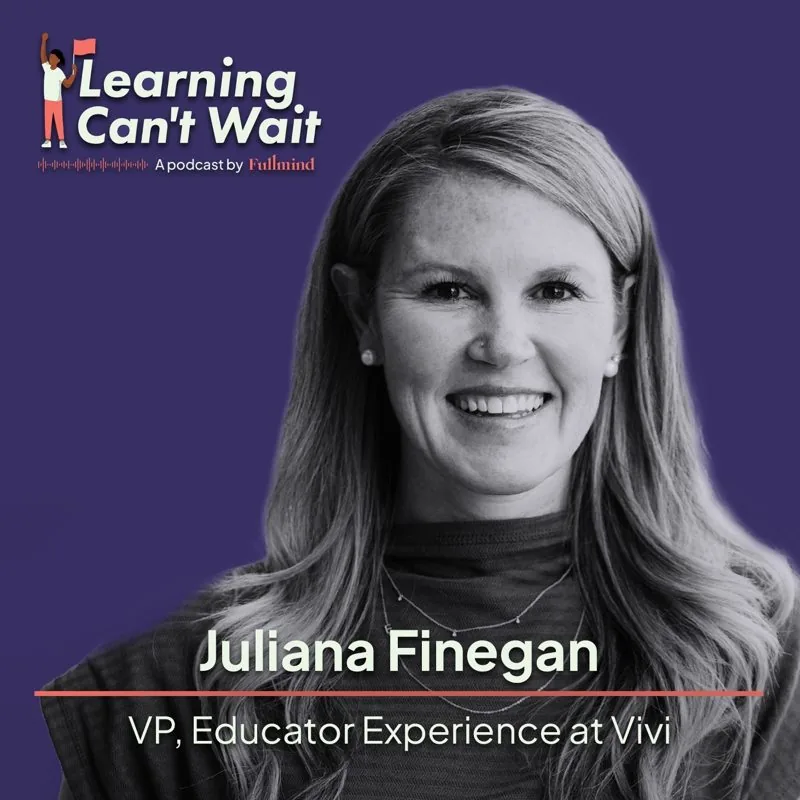
- Juliana Finnegan, VP of Educator Experience at Vivi
 Hosted by Hayley Spira-Bauer, Chief Academic Officer at Fullmind
Listen now
Juliana Finnegan: Vivi, Student Driven Learning, Tech Enabled Learning, AI in Education
Episode summary
Repeat guest Juliana Finnegan, VP of educator experience at Vivi, shares the launch of a free Vivi for Teachers web app for wireless student screen sharing and explains how the full platform adds instructional tools, digital signage, live announcements, and emergency alerts. Responding to calls to get tech out of classrooms, she argues technology should be tech-enabled, not tech-dependent, and that active engagement is the goal. She expects a district tech audit as ESSER ends, urges future-proofed and interoperable tools, and grounds everything in research on effective, equitable learning.
Key takeaways
- Vivi for Teachers lets quiet students share work from their seats, building voice and collaboration
- Vivi proper adds multi-screen sharing, digital signage, live announcements, and emergency alerts that power on screens
- Learning should be tech-enabled, not tech-dependent; avoid passive screen time and glorified babysitting
- Expect a post-ESSER tech audit: tools must interoperate, match the community, and be future-proofed
- Anchor technology choices in research: rigorous, relevant, actively engaging, socially connected, growth oriented
About this episode
Welcome back to the Learning Can’t Wait podcast! This week, Hayley Spira-Bauer hosts a thought-provoking conversation with Juliana Finnegan, VP of Educator Experience at Vivi.
Tune in as Juliana shares her thoughts about the role of technology in the classroom and how it can support effective instruction without replacing essential human connection. Hayley and Juliana also discuss Learning Language Models and the vital difference between passive and active engagement. Finally, we learn about why Juliana believes we need to make technology “future proof” if we’re going to use it in schools.
Join us every Tuesday at fullmindlearning.com/podcast. Next week, we talk to Jessica Sie, Chief Academic Officer at Zeta Charter School.
Resources from this conversation include:
Jessica Grose's three writing pieces
Research-Based, Online Learning for Teachers
Produced by Fullmind
Full transcript
Transcript generated from the recording; minor errors may remain.
Hayley Spira-Bauer: Welcome back everybody to the Learning Can't Wait podcasts. I have someone special here today. Not only is she a repeat guest, but she is one of my favorite humans and someone who I'm lucky to call a friend, and I admire her. So welcome with me. Juliana Finegan, the VP of Educator Experience at Vivi.
Juliana Finegan: Thank you so much for having me. And you guys can't see me. But I'm like glowing, because, just being here with Hayley, we were actually texting this morning and saying, We get to hang out, and it's for work.
Hayley Spira-Bauer: I know as if our attendance at conferences and all the other things we do isn't. But you know it's always so wonderful when work relationships turn into friendships. And so I appreciate a little bit of a blurred line, not gonna lie.
Juliana Finegan: I love it, and I love our you know, walk and talks and everything in between. So I appreciate you, and I'm constantly inspired by you and all of your work. And this podcast so.
Hayley Spira-Bauer: Everybody. Everybody's listening, and they're like, are they just gonna talk about how much they love each other day. And we could could be a whole episode.
Juliana Finegan: Absolutely.
Hayley Spira-Bauer: Oh, but we'll save that. We'll save that. For when I create the personal podcast. That you know in the future, this one's the work one. So I'll get us back on track. Juliana. Juliana, what have you been up to since you last appeared on? The Learning Can't Wait podcasts. And it's early days.
Juliana Finegan: I know I'm like trying to think back. I feel like it's been a million years. And yesterday kind of at the same time. So Vivi has been doing awesome we actually expanded our Vivi Educator Council, which is our global group of Vivi users from Australia to the US, and they meet quarterly, and they become like honestly, like really good friends of mine. They've helped us to really fine tune our product design, and just like fill my cup all the time. Also, recently, beginning of 20 was like, what year is it? 2024. We just launched Vivi for teachers, which is actually a free version of Vivi for teachers. It's a web-based app that allows students to join your quote, unquote virtual classroom, and then they can wirelessly share their screen from anywhere in the classroom, obviously with the teacher still in full control. But we've seen some exciting uses of it, because it's really giving students the ability to share their voice, share their work without the stress cause. I think I mean, you and I were both teachers for a while, and a lot of times. It's like the same students raising their hand every day because it's scary, especially post Covid, to get in front of your friends, share your work, share your ideas, but now they can do it from their seats. Feel really supported and secure, and also be able to build those collaborative muscles. And so it's been really exciting to see. And actually, I just fun. Thanks. Sorry. I'm still talking just going forever. I actually was just stopped by my kids school this morning, and one of the teachers who's been using it came out to me, and he's like I use it all the time he's like anytime I need my students to present. He teaches fifth grade. He's like, I pull out Vivi. He's like, I don't have to plug them in anymore. They don't have to email the links anymore. He's like, it's just so fast. And you can control it through your phone.
Hayley Spira-Bauer: So suffice to say you've been very busy. So wait. I have a question right like I am thinking of this from a business perspective. You're now offering Vivi for teachers, for free to educators. Why would a school wanna buy the hard hardware as well like? How does that change or amplify the experience.
Juliana Finegan: Great question. So actually, so first off the hardware they don't ever buy. It's kind of like a rental of sorts. So we are actually a SaaS model. So it's a subscription model for the real Vivi proper. Vivi for teachers, though very cool, is like maybe 2% of what Vivi can do. So it allows students to wirelessly screen share their screens. But Vivi proper allows teachers to wirelessly scan, share share their screens up to 4 kids can share their screens ton of instructional tools. And that's on. This is the classroom side. And honestly, on the other side, it does digital signage both for the classroom and the school. So like, we have some teachers who or some districts who have, like dad jokes in the hallway during passing periods, or like fun, quizzes that students can participate in also virtual trophy cases. And we have emergency alerts which has been a really impactful piece as well like our Vivi proper. It. You can attach it to TVs projectors, IFPs, interactive flat panels, and it can actually power them up during an emergency. So the projector doesn't have to be on so fire drill goes off. It can turn on every single screen in your school and have a visual of how to get out of the school because it has the HDMI CEC, so it's like it does, and it does. Morning announcements. We have El Segundo Unified the principal of one of the elementary schools, turns on all the screens in the morning and does like live stream announcements in the morning, and actually reads books on Fridays to this whole school.
Hayley Spira-Bauer: Become a content Creator.
Juliana Finegan: Yes, 100. And honestly given that like human connection, right like. Now, you're not just like I'm sending you to the principal. But instead, like, I get to see you every morning. And we're actually connecting. So Vivi proper has, you know, all those operational support. It's centrally managed. It can update. We like, basically do updates almost quarterly. And they can be done remotely over the weekend like, it's really built for education. So it has all of these tools. So Vivi for teachers is really like, we've never been able to offer something directly to teachers, because you would have to set up your Vivi boxes in your school. And so this way, teachers can try it out. They can get student sharing immediately. And really, start moving towards that student driven learning that we know is so effective for kids.
Hayley Spira-Bauer: That's really cool, and I love that. You are getting feedback from people in your own district, and I'm sure you're getting a ton of feedback from other folks. You know, there's a big question today about the place of technology in our schools and in our classrooms. You and I were talking right before we started recording. I I feel like I talk about this writer a lot, but her name is Jessica Grose. She writes opinion pieces for the New York Times. She put out 3 sub. 3 sequential pieces on the tenth, seventeenth, and 20 fourth of April, first one being called, Get tech out of the classroom before it's too late. I got that article sent to me, maybe 20 times from friend and professional networks. The next one was called. Most teachers know they're playing with fire when they used to check in the classroom, and the last one is every tech tool in the classroom should be ruthlessly evaluated. I feel like we need to get our mutual acquaintance Carl Hooker to comment on that last one. But curious your thoughts before we get Carl's about the free pieces and just the general mindset that's permeating our society about technology today.
Juliana Finegan: Well, I mean, this conversation about technology has been going on for a really long time. It's just been 100 amplified with Covid. Right? So if you go back to 20, 1120, 12, maybe 2013. That's when, like blended learning quote unquote. And you guys can't see my little quote quote, things blended. Learning was starting, which was like we were starting to see technology in the classroom. So we were seeing the station rotation model. We were seeing the lab model. We were seeing this flex model right? And there's all these conversations about like, where is like, where can tech be used what is beneficial. I mean, we've learned a lot since then of like, you know, that lab model doesn't really work. That's very very passive learning of just like sitting with a group of people all on technology at the same time, and not necessarily being able to leverage it to personalize the needs for students? Or how are we actually using it effectively? And the same conversation happened then, as I see happening now, where it's likeit shouldn't be tech dependent. It should be tech enabledlike that learning. And so how are we actually leveraging technology to build teacher capacity and impact student learning in ways that we couldn't do it. And that does not take the human out of the equation at all. But it's like, you know, how are we allowing students to leverage tech to create, to be collaborative, to build, to really push their learning to the next level. And I think that unfortunately. Tech can very easily be a passive learning experience, a babysitter or glorified babysitter of sorts of like. Okay, you know, we're gonna have you work in that while I'm doing this so that I know you're doing something as opposed to building those muscles around, actually, how to use technology impactfully. And when we're looking at tech tools, making sure that those tools match the needs of our school to match the needs of our students, our communities, and that we're using the tools to really support effective instruction. And so I think that a lot of times it's really easy to say we just aren't going to use tech. But tech is here, and it's here to stay. And we also want to make sure we're introducing it to our students at every age of this isn't just something that you like. I always say my students are my students. My kids are very engaged when watching a movie. They're almost drooling. To be totally honest.
Hayley Spira-Bauer: Like Thanksgiving.
Juliana Finegan: They are like, I don't know if your kids are the same way I'm like, Hello, Hello! Are you there? When they're watching movie? They're gone.
Hayley Spira-Bauer: Totally.
Juliana Finegan: But you know what. And then I say, the difference between engagement.We don't want just engagement. We want active engagement, and then, when they're watching Mickey Mouse Clubhouse. They are like talking. They're identifying. They're like, you know, I mean, that's not, you know, our end goal. But that's kind of what I say, the difference between that like engagement versus active engagement and I think that the building professionals Okay? So and we also see this with the NETP. How they're mapping out, you know, digital access. What does that look like? And really thinking through? How are we supporting educators with like robust professional development and learning around how to implement tech effectively? How are we making sure? All of our students have access to the technology that does impact student learning that can be leveraged in ways to personalize and support all of our students where they're at when they need it, and also help our teachers like. That's what I talk about with Vivi. It's like. How do our teachers are working so hard? So how do we give them technology that can help to build their capacity to do what they do best, which is work with students and teach students. So.
Hayley Spira-Bauer: I'd be remiss if I didn't dovetail what you're sharing here with a lot of conversations we had both together, and likely separately last week at ASU+GSV. And at the first-of-its-kind AIR Show, which was focused exclusively on AI. There were a lot of folks that had polarizing opinions about AI in schools. I think it's likely an extension of what you're naming here, right like tech enabled AI enabled we're not trying to replace the jobs of teachers with AI. I'm assuming that's not your vantage point. But, like, please correct me. If that's the rabbit hole you fell down.
Juliana Finegan: I would like to not do that.
Hayley Spira-Bauer: Cool, cool, cool. Thank you. Like.
Juliana Finegan: Take a strong stance there. But I do think, and I know I went back to like, you know, 2012. But then we like fast forward to Covid. And all of a sudden, what something we've been pushing for so long was to get one to one. Devices in all of our schools happened with Covid. So now we have the devices. But like we're still struggling with how we use those devices, I think the similar thing is happening with AI, right? It's like we have the AI. But if you're just using it just like we did with tech for a little bit, it's like as a bells and whistle shiny cool engagement piece as opposed to something that is, I think we use the word, not the podcast we did together was like, how can it amplify your work? And you know you are still as the educator. The you know. The content expert. And so AI can be really helpful with, Hey, I need to. I used an example. I was like. I need to think up a team name for my 6 year olds soccer team like it's so little. But it's like, I just didn't have the mental capacity to think through all of the names that could be useful that were soccer related for a 5 year old, put into ChatGPT. It was great, really quickly. That is something that just helped me to save some quick time. Same idea with using AI like, how can it help us to generate really like really strong and rigorous questions around a piece of reading? And you're still going to be going through that instruction with your students. You're still going to be building that assessment. But how can we give you the tools to not just sit there and be like. I need to think through 10 questions to put on this assessment. And that's and then but also make sure you're not just copying and pasting, right? You're actually reading through. You are still the holder of that content knowledge. You're still that expert. And so. But I do see a lot of tools, you know. How are we leveraging these tools to support what we're doing and amplify.
Hayley Spira-Bauer: When when ChatGPT first came out, I was using it every single night to generate stories, to read to my kid that had whatever topic or subject that he was interested in. So, of course, with my son. Gosh! Love him! We were reading Star Wars stories about Legos with an 8 year old boy who happened to share his name, which is [student] like it was so fun. And you know, at the time everybody wanted to try out different used cases. And now we've seen a true evolution in how we're using these language language learning models to continue to build. And I think you're right. I think that what most commonly I heard while we were in ASU+GSV in San Diego. Excuse me. I most commonly heard people that were like smart people still need to operate the AI it is really curious. I mean, there are tools popping up every single day. How do you think, as a society. We should be approaching the pending fiscal cliff and the development of new tools and the rapid proliferation. How do you balance those 2 things? There's a clampdown that's happening. This is a question somebody raised to me this morning. Our good friend Matt Miller, actually raised it to me in preparation for an interview. I'm doing upcoming. And I I actually wanna know what you would say about that.
Juliana Finegan: You know me an internal processor. I'm sitting here. I'm like, okay, all of these. First off, I just wanna say I'm totally doing your story hack tonight, because.
Hayley Spira-Bauer: Fast. It's for.
Juliana Finegan: It's incredible, I will say, though, my girls, we read Rebel Girls every night like they get to have 3 Rebel Girls every night, so maybe we can add in some in there. But I love that idea because it's you've you've read the same things a million times by this.
Hayley Spira-Bauer: Right, or even like when they want you to tell them a story. They're like, Mom, tell me a story, and I'm like I'm tapped out of generative ideas. Let me use some generative technology to help me tell some good stories here.
Juliana Finegan: Think your kids have higher expectations for you than.
Hayley Spira-Bauer: Oh, my goodness, yeah, for stories. I'm like.
Juliana Finegan: Not not there.
Hayley Spira-Bauer: Yeah. Oh, that again, that there's a whole other episode we could have about my kids expectations for me.
Juliana Finegan: But I think that. Yes. There is. I think there's going to be a really big I don't know what to call like tech audit of sorts in a lot of districts where you kind of say, Okay, what do we have? What's working? I think there's gonna there's a big push, as there has been a big push for a while is like interactivity between everything. And how can we not just have like one thing for one specific piece, I think what we saw in Covid was like. We added a lot of Band-aids really quick with technology as opposed to one big band aid. That kind of helped to Co like, build cohesion across the board. So I think when we're looking at tech products, it's like it can't just do one specific thing, how can it? And if it does one specific thing, how does it play nice with other things? So that we are filling all of the gaps and needs for all of our districts, because districts have a lot of similar challenges, but also very different challenges, and really making sure that the tech matches. And that's why I say, matches the school. The teachers, the educators, the leaders, the students and the community. So really making sure that there's buy-in across the board, and also within that audit, making sure that it resonates with everyone all those stakeholders. I also think there's going to be a big push, and this is, and I don't mean to be like, you know, pushing baby. But whatever that's my work. I think there needs to be a future proofing of some of our technology, too, because we're also seeing a lot of things dying out after like 5 years is kind of the moment where things start, you know, not working. And from both a green perspective of not having to throw out a ton of tech into like, literally a landfill, but actually getting technology. That that's what I love about. Vivi is like, it's a little box that you essentially borrow. But it can be updated every quarter. It's never gonna go bad. You're never gonna have to get rid of it. So thinking through technology, that is future proofed in the way that it's gonna support you now, but it can also support you in 2025 to 2035. So really thinking through, because I also hope that when we're looking at technology, and we're looking at our funding we're looking at not just now. But what do we want our districts to look like in 5, 10 years? And how can we leverage technology to move that needle pedagogically as well like, we don't want teachers at the front of the classroom. We want teachers with their students. We know, student driven learning and small groups is like much more effective. You know, we know, how do you build that growth mindset with our students in our classroom, and like these types of rigorous learning experiences. And so I don't know if I answered your question completely.
Hayley Spira-Bauer: It you did. And and I think that there. There is a reckoning coming ahead of us. I also think, though. We've really blown the top off of what the future of education is going to look like. First we did it because we had to. There was a pandemic. We had no choice. It was an emergency. And now we're really facing a reinvention of what students future in school will look like. I think. AI and the future careers that our students have are not even we haven't even ideated them yet. One thing I appreciate about education is, it's our job as educators. And specifically here. I say our job. And I'm not a classroom teacher anymore. But it's the job of classroom teachers and leaders to prepare students for a future of hopefully the their choice, the direction of their choice. And I do think it's challenging when you consider that the world is gonna be so different in 10 years due to the advent and rapid proliferation of AI. Then we all can even fathom.
Juliana Finegan: Well, and I think like double underline. Yes, and I think that's the hardest part, too, is when when we say school is gonna look different, and education is gonna look different. But like the biggest difference is going to be what happens when you leave school and what the jobs look like there? And are we truly preparing our young people to and our learners to be successful in that unknown? And so I think there's a lot of like. I love this. I'm scientist teacher backwards, designing to do right like. What does what could the future look like? And how do we enable schools, both K. 12 Pre. K. And I. Hs. Institutes of higher Ed to be thinking about the learning experiences there going through. And how is that setting them up for success in that future world?
Hayley Spira-Bauer: I can't wait like I am so excited because one, nothing I could do about it. The world's gonna change, whether I wanted to or not, so I'm going to be excited about it, cause that's generally the take I have on life is, if I can't control it. I'm I have to find a way to be excited about it. I'm excited about it, and I'm excited for my own kids, you know, like I I imagine, that the career they think they're going to have this moment is going to be a very different career by the time they're ready for it. Or, yeah.
Juliana Finegan: Well and think about like the differences I mean. So I think you're with me on. We're like kind of a Xennial. Where we grew up very much without technology. But college was like my first email address. And I remember being like, so I have to check my grades on that. Okay. I was like I had a beeper, you know, like.
Hayley Spira-Bauer: Beeper. Bring back the beeper.
Juliana Finegan: Well, I mean, like, I still remember calling my mom on a pay phone and being like you have a collect call from Mom. Soccer's done like, and that.
Hayley Spira-Bauer: We have. We hacked that system. By the way.
Juliana Finegan: System. Don't tell anyone. I mean, I don't think it matters anymore because they don't exist, really. But but I mean, if you just even look in that short amount of time. The difference. And I think but I think the big thing to remember is with this technology, with what we're setting them up for the future is like getting the research. I think sometimes we get so lost in the what is it gonna be? But like, what is the research like in my old position at The Learning Accelerator? Really, we did a ton of research, and what is effective, engaging, and equitable learning for our students, and really like breaking down those key quality drivers, and like that hasn't changed right? Like it should be rigorous and relevant, actively engaging, socially connected and growth oriented, like all of those pieces. Are what we want to see in classrooms. So how can we build those in for our kids leveraging technology that's already there in really impactful ways and pointing to different instructional practices. Say, this is actually building that growth mindset that like, there's not one way to answer a question that you can continually improve. That, like the standards isn't are. I mean, I could go off on that. But likestandards aren't the end zone.It's like. Okay, that base knowledge. You've got it. Now, how do you apply that knowledge? How do you create using that information? And so I think that like if we get focused more on the research and what we know is good for kids and then start building into it like, what is the tech stack that allows us to get there? What do we currently have in our schools? And how can we use that even better? And how do we get the data around how our students are using those pieces, how our teachers are using those pieces. And we're going to be able to work towards that in a more effective, aligned and engaged way. Right? So it's like we can keep being like like you said. You know, I have no control over it. So I'm going to be excited. It's like, but at the same time we have control over mostly like we have, like, you know, some control over like how we can. I'll use Duane's words like, Do right by students. And so and how can we get on the same page with that? And I think that's where like the NETP is really important, is like, if you haven't read it, please read it. But you know. Using that research, using what we know about technology and education. And really trying to build these robust learning experiences for our students now, so that they also see themselves as not only students, but learners and lifelong learners. And they want to keep learning. And so that's my, that's my feelings there. So a lot of times we just forget about the research I'm like, I'm so passionate about the research and not just research for student learning, but research for adult learning. And I can share with you the link of the research I did around that Pre covid which seemed random, is effective asynchronous learning for adults. And then Covid happened. Everyone's like, so that research paper you did. Can you send that to me? So.
Hayley Spira-Bauer: Well, we'll actually link all of these referenced articles and readings and research in the show notes of this episode on Fullmind learning.com slash podcasts. So if you're looking to find NETP or Jess Grose writings or the piece that Juliana put together in a previous role. You will be able to find them very easily. Juliana. I could talk for days. But we know podcast listeners don't have that kind of attention span. So we'll just keep having you back. But I do have a question. You know, I'm gonna tweak my typical final question, which is, what advice would you give a teacher starting your career today. I would give you a little twist on that cause. You've already answered that. And it is what advice would you give a student graduating high school or college today.
Juliana Finegan: My God! As a like past high school teacher, I'm like. I'd say. Never stop learning. And also like, Follow your gut. And that's like such a weird. But I think the thing is, is post high school, post college. For myself.At least, it was like I felt like I was in a funnel that I was supposed to do one thing. And you and I are definitely examples of the fact that, like you never know the twist and turns that your life and your career can have.But I think we both have never stopped learning like every job I've done, has helped me to be a better version of myself, and helped me to learn and grow. And I followed my gut with like what fills my cup. And so I say, gut, because I want to say like, Follow my heart. But like that could be slightly cliche. But it's like you have that feeling where you're like. What is, gonna make you happy. And if you need help, too, ask for help. I think that's the hardest thing, too. I remember I look back at me at 22, and I was like, I can do this myself, and I was so young, and did not know what I was doing at all, and I think now, at like almost 43. It's like I am way more apt to say, Hey, I'd love to pick your brain on this, or I need some help with this. And I think that that is something that we want to teach our learners at every step of the way that it's okay to ask questions. It's okay to ask for help. Because that's actually, cyclically part of your learning experience as well. So yeah, I think.
Hayley Spira-Bauer: Period. That's like right there. I yes, asking for help is a sign of strength, not a sign of weakness.
Juliana Finegan: It's all about the people that you have around you, who are your go to folks, your go to. But partners, your person for support your person when you need a hug like it's all about those people that you surround yourself with, and that vulnerability is okay. And I think that's a hard learning experience as well so.
Hayley Spira-Bauer: Juliana Finegan, you are such a dream. You're both brilliant, kind, generous, thoughtful. Thank you. So much for coming back to the Learning Can't Wait podcast.
Juliana Finegan: Thank you so much for having me. And also I just realized I will give you the link also for Vivi, for teachers, for any teachers who want to try it for free. Or if you have friends. Send it to them. Love to get more people in there and using their technology effectively.
Hayley Spira-Bauer: Amazing.
Juliana Finegan: Thank you so much for having me.
Hayley Spira-Bauer: I'm so is the way to encrypt that.
Juliana Finegan: By the way.
Hayley Spira-Bauer: I know. I know it's literally the best, and thank you to everybody who tuned into this lovefest, slash, brilliant sharing of thoughts and ideas with Juliana Finegan and the Learning Can't Wait Podcast.
Juliana Finegan: Thank you all. Thank you for having me again. I appreciate you.
Hayley Spira-Bauer: Of course, of course.