
Learning Can’t Wait · Season 0, Episode 3
The Big Activity Book for Teachers
 Hosted by Hayley Spira-Bauer, Chief Academic Officer at Fullmind
Listen now
The Big Activity Book for Teachers
Episode summary
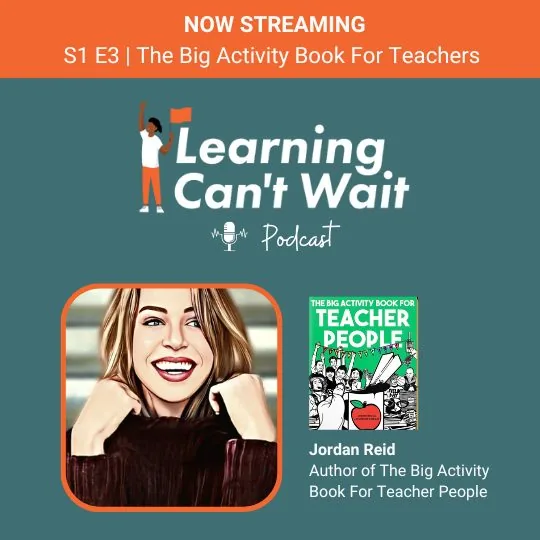
Author Jordan Reid discusses The Big Activity Book for Teacher People, the latest in a series that brings humor and empathy to heavy topics. She explains why teachers needed it most after the pandemic, why most teacher gifts are saccharine, and how the book is meant for teachers, administrators, and parents who want to say I see you. The conversation covers pay inequity, teachers being pulled into partisan fights over curriculum, parallels between teaching and motherhood, and her advice: stop talking about the thing and do it.
Key takeaways
- The book is a gift teachers can give each other and parents can give teachers that says I get it
- Most teacher merchandise is saccharine; real teachers are funny, unfiltered adults with great stories
- Teachers now face curriculum policing from parents and politics in ways earlier generations did not
- Culture, not biology, steers women into caring professions where they feel inadequate
- Just start: the difference between talking about a project and doing it is everything
About this episode
In this episode, host Hayley Spira-Bauer, sits down with author, Jordan Reid, to discuss her new book: The Big Activity Book for Teacher People. This conversation goes from the treatment of teachers, to women in education, to motherhood, to gender and all the way back around again and more. Sharing her expertise and unique view into the intersection of artist, mother, and teacher, this isn’t an episode you want to miss, and don’t miss the opportunity to give your favorite teacher your new favorite book!
Learning Can't Wait is brought to you by iTutor.com.
Full transcript
Transcript generated from the recording; minor errors may remain.
Welcome to the Learning Can't Wait podcast, an iTutor production. At iTutor, our vision is to ensure every child has access to education regardless of circumstance. Each episode, we will be joined by Pathfinders within and around the education space who are bringing about transformational change. On behalf of deserving students, I am your host, Hayley Spau.
Welcome back everybody. I am so excited to have on the podcast today. A person who I'm pretty sure will agree with me falls outside the category of educator, but is very interested in topics related to teachers today. Her name is Jordan Reid. She is the author of the Big Activity Book for Teacher People.
Jordan, welcome to the podcast. Thank you so much for having me. I'm super excited. I didn't know with what, how, how to start the conversation. Cause I, I, I almost started with someone for whom I've been reading their blog for over a decade. But then I went with not an educator, which sounds like a little bit of a denouncement, but wasn't the intention.
Do you mind telling everybody, how do you describe your profession? I, I've been describing it to folks recently, probably in a similar way, just from having read your writing for so long. But I'd love to hear you say it. That is an excellent question, and I did not take it as a denouncement. So I was an actress for many years, back in the day, and I ended up wanting to go into writing during the exact moment that the entire journalism industry collapsed, due to the advent of things called blogs.
So I ended up starting a blog, having no idea what that meant. I had to have a friend teach me what a hyperlink was, and, found, you know, a. A good deal of success in, in that world. My blog is Ramshackle Glam. I don't really blog as much anymore because I'm, I'm busy doing other stuff. But, that was my career for, I would say 10 year, 10, 12 years maybe.
Around that time I met Erin Williams, who is the co-creator of the Big Activity Book series. She and I had a little e-commerce site together that didn't make very much money, but she created this very funny mini comic book about pregnancy, and I thought, huh, I haven't seen anything like this on the market.
And so we wrote The Big Fat Activity Book for Pregnant People, and it ended up being a hit. And I thought, I feel like we have something here with this idea of. Books focused on mental health, pregnancy anxiety, digital malaise, teachers, like all of these topics that don't necessarily get treated with humor and empathy.
And we felt like this was a really amazing opportunity to, fill that market niche. The Big Activity Book for Teacher People is illustrated by Jackie and May who. Absolutely brilliant. Erin introduced me to her and the idea for this particular book, I always thought of the Big Activity Book series. I conceived of it as like, there's one for everyone who needs this.
Kind of a, like a fun but still, you know, hopefully compassionate outlet. And going through the pandemic. I'm not sure who needed it more than teachers. And that, yeah. Mm-hmm. , I think you, you have kids, so not only are you friends with some teachers, I know this from talking to you before mm-hmm. , but you have children, you watched your children's teachers just like mm-hmm.
Your children struggle through the twists and turns. And so yeah, you're aptly naming what is a huge conversation point right now, which is the burden that teachers have carried over the past two years in trying to navigate an ever-changing world. So, It's, I, I could not agree more that it is a great next installment in your series.
And that the series itself, I love, I love the way you described, bringing humor to a variety of topics that are typically, I would name them as taboo, right? Like women, before I had kids, I didn't know a lot about having kids in pregnancy and I bought your books for my friends, and now there's the, now there's an anxiety book for children.
huh The Everybody Gets Anxious Activity Book, which I also got for my child. And now the teacher people book is coming out and I can't wait to buy that for teachers. Do you think that the book is meant for teachers or people that are teacher adjacent? So I've had obviously a lot of conversations with teachers, over the course of writing the book, and then once the manuscript was done, sent it to various teacher people, friends, and.
They, they were like, it, it includes, this is, you know, very kindly they said. Teachers, it is for teachers. Teachers will recognize themselves in it and administrators and anyone teacher adjacent, but hopefully parents can see the humor in it too. Not to say that parents would buy it for themselves, but whenever, you know, Teacher Appreciation Week or Christmas or anything comes around, I know from all my teacher friends, they definitely don't want like a stuffed animal that your child may or may not have slept with.
They might wanna plant, maybe, they definitely want a gift card. But not everyone gives teachers gift cards. And I sort of wanted to provide something that parents could give to teachers and teachers could give to each other, saying like, I totally get it. Like, I get what you're going through. I, I get that you're human.
andI want you to laugh. Because you deserve it.That's such a nice message. I, you know, when I originally saw the book, I thought of it as, oh my goodness, if I was still in a school, I would be taking this to happy hour, smacking it down on the table and we would be pouring over it, laughing and drinking.
But I, I, I had trouble shifting the paradigm to think about it. Now as a parent, that what a cool bridge for parents and teachers to have that. I see you moment via your book. Yeah, and that's, that's really what I hope. To see some of that just, just because like, there's so much, I did research, when deciding what book to write next into like, you know, what teacher stuff is available on the marketplace and I found that the vast majority of it was sort of, saccharin.
And al almost, almost like juvenile, like cat posters of like, you know, you can do it. And like, you know, like just very, like lots of really nice sayings written on pretty things. And I was like, my best friend's, a teacher. She doesn't want that. Like she's a real person. She's hilarious. She like she and the story.
Oh gosh. The stories teachers have to tell. Mm, they're the best. They're so funny. The things kids say in particular, so good. Why? Why? Yeah, I mean, they're, they're unfiltered. I mean, it's, when you're a kid, it's totally acceptable to be that unfiltered, and so they are. And in school they definitely are. So, yeah, no, I think that what your book really captures in, in that spirit is seeing teachers for who they are, as you name the lightness of the experience.
And this heaviness, this heaviness that teachers have carried. Not just over the past two years, but it, you know, there's a little bit of a different perspective in how society treats teachers today mm-hmm. Than how society interacted with teachers maybe when, when we were growing up. And so I think your book captures that shift in the expectations of the teaching profession.
It, it, in a roundabout manner, it, it hits the nail on the head. For how many stakeholders, teachers are now responsible? Yeah, I mean, we definitely address, the ridiculous, pay inequity that teachers are dealing with. I mean, we entrust our most precious little people to them. Then we're like, what really?
Should we pay you a living wage? No. It's a question on people's mind. Apparently. It's a question. I mean, we, we were in a public school in, Silicon Valley. And I was on the PTA and, andnone of the teachers could afford to live in the zip code where they taught.Cause they, because yeah, they, and under no circumstances could they, unless they, you know, were in a partnership and that was how that was working.
But there's that, but there's also the fact that teachers have been drawn into this like charged political milieu in a way that I find. I can imagine must be exhausting and feel incredibly unfair. Like growing up, I don't know what political affiliation my teachers had, my parents didn't email them with like suggestions for the core curriculum.
I went to school and my parents trusted that the educators who were trained in education knew what they were doing and they did. And now there is. Especially, especially unfortunately, especially on the right, there seems to be a desire to, police the educational system and make sure teachers aren't just teaching, but are teaching what we want them to teach as individuals.
you know, with the whole critical race theory uproar and, and everything, and there have been some bills that have been, being tried to pass through Congress that essentially allow or require parents to put their entirety of their curriculum online for parents to review. . Now, should parents be intimately involved in their kids' education?
Of course. Do they have a right to voice opinions about the curriculum? Of course. Do they even have a right to say, I this, this lesson does not fit with my family's fundamental values. Let's say with religion or something like that, work with the teacher. Teachers are generally pretty happy to work with people, but the idea.
That a teacher would be subject to having her entire curriculum, police by parents from all walks of life, sounds like an impossible situation, not to mention a disrespectful one. And it's just, I, I find that approach demeaning and it makes me, livid. And, and to your point, you know, having 30 stakeholders, In a classroom, all who have various opinions, it would be impossible to appease everybody and their, their individual viewpoints and their standpoints and, and their, their feelings.
So yeah. Yet another thing that really becomes on, comes on the table for teachers that makes it even more challenging today to be a teacher than it ever has been before. So in your research for this book, I'm imagining you talked to some. No. How did you decide? What did you, none at all. I wrote it from the goodness of my heart, from my own experience, so, so how did you decide what made it into the book and what got excluded from the final version of The Big Activity Book for Teacher People?
that's a really good question. The process. So we've written five of these activity books for adults by now, plus a children's activity book. And basically the way that the writing process works is, well, this one was a little different because it wasn't with Erin, it was with Jackie. But we throw all these millions of ideas into a Google.
Just basically page ideas. And so I'll, I'll like have a conversation with the teacher and like, as they're talking, just throwing ideas into this. And then we flesh out the ideas. And it's like anything that doesn't ring true, like anything that doesn't sound like it's for a, like a grown real actual human doesn't make it in the book.
Like there's no, Proselytizing. There's no, it's, it's meant to hopefully be a super fun outlet that teachers can recognize themselves in. I really like the page that's like, it's like what you see versus what your, your students see. And it's like what they see is this like, School Mar, who definitely doesn't have sex, never drank a drop of alcohol, has at the school, probably sleeps, sleeps at the school, doesn't have a life outside the school.
and it's like, no, what you really are, like, maybe you wear rompers on the weekend. I don't know. That's the example of what makes, what makes a teacher human outside of school is like the romper girl. The romper wearing, yeah. Yeah. No, that's, it definitely paints a picture for our listeners of what kinda teacher we're picturing here outside of school.
I love that. You know, and, and it's, you know, when you're a kid and I, and I see this with my own son now. The, the teacher is the, and my, my son is little, so he's still in the idealized phase of school and education. Sure. And I hope it never changes, but reality is it might at some point change, but he sees his teacher as the be all, end all, and that's sort of like, oh, no, no.
They're, you know, they have no children. I'm their child sort of perspective. So I do, I do like that book as well, cuz it, you know, is, is this, you know, and I made a parallel before Tea on your blog actually, on a post the other day about teachers. That this is also a joke made about motherhood, right?
Like we see ourselves as exhausted and failing and dropping the ball and not being excuse, but yet our kids are just like, no, you're perfect. No, you're wonderful. And except when they're really mad at us, they're, they think we're really exceptional. And I don't think it's, I really don't think it's coincidence that the majority of teachers are women, and there is nope, a similar vein to being a mother of feeling less than impactful as there is to being a teacher.
I think that it is a gender related kind of vein that carries between the two. Abso. It's not a mistake. I was listening to that guy. You remember Jordan Peterson? He appeared on Joe Rogan's podcast and yes, he got a lot of backlash. Obviously it's about a vaccine mis and misinformation and everything.
I listened to that episode and he's talking about how. Men and women are fundamentally different, right? And he's like, men are attracted to things and women are attracted to people, which is why women are nurses and teachers and men are, I don't know, construction workers or whatever he said, and I'm literally in my car alone going, it's the culture.
I was like, yeah, sure. Like we, we like give birth to the babies, but it is our culture that tells women these things and, and, and not necessarily pushes us, but like, it's, it's a, it's a symbiotic relationship that leads women into these careers where they are both caring for people and feeling woefully inadequate at every turn.
And, no, I know Jordan Peterson, that's not my, DNA. , I would say society has a little bit to do with that. Yeah. And, and you know, you think about the message that children receive about gender expectations and the types of, it's no question that if it's on the radio and it's in the toy catalogs and it's in the mm-hmm.
The literature our children read, it's, it's a pervasive message that children get and thus reinforce the expectations that are put upon. Women as they, as they grow and they get older. Absolutely. We did try to write this book, from a gender neutral perspective, because of course men are educators and we wanted to make sure that they are, they feel included in the book.
And so it's not like a book for women. But isn't it kinda. So I'm glad you're clarifying that as we go down this like, I mean here about women and edu and teachers and parenthood and all these other things, but it's good to note that it definitely is, down the, it is not completely biased towards a book for women.
However, a lot of, a lot of the things we're talking about are messages that you hear, in mom communities and other places as. Exactly. Exactly. And, and I think that is very as suit that you draw that line between the experience of motherhood and the experience of being a teacher. Cause I do think that there are, there is a lot of overlap and, and there is just a lot of connections that could be made there.
And I, and I, it is sad to me how like partisan politics has come into. The educational sphere, like take, look at what's happening in colleges. This is blowing me away. My friends who have college-aged students, I talk to them and they're like, oh, we're not allow, like, I would never voice a contrary opinion to like whatever the class's opinion is.
Like, and, and generally leaning on the liberal side. Like if everyone's saying, like take for example, the swimmer who was in the Olympics, transgender swimmer. So if everyone's saying, that's great, she should be allowed to swim, no one would feel comfortable raising their hand, saying, well, I mean, and voicing an alternative opinion.
Doesn't matter in this context. It doesn't matter which is right or wrong. What matters is you're in college. That's the place where you go to say things that are wrong or stupid and learn from them or challenge each other and come to a place of greater understanding. And it, the, the, the, the politics have just like bled into the educational system in such a deep way that it's really working to, its detri.
And I just, I just wish I, I do hope that, you know, this book makes teachers feel like the spectacular and hilarious human beings they are. Because I have a feeling that they're not feeling that way as often as they should in this. In this cultural moment. Well, and, and again, to go back to this original idea, burden is really heavy and so with expectations constantly kind of leveling up a bit, teachers are supposed to be able, and I would include secondary professionals as well, allow for discourse and dialogue and help students, you know, learn how to.
Their opinions and debate. I mean, I, some of my fondest memories from growing up are in classrooms where debate was encouraged, and of course, so I, I hope that there is, Space in place for a respectful conversation. I think our society might be better if we were able to have disparate opinions and talk about them with respect.
And where does that really start? It starts in the classroom. It starts with children. It starts with them having it modeled for them continuously and having it be reinforced. That respectful dialogue is a productive way to learn from one another and grow and change our opinions. And what's the saying?
It's strong opinions loosely. , like as you learn information, as you learn information, you can change your perspective and opinion, but you can't learn new information unless you're talking about it. And if you're not talking about it, no one is growing. Yeah. And they also say that, if I butcher this, forgive me.
The definition of intelligence is being able to hold two thoughts in your head simultaneously. Two, Opposite thought. Simultaneous. Simultaneous, something like that. Yeah, absolutely. My, my fourth grade class, I was volunteering in the, in the art class the other day and they all made these little monster pots, I don't know, and they were all presenting their monster pot.
And the first little girl comes up and she's like, this is my monster. Her name is Polly, and she's a girl and she's good at making macaroni cheese or whatever she said. And then the next person gets up, he's like, this is, Jay. They are non-binary and they sit down, the next kid's like, this is whoever.
And they don't, they don't, subscribe to any particular gender. And I was like, what's going on here? Just cuz like, it was, it was such a theme in the class. Like, I was like, this is fascinating. And I, the teacher said to me, she's like, yeah, we just had this conversation about gender identity, like right before class started.
Hence the kids', overwhelming interest in determining the gender identity of their monster. Yes. Which I mean I was like, awesome. But also, oh God, you're gonna get some phone calls tomorrow. You know, also I can, a lot of opinions fam again, a lot of opinions, going back to what you said, families have a lot of opinions and also a child in that class.
I can imagine during that conversation, I'm just picturing a kid raising his hand and being like, well, I believe. Boys are born, boys, whatever, and expressing a different opinion and then getting turned on by the class, even in fourth grade, I could see that happening. And I would hope that, you know, again, to the point of what education is supposed to be and what teachers are supposed to do, I, I would hope that the position of the teacher is to teach children to extend dialogue.
And I hear you saying in colleges, that's not happening. I've seen in, in classrooms that happen often, I'm sure it's not everywhere, but. That they, they hold the space for kids to express their opinions and share their feelings and really do it in a manner that is affirming and respectful of the, of those around them.
It, it, it's, it's tough. It's, it's wild to think about, like you said, some of the really kind of difficult, pervasive, challenging opinions that have spread into different parts of our society, but it's an education being the last kind of spot for it. , you know, school is just a reflection of the outside world, and so what's happening in the outside world is eventually gonna happen in schools.
Here's a question for you as you're writing your books and you, you've re, you've written quite a few of them now about all different topics, education being the most recent one, or teacher people being the most recent one to come out. You mentioned that you consistently have this list of what might come next and what might be interesting.
Who do you think your audience is when, or like, how do you, how do you address your audience and how do you kind of reel them in as you're doing the publication for your books and getting folks to zone, tune in and, and know all about what each book is intended to achieve. The nice thing at this point with the big activity books is they are, you know, the first two kind of lived on their own, The Big Fat Activity Book for Pregnant People and The Big Activity Book for Anxious People sort of went out into the world and.
Miraculously found their audiences. I'm not quite sure how, because publishers don't tend to do a ton of marketing in this, day and age. But, then with the subsequent books, it became what I always, what I always hoped it would be, which would be a brand where there's a book for anyone. Like whatever your thing is, you can find that funny, empathetic.
Activity book for you. So at, at this point, like it's, they sort of build off each other, which is really exciting. And like independent bookstores, I'll go into one and then they, they have one, but then they order the rest. So, and if you buy the anxious book and then you're like, oh, I have a friend as a teacher, and then you know what you're getting essentially with these books, they have a very distinctive voice that I think, isn't, is a through line through all of them.
So what's coming? Are you not allowed to ? Is that off the record? No, no, no. No. What's coming next? We, so we wrote the, the children's, everybody gets anxious activity book and that's for kids five to 12. And I was, it was so fun, especially having two kids, my own and my co-author has a, a child and so we are expanding the kid side of the brand.
I really wanna write one for nurses. Because I feel like that's another very heavy burdened population. A profession, yeah. Over the past two years. Absolutely. Who is not seen as humans in and of themselves in the, in a similar way that I feel like teachers are and mothers. You know, they're defined through the profession or through the, the, what they're doing, not through, you know, being an individual.
so I think nurses would be really fascinating. Erin and I are also talking about more mental health topics. So yeah. That's a, that's a, there's much, much to come. There's, that's a good list. And I think, like you said, the goal is to bring levity and joy and, I think that's, that really comes through when you, when you look at the activity book.
I know that for a lot of folks who are tuning in today and are really heavy, a lot of our listeners are in the education space, so they're in and around schools, whether it be virtual schools or brick and mortar schools, whatever. Mm-hmm. , whatever that sector is, and. I think everybody could use a little levity.
Right now we're we're hitting the hardest time of the year. I typically used to say March. Just it destroyed me. Now, it depends on what state you live in, because in many states, in some states, march is when spring break occurs. But where I grew up and where I taught in New York State, March has no days off.
Not a single one. Not a one. And so March was always a tough time and you're rolling into when kids are taking standardized exams. I know this week in New York State, it's the end of March right now when we're recording this episode. The students will be taking the state exams on Wednesday and Thursday of this week, and I think ELA or math, I can't recall which is first, but.
Yeah, this is a tough month and so right about now is a good time to release a book that brings joy into people's lives. Here and Teacher Appreciation Week is coming. I love Teacher Appreciation Week. What, what does it look like for, for your school and your community? What, what are the kind of perks of, of, or the highlights of Teacher Appreciation Week that you've seen that.
I just, like, every day there's something and I, I love that the, I love that the administration is really actively included because, you know, like the, the nurse is included and the, the women who work in the front office are amazing and it's just so fun to, I just, our community, our school community is so wonderful and it's so fun to just give them extra love and, lots of cake.
Cake is always good sweets. Right. I think Teacher Appreciation Week can be really, like when I work, I worked at a school where the PTA actually planned it. I don't know if that's the case, where you are. Mm-hmm. . So the PTA planned it, and each day there was just like, a lot of, it's a theme. A theme. We have theme, we have theme days.
Yes. Yeah. And there were lots of, my favorite day was the day where like the kids would write notes and my kids were super little, so they couldn't always write. So there were these great pictures of. That look absolutely nothing like me. But I cherish them. I think that Were you wearing clothing?
Because kids can sometimes draw like , God, the most embarrassing pictures of us to hand in to their teachers. Oh, I was, but I have, I wear glasses, which if you have seen my headshot, you would know. And, and my glasses would always like take over my face. So my eyes might not even exist, but there would always be glasses in the image that they wrote me.
So that was what was, that was what was powerful to them, was the fact that I wore spec. Apparently amazing. Good to know. Amazing . So will people be able to buy your book by the start of Teacher Appreciation Week? Yes. So the book, the book comes out officially on the 12th and it is available like pretty much anywhere books are sold.
Amazon Target, Barnes & Noble. Please support your independent bookstores if possible. A lot of them will hopefully carry it. If they don't, you can always call and say, please carry it . And, yeah, no, it's, it's, I think Teacher Appreciation Week is the first week of May, so well. Well in time so people can get it ordered and wrapped and gifted by the time Teacher Appreciation Week hits.
So what is it? But if you could help us, we're gonna, we're gonna be coming to our closing question, which is always the same, but I'm gonna, before I do that, what is something that you wanna share with the folks that are listening today? Maybe about your process for writing books or maybe about your hopes for this book and, and kind of where it.
Oh, I love that question. So I get asked this a lot, because there are so many people who want, who feel this, that they have this writing inside them, this, this thing that they have to say, they have to write it. And I remember that from my, my twenties. I, I spent my twenties writing this, the two books actually, which we'll never see the light of day cause they're so embarrassing.
But, I never finished them and. I discovered that this is such in stupid advice, but it's so true. It's like you just have to write it because nothing happens until you, as a wise woman named Becca Kufrin, Bachelorette said, do the dancing. So my, my , I just quote the best friend. My dream in life from the time I was four years old was to write.
Number one dream wrote it down. And I always said to myself, if I could just write one book, one book, I don't even care if anyone reads it. I don't care if it's sold anywhere, which I care now, trust me. But, but at the time I was like, I just wanna hold my book in my hands and. You know, after I was writing my blog for a while, I was like, I wanna write a book.
And so I wrote, I Googled how to write a book proposal, which actually I have a tutorial on my website, Ramshackle Glam. If you search how to write a book, it lays out very specifically how to put together a proposal and take the next steps. And then how to actually physically write the book and or my technique anyway.
and then, You know, once I had done the thing, instead of just talking about the thing, incredible stuff happens. You know, I was, I, you know, that's, I was one of the co-creators of, it's always Sunny in Philadelphia, back in, God, the early two thousands. And we were a bunch of struggling actors living, you know, not even a paycheck.
We didn't have paychecks like living like, you know, bartending, gig to bartending gig. And like so many other actors that we knew that we were friends with, we were like, we feel like we could write a script. And everybody in LA says that, except we did it. We didn't just say we wanted to do it, we did it.
And then we picked up cameras and we shot it. And now it is on, its, I don't know. I'm I, it's a very long story why I'm not involved in that show. If any of your listeners are interested, you can go to Ramshackle Glam and Search. It's Always Sunny in Philadelphia. Can read that. Yeah. The story. It's a really good story. I think justliterally the difference between talking about it and doing it, and it is hard to start, but it's the only way.
You kind of preempted my, my my last question, which is like, if you were gonna give advice to an author starting their career, what advice would you give? But I l I think it's true of so many things outside of authorship, or the question is typically phrased as, if you were gonna give advice to a teacher starting a career, what advice would you give them?
I think it's true of so many things. You know, you just gotta get started. Right? A journey starts with one step. You have to take the first. I know. And we tell our kids this and it is so hard for us to take our own advice. I mean, in everything, including like eat well and use your words, , very bad at those adults are not, adults are not always the best at taking the advice that they give.
No, no, we're not. But yeah, that has been the through line through my career is just. Just saying yes to an opportunity also, I used to be very, very, very frightened of being on stage, like very acute stage fright, which wasn't great for an actress and then wasn't great for someone who I, I do TV stuff fairly frequently or, you know, do speaking engagements and I would get like this horrible red rash and my knees are shaking and like my, like a fight or flight panic.
we go over this in The Big Activity Book for Anxious People, . Even though there were these horrible feelings associated with any kind of public speaking, whenever someone said to me, do you want to be on this show? Do you want to do the speaking engagement? Do you want to, anything that, anything that made my heart pound to say yes to, I just said yes.
And sometimes I sh trust sometimes, like it didn't go so well because, So nervous that I didn't, you know, performed my, my best abilities. But if you just keep saying yes, just it, it sounds so hippy, but like magical things happen. They do well, clearly. I mean, your goal as a child was to write a book.
Just one book. Yeah. That was the, that was it. And not, that's a huge goal. Like, like not to demean that, but you have written, written, well, more than one book now. You've written more than just this series, the Big Activity Book series, and so I think you can look back on. That childhood goal and feel really accomplished.
And we all gotta set some new ones then, right? ? Yeah. I mean, I'm ready to retire, but , that's, there's a goal at 40. I'm like, I'm done. It starts with one step. Jordan Retirement is one step forward. . I could just go take a nap right now. You know, it, it is not beyond the realm of, of expectation. . I, I think after this recording, maybe you feel tired and maybe you, go take your nap and that'll be, that'll be your one step forward.
Immense my retire. Yeah. Well, Jordan, I have loved having you on the podcast today talking about The Big Activity Book for Teacher People. I cannot wait to have a copy in my hands and give it to all my teacher friends. Thank you so much for joining me on The Learning Can't Wait podcast today. Thank you so much for having me.
That was so fun. All right everybody. Thanks again for joining us and we'll see you again next time.
Thanks for listening to the Learning Can't Wait podcast. If you liked what you heard, please rate, review, and share this episode. Be the first to know when we have a new episode by subscribing wherever you listen to podcasts. If you'd like to be a guest on the show or have a suggestion for an episode, email us at podcast@itutor.com.