
Learning Can’t Wait · Season 2, Episode 2
The Power of Connectivity
 Hosted by Hayley Spira-Bauer, Chief Academic Officer at Fullmind
Listen now
The Power of Connectivity
Episode summary
Juliana Finegan, VP of strategy and learning at Vivi, recounts ten years teaching science and chemistry in East LA and San Diego, building Relay Graduate School's online chemistry content, and a Learning Accelerator grant that sent her to 60 schools to document blended-learning practices such as clamshell laptops and one-way hallway traffic. At The Learning Accelerator she convened system-level innovation leaders from DC, Chicago, Dallas, and others into the Innovation Directors Network so they could stop reinventing the wheel. She argues connectors succeed by listening, urges teachers to look next door and share their 'pineapple' strengths and growth areas, and says leaning on others is strength.
Key takeaways
- Small routines like clamshell laptops and one-way traffic unlock student-driven blended classrooms
- Four free Canvas modules on blended learning came from visiting 60 schools and distilling six
- System-level innovation leaders work on islands; networks let them share rubrics instead of rebuilding them
- Edtech companies should share the why and the implementation path behind features, not just the feature
- Look next door: pair teacher strengths, be transparent about what you're ripening, and lean on each other
About this episode
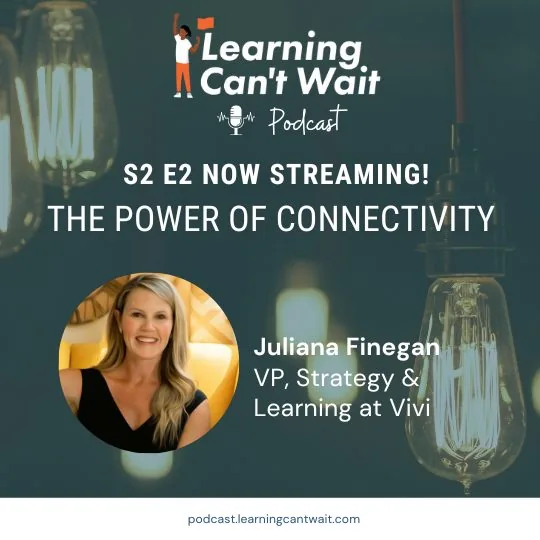
Welcome back for Season Two of Learning Can't Wait Podcast! As the world tucks into the new school year, we tuck into our new takes on it. In this week's episode, Hayley Spira-Bauer interview Juliana Finegan, VP of Strategy & Learning at Vivi. Juliana's career focuses on designing an innovative strategic approach to adult learning to ensure an engaging, effective, & equitable experience for all, using research-based strategies.
Want to learn more? Read our most recent article on The Three Cs of Powerful Connectivity.
Learning Can't Wait is brought to you by iTutor.com.
Full transcript
Transcript generated from the recording; minor errors may remain.
Welcome to the Learning Can't Wait podcast, an iTutor production at iTutor. Our vision is to ensure every child has access to education regardless of circumstance. Each episode, we will be joined by Pathfinders within and around the education space who are bringing about transformational change on behalf of.
Students, I am your host, Hayley Spau. Welcome back everybody. I am beyond. Excited to introduce you to today's guest. Her name is Juliana Finegan. She is the VP of Strategy and Learning at Vivi. Juliana, welcome. Thank you. It is so good to have you here today. I, for those of you that know anything about education, you probably know at least one of the places that Juliana has had an impact on, and you may very well learn about a new one, which is Vivi, which is new to America.
Yes. So we've actually been here for a few years, but I will say we're like at that like launchpad moment. So really like how do we really engage, involved and extend well, in addition to learning about the topic that we're gonna be spending most of our time on today. It's cool when people learn about new products.
It's cool when they learn about new places they can engage and get involved, which leads us very well into our podcast conversation. And Juliana, you yourself are an educator. Can you tell us a little bit about your journey in Educat? Yes. And just thank you so much again for having me. I know this has been in the works for a while.
We've been working on our schedules, so thank you. We're too busy moms. So that will really make it an adventure to find some collaborative time We can get together. Always an adventure with tiny humans. So what led me to education was I actually, I like to say I was to Teach For America's success story because I did Teach For America for two years, and honestly I was chemistry and business.
In college and then just fell in love with teaching. Fell in love with my students and so I taught for two years in East LA. I taught, eighth grade science and then I taught in San Diego for eight more years. High school chemistry, eighth grade science technology, everything in between as a Title I charter school for first generation college kids.
And so, and I, I'm still in contact with some of them. Some of them are teachers now. One is a teacher at the school. I just got to hang out with her in Seattle, so that's so the best. It was pretty full circle. I got to interview her to give feedback into our product for Vivi and now she's gonna be one of our beta testers.
So it's really exciting to see my students who I taught in eighth grade, which makes me feel a little bit old, but, To see them just really pushing the needle in education as well, and. . Yeah. Well, yeah. So 10 years in the classroom teaching all sorts of important subjects, but then you left the classroom and continued your journey on a parallel track in education, let's say.
Yes. So actually once I left, I moved up to Seattle, for my husband's job and started working for Relay Graduate School of Education. I built all of their online content around chemistry, which is really exciting just to kind of learn curriculum design, like how do you actually. Build all of the things you've been doing for so many years into actual, like digestible content that can be translated into multiple contexts for teachers and really help to support them, implement like targeted, relevant, rigorous content for students.
So I worked on that and then we actually got a. Grant from the Learning Accelerator to build teacher prep around blended learning. And this was when blended learning didn't really have a name yet, . It was like, so what's this blended learning thing? We had, you know, the Khan Academy from Michael Horn and Brian Greenberg, and like all this stuff is coming out.
Like what's the flex model? What's the station rotation model? The lab model. And so the learning accelerator actually brought together what they called their human capital cohort, which was Highlander Institute, TNTP, BetterLesson. Friday Institute, PowerMyLearning, I'm definitely gonna miss somebody, so I'm really sorry.
But we all literally sat around a table and we're like, okay, we're gonna be hitting this elephant from all different points, thinking through system level change, policy change, leader support, and ours was teacher support. So really thinking through that side and so, I was in charge of building a bunch of modules around how to support teachers to be successful within the space.
And really we didn't actually understand the space , so I was able to rack up quite a few frequent flyer miles and flew to about 60 schools across the nation to identify common denominators of practice. And that list was basically formulated by like fronts and family being like, so have you seen a school you like?
I'm like, what have you seen? Is it cool? I'll go see it. And so clearly I didn't have kids. Man, I just, that's cool. That's a, that's a long trip. So Juliana, you visited 60 schools, but you whittled that list down to just six. Yeah, so I really wanted to have two elementary, two middle, and two high schools, and to showcase diversity of school experience, size, demographic, all of that.
And the big thing there was to capture some of their specific strategies that enabled students to be successful. And those were really granular pieces. One thing was from Tanesha Dixon in DC Public School. She did clamshell, which was you close the computer just enough that they're not looking at it, but not enough that they have to log in again, because the amount of time it takes for students to log in again can be huge learning loss
So like losing a lot of learning time and then. If you'd use that strategy that helps to continue the learning throughout the day or like one-way streets having all the students. So at Navigator they had students all walk in one direction so they weren't like hitting each other so that they were able to have like a smooth flow.
Having that small strategy around routine enabled them to do a lot more student-driven learning, a lot more movement in the classroom. I'll never forget the first time I saw somebody place all of the worksheets on the end row in a classroom so that when the period began, the child sitting all the way closest to the windows was responsible for passing, taking one and passing the staff like that was so much more efficient than a me trying to like rapidly pass out 30 pieces of paper in between classes or B, wasting that time at the beginning of class and having one or two children walk around.
It was a light bulb moment for me really early in my career thinking about we could just be better. So, so all these great strategies, what did you do with that? Like what do you do with this collective? Awesome. So I, I built this , I built four modules that are still on canvas today for free, for any teachers, leaders to take, because I know that we're also at this pivotal moment.
Most schools are one-to-one, which is amazing. It's been a big movement towards this. And now you can start blending and start thinking through like, what does station rotation look like? Or, we've been doing centers for a long time, which is station rotation, , but in elementary. So how do we do it by really having more like.
Specific and strategic grouping to allow our students to get the content they need when they need it, and really thinking through those pieces. So it has modules around like just an overview, the strategies, culture and space, and then, going deeper into data-driven instruction and personalization, and then how to become a blended leader yourself.
And so it's funny that I actually launched those. I finished. Two days before my daughter was born and now she will be seven in October. And so it's like, it's been a while , so yeah. But they're still alive and probably helping many, many folks and Juliana. I'm going to just, you know, do the big reveal. But the, the topic we're really talking about today, and one of your absolute, insanely talented superpowers is the power of the collective of being a connector and bringing people together.
And this project that you took on where you visited these 60 schools and you built these modules was really about. Helping schools to become better by learning from one another and bringing people together. 100%. And just thank you so much. You're so kind. . I really,I do love like great people meeting great people to do great things.
Right? And I think that so many leaders, educator systems, They don't have the time to fly, fly across the country to see other schools. But it's also really hard to read between the lines when you're just reading a block or a written piece on research, seeing it in action and seeing the students walk in one way streets and seeing how the teacher does that in their classroom.
It's like so empowering. Cause it gives you a small snippet of what it looks like at that school. So really trying to give them a. A window in to seeing multiple ways to do something, to have a launchpad, to not reinvent the wheel in their own area, in their own school, in their own classroom. It's, it's an, there's a need for people like you who both enjoy bringing people together, but also recognize what it is at the end of the day that we're all here for, right?
Like this is for children. Deserving people that are on a journey in education. And so by equipping teachers with the right tools and having them have accessible content, incredible things can happen. Yeah. And that actually, so after I finished the project, I ended up moving over to the Learning Accelerator and LED practitioner learning there.
And one of the big first steps we took with working with Beth Rabbitt was like, okay, how do we actually connect? System looks across the country so that they can learn together, be a community that we can really identify ecosystem challenges across the board and address those challenges as a collective and.
Amplify and scale those best practices across the country too. So like really how do we build that network? And a lot of, we first started talking to teachers and then we talked to principals and I had like happy hours across the country and it was like an ongoing joke. I'd always have 'em at breweries cuz I really like IPAs.
And then people were like, we need wine too. I was like, okay, I gotta get smarter. I was like, if you do a fun, happy hour and invite great people and great educators, conversations will happen. You'll be able to learn from them. And so we did this cross country and I said, you know what? Actually the people who need the connection are those system level leaders around innovation, personalization, cuz they're kind of working on an island and feeling.
Really alone. Sometimes asking themselves if they're, they're crazy and then they're like, okay. Or also not being able to celebrate the amazing things they're doing. So many times I talked to system level leaders and I was like, so tell me what's going on? And they're like, oh, like this and this. And then they start saying stuff.
I was like, that's incredible. Do you realize like, People aren't doing that in other places. Do you realize you are supporting your educators in such a personalized way that they're excited to come to professional development? Like, and I love the feeling when you walk away from a conversation that somebody's like, thank you.
Like I am doing good stuff. And I think that there's that moment where you have to celebrate each other too and be able to sit as a, Like as an observer to hear what's happening and for somebody to say it back and say, You're doing awesome things. How can I help? Like what else can I do? And I look at this sticker on my computer, it says, do right by students.
Duane McCleary makes these stickers and hands 'em out. And he used to be in our Innovation Directors network, which I'll talk about in a second, but he hands 'em out and he said, you know, this is a reminder that we're all here to do right by students. But how can we help from our specific vantage point?
And so the Innovation Directors Network was basically bringing these people together that we had DC Public Schools, Chicago Public Schools, Dallas, Highline, Greeley, Beacon Network, all coming together. And now some of them become some of my closest friends. They become close friends with each other. They visit each other's districts.
They learn from each other. When remote and Covid and all the craziness happened, they'd send emails and be like, does anyone have some like virtual learning rubrics? Like all of a sudden they weren't reinventing the wheel and they weren't alone, and how they can build from each other. Let's talk about that for a second, right?
This idea of reinventing the wheel, . So it's been forever in education. You know, it's, it somewhat vacillates between a wheel and a pendulum, right? Because sometimes it's just returning to old ideas. But what, what is the benefit of like keeping the wheel we have and stopping building it again, and how do we get leaders to embrace that?
I think the big thing is, There is a moment of learning going through the struggle to build, right? So I think there is a lot to learn from going through the change management, trying something new together as a. As like a school or a system. But I think there's also, how do we use the learnings from other groups to inform where we start?
So sometimes it's, you're not like copying and pasting the wheel, if you will, but instead you're saying, okay, so I learned how they put together there. We all, I can start here, which gives me like, I. , maybe an inch a mile ahead of where I would've started. And also, you know, maybe I won't try this thing because that didn't seem to work for a lot of people.
I'm gonna try this. So thinking through the different options and approaches also helps us. Right. And I think with that, thinking through like what I currently do at Vivi, I'm doing like. VP of strategy and learning. Like the best part of my job is that I get to listen and learn from educators and leaders about what they need.
And so many times we as EdTech companies take so much time thinking through the product how we're gonna build features, and then we put out the features. We don't share any of the why. So like why did we build this feature and how would a teacher implement it? So not just how would you use it, but how would you implement it to impact your learning or your students learning?
And how would you actually leverage that technology to address instructional challenges and teacher your students better? So really thinking through like how do we learn from each other? Like iterate on that wheel and then make sure that we are constantly moving forward. I, I think folks would believe that if they didn't know about the power of connectors, they might believe that a connector's real strength was.
Talking, but you have said the word listening so many times on this call in every role that you've had. You said it when you talked about visiting 60 schools. You said it when you talked about the innovative cohort that you led at TLA. You now are saying it about Vivi. So. It's really interesting to hear you talk so much about listening rather than dictating, which is I believe like the key inflection point for creating really great partnerships and experiences where folks get to learn from one another.
And don't be fooled, Hayley. You know this, I talk a lot, but . But, but I do think there is like something to be said for where we say we have two ears and one mouth for a reason. And I truly believe that, like I feel so lucky to have some of the people surrounding me in this space for so long, and to learn from them and to grow from them.
And. Leverage their superpowers as well, right? Because the thing is, is like we all have our skills, but unless you listen and learn from what others are doing, we're not gonna grow. And we're, this is a collective goal to shift education, right? Like we wanna do better by our students. And so in order for us to do that, we can't try to do it all.
So we need to figure out. Where everyone kind of fits in the puzzle and how we can work together. And so I think that that's where you get the authentic relationships. I think the people I feel the closest to when I lean on the most are the ones that. I can be the most vulnerable with. And they can be the most vulnerable with me.
And I think that that's been a learned thing for me. Cause I'm like, oh, I got it together, don't worry about it. And then you're like, I don't got it together. I mean, I think Covid really helped us all to take down some walls and but to take down those walls, to lift each other up to say like, how can I help?
And so just kind of trying to help each other and learn from each other. And. . Yeah. I imagine that the, for the school leaders that are listening in right now, they're thinking, yeah, that's great. I am in a rural, a really rural environment and I don't have a lot of schools around me. Or, you're right, I read something, I read a blog, I follow this podcast, I do this thing, but that's not enough for me.
So, Can you share some ways that school leaders, teachers in your experience have gathered together that have been effective or places they can look, where they can network and collaborate? Yeah, absolutely. So one thing. , I'm just gonna have to like put in Vivi a little bit here. So for Vivi, if you are a Vivi user, awesome.
We are actually doing a Vivi educator council so that we can have a council of educators and teachers who can have a direct input into our product and also to collaborate with each other and learn from each other's strategies, leveraging the tool, bigger areas. If you're thinking on the system level, we have like the League of Innovative Schools from Digital Promise or Edcamps as well.
And if you are on that leaping leading edge around innovation, Innovation Directors Network with a learning accelerator, you can reach out to them. But I also think that there is a power of community as well within your local, and to tap into more national pieces too. So like go to that virtual webinar, get involved in that, like Twitter chat, you know, start building your network to lean.
And also thinking through what is a tool you currently really enjoy? How can you get more involved? How can you become a like leader in the space around that? But I think the big thing is, is like, So many times as teachers, we stay into our classroom, right? And we never wanna look next door because sometimes like it's overwhelming to be like, oh my gosh, they're doing this and I should be doing this.
And it's like sometimes easier to look outside of your school instead of looking next door. So I push also educators to look next door. And learn from each other and be vulnerable with each other as well. Like I used to do a pineapple, so a pineapple, the top, everyone has our crown, but we're also ripening something all the time.
So like, and those things can change, and being like transparent about what you're trying to ripen can help you grow as a collective as well. So saying like, you know, when I first joined TLA I. I am struggling on strategy, like I get in the weeds and I cannot zoom out. And I was very open about that and I Well, did you go?
No, my title, it's, you know, strategy where you've, I mean, but it's all about saying like, I don't have to be good at everything. But as teachers so many times, we really push ourselves to be good at everything. And so being able to learn from each other and being like, I have amazing culture in this classroom.
I'm really starting to work on doing data-driven instruction, would love to learn from you. And then you go to somebody else's pineapple and you see their rock stars and data-driven instruction. They need help with culture. How can you supplement and support each other? So I think that this podcast is really just an Abbott element.
Stan account because I am obsessed with that show. Juliana, I don't know if you've seen it, but it is like, it does highlight this notion of there's greatness around you in every school. And it's, it's, you know, there, . When I was in college and I was joining this women's organization, I remember someone said to me, Hayley, every single person is amazing for one reason or another.
It's your job to figure out why they're amazing. And in some ways, what you're talking about here reminds me of that because I leave my life with that now. I love meeting new people. I love talking to them. And for teachers, it can be just one more thing on the list to do. Totally. And teachers are so tired right now.
Hopefully they're enjoying summer break. It's July, it's middle of July then when we're recording this episode. But I know this episode's going to air in in the time when they're back in action, really in the thick of it again. So it feels like one more thing to do to make connections and try to learn from others and share, but.
It seems from my own experience and from yours and what you're sharing with the audience here, that it, it can be really a time saver in the long run. Yeah. It's you know, likethe connections build capacity. For you and those around you.Right. And I think also we're at this moment where, like, what is your superpower?
Since we're talking like on the educator side, like I used to work with my, the other chemistry teacher at my school and he was, I hope he was listening. I'm gonna send it to him just to let him know. He was like a rockstar at last. What's his name? . Jason Fleetrock. Said, hi Jason. Thanks for listening. He was a, just, I mean, is a rockstar educator and he.
Just like chemistry labs. He could like innovate and make the coolest ones. And I was like, I really love to do the systems and like the more I loved doing the posters and like the fun builders and the activity that went with it. But like the actually like getting nitty gritty into like the lab prep, I was always like, Ugh.
And so we really paired well because he would set that up and I would set up like the worksheets and the PowerPoint and like, so we really complimented each other. We could have both done both. But that would've been a lot of time and energy. Instead, he continually taught me with his deep knowledge of like getting into those nuances with the labs.
And then I was able to say, okay, so we're doing this lab. Here's how we can present it. Here's how we can bring it in. Here's an activity we can do to review the content. And so that was much more. Probably shows up on the fact that I ended up in curriculum design, so . But yeah, I think it was You didn't co-teach with this individual, did you?
No, no. We were, we were like next, so we split up, like the 10th grade had two chemistry teachers. Five, one was him and one was me, and he was, Oh, he was there the whole time I was there. And so it was work smarter, not harder moment, and Oh, totally use people's strengths to leverage for students. There's an episode of the podcast that aired in July with, a woman named Danielle Bassie and a, and a gentleman named Yancy Saines and their co-teachers in, Fannie Lou Hamer School in, in South Bronx.
And they've been co-teachers now for three years, and they really endured the. Super successfully, and they speak a lot about this, about leveraging each other's strengths, leaning on one another and celebrating what weaknesses you have that someone else is ha like has as their pineapple talk. I'm gonna call it a, A crown from now on.
And yeah, life is better when you're doing it with other people and can raise the bar collaboratively. And it enables students to get consistency and alignment across the whole grade too, right? They had two chemistry teachers in 10th grade. If we were doing totally different approaches to the curriculum, like.
How does that help either, right? So how do we make sure our students are getting the same content and the same rigor and all of that, but also giving a personalized spin to allow multiple entry points for students as well. So there's this theme we are carrying throughout the conversation today about connection.
You're talking about it at a systems level. You're talking about it on a national level. You also now are talking about it within a school, within the walls of one school. What is something like when you think back into all your years in education, both in school and surrounding schools, what's something that you feel like is worth celebrating and that as a education collective that you wish you could bring to everybody?
That you might be able to do in this format on the podcast? Oh, that's a hard one. I was like, I'm so sorry. To the listeners that we've been jumping all around, I have like so much excitement and I just love chatting with Hayley. I think the biggest thing that I'd want to bring to this. Is it's okay to lean on people.
Every part of my career teaching parenting, you know, with Relay, going to the other schools, I had to just like send cold emails to these people and be like, so my name's Juliana Finegan, would you like me to visit your school? Right. But they took a risk and they let me come visit. And then I was able to celebrate them.
Right. And then if I moved to TLA or the learning accelerator, apologies. Working with the Innovation Director Network, they were taking a risk. They were already like maxed out in capacity, taking a risk to join this community, but they were able to build and lean on each other. Right. And then when I moved companies, when I moved jobs and moved to Vivi, I.
Get to work with our product team, our marketing, our sales team. I get to work with all of these people I've met through my educational journey to get their insight, and I'm able to lean on them to learn. And to improve through the process and to like better support across the board. And like I even have, I was telling you like I have a text chain of like a few moms in education who we text each other and we're like, I'm having a bad day.
I just need a virtual hug. Or like, you know, today was a good one. I'd love to celebrate with you. And I think the hard part is so many times we get in the mindset that we're supposed to do it all ourselves. And that, especially as women that we're supposed to show this like that we are strong, we don't need help, we can do it.
But I think so many times by like saying,I'm willing to lean, allows other people to lean on you, and that's where like that magic happensbecause we all. We all want that and like it makes me so happy, like seeing you Hayley, like seeing Erin and Brett like being like we met through you. It's like, I feel like you're building this continuous community that will hopefully really push education in such a strong direction so that we're helping all of our students, but that we're also not just totally beaten up at the end.
That we're doing it in a way that is sustain. Cause I think that that's what's hard for teachers right now. It's not sustainable. They're tired. They have no capacity. How do we give them opportunities to lean? I normally ask like, what's one advice you might give an educator at the end of the podcast, but that like, there is no better advice than that unless you wanna amend it and say something different.
Like that was pretty like mic drop of a fo Juliana. Thank you. It's a, it's a hard learning, right? To just say, like, to when somebody says, so how are you doing? And not being like, great. You're like, so I'm not okay right at the moment, but we're doing okay. We're getting there. Like, or I need help. I need help.
Yeah. And, and that's doesn't mean you're weak, it means. , you're strong because you're willing to ask for the help because you're also probably willing to give the help when they need it to. And I think that's where those relationships come, is like it's a give and take. Juliana, this has been so fun. I.
Both adore you and respect you, which is the best combination, and I love that you were able to share some of how you became this incredible web of connectivity for so many brilliant people trying to move the needle for children. Thank you so much for being on the podcast today. Thank you so much for having me and right back at you
I'm excited for folks to listen and to share their thoughts and hopefully join some of these communities that you named and make the world a better place for kids. Yes, absolutely. Thank you and, and thank you guys for everything you are doing. Those who are listening. Yeah. Thank you for joining. Thanks for listening.
Feel free to share some guests if you have some at podcast@itutor.com. Thank you everyone.
Thanks for listening to the Learning Can't Wait podcast. If you liked what you heard, please rate, review, and share this episode. Be the first to know. We have a new episode by subscribing wherever you listen to podcasts. If you'd like to be a guest on the show or have a suggestion for an episode, email us at podcast@itutor.com.
This episode has been brought to you by iTutor, your online solution for sourcing highly qualified educators. Join districts all around the nation that use iTutor to connect with thousands of licensed educators who fulfill both core and supplemental instructional needs. Choose iTutor Online education when learning, can't wait.
Now I'm back to this episode.