
Learning Can’t Wait · Episode 64
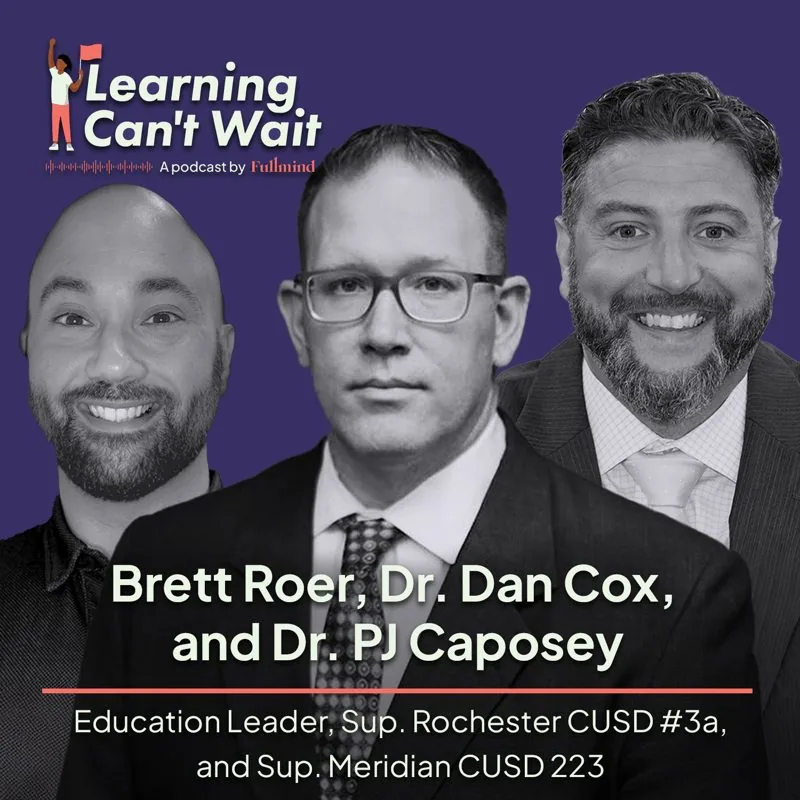
Brett Roer, Dr. PJ Caposey, Dr. Dan Cox: Growth, Fitness, Discipline, Leadership, Work-Life Balance
- Brett Roer
- Dr. PJ Caposey
- Dr. Dan Cox
 Hosted by Hayley Spira-Bauer, Chief Academic Officer at Fullmind
Rebroadcast .
Listen now
Brett Roer, Dr. PJ Caposey, Dr. Dan Cox: Growth, Fitness, Discipline, Leadership, Work-Life Balance
Episode summary
Superintendents Dr. PJ Caposey and Dr. Dan Cox join consultant and former South Bronx principal Brett Roer to discuss stress and balance in school leadership. Against a RAND finding that most superintendents call the job highly stressful, they share coping tools including Dan's two-minute rule, PJ's reminder that he gets to do this job rather than has to, and the value of executive coaching. They connect personal discipline and fitness to leadership, warn against negativity among peers, and urge new leaders to lead with vision and be authentically themselves.
Key takeaways
- Ask whether a problem will matter in two minutes, hours, days, months, or years before reacting
- Coaching and a trusted peer network are the most important supports for clear-headed leadership
- Leaders get the behaviors they model and tolerate, so personal discipline sets the tone
- Take care of your health first; the district will post your job before your obituary
- Lead with a vision and be authentically yourself rather than performing the superintendent role
About this episode
On this week’s episode of the Learning Can’t Wait podcast, host Hayley Spira-Bauer sits down with school leaders Brett Roer, Dr. PJ Caposey, and Dr. Dan Cox to speak about discipline and balance in school leadership.
The group explores how the challenges they've faced in their individual lives have contributed to personal growth and development. They also share their strategies for coping with stress, discuss habits around fitness and wellness, and examine why discipline doesn’t exist in a vacuum.
The podcast will take next week off for Thanksgiving but will be back Tuesday, November 28th when we talk to Chelsea Waite, Principal at the Center on Reinventing Public Education. Join us at fullmindlearning.com/podcast.
Full transcript
Transcript generated from the recording; minor errors may remain.
Hayley Spira-Bauer: Welcome back everybody to the Learning Can't Wait. Podcast I am so grateful to have the esteemed panel that I have today talking about balance in school leadership at a time when we know the stress levels for superintendents and other school leaders are exceedingly high. I am eager to welcome 3 individuals here today. PJ Caposey, the superintendent of Meridian CUSD. Welcome. PJ. How are you? Thank you for being here? We have Dan Cox, the superintendent of Rochester CUSD 3A Dan. Welcome.
Dan Cox: Thanks for having me.
Hayley Spira-Bauer: Thanks for being here as well and far from Illinois, where the other 2 folks are from. We have Brett Roer, the founder of Brett Roer, consulting, and also a former school leader from the South Bronx in New York. Welcome, Brett.
Brett Roer: Thank you, Hayley, for having me honor to be here.
Hayley Spira-Bauer: I'm honored that I was introduced to all of you, either by Brett or by the incredibly incredibly talented folks that we know in common. But before I jump into that, I'd love to just start out with my famous first question, which is, how did you come to be the personal and professional version of yourself. This is, gonna give a little contextualization here for the folks listening to understand why you were asked to be on this. Podcast so I'm gonna start with you. PJ, how did you get here?
PJ Caposey: I would say that the most honest answer is through just tons of failure. And and difficult things that have happened in my life. So I can go through a myriad of stories and take a pull. 45 min. But typically, I'd like to share that like 3 profound things happened that impacted my life. The first was that I'm a 3 time cancer survivor. So, going through that each time has changed my perspective dramatically. The entirety of my teaching career was in the inner city of Chicago. My last year teaching we lost 8 students to violent death in in a single year. Which impacts a little bit of every decision I make and trying to to fight for those that are voiceless are traditionally underprivileged. And the last thing for for me is that when I start off as a principal I was just pretty pretty darn terrible at it. And party of my life. People had called me a leader, and I had, you know, been given positions and titles and all of those things. And it it never struck me until I was the leader in a school system that policies and procedures and work. Ethic and knowledge of research isn't what actually makes you a leader. It's the ability to influence hearts and minds and see people for greater than they currently are and so those kind of 3 monumental events shaped me. But I would say holistically, it's just been failure. Is kind of what has driven me to be where I'm at right now.
Hayley Spira-Bauer: I appreciate you being so vulnerable. I know that you speak about this often, and we can find lots of your public speeches on the Internet. But hearing you share it here is really powerful, especially in the context of sustaining this work. And so I'm grateful that you started this out with that introduction. Thank you so much. PJ. Dan, same question for you, sir.
Dan Cox: Like PJ. I could probably take up our 45 min with with the story of how I got here, both personally and professionally, and why I do what I do. But my entire life I've been a team player. I'm want to add value to others, and I'm I'm a big believer in continuous improvement for myself personally and professionally, I'm always trying to get better. But I like adding value to others, whether it's people, communities, organizations. To get into teaching my sister Lisa. She was. She was a teacher. She was 10 years older than me, somebody I really looked up to, and was a career principal, for for many, many years after she left the classroom as a math teacher. And and she passed away from cancer. And PJ. Was actually a close friend and and colleague during that time, and, you know, supported me through that. And I think that was a transitional point. Well, it wasn't that long ago. It was a a transitional point for me both personally, that has. Now how it's it's bled over into my professional life as well, which will get into that more in our conversation today
Hayley Spira-Bauer: Again. Thank you so much for being so vulnerable in the opening. It's it's incredibly challenging to face adverse life experiences and use them for good. And so I'm excited for you both to be able to share more about your stories and how you've overcome some of these challenges you've named, but also led by example, for your communities that you serve. So thank you, Dan. And last, but certainly not least, Mr. Brett. Rower.
Brett Roer: Yeah. So thank you, echoing a lot of what PJ. And Dan just said definitely, the biggest growth comes from adversity. Starting out as a new teacher at one of the lowest performing schools in New York City that was constantly under the threat of closure. Really forged these transformational bonds that myself and the teachers and the school leaders that were there were still in constant contact. Caught up with one of them just yesterday. So I think, learning very early on that.You cannot change systems and you cannot change outcomes for students without building those transformational relationships, I think, has been what has served me. I serve me well, as I've transitioned to different roles and serve different populations of students and taken on leadership roles. It's really come down to. What are you learning from people? What are you giving back to them to make sure they can do the work. And then how are you growing? And when you get to new positions, how are you using those new levers to bring people with you so really excited to talk today about the trials and tribulations that led me to that today.
[05:00] **Hayley Spira-Bauer:** Anna Hardy. Thank you to you as well, Brett. I know you from the New York School circuit, and I'm excited for you to share a little bit more about that as well, you know, I alluded in my introduction to the fact that in July RAND Corporation did a survey and announce that 80 of superintendents say the work is often or always stressful. Naming it the most stressful job for adults. In the spring of 2023. How true do you feel? That is, as a school leader today, both from your own experience and the experience of those around you, I'll start this time with you, Dan.
Dan Cox: 100% you know, it's it's in my. I've been a superintendent now 14 years, and I was having a conversation with a colleague this morning that what I did as a superintendent 14 years ago, and what I focused on couldn't be any more different than it is today. With that being said, I think we also have to understand that that adversity is a part of life. Things are never as bad as they seem, and that nothing ever stays the same. The good times don't stay the hard times don't stay. So I take that into the superintendency as well knowing that that's it's incredibly stressful. But I also know that you have to embrace that adversity, and that that whether it's good or bad, it is going to change.
PJ Caposey: Yeah, I would. I would say that I don't find it to be that stressful of a job. So I know that I think I'm probably an outlier in the scenario, but just in terms of perspective of like what's going on in the world and what other people are doing like. We make really important decisions. And on any given day we have the opportunity to change like the trajectory of people's lives, and that is an incredible opportunity and an awesome responsibility. But, like Dan and I are pretty close, we use different. He would address the situation different, that it's not life or death, it is. It is incredibly important and vital. But there's a lot of ways that you can be successful in this job. And I think that's just the attitude that I bring to it. Like II see my number one job, and I'm very thankful that my board sees it the same way as my job is to grow other leaders in the organization, so that the organization can be stronger. And as long as we keep our focus on that we're gonna have some ups and downs, and it may be one year our test score dips a little bit, and then next year we see a big jump. But I'm not measuring, based on that. Every single day I'm measuring, based on whether the 17 people that I have direct responsibility to support their growth are growing. And for me, that is exciting. Now, is there a bunch of drama? Yeah. But I'd say there's drama every day. I just don't necessarily take it necessarily as stress.
Hayley Spira-Bauer: That's fair. And listen. That's why we want to have a panel for these types of discussions, because both experiences can be different, and also the way we approach them. And obviously we have 150 superintendents that responded to that survey. And so a lot of folks are in that stressful place. And PJ, the whole point of this podcast is to talk about what you and Dan and all the leaders that Brett has worked with and known for a long time are doing to keep that stress low, to help use the contextualization. You're doing.
Dan Cox: Wa, one of the things that helped me in that regard, and I don't remember where I learned this or picked it up along the way. But II coach my principals through this, because, you know, especially in the day to day and the in the drama the day like Tj. Or PJ, sorry. PJ, PJ, mentioned. You know you get you get caught up, you get caught up in it. And I always, you know, coach people to use the 2 min rule and ask yourself, hey? Well, this issue that's got me so heated. Will it matter in 2 min? 2 h, 2 days, 2 months and 2 years from now. And that's how I gauge how big of a deal it is. And I use that as a self barometer, and more times than not the things that that raise my stress level to a point where it may be borderline unhealthy. It's the stuff that's lower on that continuum. It's usually stuff that won't matter. 2 days from now or 2 weeks from now. Now, every now and then I get those 2 month problems, and and in the rare instance I get the 2 year problem that comes my way, and I might want to pay more attention to that. But I've just found that that things I really think are a big deal aren't as big as they seem at the time.
Hayley Spira-Bauer: I need to start using that in my life. I'm not leading a school, but that sure sounds valuable. How are you? You have unique, unique purview of being able to talk to lots of school leaders all over the United States on a regular basis, either cause it's your job or just cause you like it. What's the sense that you're getting in your interactions right now, is it different than PJ. And Dan have shared, or is is it aligned?
Brett Roer: I think. Actually, it's it's a combination. So one thing you know. PJ, sharing it depends on who you're talking to, whether and what their seat is and what the demographics they're serving or the current issues. But some folks are dealing with that day-to-day life or death fight or flight response. And that's obviously a major source of anxiety. Something, Dan just said. I think the power of coaching is probably what most leaders need the most, and while many districts provide that coaching, or hopefully, they're providing leadership or executive coaching. It also comes down to the quality and the fit. So one thing I'm noticing is The leaders that I find are in the best position to lead clear headed. To think of things more rationally and not emotionally is are using tools like Dan just mentioned. But they're also really investing in their own growth and leadership development by finding great coaches. And then, as PJ. Said, making sure they're modeling that for the X amount of people that they're directly supervising and hoping that trickle effect amplifies throughout the entire district. They lead, or the bill building they lead. So I think, investing in coaching in yourself and investing in finding the coping mechanisms. That work best for you is what I've noticed across the board is helping people to to lead effectively in their districts.
[10:00] **Hayley Spira-Bauer:** I don't want to bury the lead. But that same Rand survey did say that 50% of respondents felt like they were coping well with the stress. So let's talk a little bit about coping with stress, because I think, Dan, PJ, you really started us off with that like, yes, there's stress, and it isn't necessarily getting to me on a regular basis, because it's not a life or death decision making every single day. What are you personally doing to manage the stress levels you have on a regular basis. And how do you feel like some of the history you shared at the top of this call has helped you to prioritize that.
PJ Caposey: Yeah. So the majority of the time I take pretty good care of myself. I'm not on on a role like Dan has been like the last 18 months in terms of of prioritizing himself and his health. But so II like to try to take care of myself, but for me the the biggest thing in terms of coping is just again realizing what we get the opportunity to do in owning it right? So when I signed up for this job I didn't sign up for it because it was easy. I signed up for it because I had a great opportunity. And when I remind myself of that it's it's pretty stark. So I would say. The the low point of my career as a superintendent was mid. Covid had like a weird string of you. It's against me. I had stuff throwing at me in a restaurant cause. We were still wearing masks, and wherever else. It was just the kind of the low point, and we had a board meeting coming up, and it was gonna be another one of those board meetings that you know I thought literally may go viral right like. That's how divided our community was. And I just remember thinking, like, about 12 h out, that I wish I could be anywhere but that board meeting that night and I call the coach, and, as as Brett said, I think it's it's vital, and he reminded me that 10 years ago I would have been done anything to have the opportunity to sit in that seat and to be able to lead in that moment. And that has stuck with me kind of forever. It's like I get the opportunity to do this. I don't have to do it. I could do lots of other things make probably as much or more money, and whatever I get the opportunity. This is so on top of just trying to stay. I guess, within myself, right? So grounded in terms of where I'm at social, emotionally and taking care of my body. The biggest thing is just I get to do this. I don't have to. And that kind of spurs me forward every day.
Hayley Spira-Bauer: That's a real mindset right? That that understanding and that belief. I know how you frame your mind and how you helps you frame the world. So that's that's a strong one. I think that you know I've seen lots of school leaders adapt Mo adopt mindsets like that, and be able to endure because you're making the choice, and you have a choice every single day. Whether or not you want to continue to leave the community that you're leading. Dan. When you hear PJ, share that, how does that? How does that similar or different to how you feel about the work you're doing today.
Dan Cox: You know, there's a lot there's a lot to unpack with that. And I appreciate what PJ. Said. Because you know. In our communities, especially in the communities that that PJ. And I serve, our schools are the heartbeat of our communities. They're a source of pride. They're they're the center point. They're the social event. You, you've got legacy families that you know, their grandparents, the parents, the children, their grandchildren. They all. They all go to school there. And we're to be our school district's biggest cheerleaders right? I say, I say it to the point I get made fun of, so I know I know I doing it something right whenever I say it's a great day to be a rocket cause it truly is. I feel, even on my worst days as a superintendent or Rochester. It's it's better than most people's, you know, best days. It's it's really incredible. And II really appreciate what PJ. Said in in regards to the opportunity to be here, because when I am having a tough day. I remember that that this was a job I really really wanted and and sought after and was able to get that. And so II don't wanna waste that opportunity. I had an experience at the School Board Conference. When I was a new superintendent I was. Probably I was in my first or second year, the superintendency and one of our colleagues. We'd all met for lunch, and there was probably 14 superintendents, many of whom I didn't know PJ. Would know Nick and Mike and and some of them. We're all meeting for lunch, and as a new superintendent I didn't know who they were, and it was just a social lunch to to get together, and before we started Nick said, Hey, I will. Everybody doesn't know everybody. I'd like everyone to go around the table and say pot something positive about their school district. And we were going around the Horn, and at that time I was closing and reorganizing schools. It was not fun. There was a lot of hate directed my way, and when it got to me I did not have one single positive thing to say about my school district, and it wasn't about the district. It was the situation I was in, and me feeling sorry for myself, and that stuck with me that I should never be in a room where I can't say something positive about my school district, and you know II wish I could say, whenever I go to meetings with superintendents, that that everybody's upbeat and positive cause, we do deal with difficult things, but sometimes those rooms They're not the best. They're not the most positive rooms, because people are stuck, you know, in that. What was me or these things that we're dealing with are so hard, instead of starting with that positive. And and I think we do need to remember every single day we have an opportunity to help shape the communities that we live in through our school districts, and the people are really proud of of where we are and what we do in in our schools
[15:00] **PJ Caposey:** Just to jump in real quick before you. Is that when you, when you said that it brought back so many memories of sitting through terrible meetings with superintendents when I was new, and I I'm 20 years younger than most of them, and everyone's red faced and angry, wearing the same tweet laser since, like nice, I just and every all I knew I did was complain. And I hate it. Yeah. And it's interesting, because, as you become a veteran in the in the profession. When you're around soups, it's like the only place you feel safe to say what you're really feeling. But then it really trickles down into just this this like vacuum of negativity, really quickly. And it just when you said that it really reminded me, like we need to do a better job of kind of self policing, allowing it to be a safe space. Here's 15 min. Get it all out, then let's get back to what we're doing as opposed to allowing it. Just become this dark cloud. And I, as now, I'm one of the veterans sitting around the table. I don't think I do a good enough job policing that because when people go off on those rants. I usually just check out. Look at my email until we're done, and then we get back to business. I probably could be a much better positive influence for my peers by calling that behavior out.
Dan Cox: Well, and sometimes it's the it's the approach, too. Right? So like people ask me, hey, how you doing right? That that simple greeting when people really don't care how you're doing. But people ask me how you're doing right, and I'll say I'm having my best day since yesterday. I found that's about the best, best and honest answer you can give, and I joke then some because people always laugh. I usually get a laugh out of that. And I said, sometimes that's a high bar to clear, and sometimes that's a low bar to Cr clear. But either way, I'm having my best day since yesterday, and it's just a light hearted way to get people to focus on, you know, just being positive and having a good day. Because again, I think it's so hard what we do. And and you know, maybe not hard. But there's just a lot of responsibility. And it's it's a simple way to remind ourselves that that, hey, this is a good opportunity for us, and what we get to do is pretty special.
Brett Roer: Yeah, I would say, something that will always stick with me was, you know, I'm beginning. I mean, keep saying something that PJ. Said. You know there were a lot of moments as a principal turnaround of school with 3 new prints, 3 3 new principals. In 6 months it did feel life or death, and it was very hard for me to find focus and be present on, like the conversation at hand, and that's something that. As a new principal, we had a critical friends group. We would inter visit people's schools, and, like PJ. Was saying, I was the one who was always on my phone or email, like waiting for the next crisis. I couldn't allow myself to be present. Eventually, obviously, in building a team we were able to get there. But I actually got feedback from my coach, and he said, You know the other principals were offended that you couldn't engage with them. And I will never forget that, because it made me realize you know I you can treat that moment. However, you want. You know, I can't break up a fight if I'm at someone else's school, so why not accept that and be really present and learn and build relationships with others. And so I think I know today's focus is gonna be on finding that balance. And that was something that I definitely struggled with but took to heart and tried to make sure as a future coach, and also in those final few years of principal, really making sure people always thought I was present, engaged, and really cared about the exact whatever was in my purview that I could be passionate about and build relationships on in that moment so definitely a struggle. But I know that's something we're going to be talking about today.
Hayley Spira-Bauer: Well, I mean, I guess that's a good segue, right Brett Roer is known very famously for attending conferences and leading 5 Am. Workouts. I have never ever attended one of these workouts. But one of the reasons why Sarah Williamson, illustrious Pr. Had recommended Dan and PJ. For this Podcast is because. They, too, lead very healthy, balance lives and incorporate exercise as a part of the regular regimen. So, firstly, have either of you ever attended one of Brett's workout sessions.
[20:00] **PJ Caposey:** I think, Brett, it's cool.
Dan Cox: Brett attended one of mine. I think credit for that, Brett, me or you?
Brett Roer: It was very organic experience, as many of these conferences are. You meet people you do talk about fitness. So Dan was carrying around a weighted backpack which I'd never met anyone who actually did that like in a professional setting. He just had like a little weight, you know. I don't know how many pounds at that time, but I'd never seen that this is 2022 or in Puerto Rico. It's one of my first, ever major conferences surrounded by soup. So know a lot of people. That evening we're catching up, and Dan's like I said, I love leading outdoor morning workouts. I did it in New York City for free for many years. It's like burpees on the beach. It's like great. I'll see you there. And he he was there bright and early, as well as some other really ambitious soups. And it was still a personal highlight doing burpees at with the sun coming up on the beach in Puerto Rico. You know, one of those moments you're never gonna forget. So those are the kind of relationships you can build when you find people also are looking for the best way to to start their day and to build community. So Dan, I think that was a symbiotic long way of saying, I think we form something together there in the moment. Yeah, I will. I will agree. We we we did. The 6 Am. Water burpees. You haven't experienced life yet until you're doing burpees and suckin air in in the surf at at 6 in the morning, but we we got it done.
Hayley Spira-Bauer: That sure sounds like a way to start today. How about you? PJ, have you ever so are you used to doing some fitness, some working out with with Brett or Dan
PJ Caposey: Dan and I have have have shared some workouts together, but II have never worked out with Brett. Alright. So this will schedule that follow up. We'll make sure it happens. I mean.
Hayley Spira-Bauer: So why is this important? Why are their school leaders right now constantly talking when I did some research prior to this call. Why is it that what's the connection between the fitness community and the school leaders that you all know you all know and work with.
PJ Caposey: Well, I will just say that. I don't think that discipline is exists in a vacuum. So I think that typically when you find the most successful people to me, you find very disciplined individuals that sometimes make choices that are different or abnormal compared to their peers and are not exactly what they want to do. And I think when you look at highly successful people, you see, highly disciplined people. Typically right? Like, I think there's outliers and everything. And there's lots of elements of being a human being. So I think that when you find a group of of leaders that also are disciplined in another aspect of like, such as fitness, or in whatever that looks like right like that might mean that you're rockin. That might mean that you're spinning to the heavy stuff, whatever it is, right. Then I think it draws you to them because you're seeing somebody like, Hey. Not only that high achiever here, and I might be a high achiever here, so there might be something there. But now I'm getting the fact, the sense that this person is disciplined and cares deeply, and is thoughtful about their actions, and I think that makes much easier to become connected with somebody. That is is going to have that similar mindset. Dan posts a lot, and and we talk and we know each other's families and talks about his boys. And this boys are are are different beings in terms of their level of commitment. But I posted something just the other day, like what? When people don't understand you. Maybe maybe you're doing something right. And I think that's kind of the vibe that we get when you work with highly successful people. Is that like with my schedule, I've got like 4 like legitimate full time jobs. If you report it onto paper. And people like, well, how do you do it? And I'm like, I don't necessarily, if you don't have the capacity to understand what I'm doing in order to maintain it. Then I don't think you're gonna understand anything that I do. And the same people that look at Dan and be like, how are you doing a 20 mile race on Saturday and leading school on Monday? If they don't have the capacity, understand it, then they might not just get it. And so I think sometimes we self sort our peer group to people that might understand that
Hayley Spira-Bauer: I wanna share it. That says I don't think discipline exists in a vacuum. PJ, if you haven't written that down yet, I highly suggest you do, because I think that is like that could be the title of this episode when it gets released.
Dan Cox: Well, and it's to that point. It's not. It's it is about discipline.: it's, you know. Oftentimes people will talk about being motivated like I'll I'll do something when I'm motivated or I'm motivated to do this. That's a flash and a plan. Motive motivation is fleeting and I'm not proposing people do what I do. From from a fitness standpoint. That that's a whole discussion in in journey end of itself. But don't think for a minute that I want to do the things I do every day. I last 2 Sundays ago I got up and ran 20 miles for a training run, just a training run, because I'm getting ready to do a 60 mile race right? And I did not want to run nothing in my body. Nothing in my schedule, nothing wanted to do 20 miles on a Sunday morning and spend my entire morning that way. But I did it anyway, and and I have my own personal reasons for doing that. But I did it, and that was the discipline piece of that, and it and it does bleed over into other parts of life. You know, we can talk about the physical that we can talk about the physical aspect. You're good. Sorry about that.Sorry sorry about that. We can talk about the we can talk about the physical aspect. Of it. But there's also the other pieces of fitness and wellness in your schedule so, or in your life like your financial health.your mental health.Your other parts of physical health, you know, working out isn't just a piece of it. One day II got hit unknowingly, and and PJ. Doesn't even know he hit me with this. I think he posted something on social media on Twitter, about about scheduling your doctor's appointments, making sure you're doing your annual wellness check. And I do that. But I sit down, and I'm you know I'm 47 years old now, and I'm like, am I doing everything I should be doing to take care of myself and do my wellness checks and go to the doctor. I don't wanna do some of these appointments. And then, I ask myself, have I ever have I ever skipped appointments because of my job.and I sit down, and I looked at my calendar, and I looked at how many times I had rescheduled dental appointments and just checkups, or my my different tests. I need to do in different blood work that I need to do and and again, it. It takes some discipline to do that. And and so wellness can't be in a vacuum of itself, either.
Brett Roer: Yeah, I I want to say, but that PJ. Already mentioned. Dan is on this amazing journey. I'm really grateful. I got to meet about the beginning of that. I would say as a leader, one of the things that I was really excited to talk about today is the idea of balance. I was the person that just you know, 8 am. To 8 PM. I'm gonna fix this school. And when my son, when my wife was pregnant with our son my first, my firstborn. I went to that physical, and there's the first time a doctor was like, Hey, like, you got some things going on. And he's like, you gotta make some lifestyle change like, well, I work basically all day. And we're about to have our first kid and pretty high stress job. And I don't know what to do. And it was the first. Wake up, call for that. You have to start somewhere, and you have to change so for me. It was: changing my diet immediately. Things that made me pause before I would like stressfully eat or make sure. I packed food every day. But it's those small changes that I realize immediately had, like a multiplier effect on me. And then going into the pandemic. I was a big fan of like crossfit or training, and that got a sciatic nerve. And so those that last month what I remember about before we went into Covid was screaming in the car because I couldn't handle the the pain, but not going to a doctor, because we're in the midst of this crazy time in our school. So I think for me, the reflection is, how do you find that balance and recognize you're not the best version of yourself for your family, for your community, that you're leading for your friends, for your peer group. If you can't first reflect on what? What are your immediate needs, that health, health and mental health and physical health wise that are, gonna allow you to be the best leader. So again, I'm so impressed when I meet superintendents or building leaders or educators who can find that can find that balance and be examples for others, because that also is inspiring and leads them, leads others to want to at least learn how you're doing it, and hopefully take those best practices and adopt what they can at that moment.
Hayley Spira-Bauer: You know, as I'm listening to you, I'll share, and I hear I'm going back to this comment about discipline existing in a vacuum. I'm wondering how the folks around you view it, Dan and PJ, like, how does your school team do they recognize the type of dedication you have in the discipline you have. Has it spilled over to them. Do you find it having like a trickle? Not, I won't say down, but a trickle around effect in your community or per, pj, your comment is it kind of like the folks that get it? Get it, and the folks that don't know what. What's your experience? There
PJ Caposey: Go first, Dan, cause you're a little bit more outspoken on what you're going through.
Dan Cox: Yes, so you know, II post a lot on social media about what I'm doing, and and I don't do it for the recognition. I honestly do it for my own self accountability. One of the things I believe strongly in is sign up before you're ready. Just start and do hard things. You can do more than you think you're capable of doing. And 3 years ago I couldn't run for 2 min without walking. I couldn't run a 5 K. That was 3 years ago. In in 3 weeks I'm gonna run a 24 h event where I run for 60 miles and do 200 obstacles along the way over a 24 h period, right? And again, that's not the goal for people. But I put that out there as a self accountability, because if I'm doing it and I'm making myself accountable to other people and telling them what I'm doing, they hold me accountable.But what I found is along the way of sharing that story. It's helping influence and inspire other people. We just had our State Superintendent Conference at the end of September. The IASA Conference, which is, which is a really phenomenal event. That's a great time to see some of our colleagues and friends around the State, and I had so many superintendents who I didn't know very well, came up to me and tell me that they had started walking, or they had started biking, or they had started rocking or running, based off of what I'm doing. They're like, Hey, if you're doing this in your job, I can do it in my job to one even came up the best part of the whole conference for me other than PJ's awesome talk that he gave But one of the best parts of that conference was was a superintendent who I knew, you know, loosely. We we didn't know each other well. I would call us acquaintances, and he ran up to me. Couldn't wait to show me he was wearing his running shoes to the conference. He's like I ran this morning, and I wore my running shoes all day long, because I wanted to show you that I've started running because of the stuff you're sharing, and that that's pretty awesome. So yeah, people do notice and it. And it does rub off and and again.: just start they. They're like, I don't have the time. I'll just say, just start, you know the best way to do is put on your shoes and walk out the door.
PJ Caposey: I would say that whenever you excel at anything. So whether this is the fitness, the the balance, the whatever it happens to be. There are gonna be people that are attracted to that. And they're gonna be people that are repelled from that. And likely that has much more to do with with them than than with you. And so the the if anything. I think that we should know that as leaders we typically get the behaviors that we model and we tolerate. And so if we are modeling appropriate behaviors, we are likely to to receive those back and full, and if so, if somebody were to see me, I like in what I hope my team takes and kind of my thesis, for life is like. I don't want to leave a drop of talent that I have in my body. Right? So if if I can, Max, out my talent in in, you know, to use the sports analogy, leave it all on the floor, even if I'm not the most successful person, or the richest person, or the this person or the that person. I'm gonna feel pretty good about it. So like I always, II reject the term balance typically. And I talk about fit, because at different stages of my life different things have fit together as long as I'm conscious about it. So if if in my fit, people can see that I am doing everything I can to to be as impactful on our society as possible, given the the limited talent and energy and effort that I can produce. Then hopefully, they do the same. And I think if we do that, then we all become multipliers like we said earlier. And so that's what I hope my team sees. So I don't care if my team can ever deadlift 500 pounds right like that's or wants to to go on a hundred mile bike ride like that'd be great if they do. But I just want them to to try to get to a point where they're leaving nothing in the tank every day, and I think we're in a better spot.
Hayley Spira-Bauer: I love that. I love that. And you know, at the end of the day it's not. It's about people's individual measuring sticks and doing their very possible best at what they're doing. You know, I promise you all a 45 min conversation. You're very, very busy individuals, and so I always lament the last question, because it it means at the end of our time together for right now. But we're gonna go there. I'm gonna start with you, Brett. What advice would you give us school later starting their career today.
Brett Roer: Yeah, well, first, I just wanna make sure. I give one shout out to the 5 15 Am. Crew out of Montgomery County, Ohio that meet every morning on zoom and that is a great example of leadership, and making sure you wake up early enough to support your people and anyone that wants to opt and opt in so big shout out to Candace and Amy on Montgomery County, Ohio. I think if you're a new leader. I've been fortunate enough where I happen, you know, able to provide some coaching the last few years to some people who are stepping into leadership. Roles is. Be ready and be flexible to the changes that are gonna come. And I think to take a word that PJ. Just said, find your fit if working out in the morning is the thing that's going to make you the best leader that day. That's great. But really figure out where your lifestyle fits in with your professional responsibilities and your personal commitments and goals. And try to make sure it's all in equilibrium, and that is easier said than done. And the last piece is. Search wide and far for your network. For your champions. We're gonna hold you accountable. So you leave all that talent, you know, in the classroom, in the school, in the building, in the district, and in your life. And once you find those people hold on to them for dear life because they will stay with you.Beyond orgs, roles. Regions they're gonna be. They're gonna be your accountability. Buddies and champions for life. So find them early. Find them often, and don't give up till you have enough people to get you through it.
Hayley Spira-Bauer: Thank you, Brett. I know community is a huge part of being able to succeed, especially when you're in the lonely position at the top of the of the or chart. Sometimes I've heard that before from leaders that have been on this podcast and I appreciate you echoing it here, Dan, same question for you.
Dan Cox: Don't let I'm speaking to A, to a new leader. And I fell into this trap. I was a 32 year old superintendent, and II thought I was pretty big stuff right. I was pretty proud of myself. And I was walking through I. The first district I was superintendent in was the district I graduated high school from, and II was, you know, feeling: pretty cocky, pretty, arrogant, quite frankly, and I walked down the hallway, and I saw this sign. It was a tiny little plaque that I'd never seen before as a student, and it was the the chemistry and science wing of that high school, and it was named after a superintendent in the 19 fifties. I'm like, Wow, that guy must have been a heck of an educator. Must have been really awesome to have this wing named after him. I'm like I never! I never knew who he was. I didn't even see this before. And then I stood there and I go, and I don't care, and it hit me like right then and there. I'm like, someday I hope I can. You know, influence communities and people think that highly of me. But but time is gonna move on, and these schools are bigger than us. And that was the first moment, though I had to learn the hard way and through a lot of failures that I learned that that I need to not let my job define me, that a superintendent is not just who I am. You know it's part of what I do. It's part of the fabric of of me, and and what makes me a person and a whole person and the things that I've learned and the opportunities I've had in this career. But there's much more to me in that. And and if we're real talking, can I real talk here, Hayley? So this just a little heavy talk here? Yes, yes.So here, here's the thing. You have to take care of yourself to be your best version of yourself. II had preached a lot of years about continuous improvement and being your best, and the reality was I wasn't doing that. I was coping with stress, and I was coasting with the difficulties of the job and unhealthy ways, and I was not living a healthy lifestyle and II, personally, was not in good health, and and I had to change that, and I had to practice what I preached. But the thing that was told to me, and I've hung onto this is they will post your.They will post your job before they post your obituary.and I have to share that with superintendents. Because they do.: don't take care of themselves. They don't take care of their mental wellness. They they don't take care of their financial health or their marriages. The number of colleagues that I've had to help through difficult situations in their personal lives and their in their health lives. Is more than I would care to explain. So I think it's really important that we understand. We've got to take care of ourselves and be our best, so we can take care of the people around us. The most importantly, so we can be there for our families.
Hayley Spira-Bauer: Not right. There is the second part of this podcast both discipline and balance in ensuring that you can sustain the work. And last, but certainly not least, PJ, same question for you.
PJ Caposey: The 2 things that I like to talk to new leaders about is is vision and then just ownership of of who you are. So for me the. It's. It's an interesting paradigm. Because if you talk to any group of school leaders, and you say, Hey, can school look the way it does in 2034, as it does right now, and we still be relevant and almost universally. The answer is, no. And then you say, Okay, well, what are we doing about it. And I mean, like, it's real quiet, right like. So if, like, society is changing at log.
Hayley Spira-Bauer: But still not keeping up with the pace of change of society. PJ, can you start that again? You got cut off for just a second. So from like 15 s ago.
PJ Caposey: I'll just start. The whole thing. Is that easier? Alright, so I would. I would advise new leaders on 2 things. Number one is to have a vision. Whenever I talk to new leaders in particular, but sometimes leaders in general, if I ask them, can schools look the same in 10 years as they look now? The answer is always no, they can't. We won't be relevant.But if we ask them, what are they going to do to make the change? They don't have any answers either. And so if society is going to continue to change at exponential rates, then we're gonna have to continue to change that way, too. And we need leaders to push us forward, so don't just take the job. Take the job with a purpose. If you don't take a job with a purpose. The analogy I like to use. It's like trying to balance on a bike.Balancing on a bike when it's not moving forward is really hard balancing on a bike when it's moving forward is very easy.So it's just a matter of we have to continue to move forward. And that's what we're doing. The second part is like, Be authentically you. And this is dangerous in some ways, right. But if I couldn't imagine trying to do this job trying to be somebody else. I cuss. I don't wear suits. I am rough around the edges. I am bold. I will say things that people think are outlandish, because that's what I believe, and I am perfectly comfortable on my own skin, which is why I've had success. I couldn't imagine trying to perform or be the the title of superintendent, and not just be who I am as an individual, and that to me, if you can't find that equilibrium, I think you're gonna be miserable almost all the time, because I couldn't imagine trying to play the role of superintendent instead of just being myself and trying to lead a school system
Dan Cox: 100%. PJ, II know we're wrapping up here. But I wish I would have learned that lesson earlier. I thought there was a persona and a role that you had to maintain. And and probably the first 4, 5, maybe even 8 years of my superintendency. I tried to be this actor as the superintendent instead of being myself. And and while I could do it front facing behind the scenes, I was not very fulfilled or happy in the job. And whenever I realized I'm gonna be me and be my authentic self. And and this is who I am. It's it's really led to a lot of fulfillment in in the profession, but also personally. And and it's been been a change for my family as well.
[40:00] **Hayley Spira-Bauer:** That's just a great life lesson right there. Show up as who you are in every place in space. Life's too short not to Dr. PJ Caposey, Dr. Dan Cox, Mr. Brett Roer. Thank you so much for coming on. The Learning Can't Wait podcast today. It has been an absolute honor to have you all on to talk about this important topic.
PJ Caposey: Thanks, Hayley.
Brett Roer: Much pleasure.
Dan Cox: Thank you, Hayley.
Hayley Spira-Bauer: Thanks to everybody for tuning in today.