
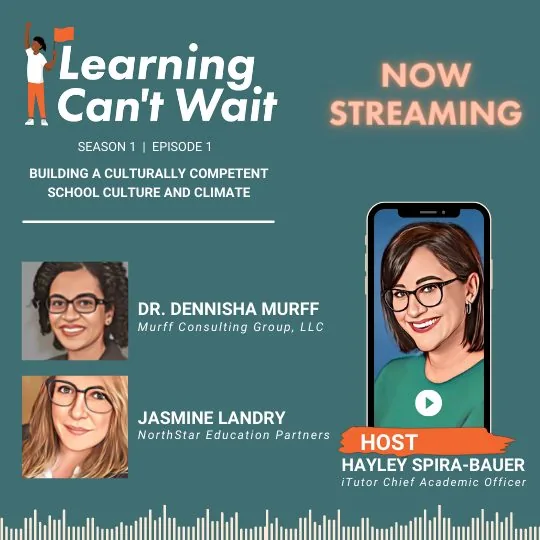
Learning Can’t Wait · Season 1, Episode 1
Building a Culturally Competent School Culture and Climate
 Hosted by Hayley Spira-Bauer, Chief Academic Officer at Fullmind
Listen now
Building a Culturally Competent School Culture and Climate
Episode summary
Dr. Dennisha Murff and Jasmine Landry discuss building culturally competent school cultures where students and staff can show up as their authentic selves instead of assimilating to a dominant culture. Dr. Murff describes how her school started with subgroup data and no excuses, trained staff on implicit bias, created lab classrooms with a culturally responsive observation protocol, and enhanced curriculum and assessment. Jasmine shares mantras like everyone has something to contribute, and both stress diverse, frequent student voice, the pandemic's lessons about moving fast, and reimagining schools with communities.
Key takeaways
- Assimilating to a dominant culture is mental gymnastics that keeps students from learning freely
- Start with subgroup data without excuses, then move from implicit-bias training to classroom practice
- Lab classrooms and a shared observation rubric turn culturally responsive teaching into something concrete
- Culturally responsive teaching is not critical race theory; it means every student sees themselves in the curriculum
- Gather student voice from diverse, rotating groups, frequently, and show students how you used it
About this episode
The act of cultural competency is not revolutionary, it is necessary. In this episode, Dr. Dennisha Murff and Jasmine Landry deep dive on intentional practices in building culturally competent schools. Our host, Hayley Spira-Bauer, takes us on a journey over the last two decades to explore how schools have centered students, cultural identity, and staff responsiveness as they’ve navigated this fundamental aspect of education.
Learning Can't Wait is brought to you by iTutor.com.
Episode notes
What does it mean to build a culturally-responsive learning environment? By fostering inclusivity and engagement, educators can empower students to overcome social disparities while feeling secure in the school setting as their authentic selves. Here’s why that is so important.
Want to build a school environment where every student feels seen, heard, and valued? Schedule your free consultation today to learn how Fullmind can help your district implement meaningful DEI strategies that foster authentic connection, student success, and inclusive school culture.
Key Takeaways
- Creating a Culturally Responsive Learning Environment is Essential: Building a school culture that values and incorporates diverse backgrounds and perspectives allows students to feel seen, heard, and valued for who they are. This inclusivity is critical for fostering student engagement and academic success.
- Authenticity and Inclusion Benefit Both Students and Educators: Both students and educators thrive when they can bring their authentic selves into the school environment. Reducing the pressure to assimilate into a dominant culture encourages diversity of thought and fresh ideas, enhancing the overall educational experience.
- Proactive and Intentional DEI Practices are Crucial: Effective Diversity, Equity, and Inclusion strategies involve proactive measures such as inviting inclusive conversations, using data to guide decisions, and focusing on eliminating inequities. This commitment helps create a supportive and equitable environment where all students have the opportunity to succeed.
Students with diverse backgrounds often face inordinate pressure to assimilate into the dominant culture. Such expectations—to speak, act, or look a certain way—can discourage a child from engaging fully in the school environment and cool their enthusiasm for learning.
Dr. Dennisha Murff’s personal school experience as a child informed her understanding of assimilation and the inherent pressures it brings to bear on young persons:
“I want them to be able to identify what they value in their own identity… to be able to bring that into a space and not feel like they have to hide parts of themselves. Because when they do that, it’s mental gymnastics. And if you're so focused on that, how can you really be free and safe? How can you reach your own true potential if you're constantly worrying about, did I say this right, did I behave this way, did I do this, and am I being valued?”
It's not only students who are affected by these behavioral cues and societal strains. These pressures impact teachers, too. Education Consultant Jasmine Landry put this in perspective:
“… if we (teachers) have to act in a certain way, then we're not going to have diversity of thought, we're not going to have fresh ideas … I think that's the potential and the power of—if we could—create schools where everyone could really be themselves and be valued for who they are.”
This highlights a fundamental issue within the education system: the lack of cultural competence. Intentional practices to build a culturally competent school environment are crucial. Students and educators alike want to be their true authentic selves when they walk into a school building. But what does it mean to have a culturally responsive learning environment? And why does it matter so much?
Having a culturally responsive learning environment has a huge impact on student success. It allows students to achieve at a high level because they feel seen, heard, and valued for who they are. This is not just an educational framework; it's a continuation of the civil rights movement. As Landry noted, “As a white educator who has had the opportunity and privilege to work with communities of color, I think it’s part of being a responsible practitioner when you get to work across lines of difference. Continuing to grow myself so I can ethically and responsibly serve students is paramount.”
Dr. Murff elaborates on the concept of bringing your authentic self: “We want students and teachers to assimilate to the dominant culture. We want everyone to put their culture on the back burner to make everyone else feel more comfortable. The weight of acting, speaking, and behaving in a certain way weighed on me as a child. I want them to be able to identify what they value, identify parts of their own identity, and bring that into a space without feeling like they have to hide parts of themselves. It’s mental gymnastics.”
This idea of “conscious freezing”—where individuals constantly monitor their behavior to avoid standing out—relates back to people-pleasing in a culture dominated by white norms. If you’re constantly thinking about how you will be perceived, you cannot effectively listen to what is being presented to you.
So, are school leaders creating a space where these conversations can effectively happen? Are they including all stakeholders, including students? Everyone has something to say, and every voice matters. It’s about making people feel like you’re glad they’re there and that you’re interested in hearing their ideas. This mantra applies not only to educators but also to students.
Prejudice limits who we think has good ideas. To solve big problems, we need multiple perspectives. Schools must be places that teach children how to have respectful conversations with one another. If students are not achieving, look at the data, get rid of the excuses, investigate implicit biases—why am I letting standards slide for some students? Involve the families and students, and change the materials if needed.
Effective DEI strategies are critical for creating supportive school environments that reflect the diversity of their communities. So, what can educators do—realistically speaking—to support diverse students with inclusion? We can start here:
- Take proactive steps to invite inclusive conversations with school communities across divisions of socio-economic status, language, race, gender, gender identity, and religion.
- Use data to guide decision-making and implementation of programs, resources, and staff training.
- Put students first. Recognize where inequities exist and work to create safe and supportive schools where diverse students can excel.
It will take a sustained commitment to provide inclusive support to students from backgrounds that are under-represented, marginalized, or challenged in some other way. Every student deserves a chance to reach their next level of learning while thriving as their authentic selves.
To learn more, check out Season 1, Episode 1 of Learning Can’t Wait, hosted by Hayley Spira-Bauer. Join this fascinating examination of the role of DEI in education today, along with Hayley’s guests, educators, and thought leaders Jasmine Landry and Dr. Dennisha Murff.
Full transcript
Transcript generated from the recording; minor errors may remain.
Welcome to the Learning Can't Wait podcast an iTutor production at iTutor. Our vision is to ensure every child has access to education regardless of circumstance. Each episode, we will be joined by Pathfinders within and around the education. Who are bringing about transformational change? On behalf of deserving students, I am your host, Hayley Spira-Bauer.
Welcome everybody to this week's episode of Student Drivers. I'm your host, Hayley Spira-Bauer, and today I am joined by two incredible educators, Dr. Dennisha Murff and Jasmine Landry. Welcome both of you. Thank you. Thanks for having us. Likewise, likewise. It's a pleasure to be here. Now it's a very cold day where all of us live, but this conversation is one that is going to keep me metaphorically warm.
we are talking today about the topic of building a culturally competent school culture, and it's one that I have felt to be very popular lately. If you read the news, you'll be reading a lot about cultural responsive teaching. You'll be reading about different topics as they relate to diversity, equity, inclusion, and the two folks that I've asked to join today.
Both feel passionately about intentional practices to build a culturally competent school culture and climate. So, Dr. Dennisha Murff, if you don't mind, would you, would you please tell us all a little bit about yourself and why this topic is so important to you? I would be honored to, my name is Dr. Dennisha Murff, and you know, when people ask you to do an intro, you always think about, what am I gonna say?
How am I gonna introduce myself? But I am through and through an. I have been able to experience the the world of having my own classroom, then becoming an assistant principal. I spent the last 15 years as an elementary school principal, and I've just begun my district level position as the curriculum coordinator for the languages.
Assistance program, for those that may not know language assistance program. Think more about our, English language learners and now what we call is our multilingual learners. I've been in the field of education for over 23 years, and it has been a true gift, a journey, a learning opportunity, and I have been able to impact lives.
But more importantly, those people have impacted my. I am the proud parent of three children. I have a wonderful husband who, they all support me in the work that I do because this topic has been something I've been passionate about for years. Being able to, work with students and families and staff members.
One thing that I know that people really want to do is to be able. Be able to be their most authentic self. When they walk into the school setting, they don't wanna wear a mask. And when I thought about what was impacting the achievement of our students, especially our students of color, it just dawned on me after just conversations, people didn't feel they could be their most authentic self.
And so I began to think about what does it mean to have a culturally responsive learning environment? How does how, how do you become culturally competent? And so I dived into that work and I was able to see the huge impact that this work has on student learning outcomes. I began to do my PhD work and focus my dissertation around culturally responsive practices.
And again, the evidence was all there. So to be able to be a part of this work and see students go to the next level in their. To be able to achieve at a high level. That is what drives me to do this work that is so incredibly powerful. Dr. Murff, I, I, you know, I don't wanna over reduce what you shared, but there was one part of it that I'm eager to talk about after Jasmine introduces herself, although I'm sure she'll connect to it, which is about being your authentic self and how, what an impact it has on the classroom.
Really look forward to talking about that during the podcast today. Thank you so much for that introduction. Jasmine, why don't you tell everybody why, why were you one of the perfect panelists for this discussion on culturally competent classrooms, school cultures, and climates? That feels like a steep order.
I don't know that I'd say I'm a perfect panelist, but I, I am a learner and it does, it is a topic that I think is really, really important as a, as a. Bio, I've, I've had a worn a lot of hats in education. I started as a teacher, as most of us do. I guess that's not entirely true, but I started as a teacher and as part of Teach For America and was really grabbed by the framing that was.
At least used at that time around education being the civil rights issue of our time. And I think it connects to this, deep seated, belief or commitment that I've always had of wanting to, to live my life in a way that makes the world better. In some way because I was here. And I think that's something that was really instilled in me by my parents and also, my grandmother who was herself a career educator.
And, and I just remember seeing people come up to her in her later years of Mrs. Landry, do you remember me? I was in your third grade class. And just seeing that that impact that educators have, I think has, has left an indelible mark on me. And when I think about. Culturally responsive or culturally relevant pedagogy?
I think it's, it's really important for a number of reasons, but particularly as a white educator who has had the opportunity and privilege to work with communities of color, I think it's part of being a responsible practitioner when when you get to work across lines of difference, to continue to learn and grow myself so that I can ethically and responsibly serve children and, and serve children who.
Lots of different identities and, and as Dr. Murff said, to, to help them show up as their full selves and feel affirmed and valued for who they are. And to use my, you know, my knowledge and talents to help them grow into the people they wanna be. And to not put my spin on what that should be to make sure that I am really trying to contribute, but also trying to take a backseat and, and let them be the drivers in their.
And their own educations. Thank you too for that powerful introduction, Jasmine. I appreciate both your history that you've shared and why this topic is so important to you and, and essential piece of your journey in supporting schools and the work that educators do today. So Dr. Murff and Jasmine, I. I literally cannot, pick another question to start with other than to talk about being authentic, having bringing, helping kids bring the authentic selves to the classrooms.
Just because Dr. Murff mentioned it first. Jasmine, you spun off it a little bit. What does that mean? Let's, let's define that for our listeners. We have some folks that are education career educators that have been in the schools and and around schools their whole lives. And we have other folks that are listening today that may not.
Be educators at all. So what? What is bringing your authentic self and being your authentic self in the classroom mean for students? I can go first, if that's okay, or Hayley, please feel free. Okay. For me, when I think about every individual walking into a school space and being their most authentic self, I think about how many times we've asked our students and even our staff members and our family members to really assimilate to the dominant culture.
We want them to do things a certain way. We want them to, you know, basically, Everything that they value their culture on the back burner to make everyone else feel more comfortable in that dominant culture. I think about times as a little girl that I felt like I had to talk a certain way, be a certain way, act a certain way, just to get that approval and how that weight was so heavy for me at times that I could not wait to get back on the bus so I can go back home into my own.
That was hard. That's a serious weight to carry. And then I thought about how that transferred even as a teacher, how I wasn't expected to have my own ideas. I was expected to assimilate to this is the way we do things. This is how it has to be here in this setting. And I had to put a mask on again. And so that's what I don't want for our young people and our families.
I want them to be able to identify what they value. Identify the parts of their own identity, be able to bring that into a space and not feel like they have to hide parts of themselves because when they do that is, that's mental gymnastics. And if you're so focused on that, how can you really be free and safe?
To learn in this environment, how can you reach your own true potential if you're constantly worrying about, did I say this right? Did I behave this way? Did I do this? Am I being valued? If that makes sense. Oh, it absolutely does make sense. And I think to add, add to that, there's an element of the student experience that is about pleasing others.
And if. You feel like you have to change who you are to achieve your own greatest capacity or success? Like, how can you, as you said, Dr. Murff, focus on the other things that really help drive you forward. The academic pieces, the social emotional pieces, the, the kind of, extracurricular parts of you that you find exciting.
Yeah. I, I so appreciate you, you naming. , Dr. Murff because when I, when I look for points of connection as I was listening to you, I, I connect in, in ways that my mother coached me to be taken seriously by powerful men as a woman, right? And so it's, it comes from gender and not from race, because I've, I've gotten a lot of benefits from, from whiteness.
but, but that white dominant culture and that assimilation, Is so prevalent in so many schools and if not good for any of us. Like I learned to play the game and I was very successful at it. And I appreciate my mother coaching me in that way because she wanted me to be able to have options and opportunities and, and, and success.
And I'm also now as an adult, trying to be really, you know, critical and reflective and how to learn to stop people pleasing in that way and to stop playing the game in that way. And to think about like, why do we even have this game in this way? It's, we made it up. Or I shouldn't even say we made it up.
powerful white men made it up. It takes a lot of consciousness freezing. I. As an adult for me at least, and I really, really appreciate how you mentioned that it's something that we don't want to burden with our students, but we also don't wanna burden our teachers to have to be a certain way, act a certain way in order to be considered smart and capable and talented and passionate.
Because to stifle that, Really hurts all of us. Likenone of us are as smart as all of us.And if we have to like act in a certain way, then we're not gonna have diversity of thought. We're not gonna have fresh ideas, we're not gonna be able to, you know, create the world that we want. Which I, I'm now getting in a very kind of like optimistic, future dreaming space.
But I think that that's the potential and the power of, if we could create schools where everyone could really be themself and be valued for who they. I'm over here just snapping my fingers as you kept saying everything that you were saying because that was so powerful. I mean, sometimes when we think about what goes through someone's mind, how many decisions they have to make, like if I'm thinking about what I'm going to say, how I'm going to say it, how I'm gonna be, Received, I'm really not able to listen and focus on what's in front of me, who's speaking, what's being presented, cuz I'm trying to process and to prepare myself for that.
And if you, when you listen to some of our young people, especially our teens, they do talk about that. They really talk about not being able to be their most authentic self when they walk into those spaces. And so having those, those conversations and really diving into that and questioning and asking, it goes such a long way.
So thank you. Thank you, Jasmine. Cuz I'm just over here clapping and snapping. Y'all are doing the, doing the work and, and having the conversation right now. So many people need to be having. So, so just to dig in a little bit further, on the topic of authentic self and ensuring that teachers and students and I, and I would say anyone, teacher adjacent as well, right?
School aide paraprofessionals, the cafeteria personnel, the custodial staff, like everybody is inclusive of this. In creating the type of climate that we want and need, what are the pieces that we can intentionally focus on to allow for this showing up as us? Right for kids of color to show up as their authentic selves.
For little girls to show up as their authentic selves. For students that are differently able to show up as their authentic selves, what do we need to be thinking about before we get into practice? What's like the philosophy that we should all be contemplating to help create the framework for a successful school climate and culture?
Well, I think for me, if I think about, you know, where we start, it has to be. With the opportunities for people to feel like the type of culture and climate you've built in your building, do people even feel they can have conversations about these things? When I thought about it, I really thought about, as the school leader in this building, am I participating and creating an environment where my own children could thrive despite the fact that they are, you know, African American students?
Are they seen as an individual? Are we looking at their hopes and their dreams and what they want to be when they get older? How do they learn best? So I think for me, it's really about having a staff that's open to conversation, a staff that's willing to go on this journey. Having a school leader that makes it a priority, including all stakeholders and making sure that student voice is a part.
I feel sometimes that we do things to students and not alongside them.Their voice isn't always heard and they will tell you if you ask. So I feel that's really important. Jasmine, I'm sorry cuz I'll talk a lot. You have to forgive me. Oh, I, I could listen to you talk all day. Dr. Murff . Absolutely. Please don't cut yourself off here.
So one thing that you said that, that I could start riffing on and go in a different direction is the importance of student voice. So maybe we can. A pin in that Hayley, and make sure we come back to it. But your question, Hayley, on like the mindsets and how we come in, as I was listening to Dr. Murff, I, you know, I would co-sign everything that she said and I was just thinking about some of like the terms of phrase in my own mind that I practiced.
When I was a classroom teacher and a school leader and a curriculum leader, and so the first one when you said like, what do we do? What, how do we have to think is we have to think like everyone in this building, students, staff, teachers, parents, like everyone has something meaningful to contribute, and I'm glad you're here.
Those are things that I would practice and rehearse almost like mantras because I know that they are true and I know that they matter. And if I'm fully honest, I don't feel them all the time or I didn't feel them all the time. But that's part of being like the leader to to be the change. You wanna see whether that's being a leader in the classroom and every kid as they come in.
Good morning. I'm so glad you're here. Good morning. It's great to see you. Whether or. In my reflect, reflect back on my early teaching days, my 23 year old self was actually glad to see that student. It doesn't matter. It's my responsibility to project that I do and to work hard so that that. That becomes true.
Cause I think it's, it's not real to pretend that every person loves every other person every minute of the day. But if you wanna create a school community that really embraces people for who they are as they are, . You have to like walk that walk even when you don't feel like it. And most of the time you will like, because it's a habit.
That's why it's a habit of mind or a mantra. It's like the more I did it, the more I did believe it, which was great because then it was less work and it was more authentic. But I think making sure that, that people feel like you're glad they're there and to really see that everyone has a contribution and that the contributions will be different.
Like, . Every kid and every person isn't gonna show up in the same way. But that doesn't mean that we don't have something to learn from them or, or to achieve with them. It's interesting because you're talking about mindsets and mantras, but I wonder, you know, one of the things that really strikes me, and I'm gonna get vulnerable for a moment here, is a, as a white woman, right, I grew up in a community that was predominantly looked like.
And I went and worked in a community that predominantly did not look like me, and I wonder. What we need to be doing, and this is like a, a much further down the road conversation, but but is also particularly relevant, how this is like a very cyclical event that we need to imbue our educators with. The mantra that every child is an individual and every child matters.
But they need to themselves learn that as well. This is a little bit the tail wagging the dog here, but I also am imagining this really important component of not only helping educators to have that mantra themselves, but then teach that mantra as well from the first moment that they meet a child, whether they be two or they be 15, helping them to live that mindset so they can.
The differences of others in their own way and welcome these differences to help create a community that they're within in the classroom as well. It just really strikes me as we talk about this, cuz I think it is a full circle moment for how our educators, as we all know, impact children and how our, the experience of our educators is so deeply ingrained in the success of our.
I definitely agree with that. That is, huge because for so many people, their first experience with, people that don't look like them is either their first school experience or a professional work experience, depending on the community that you live in, and to be able to bring different groups of people together.
That's why this topic is so important, and I know a lot of people are, you know, there's a lot of controversy about it right now. . But it's so important if we expect for our young people to be able to live and work in a global society, that we're able to have those conversations early respecting differences, talking about the value that each individual brings to the plate.
Not lumping groups of people into one category, but really helping them to see what all groups of people have contributed to our country and to the world. Totally agree. And if. I don't know that, Hayley, if you want us to be spinning off into the current controversies, but bring it on. I think it's good for our diversity.
Sure. It's like diversity and inclusion is good for all of us. And white supremacy culture hurts all of us. Like as, as a white woman who has, who has coached and taught how to play the game, like I have benefited from white supremacy culture, but it is not good for. Like it is not good for me both in terms of like the ways in which it holds up, like unrealistic standards of like perfection and gender and body and way of speaking or way of being like that's hurtful, but it's also hurtful because it limits.
Our perception of who has a good idea and what a good idea sounds like. And as Dr. Murff was talking about, like all of us need to to learn, and our young people especially need to learn how to engage with people who are different and appreciate differences. You know, we live in such a increasingly global society that we need people who under understand things differently and have different perspectives to co.
To conversations or we will never come up with meaningful solutions to big, big problems because if you only are looking at it from one lens or one angle, the the solution or idea that you have will always be limited. And that's not, that's not an indictment of any of us. It's just true. Right? Like we need each other.
We are, we are all kind of inextricably linked to each other and. And to recognize that I think makes us stronger. But also if, I think if you've grown up in a predominantly white environment, which I did though, I'm, I'm very, very lucky that, that my brother and my parents as best friends are black. And so I've had people of color in my life my entire life.
But if you grow up in a mostly white society and you only learn about. White people doing stuff, then you have a very skewed and flawed and incorrect view of history and of the current world, and that hurts us moving forward. Dr. Murff, I'd love to hear your, your thoughts and reactions and, and, and Hayley, you as well.
I definitely agree with that. I think, you know, with all the controversy swirling, I think it's a lack of knowledge. People have caught on to catchphrases. When I do workshops on being culturally responsive, the first thing I do when I say that the workshop is about culturally responsive teaching. I also tell them though, this is not critical race theory.
At the same time, those are not synonymous with each other. And if people really do that background work and they look at what. Critical race theory is they know it's not taught to little kids. What we're doing in our building is making sure, this is what my focus was with my staff, is to make sure that everyone can see themselves in the curriculum, that they have instructional practices that are aligned to the way they.
They best learn, which doesn't mean all the African American kids have the same learning style, or all our Latino children learn this way, or all of our white children learn this way. It means that we're looking at them individually, but we're also taking cultural nuances into consideration as well. We look at our assessment practices.
Those are the things that we're doing. Now, there may be controversial topics that come up, but what we talked about is as the teacher, we know that our children. Bring things in from the world into our learning spaces, and we can't be a society that says, oh no, we can't talk about that. We have to be a society that teaches our children how to have respectful discourse with each other because we don't want them modeling after the adults that they've seen who are arguing and fighting and saying hateful things.
Through social media and the news, we want them to be able to learn that. Sometimes you may agree to disagree, but you also can have an opportunity to change the world by having these conversations, looking at things that may inhibit certain people. It's not meant to harm one group or make people feel shame and guilt, but what happens is when you have some of these conversations, emotions will come up from.
The teacher's role is to be that facilitator of the conversation, not necessarily picking sides, but showing all aspects, letting multiple perspectives be shared so that we can teach them how to live in the world around them. At our church, we have a song that says the, the theme, the verses, I need you to survive.
That is huge. We need each other and we need to learn and grow together to make sure that our young people are able to grow and do better than what we've done as our ancestors before us wanted us to do, to be better than the generation before us. This theme of how much Amen, ? Yeah, absolutely. This theme of how much we need one another.
It really resonates with me. I don't have much to add to it other than like, I have chills just thinking about how dependent as a society we must be on the collective interactions of one another. So I wanna, I wanna bring us back to school communities for a second because I, I think the two topics of societal impressions, CRT and DEI are really relevant, but I also want our listeners who are tuning in to take away practical applications for their schools that they leave satisfied.
So Dr. Murff, can you talk us through some of the intentional practices? In addition to the ones you named before about really creating the spaces for discussion, but some of the intentional, maybe professional development that you did with your teams and, and the way you led into a school year, and then continue those conversations throughout a year to ensure that your staff and community was capable of conversing with one another and their students on a regular basis.
absolutely. So for us, it began with a hard look at our. But looking at the data without excuses, meaning if we had children that were still in the fourth and fifth grade reading below grade level, or achieving in math below grade level, we had to ask ourselves, how do we remove all the excuses? Because we might say, oh, well you know, this group, they're, they haven't done this, or they haven't done that.
We looked at our subgroup data and said, these are kids who have been with us since kindergarten, and they still are below grade. We can't blame that on the fact they did not have preschool because they've been with. Since kindergarten, if we wanna say that we're a quality school, we need to look at what is the disconnect, what's not go, what's not going right?
What are we not doing? And that's when the cultural responsive practices came into play. So we began by really investigating our implicit bias. We really talked about what are some views I might have where I'm not setting the highest expectation for this child compared to this child? Why is this group outperforming this group?
So we talked about let's do that foundational work, beginning with our implicit bias training. We looked at articles, of course, we did book studies, but then we said, okay, we've done that for a minute. We need to put these practices, take this theory and put it into practice. What are our action? So what we were able to do is develop a core team of leaders.
We called 'em our champions. We had our equity team, within our building, and then we branched and made that even smaller with the core group of people who were trained, in culturally responsive, pedagogy. We decided the best way for us to go to the next step is to create laboratory classrooms.
Where these trained individuals would teach a lesson for the rest of our staff in small groups, we found a culturally responsive instructional observation protocol tool, and we adapted it to meet the needs of our building. And we went in as a staff, we went in as those small groups. Everyone went through it.
We observed those. That teacher in. , we scored them on a rubric and then we came back to debrief. And that debrief session was so powerful because say it was for indicator one, I gave somebody a four and the person next to me gave them a two. Well, why are we not saying the same thing? Opened up a dialogue of conversation.
It helped them to see that being culturally responsive with your practices is not some magical, unattainable. , there are things you're doing right now that are working and there are things that you are not doing that we can enhance upon. And then that really allowed us to open up more dialogue and more conversations because we had to say in our building that this is not something you get to opt in or opt out of.
We looked at our curriculum and said, okay, this textbook. It's great, but it is not culturally responsive just because they put pictures of students with disabilities or more girls or students of color inside on the pages. That does not mean it's a culturally responsive text. We talked about how do we look at this curriculum and make it more culturally responsive.
And we just decided that the best way for us to do it is not to wait for somebody else. We're going to enhance our curriculum by looking for culturally responsive materials, whether it was visual things, whether it was stories, whether it was, math problems, whatever it was for social studies or science.
We looked at how do we bring in different things to our curriculum, and then we put those practices into place and then we decided what does that look like for our assessments? So that's like a long. Version of what we, I mean a longer, a short version of the long process we went through over the years, but it made a huge difference because we got our families involved.
We asked them questions, we asked them for their feedback, and we asked the kids to participate too. When it came to finding resources and materials that would enhance our work and make it more costly. Responsive. I love that. What a thorough description, doctor like I'm so inspir. By you and your team's work.
The thing that jumped out at me that I just would love to underline cause cuz I think it's a misconception, at least with some of the folks that I've had the opportunity to work with, is that you started with the data, right? Like you started by thinking about are all of the students in our care achieving like they should and like we believe they should.
And if not, like no excuses what's happening because you know what I'm, I'm leaning now on. And Dr. Gloria Ladson-Billings's work. But when you think about the components of culturally responsive pedagogy or culturally relevant pedagogy, student learning or student achievement is the first one, right? She writes.
The bottom line is that no matter what else teachers are charged with, their main responsibility is to ins ensure student learning. And then of course, we also want the cultural competence and that critical consciousness piece. , but I've worked with a, a number of really well-intentioned educators who want to be culturally relevant or culturally responsive, and they sometimes forget that all of this is in service of supporting students in being included and feeling good, but also learning like the learning matters too.
And I just so appreciate how your team started with the data and then continued to put that data into classroom practice and to really think. What the impact of that was gonna be for students. And then also in asking students and using their voices to inform your, your next moves. I think it's just brilliant.
And you know what was so important too, is having, opportunities to build a culture where people could ask those difficult questions. Cuz it doesn't happen overnight. And I did have to say as a school leader that this is an optional work. Like this is what we're saying we're doing as a school community.
and even questioning ourselves on why. B Okay for certain students. But the A is, you know, the A is examples of high expectations. We had a kiddo that told us in our, in our office, he was crying, bless his heart. He said, I wanna be a student. I wanna get an A in this class. And so we had to have some conversations to find out, okay, well if he wants to get an A, what are we doing to make that possible?
Cuz he's putting in the work. What, what's our disconnect? And the teacher was like, well, but he's getting a B and that's great. It wasn't great for. . So how do we help bridge that gap? How do we keep that high expectation for every child? Because if they wanna reach that, let's do everything in our power to help them get there.
Because this was a child who was literally putting in the work, overtime work. At the end of the day, the whole child is represented by their academic achievement and. Their sense of self and their social and emotional wellbeing, right? They the two go hand in hand, . So to two, have a conversation about culturally competent teaching and authentic showing up as an authentic self and helping kids feel valued and seen without talking about.
There are successes in and around the classroom. It would, it would be a complete disconnect. So Dr. Murff, thank you so much for highlighting that, as Jasmine said, it is so incredibly important to be thinking about that. And I, and I wanna ask the question now because, You know, again, we're, we're driving this, this podcast in, in ways that I didn't anticipate that I'm so grateful it is happening.
But I wanna ask the question now about the pandemic. How does the pandemic accelerate the need in your opinion for culturally responsive practices and pedagogy in schools? I'm happy to jump in and go first. Oh, I don't disagree that it accelerates the need, but to me the biggest contribution of the pandemic thus far is, you know, as we were talking earlier about how we're all inextricably connected, like it that's just laid bare, right?
Whatever sense of like rugged individualism we may have had before. Some people are still holding onto. It just has been so clear, like we're all in this together, but there's also the metaphor of like, same storm, different boat. We're all in this pandemic storm together, but like my boat versus Hayley's boat versus Dr.
Me's boat versus, you know, everyone based on individual circumstance, like their experience is is different, right? Depending on the context and like what boat they're in. But I think it really shows that we're all in this together. I think the second thing. I am still holding out hope for, but have so far been kind of disappointed is it turned education on its head.
It showed that when we have to make big adaptive changes really fast, we can. And so everyone who before was saying, we have to go slower. We can't. That's too much, too fast. Like we have to do it this way cuz it's always been done that way. Like it's just not true. Like on a dime. Teachers and leaders made school go online and they're figuring things out now.
And like online school isn't the answer necessarily, but we can do things differently and I really hope that we take this opportunity to imagine things differently and to imagine schools that will work better. For all kids and for all teachers. I don't know that as a, as a field we're there yet. I think that there's been a lot of like return to normal, meaning return to like things that felt comfortable cuz they were familiar even if they weren't working well.
But I, I do think there's an opportunity and I. The data shows that, you know, students have been disproportionately impacted by disruptions to learning from the pandemic. So that, I think, highlights a need to accelerate. I totally agree, Jasmine. And when you talked about, you know, the, the changes and how quickly it could happen after, we were settled in, and I hate to say the word settled in, but we had virtual, oh, virtual school, and we had in-person school.
We have found that there were children during that time. , they were thriving in that virtual setting, and we had this notion that it could only, learning can only take place in person. It can only take place in person. And there were children who skyrocketed with their achievement. And so our districts made sure that we continue to have.
Both options. You can either attend in person or you can attend virtually. And that was a game changer for some of our students and our families. I think the pandemic really exposed the inequities in resources, whether it was urban, suburban, or rural. There were things that were able to transition very quickly, and then there were things that took a lot longer for some folks, you know, people that were still waiting on devices for children, people that had those disparities in healthcare opportunities, opportunities to feed their children.
I agree a wholeheartedly, Jasmine. School districts were figuring it out. We were standing outside handing out food. We were handing out bags of food to families. We had neighbors who would step up and they would get the, the lunches for the neighbors children. We ki we really came together and showed that we can be connected in so many different ways to help best support the people around us.
And I think our financial resources as well were, they were. But we were able to figure some things out in a new creative way, and it really shows that you don't have to sit necessarily in a classroom space to get the education, that works best for you. Dr. Murff, I, I could not agree more with that last point.
as well, I had a podcast guest, principal in the South Bronx, Luis Torres of, of CS 55. My actual, first school that I've ever taught. He was a school leader then and is still the school leader there now, and he started like a Sesame Street on the radio for his families because access was such an issue issued at devices that he started teaching both on television and on the radio, I believe, to all his families because he wanted to make sure the kids were getting education every day, and that was the easiest way for him to do that.
And so I think the creativity that you speak of, Burned, like what is it? Necessity is the mother of invention. Right? This isn't a complete invention. This has been done before, right? But it, at the same time, it allowed us to think differently about what is possible. And to Jasmine's point, there are no excuses.
We can't make excuses that we don't have enough time. We have to think it through more. We, you know, have to dive it. No. We are able to do things when we need to for the sake of our children. And so this is a. , right. This is, this is the pivotal moment in education, and I don't think it's over yet, right?
We're in the midst of another surge of a, of a variant. It's not over yet, so this is a great opportunity for schools to invest in implementing more practices that are of the benefit of students. Absolutely what I'd add to that. Oh, sorry. Didn't mean No, you're good. . What I'd add to that is to echo something, Dr.
Mek brought up earlier is we can move fast, right? And we did move fast. And so all of the excuses around, we need to take more time. I think were shown to be not true. . And also we know that like a false sense of urgency is a hallmark of like white, dominant white supremacy culture. So now there's an opportunity like, great, we moved fast, we were creative.
We did stuff, we did the best. We knew how to do with what we had and the information we had. And so now there is an opportunity, if we haven't done it already, to ask students and families like what works for you? And I, I love. That Dr. Murff's district said, oh, there are students who are thriving. Let's make sure that we keep that for them.
And I think that as we continue to, to both have to continue navigating this year, because this year in many ways, you know, for the, the school-based folks that I get the opportunity to support is even harder than last year because it's so tumultuous. Or last year was hard, but it was all online for, for a lot of folks, we should ask our students.
How does this working for you? What do you, what, what can I do more of? What can I do less of? And really incorporate student voice and design to be more inclusive, but also to get better ideas. Cuz students will think of things that adults maybe won't. There you go. Bringing up student voice again, which is what I was planning on bringing us to next.
So I love when it happens authentically Jasmine. Thank you. So let's, let's bring in this topic of student voice. I, I wonder. In the best schools you've seen. Now, Dr. Murff, you're at the district level now, Jasmine, you work with many schools. How do the best schools bring in student voice in an effective way?
What have you seen throughout your career that really makes a difference as it relates to student voice? I can go first. I really think it's diversity of the voices. That was something that we started to think about when we talked about how are we asking questions of our students and who exactly are we asking?
Because at one point people kept thinking I was putting a lot of weight. On race and gender, but I didn't want the representatives from one class to be all from the same particular, you know, SES group, race, gender. Like if I said, please select five students from your classroom, I needed there to be some diversity of thought.
Students that are English language learners, students that have an IEP students of color, making sure there are girls on that, particular committee. If you know a student who has, who, who belong in the LGBTQ group, make sure you do that as well. Like we need to hear from different. Groups of students.
If we don't, we keep doing the same thing over and over. So we mirrored ours to our efforts with our PTO, we really talked about how do we make sure that we have a diverse group rep represented? And please, as we do this several times during a year, please don't send the same children every time because people have a tendency to pick the, Hey, I was a teacher pleaser.
I, I will admit, but. , we picked those kiddos because we pretty sure we think we know what they're gonna say and they're not gonna say anything that might put me as a teacher out there, but we had to really challenge ourselves to be open to what they were gonna bring. So if we looked at it from that perspective, it really made a huge difference in the responses we received from our students.
And then making sure that if you're looking at asking little people, I call 'em my K, my K towners, my. Be very strategic in those questions because you have to guide them as far as the question you're gonna ask to help support them, but differentiate those questions from the kindergartner to the sixth grader.
And I said that because I'm elementary. I was an elementary person. No, but it's spot on. I have a kindergartner. You really got a scaffold, . Yeah. That's, that's a true thing. That's a true statement. Jasmine, what? What do you think about student voice? I think the point about. Diverse populations frequently rotated, so you're getting unique perspectives each time is huge.
What else would you add to that? I think one concrete tool that that can be implemented at the teacher level or at the school or district level is student surveys. And so I think you can do. It sounds like Dr. Murff was talking about some pretty in-depth like qualitative interviews or like student group, like working group type things.
I've also seen like Google Forms or, you know, which again, like if you have, if you got kindergartners, you gotta figure out how you're gonna do that and probably not a Google form, for kindergartner, but ways to try and hear from everybody about. What's working and what could be better. And certainly, we'll cos on everything around like crafting the questions and the way that you're gonna get the information that will be most helpful to you, which may or may not be the information you want to hear
And then once you do something like that, I think it's really important to reflect it back to the students and to say like, we heard from you and hear are the trends in what you said, or you know, we asked you on a scale of one to five how welcome you feel at school every day. And the average was a three.
And as you know, as your teacher, I. I wanna make that better. And so like what ideas do you have? So I think getting information from students and then actually using it and showing students how you use it is really important and will make them wanna contribute again. Cuz then you're showing that you, that you really care about what they have to say.
Oh, Jasmine, that was awesome. Thank you for saying that too. That is so huge because. Kids hate when you ask them things and then you don't do anything with the information. They're like, why'd you ask me anyway? Is it only kids? Cause I think adults hate that too. That's true. That's true. People hate that. I think it's everybody.
Everybody. Well, I agree. Can I add one more to that? So we, we spoke about diversity of the. And, and making sure it's con you continuously diverse. We talked about sharing the data and the, the kind of summaries from the data and what changes will be implemented as a result of that. I would add that it also needs to be frequent, you know, taking a pulse check on kids at the same time every year, once a year, is probably not going to capture the dips and the climbs in student.
Comfort satisfaction, emotional wellbeing, inclusion that happen and, and also won't allow for the proper interventions to be put in place when particularly the dips happen. Right. So absolutely, yes. Frequent assessment, whether they be formal or informal is hugely important as well. I think that's a great point, Hayley.
And I think really concrete things teachers can do would be, I've seen teachers who like, we'll add a single question to exit tickets, right? So they have an exit ticket about the lesson objective or about the content, but then we'll also have a question around, , what worked for you today and like what would've been better?
Just as like a very quick check on feedback on that lesson. I've also seen teachers have students have either like post-it notes or magnets with, you know, their initials on them, and there's some kind of like, Scale or quadrant or pictures depending on like your grade and what makes sense for them to, as they're coming into the classroom, if you're trying to, you know, check in on how students are feeling about something or even what prior knowledge they bring, where students can, you know, very quickly kind of, Plot themselves somewhere.
And there's of course ways to do that with technology as well that can be really informal, but help help students feel like they're informing what you're doing and give you the information that you need to, to be more responsive. I love that you're bringing it to the discrete actions teachers can take today to ensure that they're capturing student voice regularly.
Thanks, Jasmine and Dr. Murff. So we unfortunately are nearing the end of our time together, and as a closing thought, I would love if each of you could share, please an answer to the following question. If you had the ability to transform one thing about education today to drive student outcomes, what would it be and why?
Jasmine, I'm gonna start with you first. Can I have a two-part answer? Of course. , that I would say one A, put everything on the table for being like reimagined, restructured in service of making things work better for, for students in the communities that we serve. And to kind of get rid of the, the constraints that are either imagined or real.
But even if they're real,they were designed by people so we could undesigned them.And then in that re-imagining to center the voices of students and communities, because far too often, both currently and historically, education decisions and policies, have been very paternalistic. And I think that to flip that on its head and center, the voices of students and communities in re-imagining would.
If I could do one thing, it would be that that is a very hopeful message. I appreciate that as a thought for you, Dr. Murff. Jasmine, I'm again snapping and clapping. Thank goodness I was on mute cuz that reimagine is humongous for me. It is where the rubber meets the road. For me, when I think about that, I think about what changes can be made to think about the theory.
The practice and the real world application. So many of the activities, in my humble opinion, children don't see the point of it. They don't see how it's gonna be used in real life. And for me that's because I don't think it's culturally relevant or responsive to, to their needs. I would love to have a space where they're able to have that equitable and inclusive access to curriculum, instruction, assessment practices that will take them to the next.
How do we increase their life trajectory right here in the four walls of our schoolhouses every single day? And I think when Jasmine said, reimagine allowing our educators, our parents, and our students to talk about what their hopes and dreams are for the education of our children. Those chills are back again.
I really, this, this has left me with a lot of hope, this conversation with brilliant folks like you supporting schools and supporting teachers and supporting school leaders. That is exactly what I think will bring us to a place where we have more culturally competent school cultures and climates. And I'm really grateful that you both were able to share your perspective today on the podcast.
and generally just to be able to talk with you both. In general. This has been an absolute pleasure. Thank you both so much for joining. For joining me on today's podcast. Thank you for having us joining us. What a pleasure. Thank you to everybody who tuned in to hear Dr. Murff and Jasmine Landry share their perspectives on how we can build a more culturally competent school culture and climate.
Thanks for listening to the Learning Can't Wait podcast. If you liked what you heard, please rate, review, and share this episode. Be the first to know when we have a new episode by subscribing wherever you listen to podcasts. If you'd like to be a guest on the show or have a suggestion for an episode, email us at podcast@itutor.com.