
For Education Leaders
Get proven strategies and expert analysis from the host of the Learning Can't Wait podcast, delivered straight to your inbox.
SWD Services & IEP Fulfillment
Our virtual special education services give students with disabilities live, small-group instruction from special education–certified educators, aligned to each student's IEP goals, with progress reporting your team can document.
Hawaii Runs One District for the Whole State. It's Asking $17 Million a Year Just to Keep Mandated Special Education Funded.
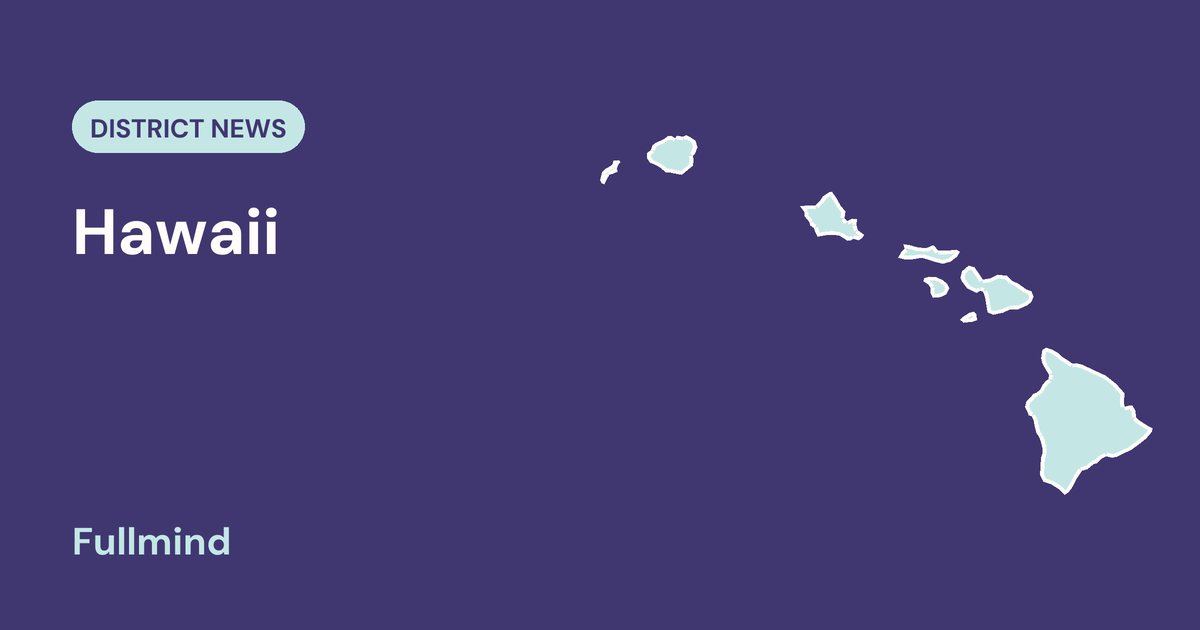
The Hawaii Department of Education is seeking $80.6 million in additional general funds for fiscal 2028–29, largely to maintain existing services and cover rising costs, according to the Honolulu Star-Advertiser (October 9). Within that request: $17 million a year for mandated special education-related services, alongside school meals and facility maintenance. The department's operating budget for 2026–27 is $2.37 billion.
Hawaii is the only state that runs its public schools as a single district. That structure makes its staffing arithmetic unusually visible. When Hawaii is short special education teachers, every island is short at once, and there is no neighboring district to recruit from. The state has paid a $10,000 annual differential to special education teachers for years, the largest such differential in the country, and confirmed this spring that it continues through 2026–27 for special education, hard-to-staff locations and Hawaiian language immersion. An earlier HIDOE study found the differential improved retention.
Our view: Hawaii has done the thing most states only debate, paying special educators meaningfully more, and it still has to ask the Legislature for $17 million a year to keep mandated services funded. That is the clearest demonstration available that pay alone does not produce certified supply in a geography where supply is capped by an ocean. For Hawaii, and for every district whose recruiting radius ends at a coastline or a county line, the question is how to deliver certified special education minutes to a school on Lanai or Molokai when the teacher is not there, and the answer is not another posting.
What happened
- HIDOE's FY2028–29 request: $80.6 million in additional general funds, including $17 million a year for mandated special education-related services and $7 million a year for preventive facility maintenance; targeted investments in language arts, mathematics and workforce development; positions to strengthen instructional support across complex areas.
- The department said the request was developed amid continuing fiscal pressure and an emphasis on using existing resources more efficiently.
- HSTA confirmed in April that shortage differentials for special education, hard-to-staff locations and Hawaiian language immersion continue through SY 2026–27; a prior HIDOE study found the $10,000 special education differential boosted retention.
- Hawaii was recruiting for 294 teaching positions in a recent count, per the Learning Policy Institute's 2026 scan.
Hawaii has done the thing most states only debate, paying special educators meaningfully more, and it still has to ask the Legislature for $17 million a year to keep mandated services funded.
What it means for districts (analysis)
Nothing above is Fullmind's claim; it is the department's, the union's and the researchers'. What follows is, and we stand behind it.
Differentials retain; they do not create. Hawaii's $10,000 differential kept special educators who were already there. It did not conjure applicants for Hana or Kau. Retention and supply are different problems, and the budget request shows the second one is unsolved.
A single district has no borrowing capacity. On the mainland, a district short a speech-language pathologist can share one with a neighbor or contract through a cooperative. Hawaii's neighbor is the Pacific. Its only options are to grow supply over years or deliver the service from somewhere else now.
Mandated services are owed before the Legislature votes. The IEP minutes are due this semester, on every island, whether or not the appropriation lands.
Distance is the variable Hawaii can design around. Live, certified special education instruction and related services delivered on each school's own schedule, with a school-based facilitator in the room, turns an island geography from a recruiting ceiling into a scheduling problem. That is the model Hawaii's structure is built to use.
Practical considerations for the department and complex areas
- For each unfilled caseload, record the service minutes owed and the minutes actually delivered, student by student, every week.
- Separate retention tools (differentials) from supply tools (pipeline, delivery) in the budget narrative; the Legislature should see that both are needed.
- For schools on neighbor islands without a resident special educator or related-service provider, schedule live, certified delivery now, with the educational assistant as facilitator.
- Measure certified hours per student in each shortage area; it is the number that moves outcomes and the one a hearing officer will ask for.
- No outside model should touch eligibility, IEP team authority or the parent relationship; those stay with the district.
Where Fullmind fits
Hawaii cannot borrow a special educator from the next district; there is no next district. Fullmind, now home to Elevate K-12, reaches a school on Lanai or in Hana the same way it reaches one on Oahu: a certified special educator or licensed provider on that school's own bell schedule, live, with the school's educational assistant in the room.
- SWD Services & IEP Fulfillment delivers the mandated minutes the $17 million request is meant to fund. Every Fullmind special education teacher is a state-certified special educator, drawn from more than 3,000 educators.
- Related Service Providers put speech-language, OT/PT, school psychology and counseling on a neighbor-island schedule without an inter-island flight.
- LIVE Staffing covers core sections in small schools; in a remote Alaska district, the closest analogue to a neighbor-island school, Fullmind's brief found 5.5 points of test-score gain per additional instructional hour.
So far, our published results are in live staffing, math growth and remote instruction, and special education results are in progress. What we can show now is the model, the certification, and the minutes delivered on the district's own schedule. For a single-district state, the relevant evidence is the remote-instruction brief, and it is the one we point to.
Run the numbers with us
Pick one neighbor-island school without a resident special educator or related-service provider and send us its caseload and the minutes owed. We will show you a weekly schedule of certified delivery, hours per student, and what it costs against the itinerant model the complex area runs today. Schedule a consultation with Fullmind.
Sources: Honolulu Star-Advertiser, "Hawaii Department of Education seeks $80.6M more in funding," October 9, 2026; Hawaii State Teachers Association, April 30, 2026; K-12 Dive (HIDOE differential study); Learning Policy Institute 2026 scan. The sources supplied the figures; Fullmind supplied the analysis and stands behind it.
Related: For Remote Districts, the Question Isn't Virtual or In-Person. It's Hours.
Podcast
From the Learning Can’t Wait podcast
 Hosted by Hayley Spira-Bauer, Chief Academic Officer at Fullmind
Newest episodes
 Vanessa Vakharia & Adam Ezring: Family Math, Math Confidence & Learning Through PlayOctober 13, 2026 · Vanessa Vakharia, Adam Ezring
 Dr. Daveda Colbert: Leadership, Belonging & ServiceOctober 6, 2026 · Dr. Daveda Colbert
 Aidan McDowell: Personalized learning, Student agency & Intrinsic motivationSeptember 29, 2026 · Aidan McDowell
For Education Leaders
Get proven strategies and expert analysis from the host of the Learning Can't Wait podcast, delivered straight to your inbox.





















































How can we help? Let’s connect.
Tell us what you need. It takes about a minute, and you’ll see the next steps right away.
We’ll reach out within one business day
An education consultant talks through your students, schedule and goals.
Get a plan for your district
A plan built around your needs and budget.
Need support? Call 1 (888) 841-7840
Thanks! We’ll confirm your meeting time by email within one business day.
Your one-pagers
Matched to what you told us. They download as one PDF.
Every child deserves the opportunity to access exceptional education.